



Indian teen discovers cheap way to make saltwater drinkable

February 5, 2017

San Francisco, Feb 5: An Indian-American student has found a cheaper and easier method to turn salt water into drinkable fresh water and his research has caught the attention of major technology firms and universities.
saltwater

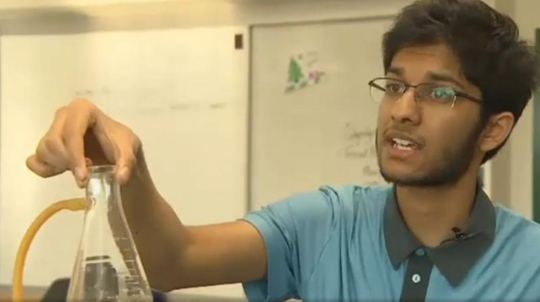
Chaitanya Karamchedu from Portland, Oregon, is turning heads across the country all because of a science experiment that began in his high school classroom.

The Jesuit High School Senior told KPTV that he has big plans of changing the world.

"1 in 8 people do not have access to clean water, it's a crying issue that needs to be addressed," said Karamchedu.

He made up his mind to address the matter himself.

"The best access for water is the sea, so 70 per cent of the planet is covered in water and almost all of that is the ocean, but the problem is that's salt water," said Karamchedu.

Isolating drinkable water from the ocean in a cost effective way is a problem that has stumped scientists for years.

"Scientists looked at desalination, but it's all still inaccessible to places and it would cost too much to implement on a large scale," Karamchedu said.

Karamchedu figured it out, on his own, in a high school lab.

"The real genesis of the idea was realising that sea water is not fully saturated with salt," he was quoted as saying.

By experimenting with a highly absorbent polymer, the teen discovered a cost effective way to remove salt from ocean water and turn it into fresh water.

"It's not bonding with water molecules, it's bonding to the salt," said Karamchedu.

"People have been looking at the problem from one view point, how do we break those bonds between salt and the water? Chai came in and thought about it from a completely different angle," said Jesuit High School Biology Teacher Dr. Lara Shamieh.

"People were concentrated on that 10 per cent of water that's bonded to the salt in the sea and no one looked at the 90 per cent that was free. Chai just looked at it and said if 10 per cent is bonded and 90 per cent is free, then why are we so focused on this 10 per cent, let's ignore it and focus on the 90," Shamieh said.

It is a breakthrough that is estimated to impact millions of lives if ever implemented on a mass scale.

"What this is compared to current techniques, is that it's cheap and accessible to everyone, everyone can use it," said Shamieh.

Scientists across the country are taking note. He won a USD 10,000 award from the US Agency for International Global Development at Intel's International Science Fair and second place at MIT's TechCon Conference where he won more money to continue his research.

"They were very encouraging, they could see things into it that I couldn't, because they've been working their whole lives on this," said Karamchedu.

Back in January, Karamchedu was also named one of 300 Regeneron Science Talent Search Semifinalists. The STS is thought to be one of the most prestigious competitions in the country for high school seniors.

Comments

James Freeman
 - 
Monday, 6 Feb 2017

Nestle (Pepsi, Coca Cola, etc.) certainly won't like this! It was Nestle Chairman, Peter Brabeck-Letmathe, who said '?ccess to water is not a public right.'?

I expect this breakthrough discovery will 'somehow' go nowhere, and this smart young man probably needs to start watching his back. Too much profit stands to be lost with this....

Add new comment

  • Coastaldigest.com reserves the right to delete or block any comments.
  • Coastaldigset.com is not responsible for its readers’ comments.
  • Comments that are abusive, incendiary or irrelevant are strictly prohibited.
  • Please use a genuine email ID and provide your name to avoid reject.
Agencies
June 22,2020

Chennai, Jun 22: Commuting the death sentence to life imprisonment for five convicts, the Madras High Court on Monday set free Chinnasamy, the main convict, who had also been sentenced to death in the Udumalpet Shankar honour killing case.

A Division Bench comprising Justice M. Sathyanarayanan and Justice M. Nirmal Kumar also dismissed the appeal by the state police against the acquittal of three persons by a lower court.

The Bench ordered the five convicts sentenced for life to undergo a jail term of not less than 25 years.

In 2016, V. Shankar, who had married C. Kausalya, was killed by a gang in Udumalpet in Tamil Nadu. The gang also injured Kausalya in the attack.

It was alleged the parents of Kausalya -- Chinnasamy, Annalakshmi -- were against the marriage.

P. Pandidurai, the uncle of Kausalya at the behest of Chinnasamy and Annalakshmi had hired a gang to kill Shankar.

The gang killed Shankar in broad daylight in a public place and Kausalya too got injured in the attack as she tried to save her husband.

The Principal District and Sessions Court in Tiruppur had convicted and sentenced to death six accused persons -- Chinnasamy, P. Jagadeesan, P. Selvakumar, M. Manikandan, M. Mathan alias Michael and P. Kalaithamilvaanan.

The court also sentenced two other accused, K. Dhanraj for life and Manikandan to a five year jail term, while acquitting Annalakshmi, Pandidurai and Prasanna.

The convicts had filed an appeal against their sentence in the Madras High Court while the police filed an appeal against the acquittal of three persons.

Comments

Add new comment

  • Coastaldigest.com reserves the right to delete or block any comments.
  • Coastaldigset.com is not responsible for its readers’ comments.
  • Comments that are abusive, incendiary or irrelevant are strictly prohibited.
  • Please use a genuine email ID and provide your name to avoid reject.
Agencies
June 27,2020

Mumbai, Jun 27: The Bombay High Court observed that COVID-19 patients from poor and indigent sections cannot be expected to produce documentary proof to avail subsidised or free treatment while getting admitted to hospitals.

The court on Friday was hearing a plea filed by seven residents of a slum rehabilitation building in Bandra, who had been charged ₹ 12.5 lakh by K J Somaiya Hospital for COVID-19 treatment between April 11 and April 28.

The bench of Justices Ramesh Dhanuka and Madhav Jamdar directed the hospital to deposit ₹10 lakh in the court.

The petitioners had borrowed money and managed to pay ₹10 lakh out of ₹12.5 lakh that the hospital had demanded, after threatening to halt their discharge if they failed to clear the bill, counsel Vivek Shukla informed the court.

According to the plea, the petitioners were also overcharged for PPE kits and unused services.

On June 13, the court had directed the state charity commissioner to probe if the hospital had reserved 20% beds for poor and indigent patients and provided free or subsidised treatment to them.

Last week, the joint charity commissioner had informed the court that although the hospital had reserved such beds, it had treated only three poor or indigent persons since the lockdown.

It was unfathomable that the hospital that claimed to have reserved 90 beds for poor and indigent patients had treated only three such persons during the pandemic, advocate Shukla said.

He further argued that COVID-19 patients, who are in distress, cannot be expected to produce income certificate and such documents as proof.

However, senior advocate Janak Dwarkadas, who represented the hospital, said the petitioners did not belong to economically weak or indigent categories and had not produced documents to prove the same.

A person who is suffering from a disease like COVID-19 cannot be expected to produce certificates from a tehsildar or social welfare officer before seeking admission in the hospital, the bench noted and asked the hospital to deposit ₹10 lakh in court within two weeks.

Comments

Add new comment

  • Coastaldigest.com reserves the right to delete or block any comments.
  • Coastaldigset.com is not responsible for its readers’ comments.
  • Comments that are abusive, incendiary or irrelevant are strictly prohibited.
  • Please use a genuine email ID and provide your name to avoid reject.
Agencies
February 25,2020

Tokyo, Feb 25: Japan's Chitetsu Watanabe, recognized at 112 years as the oldest man in the world, has passed away 11 days after he received the Guinness World Record certificate, his family said on Tuesday.

Watanabe died on Sunday night, Efe news reported.

He received the official certificate on February 12 at a nursing home in Joetsu in Niigata prefecture, where he resided.

Soon after being certified as the oldest man, he began to experience a lack of appetite and respiratory problems, the wife of his eldest son told public broadcaster NHK.

Born on March 5, 1907 in a family of farmers, Watanabe moved at the age of 20 to Taiwan, where he worked at a sugar refinery for 18 years before returning to Japan after the end of World War II.

A fan of calligraphy, custard and ice cream, Watanabe told the Guinness team that the key to his long life was laughter.

He was recognized as the oldest male in the world following the deaths in 2019 of German Gustav Gerneth (in October), aged 114 years, and Japan's Masazo Nonaka (in January), at the age of 113, three months older than the German.

It remains to be seen who will be recognized after the death of Watanabe, the only male on the list drawn up by the Gerontology Research Group of the 30 oldest people in the world.

Japan has among the highest life expectancy in the world and the number of centenarians in the country has crossed 71,000, according to the latest government figures.

Since 2000, the number of centenarians censored has quintupled, raising concern for the economic outlook and future workforce of the country - where the birthrate is on a downward trend.

Out of these, 88 per cent are women.

Comments

Add new comment

  • Coastaldigest.com reserves the right to delete or block any comments.
  • Coastaldigset.com is not responsible for its readers’ comments.
  • Comments that are abusive, incendiary or irrelevant are strictly prohibited.
  • Please use a genuine email ID and provide your name to avoid reject.