ABVP, AISA activists clash over blocking of Umar Khalid’s visit to Ramjas college

February 22, 2017

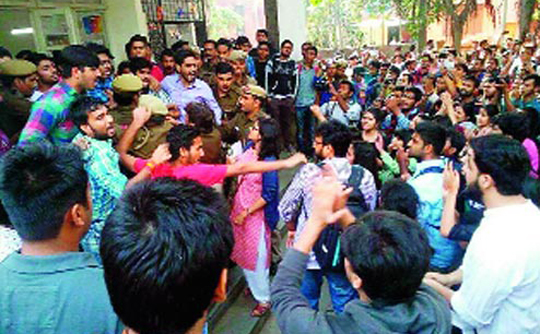
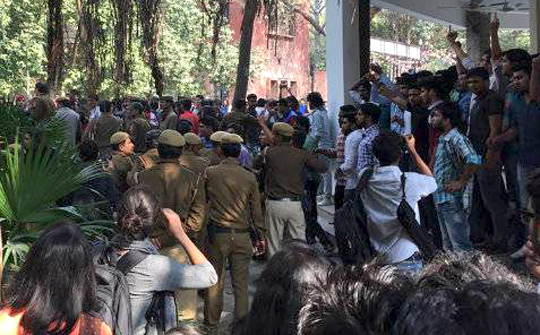
New Delhi, Feb 22: A clash broke out between activists of ABVP and AISA of Delhi University on Wednesday, a day after JNU student Umar Khalid’s visit to Ramjas College was cancelled following protests by students. The college authorities had to withdraw the invitation to Khalid, who was charged with sedition last year, and Shehla who was face of the movement demanding release of the students arrested in that case. According to reports, ABVP activists were staging a protest in the college on Wednesday, which led to a clash between them and AISA members. Both ABVP and AISA are student political groups representing divergent ideologies.

nat1

Umar Khalid and former JNUSU vice-president Shehla Rashid were invited to speak at a seminar in Ramjas College on Tuesday but their visit was cancelled after ABVP and DUSU members gathered outside the college gate and shouted slogans against them. There were also allegations of the protesters using violent methods like stone pelting.

ramjas

Meanwhile, there was a section of teachers, students and members of left- affiliated All India Students’ Association (AISA), who were agitated over the college’s decision to ‘bow down’ to “threat to freedom of speech” had decided to march to Maurice Nagar police station calling for action against ABVP members for resorting to vandalism.

During the clash, AISA members tried to barge inside the premises to ‘rescue the captives’. An AISA member said, “The students have been locked inside and those trying to come out were beaten up by ABVP goons. We tried to barge in inside the college to rescue the students but they are attacking us as well. They have come prepared with hockey sticks.”

After assessing the situation outside, Ramjas College Principal Rajender Prasad said he is in discussion with the teachers who were organisers of the event and requested both the groups to not disrupt the peace and harmony in the college.

The protesters also clashed with police personnel deployed at the scene. Umar Khalid was among JNU students who were charged with sedition after February 9 episode last year in which a group of students were seen shouting ‘anti-India’ slogans in mobile footage.

Comments

shaji
 - 
Wednesday, 22 Feb 2017

Its right time to declare ABVP a terrorist group and ban it. They came there with sticks / stones / sharp metals to attached AISA students and much to the strange police did not stop them from attacking AISA students. ABVP is fully supported by BJP and they are followign fool step of their masters in creating disturbance in the society.

Add new comment

  • Coastaldigest.com reserves the right to delete or block any comments.
  • Coastaldigset.com is not responsible for its readers’ comments.
  • Comments that are abusive, incendiary or irrelevant are strictly prohibited.
  • Please use a genuine email ID and provide your name to avoid reject.
News Network
June 25,2020

New Delhi, Jun 25: India registered its worst single-day increase in COVID-19 cases on Thursday, recording more than 16,000 coronavirus infections, to push the overall tally to 4.73 lakh as the number of fatalities also jumped by 418, the Union Health Ministry said.

This was the sixth consecutive day when coronavirus cases increased by more than 14,000. On June 20, the country registered an increase of 14,516 cases. On June 21, the increase was of 15,413 cases; 14,821 cases on June 22; 14,933 cases on June 23; and 15,968 cases on June 24.

Consequently, India added 92,573 cases since June 20, and over 2.82 lakh this month since June 1.

The health ministry data updated at 8am on Thursday showed the daily tally increased by the highest-ever 16,922 cases to reach 4,73,105, while the total deaths climbed to 14,894 with 418 new fatalities.

However, according to the data, the recovery rate has improved to 57.43 per cent. The number of active cases stands at 1,86,514 while 2,71,696 people have recovered; one patient has migrated.

The total number of confirmed cases included foreigners.

According to ICMR, a total of 75,60,782 samples have been tested up to June 24 with 2,07,871 samples being tested on Wednesday.

Of the 418 new deaths, 208 were in Maharashtra, 64 in Delhi, 33 in Tamil Nadu, 25 in Gujarat, 14 in Karnataka, 11 in West Bengal, 10 each in Rajasthan and Haryana, nine in Madhya Pradesh, eight each in Uttar Pradesh and Punjab, five each in Andhra Pradesh, Telangana and Uttarakhand.

Bihar, Goa and Jammu and Kashmir have reported one COVID-19 fatality each.

Of the total fatalities, Maharashtra tops the tally with 6,739 deaths followed by Delhi (2,365), Gujarat (1,735), Tamil Nadu (866), Uttar Pradesh (596), West Bengal (591), Madhya Pradesh (534), Rajasthan (375) and Telangana (225).

The COVID-19 death toll reached 188 in Haryana, 164 in Karnataka, 124 in Andhra Pradesh, 113 in Punjab, 88 in Jammu and Kashmir, 57 in Bihar, 35 in Uttarakhand, 22 in Kerala and 17 in Odisha.

Chhattisgarh has registered 12 deaths, Jharkhand 11, Assam and Puducherry nine each, Himachal Pradesh eight, Chandigarh six, Goa two and Meghalaya, Tripura and Ladakh have reported one fatality each.

More than 70 per cent deaths took place due to comorbidities, the health ministry said.

Maharashtra has reported the highest number of cases at 1,42,900 followed by Delhi at 70,390, Tamil Nadu at 67,468, Gujarat at 28,943, Uttar Pradesh at 19,557, Rajasthan at 16,009 and West Bengal at 15,173, according to ministry data.

The number of COVID-19 cases has gone up to 12,448 in Madhya Pradesh, 12,010 in Haryana, 10,444 in Telangana,10,331 in Andhra Pradesh and 10,118 in Karnataka.

It has risen to 8,209 in Bihar, 6,422 in Jammu and Kashmir, 6,198 in Assam and 5,752 in Odisha. Punjab has reported 4,627 novel coronavirus infections so far, while Kerala has 3,603 cases.

A total of 2,623 people have been infected by the virus in Uttarakhand, 2,419 in Chhattisgarh, 2,207 in Jharkhand, 1,259 in Tripura, 970 in Manipur, 951 in Goa, 941 in Ladakh and 806 in Himachal Pradesh.

Puducherry has recorded 461 COVID-19 cases, Chandigarh has 420, Nagaland has 347, Arunachal Pradesh has 158 and Mizoram has 142 cases.

Dadra and Nagar Haveli and Daman and Diu together have reported 120 COVID-19 cases.

Sikkim has 84, Andaman and Nicobar Islands has registered 56 infections so far while Meghalaya has recorded 46 cases.

"Our figures are being reconciled with the ICMR (Indian Council of Medical Research)," the ministry said, adding 8,493 cases are being reassigned to states.

State-wise distribution is subject to further verification and reconciliation, it added.

Comments

Add new comment

  • Coastaldigest.com reserves the right to delete or block any comments.
  • Coastaldigset.com is not responsible for its readers’ comments.
  • Comments that are abusive, incendiary or irrelevant are strictly prohibited.
  • Please use a genuine email ID and provide your name to avoid reject.
News Network
June 30,2020

New Delhi, Jun 30: With a spike of 18,522 COVID-19 cases in the last 24 hours, India's coronavirus count now stand at 5,66,840, said the Union Health and Family Welfare Ministry on Tuesday.

According to the Ministry, 418 deaths due to COVID-19 were reported in the last 24 hours. The number of deaths in the country now stands at 16,893.

There are 2,15,125 active coronavirus cases in the country while the number of cured/discharged patients stands at 3,34,821 and one patient migrated.

As per the Ministry, Maharashtra is the worst-hit state with regard to the COVID-19 cases and has reported 1,69,883 cases, including 73, 313 active cases 88,960 cured/discharged patients and 7,610 fatalities.

Tamil Nadu has a total of 86,224 cases including 1,141 deaths. Delhi's COVID-19 count stands at 85,161 cases and 2,680 fatalities.

The total number of samples tested up to 29 June is 86,08,654 of which 2,10,292 samples were tested yesterday, informed the Indian Council of Medical Research.

Comments

Add new comment

  • Coastaldigest.com reserves the right to delete or block any comments.
  • Coastaldigset.com is not responsible for its readers’ comments.
  • Comments that are abusive, incendiary or irrelevant are strictly prohibited.
  • Please use a genuine email ID and provide your name to avoid reject.
News Network
April 24,2020

New Delhi, Apr 24: The trajectory of COVID-19 cases could have plateaued and might even fall for some weeks after the lockdown is lifted but India is likely to see a second wave in late July or August with a surge in the number of cases during the monsoon, say scientists.

The timing of the peak will depend on how India is able to control physical distancing and on the level of infection spreads after restrictions are relaxed, they said.

It looks apparent that the trajectory of daily new cases has reached a plateau and eventually it will take a downward fall, maybe for some weeks or even months, Samit Bhattacharya, associate professor at the Department of Mathematics, Shiv Nadar University, said.

Still, we may get a surge of new cases of the same coronavirus and this will be considered a second wave, Bhattacharya explained.

The second epidemic may come back in late July or August in the monsoon, although the peak timing will depend on how we control social distancing during that time, he said.

Rajesh Sundaresan, professor at Bengaluru's Indian Institute of Science (IISc), agreed.

“Once we return to normal activity levels, there is a chance that infection may begin to rise again. China is seeing this to some extent post easing of some restrictions on travel,” Sundaresan, corresponding author of a working paper by researchers at IISc and the Tata Institute of Fundamental Research (TIFR) in Mumbai, said.

On March 25, when the number of coronavirus cases was 618 with 13 deaths, the government announced a nationwide lockdown that was later extended to May 3.

On Friday, the death toll due to COVID-19 rose to 718 and the number of cases to 23,077, according to the Union Health Ministry.

In good news, officials said this week that the doubling rate of cases has slowed down in the period, going from 3.4 days before lockdown to 7.5 days, with 18 states doing better than the national average. The recovery rate has also almost doubled in the last 10 days.

"Looking at the new cases in the past few days, it seems the growth of new daily infection is much slower than earlier. This apparently indicates that we might have reached at the plateau of the growth curve, Bhattacharya said.

He noted that recent studies in China and Europe observed that the infection might relapse in those people who have already recovered from earlier phases.

So, there is no evidence that the earlier infection may help acquire immunity against the second infection. And in that way, the entire population may be vulnerable to the second wave to some extent, said the scientist.

In their study unveiled this week, IISc and TIFR researchers analysed the impact of strategies such as case isolation, home quarantine, social distancing and various post-lockdown restrictions on COVID-19 that might remain in force for some time.

The study modelled on Bengaluru and Mumbai suggests the infection is likely to have a second wave and the public health threat will remain, unless steps are taken to aggressively trace, localise, isolate the cases, and prevent influx of new infections.

The new levels and the peaking times for healthcare demand depend on the levels of infection spreads in each city at the time of relaxation of restrictions, they said.

The lockdown is currently upon us. It has given us valuable time. Let us test, trace, quarantine, isolate, practice better hygiene, search for a vaccine, etc. We should do these anyway, and these are being done. When and how to lift the lockdown is going to be a difficult decision to make, said Sundaresan.

It's clear that it's going to be phased. What our team is focusing on is to come up with tools to help the decision makers assess the public health impact of various choices, he said.

According to the experts, infectious diseases spread via contact between infectious and susceptible people. In the absence of any control measures, an outbreak will grow as long as the average number of people infected by each infectious person is more than one.

Once enough people are immune there will be fewer people susceptible to the infection and the outbreak will die.

However, when an outbreak is brought under control by social distancing and other interventions, it is possible only a small proportion of the population will have been infected and gained immunity, they said.

This means enough susceptible people may remain to fuel a second wave if controls are relaxed and infection is reintroduced.

Until the vaccine comes on the market, we have to remain alert Once sporadic cases occur here and there in the country, we immediately need to implement quarantine or social distancing locally for the people in that region, and also need to perform tests to identify positive cases irrespective of showing symptoms, Bhattacharya explained.

Note that these monsoon months are also flu season in many places of India. So, we should not ignore the early signs of the flu symptoms. Irrespective of symptoms, we need to increase tests in the hotspots to identify people and contain the surge, he said.

Sundaresan added that the timeline for a second wave will depend on a lot of circumstances which may change as the time passes.

Significant testing may have been underway, there may be behavioural changes with people becoming more careful about their hygiene, wearing masks may become more common, etc. All these responses may help restrict the second wave, he said.

A study published in The Lancet journal earlier this month modelled the potential adverse consequences of premature relaxation of interventions, and found it might lead to a second wave of infections.

The finding is critical to governments globally, because it warns against premature relaxation of strict interventions, the researchers said.

While interventions to control the spread of SARS-CoV-2 are in place, countries will need to work toward returning to normalcy; thus, knowledge of the effect of each intervention is urgently required, they said in the study.

According to a recent analysis by the Harvard Chan School of Public Health, the best strategy to ease the critical care burden and loss of life from COVID-19 might be on-again, off-again social distancing.

In the absence of such interventions, surveillance and intermittent distancing may need to be maintained into 2022, which would present a substantial social and economic burden, the researchers wrote.p


Comments

Add new comment

  • Coastaldigest.com reserves the right to delete or block any comments.
  • Coastaldigset.com is not responsible for its readers’ comments.
  • Comments that are abusive, incendiary or irrelevant are strictly prohibited.
  • Please use a genuine email ID and provide your name to avoid reject.