ABVP, AISA activists clash over blocking of Umar Khalid’s visit to Ramjas college

February 22, 2017

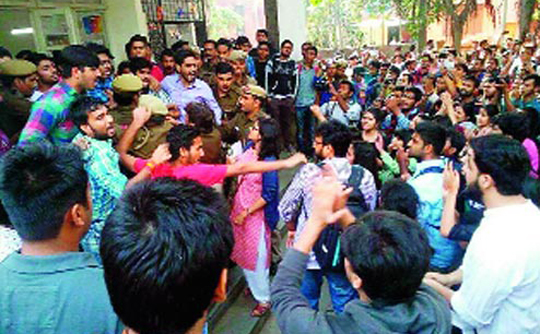
New Delhi, Feb 22: A clash broke out between activists of ABVP and AISA of Delhi University on Wednesday, a day after JNU student Umar Khalid’s visit to Ramjas College was cancelled following protests by students. The college authorities had to withdraw the invitation to Khalid, who was charged with sedition last year, and Shehla who was face of the movement demanding release of the students arrested in that case. According to reports, ABVP activists were staging a protest in the college on Wednesday, which led to a clash between them and AISA members. Both ABVP and AISA are student political groups representing divergent ideologies.
nat1

Umar Khalid and former JNUSU vice-president Shehla Rashid were invited to speak at a seminar in Ramjas College on Tuesday but their visit was cancelled after ABVP and DUSU members gathered outside the college gate and shouted slogans against them. There were also allegations of the protesters using violent methods like stone pelting.
ramjas

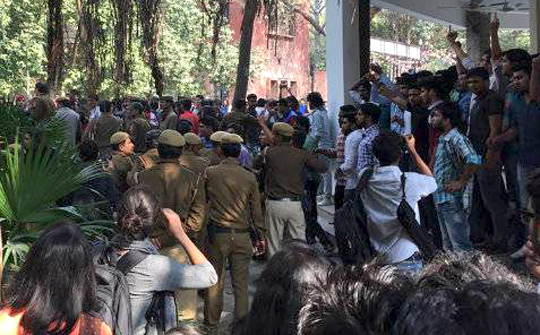
Meanwhile, there was a section of teachers, students and members of left- affiliated All India Students’ Association (AISA), who were agitated over the college’s decision to ‘bow down’ to “threat to freedom of speech” had decided to march to Maurice Nagar police station calling for action against ABVP members for resorting to vandalism.

During the clash, AISA members tried to barge inside the premises to ‘rescue the captives’. An AISA member said, “The students have been locked inside and those trying to come out were beaten up by ABVP goons. We tried to barge in inside the college to rescue the students but they are attacking us as well. They have come prepared with hockey sticks.”

After assessing the situation outside, Ramjas College Principal Rajender Prasad said he is in discussion with the teachers who were organisers of the event and requested both the groups to not disrupt the peace and harmony in the college.

The protesters also clashed with police personnel deployed at the scene. Umar Khalid was among JNU students who were charged with sedition after February 9 episode last year in which a group of students were seen shouting ‘anti-India’ slogans in mobile footage.

Comments

shaji
 - 
Wednesday, 22 Feb 2017

Its right time to declare ABVP a terrorist group and ban it. They came there with sticks / stones / sharp metals to attached AISA students and much to the strange police did not stop them from attacking AISA students. ABVP is fully supported by BJP and they are followign fool step of their masters in creating disturbance in the society.

Add new comment

  • Coastaldigest.com reserves the right to delete or block any comments.
  • Coastaldigset.com is not responsible for its readers’ comments.
  • Comments that are abusive, incendiary or irrelevant are strictly prohibited.
  • Please use a genuine email ID and provide your name to avoid reject.
News Network
March 21,2020

Mar 21: India’s economy, already in the grip of a slowdown, is in for more pain after Prime Minister Narendra Modi appealed to citizens to stay at and work from home to curb the coronavirus outbreak.

The services sector, which accounts for about 55% of India’s gross domestic product, is poised to be the worst hit after Modi, in a late evening address on Thursday, urged citizens to go on a self-imposed curfew for a day and private companies to allow employees to work from home for longer. In the country’s vast informal sector, social-distancing measures could mean a dent to productivity and consumption because of job or pay losses.

“The impact of a partial lock-down or social distancing will be significant,” said Rahul Bajoria, a senior economist at Barclays Plc in Mumbai. “If there’s a widespread community outbreak, GDP could fall as low as 3.5% in the year starting April 1.”

Shrinking output may limit growth in an economy that’s already set to expand at an 11-year low of 5% in the current year to March 31. Before the virus outbreak, India had forecast growth to recover to 6%-6.5% in the next fiscal year. S&P Global Ratings and Fitch Ratings have already slashed their growth forecast by 50 basis points.

“The current social-distancing measures will severely impact airlines, hotels, malls, multiplexes, restaurants and retailers,” according to analysts at Crisil Ltd., the local unit of S&P Global. “Lower footfalls and occupancies, decline in business volume and sub-optimal operating efficiencies will impact cash flows of companies in these sectors,” wrote the analysts led by Chief Economist Dharmakirti Joshi.

The government will try to announce a relief package for virus-affected sectors as early as possible, Finance Minister Nirmala Sitharaman said Friday.

In a televised address, Modi advised all citizens to stay at home for a day on March 22, as he sought to stem the spread of the coronavirus -- cases of which are relatively low in India at about 200, compared with more than 200,000 infected people globally. His government also barred incoming flights for a week from that day, joining a growing list of countries effectively sealing their borders.

What Bloomberg’s Economists Say

We had only earlier this week lowered our GDP outlook to consider the direct impact of the local outbreak as confirmed virus cases exceeded 100 as of March 15 and the federal and state governments announced social distancing measures that have already started to crimp economic activity. We are now revising down our GDP estimate for 4Q fiscal 2020 to 3.3%, from our 3.5%.

-- Abhishek Gupta, India economist

For more, click here

“Consumption being the biggest component of GDP, a lock-down is bound to have a big impact on the economy,” said Devendra Kumar Pant, chief economist at India Ratings and Research, the local unit of Fitch. “Modeling uncertainty in any system will be very difficult, but one can say the slowdown could deepen or prolong further.”

Work From Home

While companies, including billionaire Mukesh Ambani-controlled Reliance Industries Ltd., are asking employees to work from home, the option isn’t feasible in India’s vast informal sector.

“The option to work remotely simply won’t exist for most,” said Shilan Shah, an economist with Capital Economics Pte. in Singapore.

As many households don’t have savings buffers, the government would probably have to back this up with large-scale cash handouts that reach the poorest, he said.

Work from home is posing implementation challenges for the manufacturing sector where workers are required to be physically present at the production sites. The services sector, such as banking and information technology, also needs employees to be present in offices as confidential data is used, according to industry group Federation of Indian Chambers of Commerce and Industry.

Comments

Add new comment

  • Coastaldigest.com reserves the right to delete or block any comments.
  • Coastaldigset.com is not responsible for its readers’ comments.
  • Comments that are abusive, incendiary or irrelevant are strictly prohibited.
  • Please use a genuine email ID and provide your name to avoid reject.
Agencies
July 29,2020

New Delhi, Jul 29: The new National Education Policy (NEP) approved by the Union Cabinet on Wednesday is set to usher in a slew of changes with the vision of creating an education system that contributes directly to transforming the country, providing high-quality education to all, and making India a global knowledge superpower.

The draft of the NEP by a panel headed by former Indian Space Research Organisation (ISRO) chief Kasturirangan and submitted to the Union Human Resource Development Minister Ramesh Pokhriyal when he took charge last year. The new NEP replaces the one formulated in 1986.

Some of the key highlights of the New Education Policy are:-

The policy aims to enable an individual to study one or more specialized areas of interest at a deep level, and also develop character, scientific temper, creativity, spirit of service, and 21st century capabilities across a range of disciplines including sciences, social sciences, arts, humanities, among others.

It identified the major problems facing the higher education system in the country and suggested changes such as moving towards multidisciplinary universities and colleges, with more institutions across India that offer medium of instruction in local/Indian languages, a more multidisciplinary undergraduate education, among others. 

The governance of such institutions by independent boards having academic and administrative autonomy has also been suggested.

Under the suggestions for institutional restructuring and consolidation, it has suggested that by 2040, all higher education institutions (HEIs) shall aim to become multidisciplinary institutions, each of which will aim to have 3,000 or more students, and by 2030 each or near every district in the country there will be at least one HEI.

The aim will be to increase the Gross Enrolment Ratio in HEIs including vocational education from 26.3 per cent (2018) to 50 per cent by 2035.

Single-stream HEIs will be phased out over time, and all will move towards becoming vibrant multidisciplinary institutions or parts of vibrant multidisciplinary HEI clusters.

It also pushes for more holistic and multidisciplinary education to be provided to the students.

Comments

Add new comment

  • Coastaldigest.com reserves the right to delete or block any comments.
  • Coastaldigset.com is not responsible for its readers’ comments.
  • Comments that are abusive, incendiary or irrelevant are strictly prohibited.
  • Please use a genuine email ID and provide your name to avoid reject.
News Network
January 13,2020

New Delhi, Jan 13: The Jawaharlal Nehru University Students' Union (JNUSU) has alleged that the varsity administration has blocked the registration of 300 students on the basis of 'fake Proctor inquiries'.

The union had on Saturday asked students of the university to pay their academic tuition fee but not the hiked hostel fee.

"Today the Vice Chancellor first blocked the fee payment portal and then blocked the payment of tuition fees. It is clear that the VC was lying through the teeth when he said students want to register but are not being allowed to by protesters," JNUSU president Aishe Ghosh said.

She said the VC has also blocked the registration of 300 students based on fake proctor enquiries which are not even completed.

"The truth is that it is the administration which does not want students to register and is blocking their registration," she said.

JNUSU vice president Saket Moon said that in the meetings held in HRD ministry, it was decided that the administration would take a lenient view on the students' protest and not take action against them.

He said many students, who opened the portal for registration found they had been academically suspended and could not register.

He said the JNUSU had softened its stand by saying that they would register by paying the old fees but that has been kept on hold.

On Sunday, the administration extended the date for the winter semester registration till January 15.

Comments

Add new comment

  • Coastaldigest.com reserves the right to delete or block any comments.
  • Coastaldigset.com is not responsible for its readers’ comments.
  • Comments that are abusive, incendiary or irrelevant are strictly prohibited.
  • Please use a genuine email ID and provide your name to avoid reject.