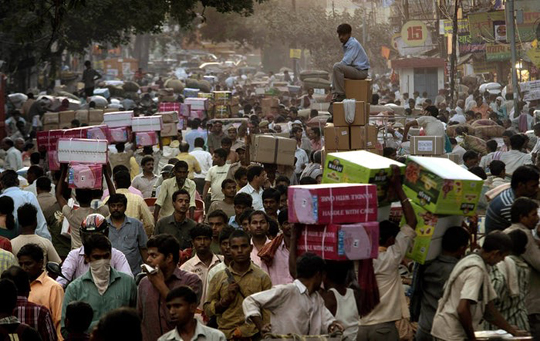
With over 1.4 bn people, India to be more populous than China by 2024: UN

Agencies
June 22, 2017

United Nations, Jun 22: India, which currently ranks as the second most populous country with 1.3 billion inhabitants, will surpass China's 1.4 billion citizens by 2024, the UN said in a report.

IndiaP

The world's total population is expected to hit 9.8 billion by 2050 despite universal lower fertility rates,the report added.

The world's population is now at least 7.6 billion, up from 7.4 billion last year, spurred by the relatively high levels of fertility in developing countries -- despite an overall drop in the number of children people have around the globe, the report World Population Prospects: The 2017 Revision revealed on Wednesday.

The concentration of global population growth is in the poorest countries, presenting a challenge as the world seeks to implement the 2030 Sustainable Development Agenda, which is aimed to end poverty and preserve the planet, according to the report.

"With roughly 83 million people being added to the world's population every year, the upward trend in population size is expected to continue, even assuming that fertility levels will continue to decline," said the UN Department of Economic and Social Affairs.

At this rate, the world population is expected to reach 8.6 billion in 2030, 9.8 billion in 2050 and surpass 11.2 billion in 2100, reports Xinhua news agency.

The growth is expected to come, in part, from the 47 least developed countries, where the fertility rate is around 4.3 births per woman, and whose population is expected to reach 1.9 billion people in 2050 from the current estimate of 1 billion.

In addition, the birth rates in African countries are likely to "at least double" by 2050, said the report.

That trend comes despite lower fertility rates in nearly all regions of the world, including in Africa, where rates fell from 5.1 births per woman up to 2005 to 4.7 births in the five years following.

In contrast, the birth rates in Europe are up to 1.6 births per woman, up from 1.4 births in 2000-2005.

The lower fertility rates are resulting in an ageing population, with the number of people aged 60 or over expected to more than double by 2050 and triple by 2100, from the current 962 million to 3.1 billion.

Africa, which has the youngest age distribution of any region, is projected to experience a rapid ageing of its population, the report noted.

By 2050, the third most populous country will be Nigeria, which currently ranks seventh, and which is poised to replace the US.

Comments

Nothing but Truth
 - 
Thursday, 22 Jun 2017

Major contribution will be from Peace Community..sadly

Add new comment

  • Coastaldigest.com reserves the right to delete or block any comments.
  • Coastaldigset.com is not responsible for its readers’ comments.
  • Comments that are abusive, incendiary or irrelevant are strictly prohibited.
  • Please use a genuine email ID and provide your name to avoid reject.
Agencies
February 4,2020

The death toll in China's coronavirus rose sharply to 425 with 64 deaths on Monday alone while 3,235 new confirmed cases were reported, taking the number of those infected with the deadly disease to 20,438, Chinese health authorities said on Tuesday.

The 64 people who died on Monday were all from the Hubei province, the epicentre of the virus, China's National Health Commission said.

Also, 3,235 new confirmed cases of novel coronavirus infection were reported, a big increase in a day.

Another 5,072 new suspected cases were reported on Monday, said the commission, adding that 492 patients became seriously ill.

The commission said that 2,788 patients remained in severe condition and 23,214 people were suspected of being infected with the virus, a pointer that it is increasingly turning virulent.

The overall confirmed cases on the Chinese mainland had reached 20,438 by the end of Monday, the commission said, noting that a total of 425 people had died of the disease.

A total of 632 people had been discharged from hospital after recovery, state-run Xinhua news agency reported As the virus spreads from human to human, 221,015 close contacts had been traced, with 171,329 others still under medical observation.

By the end of Monday, 15 confirmed cases had been reported in Hong Kong, eight in the Macao and 10 in Taiwan.

The Philippines reported the first overseas death from the virus on Sunday while 148 cases have been reported from abroad.

India has reported three cases of the coronavirus. All the three patients from Kerala recently returned from the affected Wuhan city.

Currently, 647 Indians and seven Maldivians who have been evacuated from Wuhan and Hubei are in 14-day quarantine at a medical camp in Manesar, near Delhi.

As the virus continued to spread at an alarming rate, Chinese President Xi Jinping on Monday warned officials of punishment if they shirked responsibility in tackling the virus outbreak.

On Monday, China has opened a 1,000-bed hospital built in record nine days in Wuhan city and started trials for new drug to contain the virus and is set to open another 1,300 bed hospital next to it on Wednesday.

The ruling Communist Party of China on Monday held its political bureau meeting presided by President Xi to review the steps being taken on various fronts to halt the spread of the deadly virus.

The outcome of the epidemic prevention and control directly affects people's lives and health, the overall economic and social stability and the country's opening-up, Xi said.

"Those who disobey the unified command or shirk off responsibilities will be punished," Xi was quoted as saying by the state-run Xinhua news agency.

Xi said that the party and government leaders supervising them would also be held accountable in severe cases.

Chinese armament firms, including those building aircraft carrier and military aircraft, have postponed planned work in order to concentrate on controlling the risk of coronavirus, state-run Global Times reported.

Noted Chinese health expert Zhong Nanshan has said that based on the fresh evidence, the novel coronavirus, which is spreading rapidly in China and the world, may reach its peak in the next 10 to 14 days, contrary to earlier estimates of climaxing sooner.

This means that the cases would drastically increase in the next two weeks before slowing down.

Also, China has begun clinical trials to test a drug to treat the patients of the coronavirus which till now has no cure.

Currently, patients are being treated with a combination of antivirals and other measures, as scientists race to find a vaccine.

Some reports said drugs to treat HIV too was being tried to treat the patients.

The experimental antiviral drug, Remdesivir, to be tested in field trials is developed by US-based Gilead Sciences. It is aimed at treating infectious diseases such as Ebola and SARS, South China Morning Post reported.

It was given to the first US patient last week - a 35-year-old man whose condition appeared to improve within a day, it said.

Comments

Add new comment

  • Coastaldigest.com reserves the right to delete or block any comments.
  • Coastaldigset.com is not responsible for its readers’ comments.
  • Comments that are abusive, incendiary or irrelevant are strictly prohibited.
  • Please use a genuine email ID and provide your name to avoid reject.
News Network
June 26,2020

Washington, Jun 26: The United States reported more than 39,000 new coronavirus cases on Thursday, its highest-ever single-day count as the government relaxed restrictions and is downplaying the threat of the deadly virus.

According to the Washington Post, experts believe there is a troubling lack of consistent, unified messaging from President Donald Trump and Vice President Mike Pence. They have downplayed the danger and denigrated effective disease defences such as mask-wearing, testing, and social distancing.

Churches, beaches, and bars are filling up with people and so are hospital beds, the report said.

The counties home to Dallas, Phoenix, and Tampa all reported record-high averages on at least 15 straight days in June.

The hardest-hit states are California, Texas, Florida and those that thought they had the virus under control, like Utah and Oregon.

"I think the politicians are in denial," said Kami Kim, director of the Division of Infectious Disease and International Medicine at the University of South Florida.

The chief of the Division of Pediatric Infectious Diseases at the University of Utah Health, Andrew T. Pavia, is of the view that the push to reopen quickly even as cases climb sends a dangerous and inaccurate message.

"On the one hand, you get messages from politicians and the business community that we have to go, go, go and open up," he said. "On the other hand, you're seeing epidemiological indicators that we still have to be very careful."

"It's cognitive dissonance," he added.

The Trump administration has tried to downplay the rising number. Pence called concerns about another surge of infections "overblown," the product of media "fearmongering."

Some governors have followed the administration's lead, blaming rising caseloads on more testing.

Testifying before a congressional committee this week, Anthony S. Fauci, the nation's top infectious-diseases expert, said the new cases were "a disturbing surge" spurred by community transmission rather than testing.

"That's something I'm really quite concerned about," Fauci said. "A couple of days ago, there were 30,000 new infections. That's very disturbing to me."

Several states like Arizona, Arkansas, the Carolinas, Mississippi, Tennessee, Texas and Utah have recently reported new highs in the number of coronavirus patients hospitalized.

"We're seeing a 40 per cent increase in the last two weeks in hospitalizations," said Dallas County Judge Clay Jenkins (D), the jurisdiction's top elected official. "We're by far at our record numbers, and we're at record numbers in north Texas. Houston is at a record, the state is at a record." The Texas Medical Center in Houston, a massive medical complex, reported Thursday that 100 per cent of the beds in its intensive care unit are occupied.

Comments

Add new comment

  • Coastaldigest.com reserves the right to delete or block any comments.
  • Coastaldigset.com is not responsible for its readers’ comments.
  • Comments that are abusive, incendiary or irrelevant are strictly prohibited.
  • Please use a genuine email ID and provide your name to avoid reject.
Agencies
July 2,2020

Moscow, Jul 2: Russian voters approved changes to the constitution that will allow President Vladimir Putin to hold power until 2036, but the weeklong plebiscite that concluded Wednesday was tarnished by widespread reports of pressure on voters and other irregularities.

With most of the nation's polls closed and 20% of precincts counted, 72% voted for the constitutional amendments, according to election officials.

For the first time in Russia, polls were kept open for a week to bolster turnout without increasing crowds casting ballots amid the coronavirus pandemic a provision that Kremlin critics denounced as an extra tool to manipulate the outcome.

A massive propaganda campaign and the opposition's failure to mount a coordinated challenge helped Putin get the result he wanted, but the plebiscite could end up eroding his position because of the unconventional methods used to boost participation and the dubious legal basis for the balloting.

By the time polls closed in Moscow and most other parts of Western Russia, the overall turnout was at 65%, according to election officials. In some regions, almost 90% of eligible voters cast ballots.

On Russia's easternmost Chukchi Peninsula, nine hours ahead of Moscow, officials quickly announced full preliminary results showing 80% of voters supported the amendments, and in other parts of the Far East, they said over 70% of voters backed the changes.

Kremlin critics and independent election observers questioned the turnout figures.

We look at neighboring regions, and anomalies are obvious there are regions where the turnout is artificially (boosted), there are regions where it is more or less real, Grigory Melkonyants, co-chair of the independent election monitoring group Golos, told The Associated Press.

Putin voted at a Moscow polling station, dutifully showing his passport to the election worker. His face was uncovered, unlike most of the other voters who were offered free masks at the entrance.

The vote completes a convoluted saga that began in January, when Putin first proposed the constitutional changes.

He offered to broaden the powers of parliament and redistribute authority among the branches of government, stoking speculation he might seek to become parliamentary speaker or chairman of the State Council when his presidential term ends in 2024.

His intentions became clear only hours before a vote in parliament, when legislator Valentina Tereshkova, a Soviet-era cosmonaut who was the first woman in space in 1963, proposed letting him run two more times.

The amendments, which also emphasize the primacy of Russian law over international norms, outlaw same-sex marriages and mention a belief in God as a core value, were quickly passed by the Kremlin-controlled legislature.

Putin, who has been in power for more than two decades longer than any other Kremlin leader since Soviet dictator Josef Stalin said he would decide later whether to run again in 2024.

He argued that resetting the term count was necessary to keep his lieutenants focused on their work instead of darting their eyes in search for possible successors.

Analyst Gleb Pavlovsky, a former Kremlin political consultant, said Putin's push to hold the vote despite the fact that Russia has thousands of new coronavirus infections each day reflected his potential vulnerabilities.

Putin lacks confidence in his inner circle and he's worried about the future, Pavlovsky said.

He wants an irrefutable proof of public support.

Even though the parliament's approval was enough to make it law, the 67-year-old Russian president put his constitutional plan to voters to showcase his broad support and add a democratic veneer to the changes.

But then the coronavirus pandemic engulfed Russia, forcing him to postpone the April 22 plebiscite.

The delay made Putin's campaign blitz lose momentum and left his constitutional reform plan hanging as the damage from the virus mounted and public discontent grew.

Plummeting incomes and rising unemployment during the outbreak have dented his approval ratings, which sank to 59%, the lowest level since he came to power, according to the Levada Center, Russia's top independent pollster.

Moscow-based political analyst Ekaterina Schulmann said the Kremlin had faced a difficult dilemma: Holding the vote sooner would have brought accusations of jeopardizing public health for political ends, while delaying it raised the risks of defeat.

Holding it in the autumn would have been too risky, she said.

In Moscow, several activists briefly lay on Red Square, forming the number 2036 with their bodies in protest before police stopped them.

Some others in Moscow and St. Petersburg staged one-person pickets and police didn't intervene.

Several hundred opposition supporters rallied in central Moscow to protest the changes, defying a ban on public gatherings imposed for the coronavirus outbreak. Police didn't intervene and even handed masks to the participants.

Authorities mounted a sweeping effort to persuade teachers, doctors, workers at public sector enterprises and others who are paid by the state to cast ballots. Reports surfaced from across the vast country of managers coercing people to vote.

The Kremlin has used other tactics to boost turnout and support for the amendments.

Comments

Add new comment

  • Coastaldigest.com reserves the right to delete or block any comments.
  • Coastaldigset.com is not responsible for its readers’ comments.
  • Comments that are abusive, incendiary or irrelevant are strictly prohibited.
  • Please use a genuine email ID and provide your name to avoid reject.