Six Congress MPs suspended from LS for throwing papers at Speaker

Agencies
July 25, 2017

New Delhi, Jul 25: Lok Sabha Speaker Sumitra Mahajan on Monday suspended six Congress MPs for five consecutive sittings for improper conduct after they tore up papers and threw them towards her podium.

The six MPs - Gaurav Gogoi, Adhir Ranjan Chowdhury, Ranjit Ranjan, Sushmita Dev, MK Raghavan and K Suresh - would have to remain out of the lower House for the whole of this week.

During Zero Hour, as the Congress MPs were protesting demanding a discussion on attacks on Dalits and Muslims by cow vigilantes, the six MPs tore up the papers and threw them in the air and towards the Speaker's podium.

"This conduct is not right. It is highly unbecoming and against the rules of the House which seeks to undermine the dignity of the House," Mahajan said.

She said the members were "wilfully obstructing" the House and had caused disorder. She announced their suspension under rule 374 A for "five consecutive sittings".

Comments

Fairman
 - 
Tuesday, 25 Jul 2017

Sister,
You are innocent.
The God is alive always. You will get justice, even if you don't get it here.

Your culprits will pay you dearly there. The God will do justice to you.
You will be in Jannatul Firdous.

Add new comment

  • Coastaldigest.com reserves the right to delete or block any comments.
  • Coastaldigset.com is not responsible for its readers’ comments.
  • Comments that are abusive, incendiary or irrelevant are strictly prohibited.
  • Please use a genuine email ID and provide your name to avoid reject.
News Network
February 18,2020

New Delhi, Feb 18: A Delhi court today sent Sharjeel Imam, who has been named as an "instigator" by the Delhi Police in its chargesheet on violent protests against the amended citizenship act at New Friends Colony near Jamia in Delhi last year, to judicial custody till March 3.

Sharjeel Imam was arrested on sedition charges last month.

The Delhi Police has filed a chargesheet before Chief Metropolitan Magistrate Gurmohina Kaur, naming Sharjeel Imam as an instigator of the violence.

It said it has attached CCTV footage, call detail records and statements of over 100 witnesses as evidence in the chargesheet.

The court had on Monday sent Sharjeel Imam to one-day custody of Delhi Police in the case.

Protestors had torched four public buses and two police vehicles as they clashed with police in New Friends Colony near Jamia Millia Islamia in Delhi during the demonstration against the CAA on December 15, leaving nearly 60 people including students, cops and fire fighters injured.

Comments

Add new comment

  • Coastaldigest.com reserves the right to delete or block any comments.
  • Coastaldigset.com is not responsible for its readers’ comments.
  • Comments that are abusive, incendiary or irrelevant are strictly prohibited.
  • Please use a genuine email ID and provide your name to avoid reject.
Agencies
August 2,2020

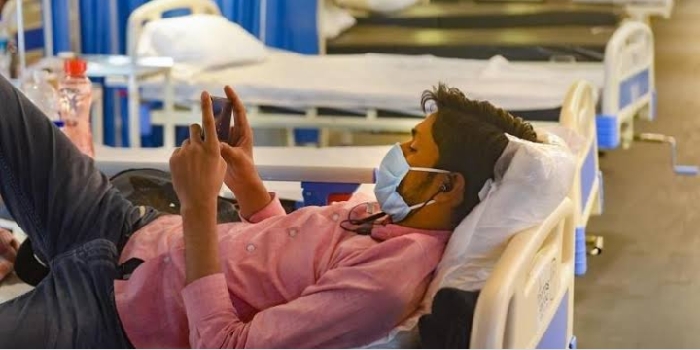
New Delhi, Aug 2: The Centre has written to all states and Union Territories stating that smartphones and tablet devices should be allowed for hospitalised Covid-19 patients so that they can interact with family and friends through video conferencing, which would provide them psychological support.

Though mobile phones are allowed in hospital wards, the missive was issued following some representation from the kin of patients alleging otherwise.

Director-General of Health Services (DGHS) in the Health Ministry Dr Rajiv Garg in the letter to the principal secretaries of health and medical education of states and Union territories said appropriate protocols for disinfecting devices and allotting timeslots can be developed by the hospital concerned to facilitate contact between patients and their family.

He underlined that administrative and medical teams should be responsive to the psychological needs of patients admitted in Covid-19 wards and ICUs of various hospitals.

"Social connection can calm down patients and also reinforce the psychological support given by the treating team. Please instruct all concerned that they should allow smartphones and tablet devices in patient areas so that the patient can video conference with their family and friends," stated the letter issued on July 29.

"Though mobile phones are allowed in the wards to enable a patient stay in touch with his or her family, we received representations from the patient families from some states stating mobile phones are not being allowed by hospital administrations because of which they were not being able to stay in contact with the patient," said Dr Garg.

Comments

Add new comment

  • Coastaldigest.com reserves the right to delete or block any comments.
  • Coastaldigset.com is not responsible for its readers’ comments.
  • Comments that are abusive, incendiary or irrelevant are strictly prohibited.
  • Please use a genuine email ID and provide your name to avoid reject.
Agencies
April 23,2020

New Delhi, Apr 23: The nationwide lockdown in India which started about a month ago has impacted nearly 40 million internal migrants, the World Bank has said.

The lockdown in India has impacted the livelihoods of a large proportion of the country's nearly 40 million internal migrants. Around 50,000 60,000 moved from urban centers to rural areas of origin in the span of a few days, the bank said in a report released on Wednesday.

According to the report -- 'COVID-19 Crisis Through a Migration Lens' -- the magnitude of internal migration is about two-and-a-half times that of international migration.

Lockdowns, loss of employment, and social distancing prompted a chaotic and painful process of mass return for internal migrants in India and many countries in Latin America, it said.

Thus, the COVID-19 containment measures might have contributed to spreading the epidemic, the report said.

Governments need to address the challenges facing internal migrants by including them in health services and cash transfer and other social programmes, and protecting them from discrimination, it said.

World Bank said that coronavirus crisis has affected both international and internal migration in the South Asia region.

As the early phases of the crisis unfolded, many international migrants, especially from the Gulf countries, returned to countries such as India, Pakistan, and Bangladesh until travel restrictions halted these flows.

Some migrants had to be evacuated by governments, such as those of China and Iran, it said.

Before the coronavirus crisis, migrant outflows from the region were robust, the report said.

The number of recorded, primarily low-skilled emigrants from India and Pakistan rose in 2019 relative to the prior year but is expected to decline in 2020 due to the pandemic and oil price declines impacting the Gulf countries.

In India, the number of low-skilled emigrants seeking mandatory clearance for emigration rose slightly by eight percent to 368,048 in 2019.

In Pakistan, the number of emigrants jumped 63 per cent to 6,25,203 in 2019, largely due to a doubling of emigration to Saudi Arabia, it said.

According to the bank, migration flows are likely to fall, but the stock of international migrants may not decrease immediately, since migrants cannot return to their countries due to travel bans and disruption to transportation services.

In 2019, there were around 272 million international migrants.

The rate of voluntary return migration is likely to fall, except in the case of a few cross-border migration corridors in the South (such as Venezuela-Colombia, Nepal-India, Zimbabwe South Africa, Myanmar-Thailand), it said.

Migrant workers tend to be vulnerable to the loss of employment and wages during an economic crisis in their host country, more so than native-born workers.

Lockdowns in labour camps and dormitories can also increase the risk of contagion among migrant workers.

Many migrants have been stranded due to the suspension of transport services. Some host countries have granted visa extensions and temporary amnesty to migrant workers, and some have suspended the involuntary return of migrants, it said.

Observing that government policy responses to the COVID-19 crisis have largely excluded migrants and their families back home, the World Bank said there is a strong case for including migrants in the near-term health strategies of all countries, given the externalities associated with the health status of an entire population in the face of a highly contagious pandemic.

The Bank said governments would do well to consider short, medium and long-term interventions to support stranded migrants, remittance infrastructure, loss of subsistence income for families back home, and access to health, housing, education, and jobs for migrant workers in host/transit countries and their families back home.

The pandemic has also highlighted the global shortage of health professionals and an urgent need for global cooperation and long-term investments in medical training, it said.


Comments

Add new comment

  • Coastaldigest.com reserves the right to delete or block any comments.
  • Coastaldigset.com is not responsible for its readers’ comments.
  • Comments that are abusive, incendiary or irrelevant are strictly prohibited.
  • Please use a genuine email ID and provide your name to avoid reject.