


Common people have right to kill those indulging in murder, arson, rape: DGP

May 28, 2016

Chandigarh, May 27: Haryana DGP K P Singh has kicked up a controversy with his remarks that common people coming across any miscreant trying to outrage the modesty of a woman or indulging in acts of arson or murder have the right to "take his life".
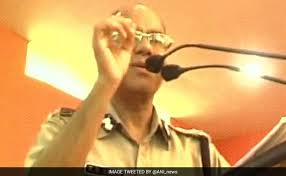
dgpSingh, who was recently made DGP after his predecessor Yashpal Singhal was removed in the wake of severe flak faced by the state police over handling of the Jat stir, said citizens are not aware that they can take action when they come across violations of law.

"Common citizens are not aware that this is not just the right which the law gives to policemen only. If the common man is a witness to someone insulting a woman or indulging in acts of arson by burning someone's property or trying to kill a person then the law gives the right to the common man that he can take the life of the person indulging in such acts," DGP Singh said.

The DGP expressed these views while taking part in a convention about the role of police in Panchayati Raj in Haryana's Jind yesterday, where BJP MLA Prem Lata Singh who is wife of Union Minister Birender Singh, was among those present.

He stressed that while it is the police's role to maintain law and order, one needs to understand the role of a common man.

"It is police's job to maintain law and order but as common citizens you have to understand your role...," he said.

Notably, sections 96 to 106 of the Indian Penal Code pertain to the law relating to the right of private defence of person and property.

The provisions contained in these sections give authority to a person to use necessary force against an assailant or wrong-doer for the purpose of protecting one's own body and property as also another's body and property when immediate aid from the state machinery is not readily available.

With state police drawing flak over its handling of the Jat quota stir in February, DGP Singh said the Haryana Police will not be a mute spectator if any ruckus is created in the future and strict action will be taken against the culprits.

In the backdrop of some Jat leaders renewing the threat to start the agitation afresh over their quota demand, the DGP said some people from outside the state are trying to disturb the peaceful atmosphere but it is the duty of locals to keep away from them.

"Agitation is right of public but it is wrong when protesters damage the environment by cutting trees and cause damage to public and private property," he said.

Notably, the Prakash Singh Committee report which was submitted to the Haryana Chief Minister recently found "deliberate negligence" on the part of 90 officials, including IAS and IPS officers.

On May 17, the Haryana government had shunted out Additional Chief Secretary (Home) P K Das who was replaced by senior IAS officer Ram Niwas. Prior to that, DGP Singhal was replaced by K P Singh.

Thirty people were killed in violence and there was extensive damage to property during the stir whose epicentre was Rohtak district.

Comments

Priyanka
 - 
Saturday, 28 May 2016

well said rapist should be hanged infront of pubic

Mehak
 - 
Saturday, 28 May 2016

yes thats great, those type of criminals should be stoned by locals.

Add new comment

  • Coastaldigest.com reserves the right to delete or block any comments.
  • Coastaldigset.com is not responsible for its readers’ comments.
  • Comments that are abusive, incendiary or irrelevant are strictly prohibited.
  • Please use a genuine email ID and provide your name to avoid reject.
coastaldigest.com web desk
January 3,2020

Mangaluru, Jan 3: S Cube Art Gallery has successfully concluded its prestigious assignment from Airports Authority of India (AAI) to beautify Mangaluru Airport with artistic works. AAI had invited tenders for various jobs to be executed in the airport premises. S Cube Art Gallery had made a competitive bid which was subsequently followed up with presentation before selection panel and award of contract. S Cube Art Gallery bagged the contract for six works in two sectors out of the total four sectors for which the tender had been called.

The themes presented by S Cube Art Gallery showcase the Tulu culture and heritage of the people of Coastal Karnataka. The six themes selected are:

1. ‘Human Hand Flying Paper Plane’ – fibre glass and steel sculpture work installed in the circle in the outer precincts of the airport. This is a larger than life sculpture signifying the dreams and aspirations of the air travelers. Artist: Harish Kodialbail, Mangalore

2. ‘Kambala’ – fibre glass sculpture installed at the exit area of the airport. This sculpture is meant to introduce ‘Kambala’, the iconic folk sport of the region to the visitors and tourists. Artist: Harish Kodialbail, Mangalore

3. ‘Fisherman with Boat’ - fibre glass and steel sculpture installed at the entrance to departures lounge of the airport. It symbolizes the fishing culture of the coastal region depicting the soaring aspirations, life of courage and adventure as well as the daily struggles of the fisher folk. Artist: Harish Kodialbail, Mangalore

4. ‘Tiger Dance’ - fibre glass and steel sculpture installed at the arrivals lounge of the airport. This work depicts the world famous ‘Mangalore Pilivesha’ showing tiger dancers in various typical postures to the visiting tourists. Artist: Harish Kodialbail, Mangalore

5. ‘Folk Art Forms’ – six individual terracotta sculptures with Tulunadu cultural themes installed alongside the domestic and international corridors of the airport. Artist: Venki Palimaru, Udupi

6. ‘Jain Miniature Paintings’ – Jain miniature paintings (18x6 feet) – Two works of acrylic on canvas displayed on the wall on either sides of the exit area. The work was conceived after referring to authentic traditional Jain paintings in Moodbidri Jain Mutt and Shravanabelagola Mutt. Artist: Reshma S. Shetty, Mangalore

The total value of the contract was Rs. 56 lakhs. The work was completed over a period of six months and concluded in the month of July, 2019.  S Cube Art Gallery is grateful to the Airports Authority of India for giving the opportunity to participate in this project and showcase the artistic talents of the region.

Comments

Add new comment

  • Coastaldigest.com reserves the right to delete or block any comments.
  • Coastaldigset.com is not responsible for its readers’ comments.
  • Comments that are abusive, incendiary or irrelevant are strictly prohibited.
  • Please use a genuine email ID and provide your name to avoid reject.
News Network
April 20,2020

Bengaluru, Apr 20: As many as 59 people were arrested on Monday for attacking police and health officials at the minority dominated Padarayanapura in the city when they went to quarantine some people, police said.

"Fifty-nine people have been arrested (in Padarayanapura) and have been taken into custody. The people attacked the officials who had gone to quarantine some poeple who were the primary and secondary contacts of three COVID-19 patients," a police officer said.

A large number of people, mostly youth from the minority community poured on to the road on Sunday and thrashed the health workers who had gone to quarantine some people who were the primary and secondary contacts of the health workers.

The officials were allegedly beaten black and blue.

Some local residents who went to the rescue of these officials were also thrashed.

According to police, one among the arrested is a woman by name Firoza who had allegedly instigated the mob to attack the health and police officials.

Subsequently, a large number of police personnel were deployed in the area to avert any untoward incident and to quarantine those who are suspected to be infected with COVID- 19.

Blowing sirens, a strong contingent of policemen carried out a flag march in the area.

The Bengaluru police commissioner Bhaskar Rao later called on Chief Minister B S Yediyurappa and briefed him about the situation in Padayarayanapura.

The violent incident drew angry reactions from various quarters.

Karnataka Home Minister Basavaraj Bommai said an incident like the one at Padayarayanapura will not be tolerated.

"I met Chief Minister and briefed him about the incident. He has told us to act strictly. I have told the same to my officials. We won't tolerate such acts by anyone. We have arrested 59 people. Five FIRs have been registered," the minister told reporters.

Bommai, who visited the area took the senior police officials to task for not being present on the spot when the incident took place.

"Where were you? What were you doing when the incident happened?" he questioned a senior police officer.

"We will demonstrate to the people what is containment zone, what is seal down and what is police action," he said.

Condemning the incident, Health Minister B Srimulu warned those who indulged in such activities.

"The inhuman act of attacking police and health workers in Padarayanapura is highly deplorable. Our government will take appropriate step against those indulging in the attack on health officials and police officials who had gone there to protect them," he tweeted.

BJP's firebrand MP Shobha Karandlaje reacted sharply.

"Seculars attack #CoronaWarriors when they were quarantining the secondary contacts of #Covid19 in Padarayanapura of BLR. While #HealthcareHeroes are working overnight to contain #CoronaPandemic, these morons are assaulting our heroes! Let's not be soft on these anti- nationals!" Karandlaje tweeted.

Meanwhile, the minority leaders called on Congress state president D K Shivakumar to persuade the people of the minority community to assist in identifying the COVID-19 patients or carriers.

Former chief minister H D Kumaraswamy too condemned the attack and demanded stringent action against the culprits.

The Congress MLA from the area B Z Zameer Ahmed Khan while condemning the incident, sought to know why the health workers and police officials went to the area late in the night and not in the morning.

"Why did the police and the health workers go in the night when I had told the BBMP Commissioner that I will take them at 10 am?" Khan told reporters.

Defending those who attacked the government officials, Khan said they were uneducated labourers who didn't know what they were doing.

Padarayanapura and Bapuji Nagar were among the first areas to be completely sealed as people were not abiding by the prohibitory orders under Section 144 of the CrPC.

Comments

Add new comment

  • Coastaldigest.com reserves the right to delete or block any comments.
  • Coastaldigset.com is not responsible for its readers’ comments.
  • Comments that are abusive, incendiary or irrelevant are strictly prohibited.
  • Please use a genuine email ID and provide your name to avoid reject.
Ram Puniyani
January 14,2020

In the beginning of January 2020 two very disturbing events were reported from Pakistan. One was the attack on Nankana Sahib, the holy shrine where Sant Guru Nanak was born. While one report said that the place has been desecrated, the other stated that it was a fight between two Muslim groups. Prime Minister of Pakistan Imran Khan condemned the incident and the main accused Imran Chisti was arrested. The matter related to abduction and conversion of a Sikh girl Jagjit Kaur, daughter of Pathi (One who reads Holy Guru Granth Sahib in Gurudwara) of the Gurudwara. In another incident one Sikh youth Ravinder Singh, who was out on shopping for his marriage, was shot dead in Peshawar.

While these condemnable attacks took place on the Sikh minority in Pakistan, BJP was quick enough to jump to state that it is events like this which justify the Citizenship Amendment Act (CAA). Incidentally CAA is the Act which is discriminatory and relates to citizenship with Religion, which is not as per the norms of Indian constitution. There are constant debates and propaganda that population of Hindus has come down drastically in Pakistan and Bangla Desh. Amit Shah, the Home minister stated that in Pakistan the population of Hindus has come down from 23% at the time of partition to 3.7% at present. And in Bangla Desh it has come down from 22% to present 8%.

While not denying the fact that the religious minorities are getting a rough deal in both these countries, the figures which are presented are totally off the mark. These figures don’t take into consideration the painful migrations, which took place at the time of partition and formation of Bangla Desh later. Pakistan census figures tell a different tale. Their first census was held in 1951. As per this census the overall percentage of Non Muslim in Pakistan (East and West together) was 14.2%, of this in West Pakistan (Now Pakistan) it was 3.44 and in Eat Pakistan it was 23.2. In the census held in Pakistan 1998 it became 3.72%. As far as Bangla Desh is concerned the share of Non Muslims has gone down from 23.2 (1951) to 9.6% in 2011.

The largest minority of Pakistan is Ahmadis, (https://minorityrights.org/country/pakistan/) who are close to 4 Million and are not recognised as Muslims in Pakistan. In Bangla Desh the major migrations of Hindus from Bangla Desh took place in the backdrop of Pakistan army’s atrocities in the then East Pakistan.

As far as UN data on refugees in India it went up by 17% between 2016-2019 and largest numbers were from Tibet and Sri Lanka.  (https://www.un.org/en/development/desa/population/migration/publication…)

The state of minorities is in a way the index of strength of democracy. Most South Asian Countries have not been able to sustain democratic values properly. In Pakistan, the Republic began with Jinnah’s classic speech where secularism was to be central credo of Pakistan. This 11th August speech was in a way what the state policy should be, as per which people of all faiths are free to practice their religion. Soon enough the logic of ‘Two Nation theory” and formation of Pakistan, a separate state for Muslim took over. Army stepped in and dictatorship was to reign there intermittently. Democratic elements were suppressed and the worst came when Zia Ul Haq Islamized the state in collusion with Maulanas. The army was already a strong presence in Pakistan. The popular formulation for Pakistan was that it is ruled by three A’s, Army, America and Allah (Mullah).

Bangla Desh had a different trajectory. Its very formation was a nail in the coffin of ‘two nation theory’; that religion can be the basis of a state. Bangla Desh did begin as a secular republic but communal forces and secular forces kept struggling for their dominance and in 1988 it also became Islamic republic. At another level Myanmar, in the grip of military dictatorship, with democratic elements trying to retain their presence is also seeing a hard battle. Democracy or not, the army and Sanghas (Buddhist Sang has) are strong, in Myanmar as well. The most visible result is persecution of Rohingya Muslims.

Similar phenomenon is dominating in Sri Lanka also where Budhhist Sanghas and army have strong say in the political affairs, irrespective of which Government is ruling. Muslim and Christian minorities are a big victim there, while Tamils (Hindus, Christians etc.) suffered the biggest damage as ethnic and religious minorities. India had the best prospect of democracy, pluralism and secularism flourishing here. The secular constitution, the outcome of India’s freedom struggle, the leadership of Gandhi and Nehru did ensure the rooting of democracy and secularism in a strong way.

India so far had best democratic credentials amongst all the south Asian countries. Despite that though the population of minorities rose mainly due to poverty and illiteracy, their overall marginalisation was order of the day, it went on worsening with the rise of communal forces, with communal forces resorting to identity issues, and indulging in propaganda against minorities.

While other South Asian countries should had followed India to focus more on infrastructure and political culture of liberalism, today India is following the footsteps of Pakistan. The retrograde march of India is most visible in the issues which have dominated the political space during last few years. Issues like Ram Temple, Ghar Wapasi, Love Jihad, Beef-Cow are now finding their peak in CAA.

India’s reversal towards a polity with religion’s identity dominating the political scene was nicely presented by the late Pakistani poetess Fahmida Riaz in her poem, Tum bhi Hum Jaise Nikle (You also turned out to be like us). While trying to resist communal forces has been an arduous task, it is becoming more difficult by the day. This phenomenon has been variously called, Fundamentalism, Communalism or religious nationalism among others. Surely it has nothing to do with the religion as practiced by the great Saint and Sufi traditions of India; it resorts mainly to political mobilization by using religion as a tool.

Comments

Ashi
 - 
Tuesday, 14 Jan 2020

If Malaysia implement similar NRC/CAA, India and China are the loser.

Add new comment

  • Coastaldigest.com reserves the right to delete or block any comments.
  • Coastaldigset.com is not responsible for its readers’ comments.
  • Comments that are abusive, incendiary or irrelevant are strictly prohibited.
  • Please use a genuine email ID and provide your name to avoid reject.