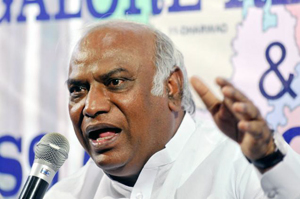
Convene legislature party meet to discuss ACB, Kharge tells Siddu

March 31, 2016

New Delhi, Mar 31: A day after former chief minister S M Krishna's meeting with Congress president Sonia Gandhi and vice-president Rahul Gandhi, senior Congress leader Mallikarjuna Kharge on Wednesday said Chief Minister Siddaramaiah should convene the Congress Legislature Party meeting immediately and take the party's view on the decision to set up the Anti-Corruption Bureau.

KHARGEKharge's statement gains significance as Krishna, at the meeting, cautioned about the decision to set up the ACB.

The chief minister should clarify the doubts about the ACB in the party forum and put an end to the controversy, Kharge told Deccan Herald.

“Congress always favoured a strong Lokpal to fight corruption. This is my stand also,” he said.

The State government has formed the ACB, which exists in 15 states. However, before taking such a decision, the chief minister should have discussed the pros and cons in the party forum, he said.

Dismissing charges that he had supported the move to “weaken” the Lokayukta, Kharge said he had never indulged in such activities.

Neither did he support the ACB nor had he given any suggestions on it, Kharge, Congress party leader in the Lok Sabha, said.

Dismissing media speculations that he had supported the ACB after his recent meeting with the chief minister, Kharge said that he was not at all a party to this controversy.

Earlier, senior Congress leader Janardhana Poojary had suggested the chief minister to reconsider the decision to set up the ACB.

Comments

Pramod
 - 
Thursday, 31 Mar 2016

what to discuss, corrupt govt all they do best to loot the state money as soon as possible, their term will be finishing soon before that they have to loot the money.

Mohan Kulakarni
 - 
Thursday, 31 Mar 2016

everything s fake from congress ruled state, kharge is no 1 Fraudster.

Add new comment

  • Coastaldigest.com reserves the right to delete or block any comments.
  • Coastaldigset.com is not responsible for its readers’ comments.
  • Comments that are abusive, incendiary or irrelevant are strictly prohibited.
  • Please use a genuine email ID and provide your name to avoid reject.
Ram Puniyani
January 14,2020

In the beginning of January 2020 two very disturbing events were reported from Pakistan. One was the attack on Nankana Sahib, the holy shrine where Sant Guru Nanak was born. While one report said that the place has been desecrated, the other stated that it was a fight between two Muslim groups. Prime Minister of Pakistan Imran Khan condemned the incident and the main accused Imran Chisti was arrested. The matter related to abduction and conversion of a Sikh girl Jagjit Kaur, daughter of Pathi (One who reads Holy Guru Granth Sahib in Gurudwara) of the Gurudwara. In another incident one Sikh youth Ravinder Singh, who was out on shopping for his marriage, was shot dead in Peshawar.

While these condemnable attacks took place on the Sikh minority in Pakistan, BJP was quick enough to jump to state that it is events like this which justify the Citizenship Amendment Act (CAA). Incidentally CAA is the Act which is discriminatory and relates to citizenship with Religion, which is not as per the norms of Indian constitution. There are constant debates and propaganda that population of Hindus has come down drastically in Pakistan and Bangla Desh. Amit Shah, the Home minister stated that in Pakistan the population of Hindus has come down from 23% at the time of partition to 3.7% at present. And in Bangla Desh it has come down from 22% to present 8%.

While not denying the fact that the religious minorities are getting a rough deal in both these countries, the figures which are presented are totally off the mark. These figures don’t take into consideration the painful migrations, which took place at the time of partition and formation of Bangla Desh later. Pakistan census figures tell a different tale. Their first census was held in 1951. As per this census the overall percentage of Non Muslim in Pakistan (East and West together) was 14.2%, of this in West Pakistan (Now Pakistan) it was 3.44 and in Eat Pakistan it was 23.2. In the census held in Pakistan 1998 it became 3.72%. As far as Bangla Desh is concerned the share of Non Muslims has gone down from 23.2 (1951) to 9.6% in 2011.

The largest minority of Pakistan is Ahmadis, (https://minorityrights.org/country/pakistan/) who are close to 4 Million and are not recognised as Muslims in Pakistan. In Bangla Desh the major migrations of Hindus from Bangla Desh took place in the backdrop of Pakistan army’s atrocities in the then East Pakistan.

As far as UN data on refugees in India it went up by 17% between 2016-2019 and largest numbers were from Tibet and Sri Lanka.  (https://www.un.org/en/development/desa/population/migration/publication…)

The state of minorities is in a way the index of strength of democracy. Most South Asian Countries have not been able to sustain democratic values properly. In Pakistan, the Republic began with Jinnah’s classic speech where secularism was to be central credo of Pakistan. This 11th August speech was in a way what the state policy should be, as per which people of all faiths are free to practice their religion. Soon enough the logic of ‘Two Nation theory” and formation of Pakistan, a separate state for Muslim took over. Army stepped in and dictatorship was to reign there intermittently. Democratic elements were suppressed and the worst came when Zia Ul Haq Islamized the state in collusion with Maulanas. The army was already a strong presence in Pakistan. The popular formulation for Pakistan was that it is ruled by three A’s, Army, America and Allah (Mullah).

Bangla Desh had a different trajectory. Its very formation was a nail in the coffin of ‘two nation theory’; that religion can be the basis of a state. Bangla Desh did begin as a secular republic but communal forces and secular forces kept struggling for their dominance and in 1988 it also became Islamic republic. At another level Myanmar, in the grip of military dictatorship, with democratic elements trying to retain their presence is also seeing a hard battle. Democracy or not, the army and Sanghas (Buddhist Sang has) are strong, in Myanmar as well. The most visible result is persecution of Rohingya Muslims.

Similar phenomenon is dominating in Sri Lanka also where Budhhist Sanghas and army have strong say in the political affairs, irrespective of which Government is ruling. Muslim and Christian minorities are a big victim there, while Tamils (Hindus, Christians etc.) suffered the biggest damage as ethnic and religious minorities. India had the best prospect of democracy, pluralism and secularism flourishing here. The secular constitution, the outcome of India’s freedom struggle, the leadership of Gandhi and Nehru did ensure the rooting of democracy and secularism in a strong way.

India so far had best democratic credentials amongst all the south Asian countries. Despite that though the population of minorities rose mainly due to poverty and illiteracy, their overall marginalisation was order of the day, it went on worsening with the rise of communal forces, with communal forces resorting to identity issues, and indulging in propaganda against minorities.

While other South Asian countries should had followed India to focus more on infrastructure and political culture of liberalism, today India is following the footsteps of Pakistan. The retrograde march of India is most visible in the issues which have dominated the political space during last few years. Issues like Ram Temple, Ghar Wapasi, Love Jihad, Beef-Cow are now finding their peak in CAA.

India’s reversal towards a polity with religion’s identity dominating the political scene was nicely presented by the late Pakistani poetess Fahmida Riaz in her poem, Tum bhi Hum Jaise Nikle (You also turned out to be like us). While trying to resist communal forces has been an arduous task, it is becoming more difficult by the day. This phenomenon has been variously called, Fundamentalism, Communalism or religious nationalism among others. Surely it has nothing to do with the religion as practiced by the great Saint and Sufi traditions of India; it resorts mainly to political mobilization by using religion as a tool.


Comments

Ashi
 - 
Tuesday, 14 Jan 2020

If Malaysia implement similar NRC/CAA, India and China are the loser.

Add new comment

  • Coastaldigest.com reserves the right to delete or block any comments.
  • Coastaldigset.com is not responsible for its readers’ comments.
  • Comments that are abusive, incendiary or irrelevant are strictly prohibited.
  • Please use a genuine email ID and provide your name to avoid reject.
News Network
April 29,2020

New Delhi, Apr 29: Karnataka is likely to withdraw the case filed against a CRPF commando who was arrested by state police officials for alleged assault on them during COVID-19 lockdown duty in Belgaum, a charge contested by the paramilitary Central Reserve Police Force.

In a bid to diffuse the ongoing tussle between CRPF and Karnataka police, the official communication sent to CRPF headquarters on Tuesday, with the details of bail granted to CRPF jawan Sunil Sachin Sawant, stated that the issue was discussed with the DGP Karnataka and other senior state authorities with a request to withdraw the case.

According to official communication, Karnataka Director General of Police has assured top CRPF officers that the "case registered against CRPF CoBRA commando is likely to be withdrawn by the state authorities".

The communication also states that "they assured that the criminal case registered against constable of 207 CoBRA BN is likely to be withdrawn by the state authority."

A CRPF CoBRA commando was thrashed and dragged to police station barefoot by police on April 23 for allegedly violating lockdown norms and assaulting/deterring public servant from discharging his duty in Belgavi district of Karnataka. A case was also registered against him.

This is not the first time when the state is showing efforts to solve the matter amicably.

Karnataka culture and tourism minister CT Ravi had also tweeted on April 27 claiming that he had a word with two ministers including state deputy chief minister who 'confirmed that the issue will be resolved amicably'

"Unfortunate that this incident happened with a CRPF Commando and the police. I have spoken with Industries Minister @JagadishShettar and Transport Minister @LaxmanSavadi. Both have confirmed that the issue will be resolved amicably," CT Ravi had tweeted.

CRPF Additional Director General (ADG) Sanjay Arora had also written to DG showing his displeasure over the ill-treatment done by Karnataka police with CRPF jawan and had said that "Keeping in view the gravity of the incident and its impact on the relationship between the two police forces, I am desired by the Director-General CRPF to request you to kindly get the matter inquired and provide justice. We would be thankful if you could inform us of the outcome."

Arora, in his letter, had also said that Karnataka police should have informed the force before registering a case.

The CRPF CbBRA commando was on extended leave and cleaning his motorcycle in front of his house in Examba city when he was allegedly manhandled and ill-treated in front of his family members and paraded to the police station barefoot, where he was kept in chains and handcuff.

The commando was granted bail by a court on Tuesday in the matter.

Sunil Sachin Sawant has been involved in various anti-Naxals operations and is a part of the CRPF elite CoBRA force, which is famous for doing anti-Naxals operations and has eliminated hundreds of Naxals in the past few years.

Comments

Add new comment

  • Coastaldigest.com reserves the right to delete or block any comments.
  • Coastaldigset.com is not responsible for its readers’ comments.
  • Comments that are abusive, incendiary or irrelevant are strictly prohibited.
  • Please use a genuine email ID and provide your name to avoid reject.
News Network
April 3,2020

Bengaluru, April 3: The ASHA worker, who was attacked by locals in Sadiq layout area in Bengaluru while conducting a coronavirus survey, on Friday expressed satisfaction with police action in the matter.

"I am happy that five people have been arrested for attacking me while I was conducting a survey in view of COVID-19 in Sadiq layout area in Bengaluru on April 1. We serve the people and work for the betterment of the society," Krishnaveni, the ASHA worker, told news agency here.

ASHA workers, who were deployed to spread awareness about coronavirus and identify suspected cases, were allegedly attacked by a group of locals in the area on Wednesday.

"We had been conducting surveys for the past 14 days ever since a positive coronavirus case was identified in the area. A person came and asked why we were gathering information. We informed him that a positive case was identified in the area," Krishnaveni said.

"They made an announcement from the mosque not to give any information to us. Afterwards, several people came out of their houses and started attacking us," she added.

Police initiated an investigation and have made arrests in the matter.

This comes as the country is under a 21-day lockdown to prevent the spread of coronavirus, which has claimed the lives of at least 56 people and infected over 2,000 people.

Comments

Add new comment

  • Coastaldigest.com reserves the right to delete or block any comments.
  • Coastaldigset.com is not responsible for its readers’ comments.
  • Comments that are abusive, incendiary or irrelevant are strictly prohibited.
  • Please use a genuine email ID and provide your name to avoid reject.