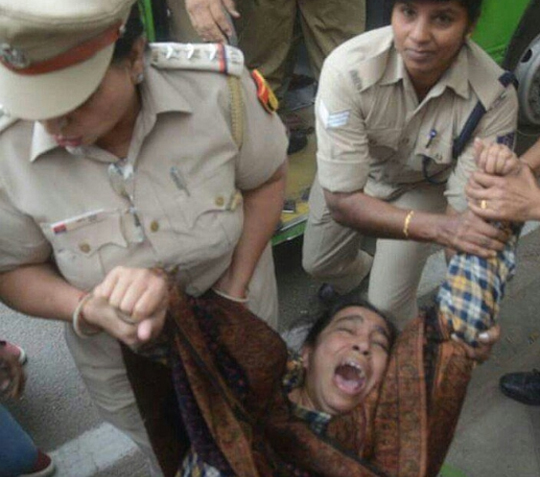
Cops mercilessly drag, detain missing JNU student Najeeb's mother

[email protected] (CD Network)
November 6, 2016

New Delhi, Nov 6: Jawaharlal Nehru University students' protest against the government over missing student Najeeb Ahmed turned violent on Sunday near India Gate when police took the protestors back to their buses in order to prevent any clash. Shocking visuals, which appeared all over social media, showed Najeeb's mother Fatima Nafees being dragged by Delhi Police personnel from the protest site.

Untitled-1

Najeeb Ahmed, a first-year MSc student at the School of Biotechnology in JNU reportedly went missing on October 15 after allegedly being beaten up by a mob of 20 students comprising ABVP members, who had gone campaigning to his room for hostel elections. Fatima has been camping in Delhi since last month, after coming from Badaun in Uttar Pradesh following a frantic phone call from her son on the evening of October 14.

"The shameless Delhi Police, which failed to find Najeeb for the last 23 days, have misbehaved with Najeeb's mother. She was beaten up and dragged into the police van. His sister is also detained," said Satarupa Chakraborty, general secretary of Jawaharlal Nehru University Students' Union, slamming Sunday's police intervention in a peaceful rally.

According to media reports, members of the Akhil Bharatiya Vidyarthi Parishad allegedly entered into the protest area and indulged in a scuffle with JNU protestors. This invoked the police to stop the protest and take the students inside the buses. In the process, Najeeb's mother got injured.

Defended the action on protestors, the Delhi Police said no permission had been granted for the protest and that Section 144 was imposed in the India Gate area because of Chhat Puja.

Delhi Chief Minister Arvind Kejriwal, however, strongly marked his dissent against the police.

Speaking to the media, he urged the Delhi police to not convert the city into a police state, and instead put its resources into finding Najeeb.

Earlier in the day, Kejriwal met President Pranab Mukherjee to seek his intervention into the matter.

Speaking to the media after meeting with the President, Kejriwal pinned the blame on Delhi Police, accusing them of refusing to take action after coming under political pressure.

The chief minister further said that President Mukherjee had assured him of seeking a report both from the JNU administration and the Delhi Police as well.

Comments

Bopanna
 - 
Wednesday, 9 Nov 2016

This Muslim woman will have some terror links.
No muslim is innocent - if they follow the terror manual
How can they be innocent ?

abdullah
 - 
Monday, 7 Nov 2016

Criminal Modi's Protection for Muslim women!!!!

Fairman
 - 
Sunday, 6 Nov 2016

Height of Zulm,

Pouring oil on the fire.
This lady is begging for her son. These criminals are paining, harassing her.

The God is great and need to face the trial, he will do justice.

Rikaz
 - 
Sunday, 6 Nov 2016

Stupid and reckless cops....their job is to give protection to women....this woman lost her son...its cops job to find him...sorry to see what's happening to this mother....
Government is simply wasting tax payers money on these cops....need to put them behind bar for more than 10 years.

Add new comment

  • Coastaldigest.com reserves the right to delete or block any comments.
  • Coastaldigset.com is not responsible for its readers’ comments.
  • Comments that are abusive, incendiary or irrelevant are strictly prohibited.
  • Please use a genuine email ID and provide your name to avoid reject.
News Network
May 1,2020

May 1: India on Thursday called as "propaganda" certain social media posts from the Arab world alleging harassment of Muslims in several parts of the country in the name of containing the spread of coronavirus.

Strongly rebutting the charges, External Affairs Ministry Spokesperson Anurag Srivastava said the Gulf countries are deeply committed to friendly relations with India and they are even seeking bilateral talks on the post-COVID-19 economic recovery.

Talking about India's close and traditional ties with the Arab countries, he said New Delhi is ensuring uninterrupted supply of food and essential commodities to the region during Ramzan as part of its deep-rooted friendship.

Srivastava said the countries in the region do not support any interference in India's internal affairs.

"Much of what you see is propaganda by interested parties. Stray tweets can not be used to characterise our bilateral ties with these countries. The real picture of these relations is very much different," he said during an online media briefing.

There has been a wave of angry reactions on Twitter by leading citizens and rights activists from various Arab countries following allegations that Muslims are being blamed for spreading COVID-19 in several parts of India.

The Organisation of Islamic Cooperation, a powerful bloc of 57 countries, recently accused India of "Islamophobia". India rejected the charges as regrettable.

"We have been making special efforts to ensure uninterrupted supply of food and essential commodities which are required during the Ramzan period in these countries, and this is something which has been greatly appreciated. These countries also want a priority discussion with India on the post-COVID-19 economic recovery," Srivastava said.

Prime Minister Narendra Modi and External Affairs Minister S Jaishankar have been in regular touch with their counterparts from the region in the wake of the coronavirus pandemic.

"In these discussions, there have been requests for sending medicines and medical teams to these countries. We already deployed a Rapid Response Team in Kuwait. There is also a request to send doctors and nurses from India," said Srivastava.

"What comes out clearly is that these countries are deeply committed to friendly relations with India. They also do not support any interference in internal matters of India. It is, therefore, important that the friendly and cooperative nature of our relations is accurately recognised and the misuse of social media is not given credence," he added.

Asked about reports of an order issued by Oman's Finance Ministry asking all state-owned companies to replace foreign workers with qualified local Omanis, Srivastava said it is not aimed at Indians working in the Gulf nation.

"The policy is a decades-old one and not specific to India. It does not target the Indians in any way," he said.

There have been apprehensions that the order will render thousands of Indians working in state-run firms in Oman jobless.

"They greatly value relationship with India. Government of Oman is taking special care of Indians which included free testing for coronavirus, its treatment, providing food," the MEA spokesperson said.

Oman government is also extending certain categories of visas of Indians.

Srivastava said India has been in touch with its friends and partners across the world as part of the collaborative approach to dealing with the pandemic.

Comments

Add new comment

  • Coastaldigest.com reserves the right to delete or block any comments.
  • Coastaldigset.com is not responsible for its readers’ comments.
  • Comments that are abusive, incendiary or irrelevant are strictly prohibited.
  • Please use a genuine email ID and provide your name to avoid reject.
News Network
January 1,2020

Mangaluru, Jan 1: Karnataka Home Minister Basavaraj Bommai said here on Tuesday that the State government will think about making policy on giving compensation to the families of those who have died in police firing.

Speaking to newsmen here on Tuesday, he said that the government withholding compensation to the families of two persons who died in police firing in the city on December 19 after a protest against the Citizenship (Amendment) Act turned violent and even in 2006 when two persons had died in police firing at Mulky in Dakshina Kannada the then State government had not given any compensation to their families.

In the latest case, the First Information Report (FIR) has named the two persons who had died in the firing as the accused. After the incident, there were demands to provide compensation to the families of the victims.

Comments

Add new comment

  • Coastaldigest.com reserves the right to delete or block any comments.
  • Coastaldigset.com is not responsible for its readers’ comments.
  • Comments that are abusive, incendiary or irrelevant are strictly prohibited.
  • Please use a genuine email ID and provide your name to avoid reject.
Ram Puniyani
January 14,2020

In the beginning of January 2020 two very disturbing events were reported from Pakistan. One was the attack on Nankana Sahib, the holy shrine where Sant Guru Nanak was born. While one report said that the place has been desecrated, the other stated that it was a fight between two Muslim groups. Prime Minister of Pakistan Imran Khan condemned the incident and the main accused Imran Chisti was arrested. The matter related to abduction and conversion of a Sikh girl Jagjit Kaur, daughter of Pathi (One who reads Holy Guru Granth Sahib in Gurudwara) of the Gurudwara. In another incident one Sikh youth Ravinder Singh, who was out on shopping for his marriage, was shot dead in Peshawar.

While these condemnable attacks took place on the Sikh minority in Pakistan, BJP was quick enough to jump to state that it is events like this which justify the Citizenship Amendment Act (CAA). Incidentally CAA is the Act which is discriminatory and relates to citizenship with Religion, which is not as per the norms of Indian constitution. There are constant debates and propaganda that population of Hindus has come down drastically in Pakistan and Bangla Desh. Amit Shah, the Home minister stated that in Pakistan the population of Hindus has come down from 23% at the time of partition to 3.7% at present. And in Bangla Desh it has come down from 22% to present 8%.

While not denying the fact that the religious minorities are getting a rough deal in both these countries, the figures which are presented are totally off the mark. These figures don’t take into consideration the painful migrations, which took place at the time of partition and formation of Bangla Desh later. Pakistan census figures tell a different tale. Their first census was held in 1951. As per this census the overall percentage of Non Muslim in Pakistan (East and West together) was 14.2%, of this in West Pakistan (Now Pakistan) it was 3.44 and in Eat Pakistan it was 23.2. In the census held in Pakistan 1998 it became 3.72%. As far as Bangla Desh is concerned the share of Non Muslims has gone down from 23.2 (1951) to 9.6% in 2011.

The largest minority of Pakistan is Ahmadis, (https://minorityrights.org/country/pakistan/) who are close to 4 Million and are not recognised as Muslims in Pakistan. In Bangla Desh the major migrations of Hindus from Bangla Desh took place in the backdrop of Pakistan army’s atrocities in the then East Pakistan.

As far as UN data on refugees in India it went up by 17% between 2016-2019 and largest numbers were from Tibet and Sri Lanka.  (https://www.un.org/en/development/desa/population/migration/publication…)

The state of minorities is in a way the index of strength of democracy. Most South Asian Countries have not been able to sustain democratic values properly. In Pakistan, the Republic began with Jinnah’s classic speech where secularism was to be central credo of Pakistan. This 11th August speech was in a way what the state policy should be, as per which people of all faiths are free to practice their religion. Soon enough the logic of ‘Two Nation theory” and formation of Pakistan, a separate state for Muslim took over. Army stepped in and dictatorship was to reign there intermittently. Democratic elements were suppressed and the worst came when Zia Ul Haq Islamized the state in collusion with Maulanas. The army was already a strong presence in Pakistan. The popular formulation for Pakistan was that it is ruled by three A’s, Army, America and Allah (Mullah).

Bangla Desh had a different trajectory. Its very formation was a nail in the coffin of ‘two nation theory’; that religion can be the basis of a state. Bangla Desh did begin as a secular republic but communal forces and secular forces kept struggling for their dominance and in 1988 it also became Islamic republic. At another level Myanmar, in the grip of military dictatorship, with democratic elements trying to retain their presence is also seeing a hard battle. Democracy or not, the army and Sanghas (Buddhist Sang has) are strong, in Myanmar as well. The most visible result is persecution of Rohingya Muslims.

Similar phenomenon is dominating in Sri Lanka also where Budhhist Sanghas and army have strong say in the political affairs, irrespective of which Government is ruling. Muslim and Christian minorities are a big victim there, while Tamils (Hindus, Christians etc.) suffered the biggest damage as ethnic and religious minorities. India had the best prospect of democracy, pluralism and secularism flourishing here. The secular constitution, the outcome of India’s freedom struggle, the leadership of Gandhi and Nehru did ensure the rooting of democracy and secularism in a strong way.

India so far had best democratic credentials amongst all the south Asian countries. Despite that though the population of minorities rose mainly due to poverty and illiteracy, their overall marginalisation was order of the day, it went on worsening with the rise of communal forces, with communal forces resorting to identity issues, and indulging in propaganda against minorities.

While other South Asian countries should had followed India to focus more on infrastructure and political culture of liberalism, today India is following the footsteps of Pakistan. The retrograde march of India is most visible in the issues which have dominated the political space during last few years. Issues like Ram Temple, Ghar Wapasi, Love Jihad, Beef-Cow are now finding their peak in CAA.

India’s reversal towards a polity with religion’s identity dominating the political scene was nicely presented by the late Pakistani poetess Fahmida Riaz in her poem, Tum bhi Hum Jaise Nikle (You also turned out to be like us). While trying to resist communal forces has been an arduous task, it is becoming more difficult by the day. This phenomenon has been variously called, Fundamentalism, Communalism or religious nationalism among others. Surely it has nothing to do with the religion as practiced by the great Saint and Sufi traditions of India; it resorts mainly to political mobilization by using religion as a tool.


Comments

Ashi
 - 
Tuesday, 14 Jan 2020

If Malaysia implement similar NRC/CAA, India and China are the loser.

Add new comment

  • Coastaldigest.com reserves the right to delete or block any comments.
  • Coastaldigset.com is not responsible for its readers’ comments.
  • Comments that are abusive, incendiary or irrelevant are strictly prohibited.
  • Please use a genuine email ID and provide your name to avoid reject.