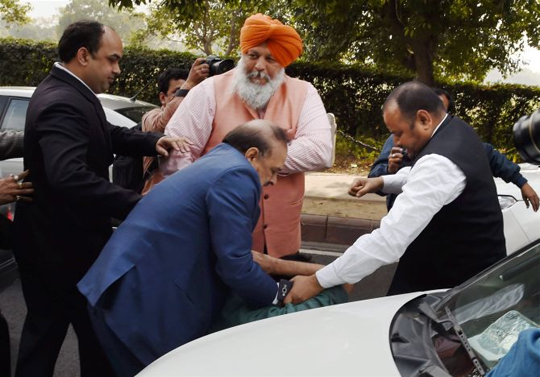
Delhi BJP MLA justifies his brutality; pics go viral, cops say no proof!

[email protected] (CD Network)
February 16, 2016

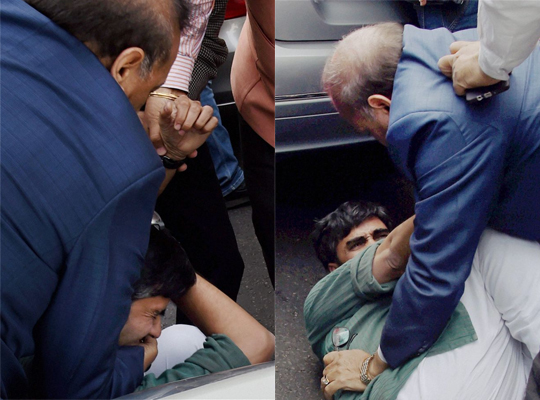
New Delhi, Feb 16: Even though the photos and video clippings of Delhi BJP MLA Om Prakash Sharma brutally attacking a protester went viral, the Delhi police which is controlled by the Narendra Modi led union government is reluctant to book a case against him.
jnuprotest3

Mr Sharma has openly justified his violent act and said that he don’t even hesitate to kill someone. “Mein goli bhi maar deta agar bandook hoti. Koi hamari Ma ko gaali dega to kya usey maaroge nahin (I would have opened fire if I had a gun. If someone abuses our mother, won’t I beat him up),” said Mr Sharma when asked why he had assaulted a CPI leader at the Patiala House Courts complex Monday afternoon.

"If you ask me, there is nothing wrong in beating up or even killing someone shouting slogans in favour of Pakistan," he said.

When a few media persons brought to his notice that it was ABVP activists who raised pro-Pakistan slogans and not CPI leader, Mr Sharma refused to comment and continued to justify his act.

Responding to the incident Delhi Police chief BS Bassi meanwhile said that investigation was still on and action would be taken as per the law after identifying the people. It is learnt that police has registered FIR against ‘unidentified men’ for the attack claiming that there was no proof MLA and his supporters’ involvement in the attack. Meanwhile union home minister Rajnath Singh has appreciated Mr Bassi’s role as top cop of Delhi.

The violence

At least ten journalists and several students were assaulted Monday by lawyers and a Delhi BJP MLA inside and outside the Patiala House Courts where a sedition case against Jawaharlal Nehru University students’ union president Kanhaiya Kumar was to be heard.

The attack took place before hearing in the case got underway. A large number of policemen present there remained mute spectators.

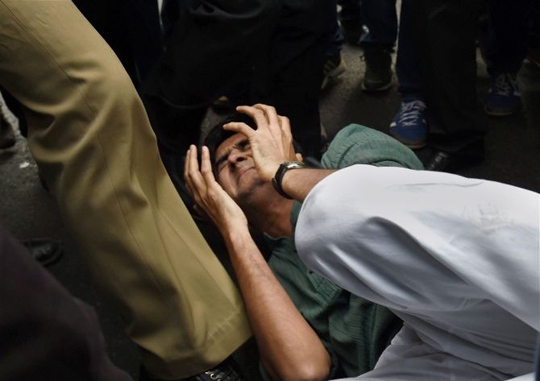
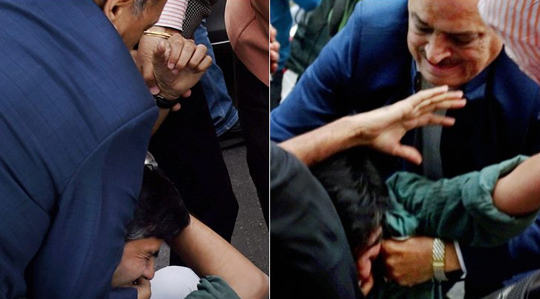
O P Sharma, BJP MLA from Vishwas Nagar, and his supporters pinned down CPI minority cell leader Ameeque Jamei and assaulted him outside the court complex.

Inside, a group of lawyers entered the court room, raised slogans and told students, teachers and journalists to leave.

But they refused, saying they had a right to attend the proceedings. Announcing they were “patriots”, the men first targeted the students and teachers.

Calling JNU a “den of anti-India elements and terrorists”, they attacked them and then turned on the journalists present in the room, punching and slapping them. Outside the court, another group of lawyers assaulted journalists and students.

MLA Sharma, who was in the complex in connection with a hearing in the defamation case filed by Union Finance Minister Arun Jaitley, was seen assaulting Jamei.

Later, Sharma claimed he was roughed up in a melee where slogans like ‘Pakistan Zindabad, Hindustan Murdabad’ were shouted. Told there was footage of him assaulting Jamei, Sharma justified his crime and accused the victims of raising anti-India slogan.

Son of a driver

Sharma, who flaunts his proximity to Union Finance Minister Arun Jaitley, made his debut in politics in 2008 when he unsuccessfully contested the assembly elections in Delhi.

Unwilling to move out of Vishwas Nagar, he contested again in 2013 and won. When elections were held again in 2015, he was the only BJP MLA to retain his seat.

Sharma’s father was a driver in the Municipal Corporation of Delhi and he was born in the staff quarters of corporation employees at Kashmere Gate. The eldest of three sons, Sharma graduated from Satyawati College where he was college president. He also contested the Delhi University students’ union election and was an executive member of the team which Jaitley headed as president.

He once worked as an employee of the municipal corporation. After his father died, he became an inspector in the house tax department. He quit the job within a year and started taking care of sweets shops his family owns.

One of these shops was “raided” by AAP MLA Alka Lamba last year, leading to acrimonious scenes in the Delhi assembly and Sharma’s suspension after he made derogatory remarks about her. His wife Geeta too tried to enter politics by contesting the municipal elections in 2002 but was defeated. Sharma has two sons — the younger, Chetan, is a lawyer while the elder, Vikas, runs the sweets shop. He also owns showrooms of leading sports brands.
jnuprotest2

jnuprotest1

jnuprotest5

Comments

Ahmed
 - 
Wednesday, 17 Feb 2016

Game maker BJP and his supporting Media is doing very good job just to protect HR minister... just to windup Rohith vennula issue.... keep it up BJP ....

A. Mangalore
 - 
Tuesday, 16 Feb 2016

If this MLA has guts let him go to our border and fight against Pakistani infiltrators. Gali mein kutthe bhi sher banjaatahain.

These politicians are looting our nation's money and saying them self as Desh premies. Looters of our nation are also called Desh Drohies.

Add new comment

  • Coastaldigest.com reserves the right to delete or block any comments.
  • Coastaldigset.com is not responsible for its readers’ comments.
  • Comments that are abusive, incendiary or irrelevant are strictly prohibited.
  • Please use a genuine email ID and provide your name to avoid reject.
coastaldigest.com news network
July 12,2020

Mangaluru, Jul 12: No decision has been taken regarding re-imposition of complete lockdown in Dakshina Kannada, according to district in charge minister Kota Srinivas Poojary. 

The minister's clarification comes following social media rumours about complete lockdown in the district from July 14 to contain the spread of coronavirus.

Speaking to media persons, Mr Poojary said that chief minister will hold video conference with Deputy Commissioners, MPs and District ministers of the state on July 13 at 11 am. following which a decision will be taken. 

He also clarified that the government will not cause inconveniences to people by taking any such decision all of a sudden. "People should not pay heed to rumours," he said.

Comments

Add new comment

  • Coastaldigest.com reserves the right to delete or block any comments.
  • Coastaldigset.com is not responsible for its readers’ comments.
  • Comments that are abusive, incendiary or irrelevant are strictly prohibited.
  • Please use a genuine email ID and provide your name to avoid reject.
Ram Puniyani
January 14,2020

In the beginning of January 2020 two very disturbing events were reported from Pakistan. One was the attack on Nankana Sahib, the holy shrine where Sant Guru Nanak was born. While one report said that the place has been desecrated, the other stated that it was a fight between two Muslim groups. Prime Minister of Pakistan Imran Khan condemned the incident and the main accused Imran Chisti was arrested. The matter related to abduction and conversion of a Sikh girl Jagjit Kaur, daughter of Pathi (One who reads Holy Guru Granth Sahib in Gurudwara) of the Gurudwara. In another incident one Sikh youth Ravinder Singh, who was out on shopping for his marriage, was shot dead in Peshawar.

While these condemnable attacks took place on the Sikh minority in Pakistan, BJP was quick enough to jump to state that it is events like this which justify the Citizenship Amendment Act (CAA). Incidentally CAA is the Act which is discriminatory and relates to citizenship with Religion, which is not as per the norms of Indian constitution. There are constant debates and propaganda that population of Hindus has come down drastically in Pakistan and Bangla Desh. Amit Shah, the Home minister stated that in Pakistan the population of Hindus has come down from 23% at the time of partition to 3.7% at present. And in Bangla Desh it has come down from 22% to present 8%.

While not denying the fact that the religious minorities are getting a rough deal in both these countries, the figures which are presented are totally off the mark. These figures don’t take into consideration the painful migrations, which took place at the time of partition and formation of Bangla Desh later. Pakistan census figures tell a different tale. Their first census was held in 1951. As per this census the overall percentage of Non Muslim in Pakistan (East and West together) was 14.2%, of this in West Pakistan (Now Pakistan) it was 3.44 and in Eat Pakistan it was 23.2. In the census held in Pakistan 1998 it became 3.72%. As far as Bangla Desh is concerned the share of Non Muslims has gone down from 23.2 (1951) to 9.6% in 2011.

The largest minority of Pakistan is Ahmadis, (https://minorityrights.org/country/pakistan/) who are close to 4 Million and are not recognised as Muslims in Pakistan. In Bangla Desh the major migrations of Hindus from Bangla Desh took place in the backdrop of Pakistan army’s atrocities in the then East Pakistan.

As far as UN data on refugees in India it went up by 17% between 2016-2019 and largest numbers were from Tibet and Sri Lanka.  (https://www.un.org/en/development/desa/population/migration/publication…)

The state of minorities is in a way the index of strength of democracy. Most South Asian Countries have not been able to sustain democratic values properly. In Pakistan, the Republic began with Jinnah’s classic speech where secularism was to be central credo of Pakistan. This 11th August speech was in a way what the state policy should be, as per which people of all faiths are free to practice their religion. Soon enough the logic of ‘Two Nation theory” and formation of Pakistan, a separate state for Muslim took over. Army stepped in and dictatorship was to reign there intermittently. Democratic elements were suppressed and the worst came when Zia Ul Haq Islamized the state in collusion with Maulanas. The army was already a strong presence in Pakistan. The popular formulation for Pakistan was that it is ruled by three A’s, Army, America and Allah (Mullah).

Bangla Desh had a different trajectory. Its very formation was a nail in the coffin of ‘two nation theory’; that religion can be the basis of a state. Bangla Desh did begin as a secular republic but communal forces and secular forces kept struggling for their dominance and in 1988 it also became Islamic republic. At another level Myanmar, in the grip of military dictatorship, with democratic elements trying to retain their presence is also seeing a hard battle. Democracy or not, the army and Sanghas (Buddhist Sang has) are strong, in Myanmar as well. The most visible result is persecution of Rohingya Muslims.

Similar phenomenon is dominating in Sri Lanka also where Budhhist Sanghas and army have strong say in the political affairs, irrespective of which Government is ruling. Muslim and Christian minorities are a big victim there, while Tamils (Hindus, Christians etc.) suffered the biggest damage as ethnic and religious minorities. India had the best prospect of democracy, pluralism and secularism flourishing here. The secular constitution, the outcome of India’s freedom struggle, the leadership of Gandhi and Nehru did ensure the rooting of democracy and secularism in a strong way.

India so far had best democratic credentials amongst all the south Asian countries. Despite that though the population of minorities rose mainly due to poverty and illiteracy, their overall marginalisation was order of the day, it went on worsening with the rise of communal forces, with communal forces resorting to identity issues, and indulging in propaganda against minorities.

While other South Asian countries should had followed India to focus more on infrastructure and political culture of liberalism, today India is following the footsteps of Pakistan. The retrograde march of India is most visible in the issues which have dominated the political space during last few years. Issues like Ram Temple, Ghar Wapasi, Love Jihad, Beef-Cow are now finding their peak in CAA.

India’s reversal towards a polity with religion’s identity dominating the political scene was nicely presented by the late Pakistani poetess Fahmida Riaz in her poem, Tum bhi Hum Jaise Nikle (You also turned out to be like us). While trying to resist communal forces has been an arduous task, it is becoming more difficult by the day. This phenomenon has been variously called, Fundamentalism, Communalism or religious nationalism among others. Surely it has nothing to do with the religion as practiced by the great Saint and Sufi traditions of India; it resorts mainly to political mobilization by using religion as a tool.

Comments

Ashi
 - 
Tuesday, 14 Jan 2020

If Malaysia implement similar NRC/CAA, India and China are the loser.

Add new comment

  • Coastaldigest.com reserves the right to delete or block any comments.
  • Coastaldigset.com is not responsible for its readers’ comments.
  • Comments that are abusive, incendiary or irrelevant are strictly prohibited.
  • Please use a genuine email ID and provide your name to avoid reject.
News Network
March 27,2020

Bengaluru, Mar 27: Karnataka has so far witnessed 62 Covid-19 positive cases including 3 deaths and five discharges, according to mid-day bulletin released by the Department of Health and Family Welfare.

The state on Friday witnessed a sudden spike in the number of Covid-19 cases with the officials confirming seven new positive cases overnight (26 March 5:00 pm to 27 March 8:00 am) across the state including a 10-month-old baby boy becoming the youngest Covid-19 patient in Karnataka and second youngest patient in India after 8-month-old baby in Jammu and Kashmir.

According to mid-day bulletin released by the Department of Health and Family Welfare on Friday, Karnataka witnessed 62 Covid-19 positive cases including 3 deaths and five discharges. The 10-month-old baby (P56) even though had no travel history to any of the Covid-19 affected countries, officials revealed that the family members had taken the baby to Kerala and six primary contacts have been established and put under home quarantine.

This apart, a 20-year-old male (P57) who returned from Colombo, a 25-year-old female (P58) who returned from London have also been tested positive for Covid-19. Further, a 35-year-old female (P59) and 33-year-old female (P61) said to be the primary contacts of P25 (House Maid) have also been tested positive according to the officials

Besides, a 60-year-old male (P60) who returned to Sira in Tumakuru by train from New Delhi died on Friday morning also tested positive. His primary contacts, including health care professionals have been put under house quarantine. According to officials a 22-year-old male (P62) from Uttara Kannada with travel history to Dubai has also been tested positive for Covid 19 on Friday.

According to bulletin, all the patients barring P60 are being treated at designated isolation hospitals in Mangaluru, Bengaluru and Uttara Kannada. In the meantime, P1 and P3 from Bengaluru have been discharged from RGICD, according to officials.

Comments

Add new comment

  • Coastaldigest.com reserves the right to delete or block any comments.
  • Coastaldigset.com is not responsible for its readers’ comments.
  • Comments that are abusive, incendiary or irrelevant are strictly prohibited.
  • Please use a genuine email ID and provide your name to avoid reject.