


Demonetisation is organised loot, legalised plunder: Manmohan Singh

November 24, 2016

New Delhi, Nov 24: Stepping up the opposition tirade against demonetisation, former Prime Minister Manmohan Singh today castigated the government and the Prime Minister over the move, saying its implementation was a "monumental management failure" and a case of "organised loot and legalised plunder."manmhn
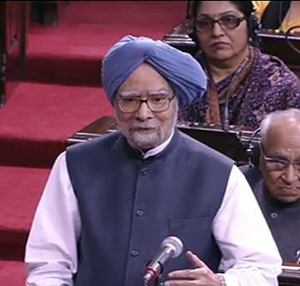
Singh, who spoke in the presence of Prime Minister Narendra Modi in Rajya Sabha, said the decision will result in decline of GDP by 2 per cent, it being an "under-estimate".

He hoped the Prime Minister will find a practical and pragmatic decision to mitigate the sufferings of the common man and the poor who have been in distress after the decision.

He said agriculture, unorganised sectors and small industry has also been hit hard by it and people were losing faith in the currency and banking system.

"These measures convinced me that the way the scheme has been implemented, it's a monumental management failure. And in fact, it is a case of organised loot and legalised plunder.

"It is not my intention to pick holes what this side or other side does. But I sincerely hope that the PM even in this late hour will help find us practical and pragmatic ways to provide relief to the suffering of the people of this country," he said in Rajya Sabha as the debate on the issue resumed after Modi came into the House.

Earlier, Leader of Opposition Ghulam Nabi Azad requested Chairman Hamid Ansari and Leader of the House Arun Jaitley that the Question Hour should not be taken up as the Prime Minister was present in the House and the debate be taken up.

Azad's request was readily accepted by the government with Jaitley saying that the debate should start immediately and Modi will certainly participate in it.

Participating in the resumed debate, Singh said it is important to take note of the grievances of the ordinary people who have suffered as a result of this imposition on the country "overnight" by the Prime Minister.

"My own feeling is that the national income, that is the GDP of the country, can decline by about 2 percentage points as a result of what has been done. This is an under-estimate and not an over-estimate.

"Therefore, I feel the Prime Minister must come with some constructive proposal on how we can implement the scheme and at the same time prevent the distrust that has been caused to the common people," Singh said.

The former Prime Minister did not agree with the Prime Minister's plea to wait for 50 days for the results of demonetisation to come about, saying no one knows about the final outcome of the decision.

"Well 50 days is a short period, but for those who are poor and deprived sections of the community even 50 days of torture can bring about disastrous effect. And that's why about 60 to 65 people have lost their lives. Maybe more.

"What is more is, what has been done can weaken and erode our people's confidence in the currency system and in the banking system," he said.

Asking Modi to spell out the names of countries where people have deposited their money in banks but are not allowed to withdraw their money, he said, "this alone I think is enough to condemn what has been done in the name of greater growth."

He said the scheme of demonetisation, the way it is being implemented, will hurt agricultural growth in our country, small industry and all those people who work in the informal sectors of the economy.

Singh, an eminent economist, criticised the government for issuing fresh instructions and modifying the rules every day on the conditions under which people can withdraw their money.

"That reflects very poorly on the Prime Minister's Office, the Finance Minister's office and on the Reserve Bank of India. I am very sorry that the Reserve Bank has been exposed to this kind of criticism which I think is fully justified," the former Prime Minister said.

He said though he agreed with the objectives of the scheme to demonetise currency notes of Rs 500 and Rs 1000 as spelt out by the Prime Minister, he wished to highlight the problems that the common people and poor have been subjected to by the move.

"But I do want to point out at least that in the process of demonetisation monumental mismanagement has been undertaken about which today there is no two opinions in the country as a whole," he said.

Referring to those saying that the move which was doing harm and creating distrust in the short run was good in the long run, Singh quoted John Maynard Keynes to say that "in the long run, all of us are dead".

"I urge upon the Prime Minister to find practical, pragmatic ways and measures to relieve the distress of the people, who happen to be a great majority of our people. After all 90 per cent of our people were in the informal sector, 55 per cent of our workers in agriculture are feeling distress," he said.

He also noted that the cooperative banking system which served large number of people in rural areas was non-functional and has been prevented from handling cash.

The senior Congress leader said though it is not his intention to pick holes in what this side or other side does, but hoped that the Prime Minister "even in this late hour will help find us practical and pragmatic ways to provide relief to the suffering of the people of this country".

Comments

Wonder Kotian
 - 
Thursday, 24 Nov 2016

Our Great Iron Man said correct, But he is trying \Dog's tail putting inside pipe\" but after removing same situation, Hindustan totally destroying already most of the business, Trading, Industry's totally loss point."

Add new comment

  • Coastaldigest.com reserves the right to delete or block any comments.
  • Coastaldigset.com is not responsible for its readers’ comments.
  • Comments that are abusive, incendiary or irrelevant are strictly prohibited.
  • Please use a genuine email ID and provide your name to avoid reject.
Ram Puniyani
February 4,2020

As democracy is seeping in slowly all over the world, there is an organization which is monitoring the degree of democracy in the individual countries, The Economist Intelligence Unit. As such in each country there are diverse factors which on one hand work to deepen it, while others weaken it. Overall there is a march from theoretical democracy to substantive one. The substantive democracy will herald not just the formal equality, freedom and community feeling in the country but will be founded on the substantive quality of these values. In India while the introduction of modern education, transport, communication laid the backdrop of beginning of the process, the direction towards deepening of the process begins with Mahatma Gandhi when he led the non-cooperation movement in 1920, in which average people participated. The movement of freedom for India went on to become the ‘greatest ever mass movement’ in the World.

The approval and standards for democracy were enshrined in Indian Constitution, which begins ‘We the people of India’, and was adopted on 26th January 1950. With this Constitution and the policies adopted by Nehru the process of democratization started seeping further, the dreaded Emergency in 1975, which was lifted later restored democratic freedoms in some degree. This process of democratisation is facing an opposition since the decade of 1990s after the launch of Ram Temple agitation, and has seen the further erosion with BJP led Government coming to power in 2014. The state has been proactively attacking civil liberties, pluralism and participative political culture with democracy becoming flawed in a serious way. And this is what got reflected in the slipping of India by ten places, to 51st, in 2019. On the index of democracy India slipped down from the score of 7.23 to 6.90. The impact of sectarian BJP politics is writ on the state of the nation, country.

Ironically this lowering of score has come at a time when the popular protests, the deepening of democracy has been given a boost and is picking up with the Shaheen Bagh protests. The protest which began in Shaheen Bagh, Delhi in the backdrop of this Government getting the Citizenship amendment Bill getting converted into an act and mercilessly attacking the students of Jamia Milia Islamia, Aligarh Muslim University along with high handed approach in Jamia Nagar and neighbouring areas.  From 15th December 2019, the laudable protest is on.

It is interesting to note that the lead in this protest has been taken by the Muslim women, from the Burqa-Hijab clad to ‘not looking Muslim’ women and was joined by students and youth from all the communities, and later by the people from all the communities. Interestingly this time around this Muslim women initiated protest has contrast from all the protests which earlier had begun by Muslims. The protests opposing Shah Bano Judgment, the protests opposing entry of women in Haji Ali, the protests opposing the Government move to abolish triple Talaq. So far the maulanas from top were initiating the protests, with beard and skull cap dominating the marches and protests. The protests were by and large for protecting Sharia, Islam and were restricted to Muslim community participating.

This time around while Narendra Modi pronounced that ‘protesters can be identified by their clothes’, those who can be identified by their external appearance are greatly outnumbered by all those identified or not identified by their appearance.

The protests are not to save Islam or any other religion but to protect Indian Constitution. The slogans are structured around ‘Defence of democracy and Indian Constitution’. The theme slogans are not Allahu Akbar’ or Nara-E-Tadbeer’ but around preamble of Indian Constitution. The lead songs have come to be Faiz Ahmad Faiz’s ‘Hum Dekhenge’, a protest against Zia Ul Haq’s attempts to crush democracy in the name of religion. Another leading protest song is from Varun Grover, ‘Tanashah Aayenge…Hum Kagaz nahin Dikhayenge’, a call to civil disobedience against the CAA-NRC exercise and characterising the dictatorial nature of the current ruling regime.

While BJP was telling us that primary problem of Muslim women is Triple talaq, the Muslim women led movements has articulated that primary problem is the very threat to Muslim community. All other communities, cutting across religious lines, those below poverty line, those landless and shelter less people also see that if the citizenship of Muslims can be threatened because of lack of some papers, they will be not far behind in the victimization process being unleashed by this Government.

While CAA-NRC has acted as the precipitating factor, the policies of Modi regime, starting from failure to fulfil the tall promises of bringing back black money, the cruel impact of demonetisation, the rising process of commodities, the rising unemployment, the divisive policies of the ruling dispensation are the base on which these protest movements are standing. The spread of the protest movement, spontaneous but having similar message is remarkable. Shaheen Bagh is no more just a physical space; it’s a symbol of resistance against the divisive policies, against the policies which are increasing the sufferings of poor workers, the farmers and the average sections of society.

What is clear is that as identity issues, emotive issues like Ram Temple, Cow Beef, Love Jihad and Ghar Wapasi aimed to divide the society, Shaheen Bagh is uniting the society like never before. The democratisation process which faced erosion is getting a boost through people coming together around the Preamble of Indian Constitution, singing of Jan Gan Man, waving of tricolour and upholding the national icons like Gandhi, Bhagat Singh, Ambedkar and Maulana Azad. One can feel the sentiments which built India; one can see the courage of people to protect what India’s freedom movement and Indian Constitution gave them.

Surely the communal forces are spreading canards and falsehood against the protests. As such these protests which is a solid foundation of our democracy. The spontaneity of the movement is a strength which needs to be channelized to uphold Indian Constitution and democratic ethos of our beloved country.

Comments

Add new comment

  • Coastaldigest.com reserves the right to delete or block any comments.
  • Coastaldigset.com is not responsible for its readers’ comments.
  • Comments that are abusive, incendiary or irrelevant are strictly prohibited.
  • Please use a genuine email ID and provide your name to avoid reject.
News Network
February 2,2020

Kolkata, Feb 2: A protester at Park Circus, known as Shaheen Bagh of Kolkata, died last night after she fell ill during her agitation against CAA, NRC and NPR.

The woman has been identified as Sameeda Khatun (57) who was a resident of Entally area of the city. According to protesters, Khatun who was asthmatic patient died after suffering a cardiac arrest. She is survived by husband and eight children.

Around 250 women from Kolkata have been holding a peaceful sit-in at Park Circus Maidan since January 7 to protest against CAA, NRC and NPR and demanding the withdrawal of the new citizenship law.

Research Scholar at Rabindra Bharati University, Nousheen Baba Khan who has been spearheading the Park Circus protest since the beginning, told the newspaper, “Sameeda Khatun was a regular face at the protest and she was not well as she had asthma.

Last evening she came to me complaining that she is having trouble in breathing. We immediately took her to Chittaranjan Hospital where doctors said she had suffered a cardiac arrest. We later took her to Islamia Hospital where doctors declared her brought dead,” said Khan.

Comments

ABDULAZIZ
 - 
Monday, 3 Feb 2020

Inna Lillahi wa in ilaihi rajivoon.    


Subhaan Allah,   she died for the cause .May Allah Almighty accept her shahada . and bless her with Jannatul Firdous .   Aameen

Add new comment

  • Coastaldigest.com reserves the right to delete or block any comments.
  • Coastaldigset.com is not responsible for its readers’ comments.
  • Comments that are abusive, incendiary or irrelevant are strictly prohibited.
  • Please use a genuine email ID and provide your name to avoid reject.
News Network
February 10,2020

Bengaluru, Feb 10: Senior Congress leader DK Shivakumar on Sunday hit out at the BJP and RSS for taking out a route march in Ramanagara against the controversial Jesus Christ statue.

“Just because the BJP won 25 seats in the Lok Sabha polls, Congress workers need not lose hope. If the Congress and JD(S) had worked out a better strategy, the BJP would not have won even 10 seats. We will correct our mistakes,” the former Congress minister said.

After the Lok Sabha polls, the BJP has failed to do well in assembly polls and has been losing power in many states. People are hitting the streets protesting against its policies such as CAA and NRC, he said.

Accusing the BJP and RSS of not being able to digest Congress’ victory in the Bengaluru Rural Lok Sabha segment in the 2019 Lok Sabha polls, he said that the BJP is trying hard to make inroads into the constituency represented by his brother D K Suresh. “Let them take out route march, we don’t care,” he said.

“We all know what the BJP did during the Lok Sabha elections, and the media reported how much money they spent in the elections. What was the Election Commission doing? Was the Income Tax Department sitting with its eyes closed? Why did they conduct raids only in Hassan, Shivamogga and Mandya districts,” he asked.

He alleged that false cases were slapped when him and other leaders, including H D Kumaraswamy, Siddaramaiah, G Parameshwara and Dinesh Gundurao.

Comments

Add new comment

  • Coastaldigest.com reserves the right to delete or block any comments.
  • Coastaldigset.com is not responsible for its readers’ comments.
  • Comments that are abusive, incendiary or irrelevant are strictly prohibited.
  • Please use a genuine email ID and provide your name to avoid reject.