



Demonetisation is organised loot, legalised plunder: Manmohan Singh

November 24, 2016

New Delhi, Nov 24: Stepping up the opposition tirade against demonetisation, former Prime Minister Manmohan Singh today castigated the government and the Prime Minister over the move, saying its implementation was a "monumental management failure" and a case of "organised loot and legalised plunder."manmhn
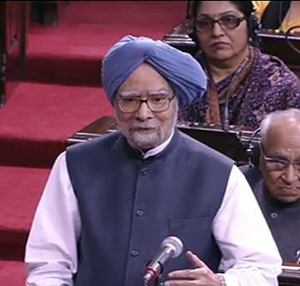
Singh, who spoke in the presence of Prime Minister Narendra Modi in Rajya Sabha, said the decision will result in decline of GDP by 2 per cent, it being an "under-estimate".

He hoped the Prime Minister will find a practical and pragmatic decision to mitigate the sufferings of the common man and the poor who have been in distress after the decision.

He said agriculture, unorganised sectors and small industry has also been hit hard by it and people were losing faith in the currency and banking system.

"These measures convinced me that the way the scheme has been implemented, it's a monumental management failure. And in fact, it is a case of organised loot and legalised plunder.

"It is not my intention to pick holes what this side or other side does. But I sincerely hope that the PM even in this late hour will help find us practical and pragmatic ways to provide relief to the suffering of the people of this country," he said in Rajya Sabha as the debate on the issue resumed after Modi came into the House.

Earlier, Leader of Opposition Ghulam Nabi Azad requested Chairman Hamid Ansari and Leader of the House Arun Jaitley that the Question Hour should not be taken up as the Prime Minister was present in the House and the debate be taken up.

Azad's request was readily accepted by the government with Jaitley saying that the debate should start immediately and Modi will certainly participate in it.

Participating in the resumed debate, Singh said it is important to take note of the grievances of the ordinary people who have suffered as a result of this imposition on the country "overnight" by the Prime Minister.

"My own feeling is that the national income, that is the GDP of the country, can decline by about 2 percentage points as a result of what has been done. This is an under-estimate and not an over-estimate.

"Therefore, I feel the Prime Minister must come with some constructive proposal on how we can implement the scheme and at the same time prevent the distrust that has been caused to the common people," Singh said.

The former Prime Minister did not agree with the Prime Minister's plea to wait for 50 days for the results of demonetisation to come about, saying no one knows about the final outcome of the decision.

"Well 50 days is a short period, but for those who are poor and deprived sections of the community even 50 days of torture can bring about disastrous effect. And that's why about 60 to 65 people have lost their lives. Maybe more.

"What is more is, what has been done can weaken and erode our people's confidence in the currency system and in the banking system," he said.

Asking Modi to spell out the names of countries where people have deposited their money in banks but are not allowed to withdraw their money, he said, "this alone I think is enough to condemn what has been done in the name of greater growth."

He said the scheme of demonetisation, the way it is being implemented, will hurt agricultural growth in our country, small industry and all those people who work in the informal sectors of the economy.

Singh, an eminent economist, criticised the government for issuing fresh instructions and modifying the rules every day on the conditions under which people can withdraw their money.

"That reflects very poorly on the Prime Minister's Office, the Finance Minister's office and on the Reserve Bank of India. I am very sorry that the Reserve Bank has been exposed to this kind of criticism which I think is fully justified," the former Prime Minister said.

He said though he agreed with the objectives of the scheme to demonetise currency notes of Rs 500 and Rs 1000 as spelt out by the Prime Minister, he wished to highlight the problems that the common people and poor have been subjected to by the move.

"But I do want to point out at least that in the process of demonetisation monumental mismanagement has been undertaken about which today there is no two opinions in the country as a whole," he said.

Referring to those saying that the move which was doing harm and creating distrust in the short run was good in the long run, Singh quoted John Maynard Keynes to say that "in the long run, all of us are dead".

"I urge upon the Prime Minister to find practical, pragmatic ways and measures to relieve the distress of the people, who happen to be a great majority of our people. After all 90 per cent of our people were in the informal sector, 55 per cent of our workers in agriculture are feeling distress," he said.

He also noted that the cooperative banking system which served large number of people in rural areas was non-functional and has been prevented from handling cash.

The senior Congress leader said though it is not his intention to pick holes in what this side or other side does, but hoped that the Prime Minister "even in this late hour will help find us practical and pragmatic ways to provide relief to the suffering of the people of this country".

Comments

Wonder Kotian
 - 
Thursday, 24 Nov 2016

Our Great Iron Man said correct, But he is trying \Dog's tail putting inside pipe\" but after removing same situation, Hindustan totally destroying already most of the business, Trading, Industry's totally loss point."

Add new comment

  • Coastaldigest.com reserves the right to delete or block any comments.
  • Coastaldigset.com is not responsible for its readers’ comments.
  • Comments that are abusive, incendiary or irrelevant are strictly prohibited.
  • Please use a genuine email ID and provide your name to avoid reject.
News Network
February 21,2020

Thiruvananthapuram, Feb 21: A school in the city has allegedly denied admission to a boy whose parents did not fill the religion column in the application form, prompting the Kerala education department to seek a report.

The parents, Naseem and Dhayna, had sought admission for their son to the first standard at the St Mary's school, a government-aided institution. They alleged that school authorities had claimed that registration will not be possible on the education department's 'Sampoorna' portal without filling the 'religion' column.

"We were informed by the school authorities that it was not possible to give admission to our child as we wrote 'nil' in the religion column. They claimed that if nil is mentioned, the admission process will not get registered in the school management software of the education department," Naseem said.

Sampoorna is a school management system project implemented by the Kerala education department to automate the system and process of over 15,000 schools in the state.

The parents later approached the ministry and the Directorate of Public Instruction (DPI) to get further clarification.

"The state government officials denied that there were any issues with the software and confirmed to us that the admission process was going on.

When we approached the school authorities again, they asked us to give in writing that we, the parents will take responsibility of any issues that may occur in the future," Naseem said.

The parents then decided not to enroll their son at the school due to the manner in which the issue was handled by the institution. Reacting swiftly, the state government sought a report from the DPI and the deputy director of the education department on the matter.

"We have asked the DPI and the deputy director of the education department to look into the matter and file a report as soon as possible," Education minister C Raveendranath told PTI. The parents said after the news spread, a school official called them offering admission.

"But we decided not to enroll him there due to the approach of the school authorities," he said.

Naseem runs a catering business after returning from the Gulf.

The school management in a release claimed that they sought a letter in writing from the parents to avoid trouble in the future. "When school authorities asked why the religion column was left blank, the parents said they were not interested in filling that part. The parents have that right.

But most benefits given by the government to school children are based on religion. We just wanted to ensure that the parents take the responsibility in case the student misses out any such benefits in the future," the management said.

School authorities maintained they never denied admission to any student. The parents are now looking for admission for their son in other schools in Thiruvanathapuram.

Ravindranath recently claimed in the state Assembly that over one lakh children in Kerala had left columns relating to caste and religion blank in school admission records during the 2017-18 academic year. In a written reply, he said as many as 1,24,147 children had not filled these columns while enrolling in different classes in government and government-aided schools during the period.

Comments

Add new comment

  • Coastaldigest.com reserves the right to delete or block any comments.
  • Coastaldigset.com is not responsible for its readers’ comments.
  • Comments that are abusive, incendiary or irrelevant are strictly prohibited.
  • Please use a genuine email ID and provide your name to avoid reject.
News Network
January 10,2020

Bengaluru, Jan 10: Education technology company Byju’s is learnt to have raised $200 million in a funding round from Tiger Global Management, which has valued the Bengaluru-based start-up at around $8 billion, making it the third-largest unicorn (start-up valued over $1 billion) in the country.

With this, the Byju Raveendran-founded company has seen over 50 per cent jump in its valuation in just around nine months. In March 2019, Byju’s was valued $5.4 billion, when it raised around $31 million from General Atlantic, and Chinese investment giant Tencent.

At the current valuation, Byju’s has now replaced home-grown cab-hailing major Ola as the third-largest unicorn, next only to Paytm and OYO, which are valued around $16 billion and $10 billion, respectively.

Byju’s confirmed the transaction through a press statement, though the company declined to share any specific details of the deal. Tiger Global could not be immediately reached for its comments.

“We are happy to partner with a strong investor like Tiger Global Management. They share our sense of purpose and this partnership will advance our long-term vision of creating an impact by changing the way students learn,” said Raveendran. “This partnership is both a validation of the impact created by us so far and a vote of confidence for our long-term vision.”

This is Tiger Global’s first investment in the edutech space in India after Vendantu, an online tutoring platform, where it, along with WestBridge Capital, led a $42-million round in August.

An early backer of India’s internet growth story, the New York-headquartered Tiger Global has been a prolific investor in the Indian start-up space. Its portfolio in the country ranges from consumer focused e-commerce companies that are vital for the growth of the sector, such as Flipkart, Delhivery, Grofers, Quikr and PolicyBazaar, to mention a few.

After tasting success with Flipkart, one of its earliest investments, where it had pumped in around $1 billion, the PE major is now doubling down its focus on the Indian start-up space, under its new investment head Scott Shleifer.

Shleifer, who set up international private equity practice for Tiger Global, is said to be as aggressive deal maker like his predecessor Lee Fixel, who left the investment firm in March. Since then, Tiger has also invested in a host of technology-focused companies in diverse sectors including Ninjacart, CRED, NoBroker and Facilio to mention a few.

“Byju’s has emerged as the leader in the Indian education-tech sector. They are pioneering technology shaping the future of learning for millions of school students in India,” Shleifer was quoted in the press statement issued by the edutech firm.

Comments

Add new comment

  • Coastaldigest.com reserves the right to delete or block any comments.
  • Coastaldigset.com is not responsible for its readers’ comments.
  • Comments that are abusive, incendiary or irrelevant are strictly prohibited.
  • Please use a genuine email ID and provide your name to avoid reject.
Ram Puniyani
January 14,2020

In the beginning of January 2020 two very disturbing events were reported from Pakistan. One was the attack on Nankana Sahib, the holy shrine where Sant Guru Nanak was born. While one report said that the place has been desecrated, the other stated that it was a fight between two Muslim groups. Prime Minister of Pakistan Imran Khan condemned the incident and the main accused Imran Chisti was arrested. The matter related to abduction and conversion of a Sikh girl Jagjit Kaur, daughter of Pathi (One who reads Holy Guru Granth Sahib in Gurudwara) of the Gurudwara. In another incident one Sikh youth Ravinder Singh, who was out on shopping for his marriage, was shot dead in Peshawar.

While these condemnable attacks took place on the Sikh minority in Pakistan, BJP was quick enough to jump to state that it is events like this which justify the Citizenship Amendment Act (CAA). Incidentally CAA is the Act which is discriminatory and relates to citizenship with Religion, which is not as per the norms of Indian constitution. There are constant debates and propaganda that population of Hindus has come down drastically in Pakistan and Bangla Desh. Amit Shah, the Home minister stated that in Pakistan the population of Hindus has come down from 23% at the time of partition to 3.7% at present. And in Bangla Desh it has come down from 22% to present 8%.

While not denying the fact that the religious minorities are getting a rough deal in both these countries, the figures which are presented are totally off the mark. These figures don’t take into consideration the painful migrations, which took place at the time of partition and formation of Bangla Desh later. Pakistan census figures tell a different tale. Their first census was held in 1951. As per this census the overall percentage of Non Muslim in Pakistan (East and West together) was 14.2%, of this in West Pakistan (Now Pakistan) it was 3.44 and in Eat Pakistan it was 23.2. In the census held in Pakistan 1998 it became 3.72%. As far as Bangla Desh is concerned the share of Non Muslims has gone down from 23.2 (1951) to 9.6% in 2011.

The largest minority of Pakistan is Ahmadis, (https://minorityrights.org/country/pakistan/) who are close to 4 Million and are not recognised as Muslims in Pakistan. In Bangla Desh the major migrations of Hindus from Bangla Desh took place in the backdrop of Pakistan army’s atrocities in the then East Pakistan.

As far as UN data on refugees in India it went up by 17% between 2016-2019 and largest numbers were from Tibet and Sri Lanka.  (https://www.un.org/en/development/desa/population/migration/publication…)

The state of minorities is in a way the index of strength of democracy. Most South Asian Countries have not been able to sustain democratic values properly. In Pakistan, the Republic began with Jinnah’s classic speech where secularism was to be central credo of Pakistan. This 11th August speech was in a way what the state policy should be, as per which people of all faiths are free to practice their religion. Soon enough the logic of ‘Two Nation theory” and formation of Pakistan, a separate state for Muslim took over. Army stepped in and dictatorship was to reign there intermittently. Democratic elements were suppressed and the worst came when Zia Ul Haq Islamized the state in collusion with Maulanas. The army was already a strong presence in Pakistan. The popular formulation for Pakistan was that it is ruled by three A’s, Army, America and Allah (Mullah).

Bangla Desh had a different trajectory. Its very formation was a nail in the coffin of ‘two nation theory’; that religion can be the basis of a state. Bangla Desh did begin as a secular republic but communal forces and secular forces kept struggling for their dominance and in 1988 it also became Islamic republic. At another level Myanmar, in the grip of military dictatorship, with democratic elements trying to retain their presence is also seeing a hard battle. Democracy or not, the army and Sanghas (Buddhist Sang has) are strong, in Myanmar as well. The most visible result is persecution of Rohingya Muslims.

Similar phenomenon is dominating in Sri Lanka also where Budhhist Sanghas and army have strong say in the political affairs, irrespective of which Government is ruling. Muslim and Christian minorities are a big victim there, while Tamils (Hindus, Christians etc.) suffered the biggest damage as ethnic and religious minorities. India had the best prospect of democracy, pluralism and secularism flourishing here. The secular constitution, the outcome of India’s freedom struggle, the leadership of Gandhi and Nehru did ensure the rooting of democracy and secularism in a strong way.

India so far had best democratic credentials amongst all the south Asian countries. Despite that though the population of minorities rose mainly due to poverty and illiteracy, their overall marginalisation was order of the day, it went on worsening with the rise of communal forces, with communal forces resorting to identity issues, and indulging in propaganda against minorities.

While other South Asian countries should had followed India to focus more on infrastructure and political culture of liberalism, today India is following the footsteps of Pakistan. The retrograde march of India is most visible in the issues which have dominated the political space during last few years. Issues like Ram Temple, Ghar Wapasi, Love Jihad, Beef-Cow are now finding their peak in CAA.

India’s reversal towards a polity with religion’s identity dominating the political scene was nicely presented by the late Pakistani poetess Fahmida Riaz in her poem, Tum bhi Hum Jaise Nikle (You also turned out to be like us). While trying to resist communal forces has been an arduous task, it is becoming more difficult by the day. This phenomenon has been variously called, Fundamentalism, Communalism or religious nationalism among others. Surely it has nothing to do with the religion as practiced by the great Saint and Sufi traditions of India; it resorts mainly to political mobilization by using religion as a tool.

Comments

Ashi
 - 
Tuesday, 14 Jan 2020

If Malaysia implement similar NRC/CAA, India and China are the loser.

Add new comment

  • Coastaldigest.com reserves the right to delete or block any comments.
  • Coastaldigset.com is not responsible for its readers’ comments.
  • Comments that are abusive, incendiary or irrelevant are strictly prohibited.
  • Please use a genuine email ID and provide your name to avoid reject.