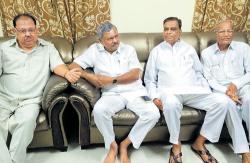
Discontent over cabinet rejig intensifies; Jaffer Sharief backs disgruntled group

June 23, 2016

Bengaluru, June 23: Discontent today snowballed in the ruling Congress over Karnataka's major ministry revamp as disgruntled party legislators decided to meet shortly to plan their next course of action, keeping the option open of pressing for leadership change.

congA series of meetings were being held for the past two days by several dropped ministers and ministerial berth aspirants after Chief Minister Siddaramaiah carried out a major rejig on Sunday, sacking 14 ministers and inducting 13 others to burnish the party's image with two years left for Assembly polls.

"...we will meet on Sunday or Monday. We will all sit together, whatever decision is taken there, is final. Now we have gone one step ahead. To save the party, if leadership change is needed, we are ready for it," senior Congress MLA from Yadagiri Malka Reddy told reporters after a meeting.

"We will fight being within the party. First option is to see if there is any chance to strengthening the party without leadership change. First, we will give medicine, if things are not solved, we will be open for surgery," he added.

Another MLA from Afzalpur Mallikayya Guttedar, sulking over not being given a ministerial berth, said "we will decide whether leadership change is needed."

The state Congress leadership continued its efforts to douse dissidence, with newly-appointed Working President Dinesh Gundu Rao seeking to pacify key sacked ministers like Ambareesh and Srinivasa Prasad, who have openly questioned Chief Minister Siddaramaiah's action of dropping them.

After meeting Ambareesh and Prasad, Rao said, "...he (Ambareesh) has no resentment against the party. I feel he will come out of these things soon, his support is needed for the party."

Senior leaders like Prasad, Qamarul Islam, Ambareesh, Baburao Chinchansoor who were dropped from the Ministry have openly criticised Siddaramaiah.

Ambareesh has even resigned as MLA, which has not been accepted.

Ministerial aspirants like Guttedar, Malka Reddy, S T Somashekar and Rajshekar Patil among others have made open remarks against Siddaramaiah and Mallikarjuna Kharge (Congress Leader in Lok Sabha), whose son Priyank Kharge has managed to find a ministerial slot.

Somashekar has claimed that eight legislators were contemplating resigning their Assembly membership in protest.

Sources said party's state in-charge Digvijay Singh is expected to visit here soon in order to control the growing resentment within the party.

Siddaramaiah had carried out the reshuffle after the Congress High Command gave its clearance for the major rejig, seen as an attempt to improve the party's image to retain power in the next polls in the only major bastion under its control after losing power in several states, most recently in Assam.

Meanwhile, former union minister C K Jaffer Sharief, who met Ambareesh, extended his support to the disgruntled group. He told reporters that Siddaramaiah was responsible for the crisis the party is witnessing.

Comments

SK
 - 
Thursday, 23 Jun 2016

As Ambarish said he is not a foot wear..... But ALL the politicians are worse than that.... The ministers should be rotated for every 2.5 years, so that others will get an opportunity to show their TALENT.... Cabinet is not their Father's property....Even Siddu has done BLUNDER by retaining other ministers like RAI..... these foot wears should be kicked out....like he changed his` car......

Abdullah
 - 
Thursday, 23 Jun 2016

This old buffalos should take rest and enjoy the rest of their life with family. How much money they want to earn???
And also they should give chance to youngsters.

Add new comment

  • Coastaldigest.com reserves the right to delete or block any comments.
  • Coastaldigset.com is not responsible for its readers’ comments.
  • Comments that are abusive, incendiary or irrelevant are strictly prohibited.
  • Please use a genuine email ID and provide your name to avoid reject.
Ram Puniyani
January 14,2020

In the beginning of January 2020 two very disturbing events were reported from Pakistan. One was the attack on Nankana Sahib, the holy shrine where Sant Guru Nanak was born. While one report said that the place has been desecrated, the other stated that it was a fight between two Muslim groups. Prime Minister of Pakistan Imran Khan condemned the incident and the main accused Imran Chisti was arrested. The matter related to abduction and conversion of a Sikh girl Jagjit Kaur, daughter of Pathi (One who reads Holy Guru Granth Sahib in Gurudwara) of the Gurudwara. In another incident one Sikh youth Ravinder Singh, who was out on shopping for his marriage, was shot dead in Peshawar.

While these condemnable attacks took place on the Sikh minority in Pakistan, BJP was quick enough to jump to state that it is events like this which justify the Citizenship Amendment Act (CAA). Incidentally CAA is the Act which is discriminatory and relates to citizenship with Religion, which is not as per the norms of Indian constitution. There are constant debates and propaganda that population of Hindus has come down drastically in Pakistan and Bangla Desh. Amit Shah, the Home minister stated that in Pakistan the population of Hindus has come down from 23% at the time of partition to 3.7% at present. And in Bangla Desh it has come down from 22% to present 8%.

While not denying the fact that the religious minorities are getting a rough deal in both these countries, the figures which are presented are totally off the mark. These figures don’t take into consideration the painful migrations, which took place at the time of partition and formation of Bangla Desh later. Pakistan census figures tell a different tale. Their first census was held in 1951. As per this census the overall percentage of Non Muslim in Pakistan (East and West together) was 14.2%, of this in West Pakistan (Now Pakistan) it was 3.44 and in Eat Pakistan it was 23.2. In the census held in Pakistan 1998 it became 3.72%. As far as Bangla Desh is concerned the share of Non Muslims has gone down from 23.2 (1951) to 9.6% in 2011.

The largest minority of Pakistan is Ahmadis, (https://minorityrights.org/country/pakistan/) who are close to 4 Million and are not recognised as Muslims in Pakistan. In Bangla Desh the major migrations of Hindus from Bangla Desh took place in the backdrop of Pakistan army’s atrocities in the then East Pakistan.

As far as UN data on refugees in India it went up by 17% between 2016-2019 and largest numbers were from Tibet and Sri Lanka.  (https://www.un.org/en/development/desa/population/migration/publication…)

The state of minorities is in a way the index of strength of democracy. Most South Asian Countries have not been able to sustain democratic values properly. In Pakistan, the Republic began with Jinnah’s classic speech where secularism was to be central credo of Pakistan. This 11th August speech was in a way what the state policy should be, as per which people of all faiths are free to practice their religion. Soon enough the logic of ‘Two Nation theory” and formation of Pakistan, a separate state for Muslim took over. Army stepped in and dictatorship was to reign there intermittently. Democratic elements were suppressed and the worst came when Zia Ul Haq Islamized the state in collusion with Maulanas. The army was already a strong presence in Pakistan. The popular formulation for Pakistan was that it is ruled by three A’s, Army, America and Allah (Mullah).

Bangla Desh had a different trajectory. Its very formation was a nail in the coffin of ‘two nation theory’; that religion can be the basis of a state. Bangla Desh did begin as a secular republic but communal forces and secular forces kept struggling for their dominance and in 1988 it also became Islamic republic. At another level Myanmar, in the grip of military dictatorship, with democratic elements trying to retain their presence is also seeing a hard battle. Democracy or not, the army and Sanghas (Buddhist Sang has) are strong, in Myanmar as well. The most visible result is persecution of Rohingya Muslims.

Similar phenomenon is dominating in Sri Lanka also where Budhhist Sanghas and army have strong say in the political affairs, irrespective of which Government is ruling. Muslim and Christian minorities are a big victim there, while Tamils (Hindus, Christians etc.) suffered the biggest damage as ethnic and religious minorities. India had the best prospect of democracy, pluralism and secularism flourishing here. The secular constitution, the outcome of India’s freedom struggle, the leadership of Gandhi and Nehru did ensure the rooting of democracy and secularism in a strong way.

India so far had best democratic credentials amongst all the south Asian countries. Despite that though the population of minorities rose mainly due to poverty and illiteracy, their overall marginalisation was order of the day, it went on worsening with the rise of communal forces, with communal forces resorting to identity issues, and indulging in propaganda against minorities.

While other South Asian countries should had followed India to focus more on infrastructure and political culture of liberalism, today India is following the footsteps of Pakistan. The retrograde march of India is most visible in the issues which have dominated the political space during last few years. Issues like Ram Temple, Ghar Wapasi, Love Jihad, Beef-Cow are now finding their peak in CAA.

India’s reversal towards a polity with religion’s identity dominating the political scene was nicely presented by the late Pakistani poetess Fahmida Riaz in her poem, Tum bhi Hum Jaise Nikle (You also turned out to be like us). While trying to resist communal forces has been an arduous task, it is becoming more difficult by the day. This phenomenon has been variously called, Fundamentalism, Communalism or religious nationalism among others. Surely it has nothing to do with the religion as practiced by the great Saint and Sufi traditions of India; it resorts mainly to political mobilization by using religion as a tool.


Comments

Ashi
 - 
Tuesday, 14 Jan 2020

If Malaysia implement similar NRC/CAA, India and China are the loser.

Add new comment

  • Coastaldigest.com reserves the right to delete or block any comments.
  • Coastaldigset.com is not responsible for its readers’ comments.
  • Comments that are abusive, incendiary or irrelevant are strictly prohibited.
  • Please use a genuine email ID and provide your name to avoid reject.
News Network
June 24,2020

Bengaluru, Jun 24: About 8,48,203 students will appear in the Secondary School Leaving Certificate (SSLC) examination tomorrow, i.e., June 24, said Karnataka Health Minister B Sriramulu on Wednesday.

Students have been advised to report to the examination centre three-hour before the commencement of the examination i.e., at 07:30 am. The examination will commence at 10:30 am.

Early entry to the centres will also help maintain social distancing that is very much essential during the pandemic, minister for primary and secondary education S Suresh Kumar said.

"SSLC exams to take place tomorrow. About 8,48,203 students will write the exam. Social distancing needs to be followed and the mask should be used. Minister of Education and I have already held a lot of meetings. Students from containment zones will be carefully handled," said Sriramulu.

Commenting upon the situation arising in the state due to COVID-19, Sriramulu said, "There is a panel of experts to decide about lockdown. There has been an opinion that the COVID-19 test should be increased. Workers, traders, and others should be categorised in 15 categories and tests must be conducted," he added.

Sriramulu further said that there will be a meeting of task force on the coming Monday.

"All the issues will be brought to the notice of the Chief Minister at the task force meeting, then CM will take a call on what needs to be done," he said.

Meanwhile, Suresh Kumar, Minister of Education inspected the schools and places where SSLC exams will be held.

Earlier Karnataka Education Minister S Suresh Kumar had announced that SSLC examinations, which were stayed in view of the coronavirus pandemic, will be conducted 'between June 25 and July 4' in the state.

According to the Union Health Ministry, Karnataka has 9,721 COVID-19 cases including 150 fatalities.

Comments

Add new comment

  • Coastaldigest.com reserves the right to delete or block any comments.
  • Coastaldigset.com is not responsible for its readers’ comments.
  • Comments that are abusive, incendiary or irrelevant are strictly prohibited.
  • Please use a genuine email ID and provide your name to avoid reject.
News Network
April 18,2020

Bengaluru, Apr 18: Amid fears that people from the unorganised sector are running out of cash to meet their daily expenses, the Karnataka government said there was no data available for such labourers, who can be provided financial assistance under the direct benefit transfer (DBT) scheme.

"The government does not have data of people in the unorganised sector such as drivers, farmers, domestic help and others. If we have to deposit directly into their account, we need data..," State Labour minister A Shivaram Hebbar told reporters.

The minister said a situation borne out of the COVID-19, where the entire nation has been lockdown was never anticipated.

To him, the pandemic has given an opportunity to gather information about the unorganised sector.

"This COVID-19 has taught the department and the workers a lesson that we should be prepared for a situation like this. We have learnt that all the information about labourers should be available with the labour department," Hebbar conceded.

The minister opined that the department should have had the list during the good times but nobody bothered to have it.

"During the good times nobody bothered about it -- neither they (beneficiaries) asked for it, nor we thought of it.," Hebbar said.

Now that the pandemic has struck, the government is focusing only on not letting anyone starve to death.

A three-level preparation has been made -- at the village level, Taluk level and the city level, the minister said.

Village anganwadis have been stuffed with food items to be cooked for the needy, whereas in Taluk level, government hostels have been turned into shelters for the labourers, he said, noting that lakhs of philanthropists in cities have come forward to feed the people from unorganised sector.

"The basic objective of our government is that no one should starve to death. The issue of organised or unorganised sector comes next," he explained.

On the fear of large-scale retrenchment, the minister said notices have been served on all the industries that no one should be expelled from the job.

However, Hebbar underlined that the industrialists today are as much in distress as the workers and his department was taking into account everyone's concern.

A decision will be taken in this connection by the government in the next two days, to provide assistance to small enterprises to keep them afloat.

Comments

Add new comment

  • Coastaldigest.com reserves the right to delete or block any comments.
  • Coastaldigset.com is not responsible for its readers’ comments.
  • Comments that are abusive, incendiary or irrelevant are strictly prohibited.
  • Please use a genuine email ID and provide your name to avoid reject.