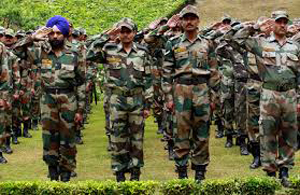
Discussions on surgical strikes will be insult to Army: BJP

October 5, 2016

New Delhi, Oct 5: Hitting out at those "seeking proof" of the surgical strikes in PoK, Union Minister M Venkaiah Naidu today said further discussions on the operations will be an "insult" to the "commendable" task carried out by the Army.

images 6"There is no need to respond to such irresponsible comments and demands. Fortunately, Congress has also realised its mistake and distanced itself from the comments of its leaders...AAP has also made it very clear," he told reporters on the sidelines of an event here.

He said nobody has any doubt about the "credentials and commitment" of the Indian Army which has done a "commendable" job and further discussions on the operations will be an "insult" to the force.

"I don't think any Indian citizen has got any doubt. Nobody is doubting the credentials and commitment of the Indian Army. It did a commendable job...It would be an insult to the Army if we further discuss," he said.

Naidu said the Director General Military Operations (DGMO) himself had given the statement about the operations in full details and also shared the information at an all-party meeting.

He wondered if giving further details will be in the interest of the nation. Observing that entire country is happy about the surgical strikes, he said the world has also acknowledge the step taken by India.

"Only Pakistan is saying something because they have to say something. They are not in a position to conduct funeral or last rites of their own citizens...This is their culture," he said.

Earlier, addressing the event, the minister said India does not want war with anybody, but will give a befitting reply if continuously provoked.

"...We never want a war with anybody. If somebody continuously provokes us, we will give them a befitting reply like our jawans gave the reply recently," he said.

Congress leader Sanjay Nirupam had accused the BJP of indulging in politics over national interest and called the surgical strikes on terror camps as fake, the comments which were slammed by his own party.

Congress leader P Chidmabaram had also reportedly said it was up to the government to give proof of the surgical strikes in which seven terror launch pads in Pakistan-occupied-Kashmir were destroyed by the Army.

Also, Delhi Chief Minister Arvind Kejriwal had on Monday released a video message "saluting" Prime Minister Narendra Modi for the surgical strikes across the LoC and urging him to "unmask" Pakistan's propaganda.

Pakistan has denied that the Indian Army conducted surgical strikes against terrorist units on its side of the border on the intervening night of September 28 and 29.

Comments

Rashid
 - 
Wednesday, 5 Oct 2016

You already made a lot of damage to the credentials of army by dragging it to your political gain. now international media also shown some sign of suspicion

Add new comment

  • Coastaldigest.com reserves the right to delete or block any comments.
  • Coastaldigset.com is not responsible for its readers’ comments.
  • Comments that are abusive, incendiary or irrelevant are strictly prohibited.
  • Please use a genuine email ID and provide your name to avoid reject.
News Network
June 9,2020

Jun 9: Prime Minister Narendra Modi wants all 1.3 billion Indians to be “vocal for local” — meaning, to not just use domestically made products but also to promote them. As an overseas citizen living in Hong Kong, I’m doing my bit by very vocally demanding Indian mangoes on every trip to the grocery. But half the summer is gone, and not a single slice so far.

My loss is due to India’s COVID-19 lockdown, which has severely pinched logistics, a perennial challenge in the huge, infrastructure-starved country. But more worrying than the disruption is the fruity political response to it. Rather than being a wake-up call for fixing supply chains, the pandemic seems to be putting India on an isolationist course. Why?

Granted that the liberal view that trade is good and autarky bad isn’t exactly fashionable anywhere right now. What makes India’s lurch troublesome is that the pace and direction of economic nationalism may be set by domestic business interests. The Indian liberals, many of whom are Western-trained academics, authors and — at least until a few years ago — policy makers, want a more competitive economy. They will be powerless to prevent the slide.

Modi’s call for a self-reliant India has been echoed by Home Minister Amit Shah, the cabinet’s unofficial No. 2, in a television interview. If Indians don’t buy foreign-made goods, the economy will see a jump, he said. The strategy — although it’s too nebulous yet to call it that — has a geopolitical element. A military standoff with China is under way, apparently triggered by India’s completion of a road and bridge near the common border in the tense Himalayan region of Ladakh. It’s very expensive to fight even a limited war there. With India’s economy flattened by COVID, New Delhi may be looking for ways to restore the status quo and send Beijing a signal.

Economic boycotts, such as Chinese consumers’ rejection of Japanese goods over territorial disputes in the East China Sea, are well understood as statecraft. In these times, it’s not even necessary to name an enemy. An undercurrent of popular anger against China, the source of both the virus and India’s biggest bilateral trade deficit, is supposed to do the job. But is it ever that easy?

A hastily introduced policy to stock only local goods in police and paramilitary canteens became a farcical exercise after the list of banned items ended up including products by the local units of Colgate-Palmolive Co., Nestle SA, and Unilever NV, which have had significant Indian operations for between 60 and 90 years, as well as Dabur India Ltd., a New Delhi-based maker of Ayurveda brands. The since-withdrawn list demonstrates the practical difficulty of bureaucrats trying to find things in a globalized world that are 100% indigenous.

Free-trade champions fret that the prime minister, whom they saw as being on their side six years ago, is acting against their advice to dismantle statist controls on land, labor and capital to help make the country more competitive. Engage with the world more, not less, they caution. But Modi also has to satisfy the Rashtriya Swayamsevak Sangh, the umbrella Hindu organisation that gets him votes. Its backbone of small traders, builders and businessmen — the RSS admits only men — was losing patience with the anemic economy even before the pandemic. Now, they’re in deep trouble, because India’s broken financial system won’t deliver even state-guaranteed loans to them.

The U.S.-China tensions — over trade, intellectual property, COVID responsibility and Hong Kong’s autonomy — offer a perfect backdrop. A dire domestic economy and trouble at the border provide the foreground. Big business will dial economic nationalism up and down to hit a trifecta of goals: Block competition from the People's Republic; make Western rivals fall in line and do joint ventures; and tap deep overseas capital markets. The first goal is being achieved with newly placed restrictions on investment from any country that shares a land border with India. The second aim is to be realized by corporate lobbying to influence India's whimsical economic policies. As for the third objective, with the regulatory environment becoming tougher for U.S.-listed Chinese companies like Alibaba Group Holding Ltd., an opportunity may open up for Indian firms.

All this may bring India Shenzhen-style enclaves of manufacturing and trade, but it will concentrate economic power in fewer hands, something that worries liberals. They’re moved by the suffering of India’s low-wage workers, who have borne the brunt of the COVID shutdown. But when their vision of a more just society and fairer income distribution prompts them to make common cause with the ideological Left, they’re quickly repelled by the Marxist voodoo that all cash, property, bonds and real estate held by citizens or within the nation “must be treated as national resources available during this crisis.” Who will invest in a country that does that instead of just printing money?

At the same time, when liberals look to the business class, they see a sudden swelling of support for ideas like a universal basic income. They wonder if this isn’t a ploy by industry to outsource part of the cost of labor to the taxpayer. Slogans like Modi’s vocal-for-local stir the pot and thicken the confusion. The value-conscious Indian consumer couldn’t give two hoots for calls to buy Indian, but large firms will know how to exploit economic nationalism. One day soon, I’ll get my mangoes — from them.


Comments

Add new comment

  • Coastaldigest.com reserves the right to delete or block any comments.
  • Coastaldigset.com is not responsible for its readers’ comments.
  • Comments that are abusive, incendiary or irrelevant are strictly prohibited.
  • Please use a genuine email ID and provide your name to avoid reject.
News Network
January 10,2020

Mumbai, Jan 10: India’s oil demand growth is set to overtake China by mid-2020s, priming the country for more refinery investment but making it more vulnerable to supply disruption in the Middle East, the International Energy Agency (IEA) said on Friday.

India’s oil demand is expected to reach 6 million barrels per day (bpd) by 2024 from 4.4 million bpd in 2017, but its domestic production is expected to rise only marginally, making the country more reliant on crude imports and more vulnerable to supply disruption in the Middle East, the agency said.

China’s demand growth is likely to be slightly lower than that of India by the mid-2020s, as per IEA’s China estimates given in November, but the gap would slowly become bigger thereafter.

“Indian economy is and will become even more exposed to risks of supply disruptions, geopolitical uncertainties and the volatility of oil prices,” the IEA said in a report on India’s energy policies.

Brent crude prices topped USD 70 a barrel on rising geopolitical tensions in the Middle East, putting pressure on emerging markets such as India. Like the rest of Asia, India is highly dependent on Middle East oil supplies with Iraq being its largest crude supplier.

India, which ranks No 3 in terms of global oil consumption after China and the United States, ships in over 80 per cent of its oil needs, of which 65 per cent is from the Middle East through the Strait of Hormuz, the IEA said.

The IEA, which coordinates release of strategic petroleum reserves (SPR) among developed countries in times of emergency, said it is important for India to expand its reserves.

REFINERY INVESTMENTS

India is the world’s fourth largest oil refiner and a net exporter of refined fuel, mainly gasoline and diesel.

India has drawn plans to lift its refining capacity to about 8 million bpd by 2025 from the current about 5 million bpd.

The IEA, however, forecasts India’s refining capacity to rise to 5.7 million bpd by 2024.

This would make “India a very attractive market for refinery investment,” IEA said.

Drawn to India’s higher fuel demand potential, global oil majors like Saudi Aramco, BP, Abu Dhabi National Oil Co and Total are looking at investing in India’s oil sector.

Saudi Aramco and ADNOC aim to own a 50 per cent stake in a planned 1.2-million bpd refinery in western Maharashtra state, for which land is yet to be acquired.

Comments

Add new comment

  • Coastaldigest.com reserves the right to delete or block any comments.
  • Coastaldigset.com is not responsible for its readers’ comments.
  • Comments that are abusive, incendiary or irrelevant are strictly prohibited.
  • Please use a genuine email ID and provide your name to avoid reject.
News Network
May 27,2020

New Delhi, May 27: Professor Johan Giesecke of the Karolinska Institute, Sweden, on Wednesday claimed that India will ruin its economy very quickly if it had a severe lockdown.

Claiming that a strict lockdown may disrupt India's economic growth, Giesecke during an interaction with Congress leader Rahul Gandhi said: "In India, you will do more harm than good with strict lockdown measures. India will ruin its economy very quickly if it had a severe lockdown."

While calling for a soft lockdown approach in India, he suggested that India has to ease restrictions one by one. It may, however, take months to completely come out of lockdown, he said.

He further criticised countries across the globe for having no post-lockdown strategy.

Emphasising on the disease, the Swedish health expert said that coronavirus is spreading like a wildfire across the world. "It is a very mild disease. Ninety-nine per cent infected people will have very less or no symptoms," he added.

Meanwhile, Ashish Jha, Director Harvard Global Health Institute and a recognised public health official, in interaction with Gandhi, called for a need to go in for an 'aggressive' COVID-19 testing to create confidence among people.

"When the economy is opened post-lockdown, you have to create confidence. There is a need for aggressive testing strategy in high-risk areas," he said.

He asserted that COVID-19 is not the last pandemic in the world, adding that "We are entering the age of large pandemics".

Jha further said that countries like South Korea, Taiwan and Hong Kong have responded the best to COVID-19 pandemic, while Italy, Spain, the US and the UK have responded the worst.

A few days ago, the Gandhi scion had interacted with former Reserve Bank of India Governor Raghuram Rajan and Nobel Prize Winner Abhijit Banerjee to discuss various issues related to the COVID-19 crisis.

Comments

Add new comment

  • Coastaldigest.com reserves the right to delete or block any comments.
  • Coastaldigset.com is not responsible for its readers’ comments.
  • Comments that are abusive, incendiary or irrelevant are strictly prohibited.
  • Please use a genuine email ID and provide your name to avoid reject.