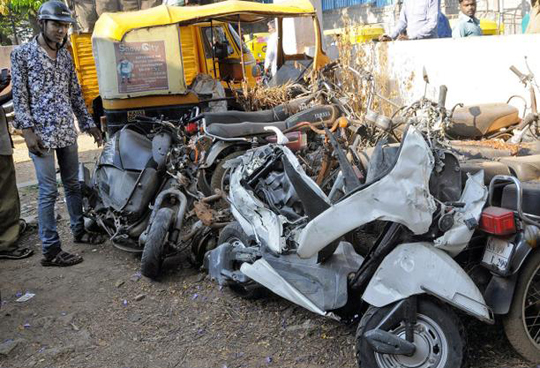
Doctor's Benz hits 5 vehicles, crashes into house; biker killed, 4 injured

[email protected] (News Network)
March 28, 2016

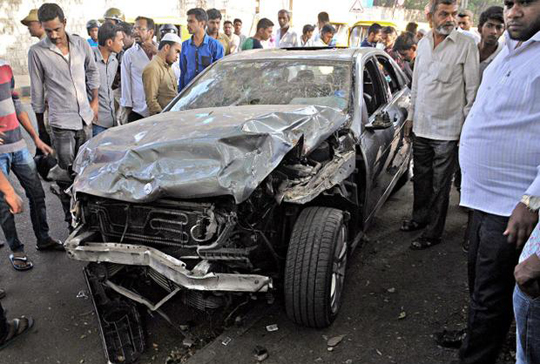
Bengaluru, Mar 28: A speeding luxury car, driven by a 55-year-old doctor, rammed at least five vehicles over a stretch of 1 km and crashed into a house before coming to a halt in Jayanagar on Sunday. A two-wheeler rider was killed and four people were injured in the accident.benz
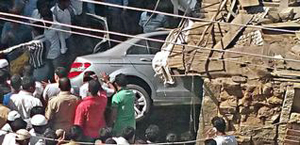
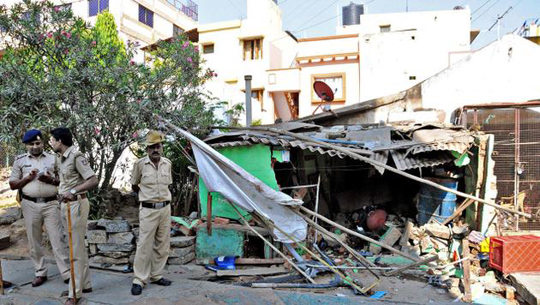
Around 2.15 pm, Dr Shankar N H (55), an Orthopaedician, was driving his high-end car. At Madhavan Park, he brushed past a car. Fearing repercussions, Shankar sped towards Byrasandra main road where his car rammed into a bike and two cars, injuring three people. Dr Shankar then sped ahead and rammed into Rizwan alias Ahmed Khan's (52) bike. The Benz came to a halt only after it ran into a roadside house, damaging it completely. Rizwan was killed on the spot, police said.

Swift action by the police saved orthopaedician Dr Shankar N H, who drove his Mercedes Benz car into three cars and two bikes, between Madhavan Park and Byrasandra in Jayanagar on Sunday afternoon, killing one and injuring three. The police secured Dr Shankar in the nick of time.

Lokesh Kumar, DCP (South), said that the police acted quickly and took away Dr Shankar from the spot and shifted him to a hospital, as he was bleeding from his ears. His domestic help Sarita and her child, who were also in the car, were taken to another hospital for treatment.

Around 20 policemen were sent to the spot to disperse the mob. If the police had reached the spot late even by a few minutes, the mob would have thrashed Dr Shankar and set his car on fire, the policemen told Deccan Herald.

The crowd turned a bit violent when Sarita re-appeared with her child at the scene for reasons unknown. A few of them pushed her, but the police took the woman and child to safety. Sarita told reporters that Dr Shankar had an epilepsy attack and lost control over the vehicle.

The airbags in the car saved the life of Shankar and Sarita. As soon as Shankar crashed his car into the house, the airbags opened up. Sampath Kumar, the owner of a grocery shop, said: “As I was coming from the Ashoka Pillar side, I noticed the driver of the Benz car driving in a reckless manner and thought that he would bang somewhere. When I reached Byrasandra, I noticed the damage.”

Almost a year ago, Shankar was booked under the Domestic Violence Act as his wife had approached the police, saying that he was harassing her for various reasons. The police had booked a case against him and even warned Shankar, said a senior police officer.

Family's fortuitous absence
The residents of the house in Byrasandra which was damaged were lucky that they were away when the accident happened.

Nagalakshmi, the owner of the house, said, “Our relatives Somashekar, his wife Rathnamma and their children reside in the house. On Sunday morning, they went to Mysuru as one of their relatives had delivered a baby. If they were in the house, the situation would have been different. Usually, Somashekar and his wife sell coconuts in front of the house and if they were present today, they may have been killed.”
benzz1

benzz2

benzz3

Comments

Sheldon
 - 
Friday, 1 Apr 2016

Definitely imagine that which you said. Your favourite justification seemed to be at
the web the easiest thing to have in mind of. I say to you, I definitely get irked at the same time as other people consider concerns that they
just do not know about. You managed to hit the nail upon the top and outlined out the whole
thing without having side effect , other people could take a signal.

Will likely be back to get more. Thank you

Also visit my homepage :: http://www.laviagraes.com/como-debo-usar-la-viagra: http://www.laviagraes.com/como-debo-usar-la-viagra

Satyameva jayate
 - 
Monday, 28 Mar 2016

Bas kuch dinon kee baath hai...doctor jaayega gharme ....victims Gaye bhaadme......aisa des hai meraa....
Where is hema malini and smriti Irani..ha haa

Irsa
 - 
Monday, 28 Mar 2016

But the real fact is the POLICE which are 60% were almost releasing the Culprit who was Drunk and Driving despite being Doctor.....but SDPI Corporator Mr.Mujahid Pasha rushed to the scene and stopped his release

Add new comment

  • Coastaldigest.com reserves the right to delete or block any comments.
  • Coastaldigset.com is not responsible for its readers’ comments.
  • Comments that are abusive, incendiary or irrelevant are strictly prohibited.
  • Please use a genuine email ID and provide your name to avoid reject.
coastaldigest.com news network
June 28,2020

Mangaluru, June 28: In his apparent bid to win the hearts of the people of Tulu Nadu while leaving this coastal city, Dr P S Harsha, the outgoing Mangaluru city police commissioner, today took to social media and thanked the people. The language he chose for his prolonged Facebook post and one paragraph tweet was Tulu.

“Loveable people of Kudla! I have received the transfer order after serving as the Commissioner of Police of Mangaluru City for 11 months. (During this period) I worked with utmost honesty and pro-people approach with the complete cooperation of my department. I wholeheartedly thank all those who supported me,” tweeted Dr Harsha, who is now posted in Bengaluru as the Deputy Inspector General and Commissioner of Information and Public Relations.

In his Facebook post, Dr Harsha claimed that thanks to his initiative “My Beat My Pride”, the policing in the coastal city has strengthened. 

“My only intention was to put an end to rowdyism and illegal activities. I had given priority to curb the drug mafia. ‘My Beat My Pride’ became a successful initiative thanks to public support,” he said. 

The IPS officer went on to claim that with the with the co-operation of the senior officers, the police department managed to efficiently handle situations during anti-CAA and pro-CAA agitations in the city, detection of explosives at Mangaluru International Airport and also during the covid-19 pandemic. 

However, he did not mention about the death of two people in random police firing following a baton charge during anti-CAA protests in the city on December 19.

Comments

MP
 - 
Tuesday, 30 Jun 2020

power is not permenant. 2 innocents were killed in mangalore,  if it was in USA the cop would have been in jail.


Add new comment

  • Coastaldigest.com reserves the right to delete or block any comments.
  • Coastaldigset.com is not responsible for its readers’ comments.
  • Comments that are abusive, incendiary or irrelevant are strictly prohibited.
  • Please use a genuine email ID and provide your name to avoid reject.
Ram Puniyani
January 14,2020

In the beginning of January 2020 two very disturbing events were reported from Pakistan. One was the attack on Nankana Sahib, the holy shrine where Sant Guru Nanak was born. While one report said that the place has been desecrated, the other stated that it was a fight between two Muslim groups. Prime Minister of Pakistan Imran Khan condemned the incident and the main accused Imran Chisti was arrested. The matter related to abduction and conversion of a Sikh girl Jagjit Kaur, daughter of Pathi (One who reads Holy Guru Granth Sahib in Gurudwara) of the Gurudwara. In another incident one Sikh youth Ravinder Singh, who was out on shopping for his marriage, was shot dead in Peshawar.

While these condemnable attacks took place on the Sikh minority in Pakistan, BJP was quick enough to jump to state that it is events like this which justify the Citizenship Amendment Act (CAA). Incidentally CAA is the Act which is discriminatory and relates to citizenship with Religion, which is not as per the norms of Indian constitution. There are constant debates and propaganda that population of Hindus has come down drastically in Pakistan and Bangla Desh. Amit Shah, the Home minister stated that in Pakistan the population of Hindus has come down from 23% at the time of partition to 3.7% at present. And in Bangla Desh it has come down from 22% to present 8%.

While not denying the fact that the religious minorities are getting a rough deal in both these countries, the figures which are presented are totally off the mark. These figures don’t take into consideration the painful migrations, which took place at the time of partition and formation of Bangla Desh later. Pakistan census figures tell a different tale. Their first census was held in 1951. As per this census the overall percentage of Non Muslim in Pakistan (East and West together) was 14.2%, of this in West Pakistan (Now Pakistan) it was 3.44 and in Eat Pakistan it was 23.2. In the census held in Pakistan 1998 it became 3.72%. As far as Bangla Desh is concerned the share of Non Muslims has gone down from 23.2 (1951) to 9.6% in 2011.

The largest minority of Pakistan is Ahmadis, (https://minorityrights.org/country/pakistan/) who are close to 4 Million and are not recognised as Muslims in Pakistan. In Bangla Desh the major migrations of Hindus from Bangla Desh took place in the backdrop of Pakistan army’s atrocities in the then East Pakistan.

As far as UN data on refugees in India it went up by 17% between 2016-2019 and largest numbers were from Tibet and Sri Lanka.  (https://www.un.org/en/development/desa/population/migration/publication…)

The state of minorities is in a way the index of strength of democracy. Most South Asian Countries have not been able to sustain democratic values properly. In Pakistan, the Republic began with Jinnah’s classic speech where secularism was to be central credo of Pakistan. This 11th August speech was in a way what the state policy should be, as per which people of all faiths are free to practice their religion. Soon enough the logic of ‘Two Nation theory” and formation of Pakistan, a separate state for Muslim took over. Army stepped in and dictatorship was to reign there intermittently. Democratic elements were suppressed and the worst came when Zia Ul Haq Islamized the state in collusion with Maulanas. The army was already a strong presence in Pakistan. The popular formulation for Pakistan was that it is ruled by three A’s, Army, America and Allah (Mullah).

Bangla Desh had a different trajectory. Its very formation was a nail in the coffin of ‘two nation theory’; that religion can be the basis of a state. Bangla Desh did begin as a secular republic but communal forces and secular forces kept struggling for their dominance and in 1988 it also became Islamic republic. At another level Myanmar, in the grip of military dictatorship, with democratic elements trying to retain their presence is also seeing a hard battle. Democracy or not, the army and Sanghas (Buddhist Sang has) are strong, in Myanmar as well. The most visible result is persecution of Rohingya Muslims.

Similar phenomenon is dominating in Sri Lanka also where Budhhist Sanghas and army have strong say in the political affairs, irrespective of which Government is ruling. Muslim and Christian minorities are a big victim there, while Tamils (Hindus, Christians etc.) suffered the biggest damage as ethnic and religious minorities. India had the best prospect of democracy, pluralism and secularism flourishing here. The secular constitution, the outcome of India’s freedom struggle, the leadership of Gandhi and Nehru did ensure the rooting of democracy and secularism in a strong way.

India so far had best democratic credentials amongst all the south Asian countries. Despite that though the population of minorities rose mainly due to poverty and illiteracy, their overall marginalisation was order of the day, it went on worsening with the rise of communal forces, with communal forces resorting to identity issues, and indulging in propaganda against minorities.

While other South Asian countries should had followed India to focus more on infrastructure and political culture of liberalism, today India is following the footsteps of Pakistan. The retrograde march of India is most visible in the issues which have dominated the political space during last few years. Issues like Ram Temple, Ghar Wapasi, Love Jihad, Beef-Cow are now finding their peak in CAA.

India’s reversal towards a polity with religion’s identity dominating the political scene was nicely presented by the late Pakistani poetess Fahmida Riaz in her poem, Tum bhi Hum Jaise Nikle (You also turned out to be like us). While trying to resist communal forces has been an arduous task, it is becoming more difficult by the day. This phenomenon has been variously called, Fundamentalism, Communalism or religious nationalism among others. Surely it has nothing to do with the religion as practiced by the great Saint and Sufi traditions of India; it resorts mainly to political mobilization by using religion as a tool.

Comments

Ashi
 - 
Tuesday, 14 Jan 2020

If Malaysia implement similar NRC/CAA, India and China are the loser.

Add new comment

  • Coastaldigest.com reserves the right to delete or block any comments.
  • Coastaldigset.com is not responsible for its readers’ comments.
  • Comments that are abusive, incendiary or irrelevant are strictly prohibited.
  • Please use a genuine email ID and provide your name to avoid reject.
Agencies
February 23,2020

Bengaluru, Feb 23: Bolstered by the Supreme Court's interim nod for the gazette notification of the Mahadayi Water Dispute Tribunal award by the Central government, Karnataka decided to allot funds for the drinking water project in the state's northwest region, an official said on Saturday.

"Funds will be allotted in the state budget for fiscal 2020-21 to complete the Kalasa-Banduri project across the Mahadayi river for supplying drinking water to the four drought-prone northern districts in the state," the official of the water resources department told media on anonymity.

As Chief Minister B.S. Yediyurappa also holds the finance portfolio, he has agreed to allocate funds for the project, held up for years in the legal battle with the neighbouring Goa and Maharashtra over the sharing of the river water among the three coastal states.

Yediyurappa is slated to present the state budget for the ensuing fiscal in the legislative assembly on March 2.

"We will resume the project work once the Centre notifies the award though it will be binding on the final outcome of the apex court's hearing the review petitions of Goa and Maharashtra against the Tribunal award," the official noted.

A division bench of Justice D.Y. Chandrachud and Justice Hemant Gupta on Thursday passed an interim order on the Tribunal award, allowing the central water resources ministry to notify it for implementation and posted the case for final hearing in July.

The Tribunal on August 14, 2018 allocated 13.42 thousand million cubic feet (tmcft) of the river water to the southern state for irrigation and drinking water supply to towns and villages across Bagalkot, Belagavi, Dharwad and Gadag districts, which are in the arid region of the Deccan plateau.

The four districts are about 400-550 km northwest of Bengaluru in the southern state.

Of the 13.42 tmcft water, 5.5 tmcft will be used in the river basin and for diversion into the depleted Malaprabha reservoir while the balance 7.92 tmcft will be utilized for hydel power generation instead of allowing the water to go into the Arabian Sea on the state's west coast through Goa.

Goa, which opposed Karnataka's demand for 36.66 tmcft, was allocated 24 tmcft, while Maharashtra got 1.3 tmcft.

The Tribunal assessed that 188.06 tmc feet water is available at 75 per cent dependability.

The three-member Tribunal is headed by Chairman Justice J.M. Panchal, Justice Viney Mittal and Justice P.S. Naayana.

The Union government had set up the inter-state Tribunal on November 16, 2010 for the djudication of the Mahadayi basin water allocation among the three riparian and contiguous states.

Goa and Maharashtra claimed 122.6 tmc feet and 6.35 tmc feet of the river water respectively.

The Tribunal, which commenced sittings on September 6, 2012, held 1,209 sittings for over 6 years.

Supreme Court senior counsel F.S. Nariman represented the state before the Tribunal to present its case.

The Tribunal's chairman and two members inspected the river basin area across the three coastal states from December 12-24, 2013.

The 77km-long Mahadayi or Mandovi river originates at Bhimgad in the Western Ghats in Belagavi district and flows into the neighbouring Goa through Maharashtra and joins the Arabian Sea off the west coast.

Though the river flows 29 km in Karnataka and 52 km in Goa, its catchment area is spread over 2,032 km in the southern state as against 1,580 km in the western state (Goa).

Comments

Add new comment

  • Coastaldigest.com reserves the right to delete or block any comments.
  • Coastaldigset.com is not responsible for its readers’ comments.
  • Comments that are abusive, incendiary or irrelevant are strictly prohibited.
  • Please use a genuine email ID and provide your name to avoid reject.