


Don't mess with govt image: Modi's message to Smriti Irani

July 6, 2016

New Delhi, Jul 6: In the high decibel din of the Cabinet expansion and reshuffle of portfolios in the Narendra Modi government, the media seems to have forgotten about a certain BJP maverick MP – Subramanian Swamy – who until recently was its obsession. Where is he now in this celebration?
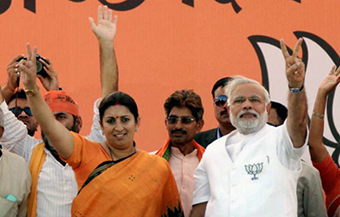
modisairathSwamy neither figures in the list of new inductees, nor does he seem to be throwing tantrums over his exclusion. Evidently, Swamy's antics of attacking the likes of RBI governor Raghuram Rajan, economic advisor Arvind Subramanian and other officials of the Finance Ministry turned out to be a misadventure. His snide remarks against Finance Minister Arun Jaitley was the final nail in the coffin of his aspirations to be a Union minister.

In his attempt to rejig the Cabinet, Prime Minister Narendra Modi has shown a distinct distaste for those with a penchant for courting controversy. Swamy's exclusion and Smriti Irani's removal from the human resource development (HRD) Ministry are indicative of a pattern.

Though unlike Swamy, Irani never crossed the Rubicon line of party discipline. Yet she found herself in the midst of many controversies related to her haughtiness with bureaucrats and academics – with Dalit scholar Rohith Vemula's suicide in Hyderabad and the JNU row marking crucial blows in her two-year tenure as HRD minister.

Though senior BJP leaders, including Modi, are quite impressed by Irani's political pugnacity, she seems to have lost out on moderation. In a recent conference of vice-chancellors of central universities, she ticked off seasoned academics in a very unpleasant manner.

Apparently the minister's conduct could not endear her to the bureaucracy and academics. On some occasions, she was seen courting controversies that may suit the image of a street-fighter, but not of a Union minister.

Contrast this with Prakash Javadekar, an unassuming leader from Maharashtra, who is the only one elevated in this Cabinet expansion – he is now the HRD minister, after relieving his post as the Environment Minister. All this, with Javadekar maintaining a low-profile while facilitating the industry to negotiate with environmental concerns.

Insiders say that Javadekar very deftly handled his assignment of aligning the regulatory regime of the environment Ministry with developmental concerns. He was rewarded with the HRD portfolio for efficiently implementing the government's agenda and for his pro-active role in the climate change talks in Paris. Given Javadekar's own training as Swayamsevak, his new assignment would only get wide approval within the Sangh Parivar.

If the reshuffle is any indication, then it is clear that the prime minister did not hesitate to clip the wings of those found falling short of his expectations. For instance, the communication portfolio was taken away from a voluble Ravi Shankar Prasad and given to Minister of State for Railway Manoj Sinha, as additional responsibility.

Sinha, an engineering graduate from Banaras Hindu University, won unqualified admiration for his efficiency, while maintaining a low-profile. Prasad was, however, given back the charge of the Law Ministry in view of his background as a lawyer – he replaced DV Sadananda Gowda, who had taken over the law ministry from Prasad back in 2014.

Modi has also plugged gaps in certain portfolios by appointing MJ Akbar in the Foreign Ministry and by deploying Ananth Kumar as Parliamentary Affairs Minister, along with SS Ahluwalia, to mobilise support from non-congress parties for the smooth conduct of Parliament.

The underlying theme of the Cabinet reshuffle is quite Biblical – 'meek shall inherit the earth'. This is the precise reason why Swami is left sulking. Similarly, a powerful leader like Yogi Adityanath in eastern UP was ignored, though the Cabinet expansion saw the accommodation of several leaders with influence at the local level. Modi also did not hesitate to axe Ram Shankar Katheria – as the junior HRD minister – as his controversial utterances had caused much consternation.

Taken together, the whole exercise conveyed that those inducted within the government would not be allowed to mess around with its image, either by their conduct or by their utterances.

The implied message was clear – that those having self-inflated notions about themselves can enjoy all the freedom of speech and expression, but while sitting outside the government.

Comments

Satyameva jayate
 - 
Thursday, 7 Jul 2016

This shows how modijis govt failed for the last two years with useless ministers.........they gave positions to the modijis schela' s and now suffering......let's see after two years what will be the change....may be this party will change the PM candidate itself......

Add new comment

  • Coastaldigest.com reserves the right to delete or block any comments.
  • Coastaldigset.com is not responsible for its readers’ comments.
  • Comments that are abusive, incendiary or irrelevant are strictly prohibited.
  • Please use a genuine email ID and provide your name to avoid reject.
News Network
January 25,2020

New Delhi, Jan 25: The latest edition of the Oxford Advanced Learner's Dictionary features 26 new Indian English words, including Aadhaar, chawl, dabba, hartal and shaadi.

The 10th edition of the dictionary, which was launched on Friday, has 384 Indian English words and incorporates over 1,000 new words such as chatbot, fake news and microplastic.

The dictionary focuses on language change and its evolution through the years, and has ensured that the language and examples used in the new edition are relevant and up to date with the times, Oxford University Press (OUP) said.

The new edition comes with interactive online support through the Oxford Learner's Dictionaries website and an app. The website includes advanced features such as audio-video tutorials, video walkthroughs, self-study activities and enhanced iWriter and iSpeaker tools.

"This edition has 26 new Indian English words of which 22 figure in the printed dictionary. The other four are in the digital version," said Fathima Dada, Managing Director (Education Division) at OUP.

Some of other new Indian words in the dictionary are auntie (while aunty already figures in the English dictionary, auntie is an Indianism), bus stand, deemed university, FIR, non-veg, redressal, tempo, tube light, veg and videograph.

The four new Indian English words in the online version of the dictionary are current (for electricity), looter, looting and upazila (one of the areas that a district is divided into for administration purposes).

According to OUP, the new edition provides better, more accurate and understandable definitions with examples, usage notes and additional resources to help the learner use the right word in the right context.

"Prevalence and common usage are the main criteria for enlisting new words. We scan the globe for words which are often used by people while speaking English. Then these words go through a rigorous testing process," Dada said.

"As OUP is the custodian of English language globally, these words have to go through its processes," she told PTI.

The Oxford Advanced Learner's Dictionary, she said, has been reinventing itself for nearly eight decades, anticipating the growing learning requirements of learners.

"The 10th edition also is equipped with a strong digital support system, including an app," she said.

It is equipped with several digital tools. With iSpeaker, learners can get help preparing for speaking exams and presentations. With iWriter, learners can plan, write and review their written work. Text Checker allows the teacher to check any text against the Oxford 3000, 5000, and OPAL (Oxford Phrasal Academic Lexicon) written word list.

Resources accessible through online premium access include lesson plans, worksheets, video walkthroughs, and classroom and self-study activities. With the OALD app one can find 86,000 words, 95,000 phrases, 112,000 meanings and 237,000 examples.

The dictionary, which spans 77 years, was originally published in Japan in 1942 and was first brought out by OUP in 1948. The learner's dictionary is based on the original values of its creator, Albert Sydney Hornby, whose aim was to help language learners worldwide understand the meaning of English words.

Comments

Add new comment

  • Coastaldigest.com reserves the right to delete or block any comments.
  • Coastaldigset.com is not responsible for its readers’ comments.
  • Comments that are abusive, incendiary or irrelevant are strictly prohibited.
  • Please use a genuine email ID and provide your name to avoid reject.
News Network
May 18,2020

Bengaluru, May 18: Karnataka Chief Minister BS Yediyurappa on Monday said that people from Gujarat, Maharashtra, Kerala and Tamil Nadu will not be allowed in the state till May 31.

"We have decided not to allow entry of people from Gujarat, Maharashtra, Kerala and Tamil Nadu till May 31," Yediyurappa said after a meeting with state ministers and senior government officers to discuss the guidelines issued by the Centre regarding the fourth phase of nationwide lockdown.

"State road transport corporation buses in Karnataka and private buses will run. Strict lockdown measures in containment zones and economic activities will be permitted in other areas. Sundays will be total lockdown across the state. Home quarantine will be strengthened," he added.

The Chief Minister further said that all shops will be allowed to open and all trains running within the state will be permitted.

The central government on Sunday extended the ongoing COVID-19 induced nationwide lockdown till May 31, but with a set of new relaxations commencing from Monday. The Union Home Ministry has also given powers to States/UTs demarcate areas in Green, Orange and Red zones, which will allow them to start activities except in containment zones.

According to the guidelines, "all other activities will be permitted except those which are specifically prohibited under these guidelines. However, in containment zones, only essential activities shall be allowed, as mentioned earlier."

Comments

Add new comment

  • Coastaldigest.com reserves the right to delete or block any comments.
  • Coastaldigset.com is not responsible for its readers’ comments.
  • Comments that are abusive, incendiary or irrelevant are strictly prohibited.
  • Please use a genuine email ID and provide your name to avoid reject.
coastaldigest.com news network
August 7,2020

Bengaluru, Aug 7: Dr Mohammed Yusuf, chairperson of the Karnataka State Board of Auqaf, passed away at a private hospital in the city today following a brief illness. He was 74.

Dr Yusuf was an industrialist and was known for his philanthropic activities. 

A veterinarian, Dr Yusuf had quit the government job and set up business in Bengaluru and Dubai decades ago and has earned considerable success.

He was re-elected as Board of Auqaf chief in January this year. He had held the post more than once in the past. 

He will be buried at the graveyard near Masjid-e-Muzammil which was built by himself at Govindapura, source said.

Comments

Add new comment

  • Coastaldigest.com reserves the right to delete or block any comments.
  • Coastaldigset.com is not responsible for its readers’ comments.
  • Comments that are abusive, incendiary or irrelevant are strictly prohibited.
  • Please use a genuine email ID and provide your name to avoid reject.