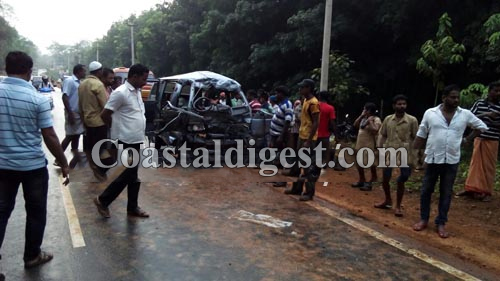
Family on its way to hospital meets with accident; 2 killed, 2 others critical

[email protected] (CD Network)
May 2, 2016

Mangaluru, May 2: Two persons lost their lives and two others belonging to the same family sustained critical injuries in a ghastly road mishap occurred on Monday near Sampaje in Sullia taluk of Dakshia Kannada district.

accident

The tragedy occurred when a family from Kadanga in Kodagu district was heading towards Mangaluru on a Maruti Omni car. A speeding container lorry coming from the opposite direction rammed into the car while negotiating a curve.

It is learnt that Maqbool (60), his wife Zulaika (55) was taking their son Saleem to a hospital in Mangaluru for treatment as the latter was suffering from heart related ailment. Yusuf (35) was driving the car.

Maqbool and Yusuf died on the spot when the collision took place. The other two who were on the backseat were injured critically.

Local residents pulled out the dead bodies from the car and shifted the injured to hospital. A case has been registered at jurisdictional police station.

accident1

Comments

Rahim khan
 - 
Monday, 2 May 2016

Inna lillahi wainna ilaihi rajiwoon

Menaka
 - 
Monday, 2 May 2016

I extend my deepest sympathies. May the departed Souls Rest in Peace.

Arif
 - 
Monday, 2 May 2016

????? ???????? ? ????? ????? ??????

Add new comment

  • Coastaldigest.com reserves the right to delete or block any comments.
  • Coastaldigset.com is not responsible for its readers’ comments.
  • Comments that are abusive, incendiary or irrelevant are strictly prohibited.
  • Please use a genuine email ID and provide your name to avoid reject.
Ram Puniyani
January 14,2020

In the beginning of January 2020 two very disturbing events were reported from Pakistan. One was the attack on Nankana Sahib, the holy shrine where Sant Guru Nanak was born. While one report said that the place has been desecrated, the other stated that it was a fight between two Muslim groups. Prime Minister of Pakistan Imran Khan condemned the incident and the main accused Imran Chisti was arrested. The matter related to abduction and conversion of a Sikh girl Jagjit Kaur, daughter of Pathi (One who reads Holy Guru Granth Sahib in Gurudwara) of the Gurudwara. In another incident one Sikh youth Ravinder Singh, who was out on shopping for his marriage, was shot dead in Peshawar.

While these condemnable attacks took place on the Sikh minority in Pakistan, BJP was quick enough to jump to state that it is events like this which justify the Citizenship Amendment Act (CAA). Incidentally CAA is the Act which is discriminatory and relates to citizenship with Religion, which is not as per the norms of Indian constitution. There are constant debates and propaganda that population of Hindus has come down drastically in Pakistan and Bangla Desh. Amit Shah, the Home minister stated that in Pakistan the population of Hindus has come down from 23% at the time of partition to 3.7% at present. And in Bangla Desh it has come down from 22% to present 8%.

While not denying the fact that the religious minorities are getting a rough deal in both these countries, the figures which are presented are totally off the mark. These figures don’t take into consideration the painful migrations, which took place at the time of partition and formation of Bangla Desh later. Pakistan census figures tell a different tale. Their first census was held in 1951. As per this census the overall percentage of Non Muslim in Pakistan (East and West together) was 14.2%, of this in West Pakistan (Now Pakistan) it was 3.44 and in Eat Pakistan it was 23.2. In the census held in Pakistan 1998 it became 3.72%. As far as Bangla Desh is concerned the share of Non Muslims has gone down from 23.2 (1951) to 9.6% in 2011.

The largest minority of Pakistan is Ahmadis, (https://minorityrights.org/country/pakistan/) who are close to 4 Million and are not recognised as Muslims in Pakistan. In Bangla Desh the major migrations of Hindus from Bangla Desh took place in the backdrop of Pakistan army’s atrocities in the then East Pakistan.

As far as UN data on refugees in India it went up by 17% between 2016-2019 and largest numbers were from Tibet and Sri Lanka.  (https://www.un.org/en/development/desa/population/migration/publication…)

The state of minorities is in a way the index of strength of democracy. Most South Asian Countries have not been able to sustain democratic values properly. In Pakistan, the Republic began with Jinnah’s classic speech where secularism was to be central credo of Pakistan. This 11th August speech was in a way what the state policy should be, as per which people of all faiths are free to practice their religion. Soon enough the logic of ‘Two Nation theory” and formation of Pakistan, a separate state for Muslim took over. Army stepped in and dictatorship was to reign there intermittently. Democratic elements were suppressed and the worst came when Zia Ul Haq Islamized the state in collusion with Maulanas. The army was already a strong presence in Pakistan. The popular formulation for Pakistan was that it is ruled by three A’s, Army, America and Allah (Mullah).

Bangla Desh had a different trajectory. Its very formation was a nail in the coffin of ‘two nation theory’; that religion can be the basis of a state. Bangla Desh did begin as a secular republic but communal forces and secular forces kept struggling for their dominance and in 1988 it also became Islamic republic. At another level Myanmar, in the grip of military dictatorship, with democratic elements trying to retain their presence is also seeing a hard battle. Democracy or not, the army and Sanghas (Buddhist Sang has) are strong, in Myanmar as well. The most visible result is persecution of Rohingya Muslims.

Similar phenomenon is dominating in Sri Lanka also where Budhhist Sanghas and army have strong say in the political affairs, irrespective of which Government is ruling. Muslim and Christian minorities are a big victim there, while Tamils (Hindus, Christians etc.) suffered the biggest damage as ethnic and religious minorities. India had the best prospect of democracy, pluralism and secularism flourishing here. The secular constitution, the outcome of India’s freedom struggle, the leadership of Gandhi and Nehru did ensure the rooting of democracy and secularism in a strong way.

India so far had best democratic credentials amongst all the south Asian countries. Despite that though the population of minorities rose mainly due to poverty and illiteracy, their overall marginalisation was order of the day, it went on worsening with the rise of communal forces, with communal forces resorting to identity issues, and indulging in propaganda against minorities.

While other South Asian countries should had followed India to focus more on infrastructure and political culture of liberalism, today India is following the footsteps of Pakistan. The retrograde march of India is most visible in the issues which have dominated the political space during last few years. Issues like Ram Temple, Ghar Wapasi, Love Jihad, Beef-Cow are now finding their peak in CAA.

India’s reversal towards a polity with religion’s identity dominating the political scene was nicely presented by the late Pakistani poetess Fahmida Riaz in her poem, Tum bhi Hum Jaise Nikle (You also turned out to be like us). While trying to resist communal forces has been an arduous task, it is becoming more difficult by the day. This phenomenon has been variously called, Fundamentalism, Communalism or religious nationalism among others. Surely it has nothing to do with the religion as practiced by the great Saint and Sufi traditions of India; it resorts mainly to political mobilization by using religion as a tool.


Comments

Ashi
 - 
Tuesday, 14 Jan 2020

If Malaysia implement similar NRC/CAA, India and China are the loser.

Add new comment

  • Coastaldigest.com reserves the right to delete or block any comments.
  • Coastaldigset.com is not responsible for its readers’ comments.
  • Comments that are abusive, incendiary or irrelevant are strictly prohibited.
  • Please use a genuine email ID and provide your name to avoid reject.
News Network
March 30,2020

Bengaluru, Mar 30: The nationwide lockdown has left the state on the brink of a fresh agrarian crisis.

The lack of transport facilities spells doom for ready-to-harvest grapes worth Rs 500-600 crore in Bengaluru Rural, Chikkaballapur and Kolar districts. Unable to find buyers, several farmers have begun dumping their produce into compost pits.

On Sunday, Munishamappa, a farmer in Chikkaballapur, emptied four truckloads of grapes into the pit as buyers didn’t turn up due to the lockdown. “If the grapes wither and fall to the ground, it will affect the soil’s fertility and I will be forced to dispose of them,” he said.

Venkata Krishnappa, Munishamappa’s son, said their 1.5-acre vineyard yielded 25 tonnes of grapes. “Just before the lockdown, 10 tonnes were harvested and delivered to the market. Due to lack of transport, buyers haven’t turned up for the remaining 15 tonnes which we are dumping into the pit.”

For latest updates on coronavirus outbreak, click here

Anjaneya Reddy, a farmer leader, said that in Chikkaballapur alone, they have cultivated grapes on 2,000 acres. “Even if you consider 15 tonnes per acre as yield, there are about 30,000 tonnes ready to be harvested in the district. At a market rate of Rs 50 to Rs 60 per kilogram, the net worth will be Rs 200 crore to Rs 300 crore. And if you consider the crop in Kolar and Bengaluru Rural, grapes worth Rs 500 to Rs 600 crore are at stake,” he explained.

The ‘Dilkush’ grapes is the most preferred variety of domestic consumption, according to the farmers.

This apart, farmers would have invested about Rs 3 lakh to 4 lakh per acre on fertilisers, pesticide and labour. “With markets being shut and no of the transport facilities available, farmers are forced to dump their produce into pits. It is high time the government intervened and provided us with market options so that farmers can sell at an affordable price of Rs 30 to 40,” Reddy said.

Somu, a farmer in Ganjam village of Srirangapattana, dumped two tonnes of chikku (sapota) citing market shutdown in Mandya. Reddy appealed to the government to emulate the Maharashtra model where the government is helping farmers market fruits through Hopcoms or dairy units as nutrient supplements to people.

Comments

Add new comment

  • Coastaldigest.com reserves the right to delete or block any comments.
  • Coastaldigset.com is not responsible for its readers’ comments.
  • Comments that are abusive, incendiary or irrelevant are strictly prohibited.
  • Please use a genuine email ID and provide your name to avoid reject.
News Network
January 21,2020

Bengaluru, Jan 21: Braving the biting cold, chief minister BS Yediyurappa took time out of his busy schedule to go around Davos on Monday.

Clad in a long coat over a suit, scarf and leather gloves, Yediyurappa, with secretary S Selvakumar in tow, took in the sights of well-laid bylanes, quaint houses and snow-covered pine trees. He also rode a cable car at Persenn.

A cook from Andhra Pradesh, who works at an Indian restaurant in Davos, served the CM shavige uppittu and khara pongal for breakfast. Yediyurappa had chapatis and rice for dinner.

Meanwhile, Karnataka is likely to have a ‘Centre for Internet of Ethical Things’, perhaps, the world’s first, which will seek to ensure ethical practices in trade and businesses, besides addressing issues like misuse of artificial intelligence, a concern that has been bothering business leaders across the globe.

At the World Economic Forum in Davos, Yediyurappa signed an informal agreement with Murat Sonmez, the forum’s managing director, on Monday. "Investors around the globe are worried about unethical practices in business and a centre is the need of the hour," Sonmez was quoted as saying in a press release. "If the Karnataka government is serious about securing investment, it should set up the centre immediately."

Yediyurappa immediately responded to the suggestion by prompting Sonmez to write down an informal agreement on a sheet of paper which both signed. "This centre will go a long way in Karnataka’s history of industrial development," Sonmez was quoted as saying in a release by the Karnataka delegation.

At the inauguration of Karnataka’s pavilion, Yediyurappa promised all support to investors. "We are happy to be here and look forward to engage you on various development agenda," he said adding that he was keen to partner on certain strategic research that can help Karnataka become a major player on the global stage. "With Karnataka emerging as a leading industrial state in India, we can make it a major player on the global stage," he said.

Industries minister Jagadish Shettar, chief secretary TM Vijaya Bhasker and industries secretary Ramana Reddy were also signatories to the informal agreement.

Comments

Add new comment

  • Coastaldigest.com reserves the right to delete or block any comments.
  • Coastaldigset.com is not responsible for its readers’ comments.
  • Comments that are abusive, incendiary or irrelevant are strictly prohibited.
  • Please use a genuine email ID and provide your name to avoid reject.