


French regiment in India brings back memories of Hyder-Tipu era

January 27, 2016

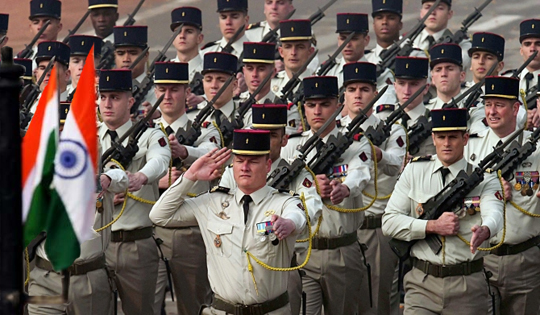
New Delhi, Jan 27: As the 124-member French military contingent marched down Rajpath amid loud cheers, they became the first foreign soldiers to take part in the Republic Day parade. But here's a fascinating fact — the moment brought the French Army, Indian Army, Pakistan Army, Tipu Sultan and the Swedish monarchy on the same side of history for the first time.
frenchregime1

The French marching contingent included 76 personnel from the 35th Infantry Regiment of the French Army (35e regiment d'infanterie). This regiment had served in India from 1781 to 1784 in its previous avatar as the 35 Aquitaine Regiment. As part of the Franco-Mysore alliance, it took part in the Second Anglo-Mysore War (1780-84), fought between the forces of the East India Company and the kingdom of Mysore under Hyder Ali and his son Tipu Sultan. The war ran parallel to the American Revolutionary War where the English were fighting their American colonies that were supported by the French.

During the war, Hyder Ali died and Tipu Sultan was forced to retreat to his capital in March 1783 when the Bombay Army invaded Mysore. The British decided to seize the opportunity to retake Cuddalore, which had been seized by Hyder from them earlier. The English advanced on Cuddalore with 1,600 European troops and 8,000 Indian troops and were joined by 1,000 cavalry of the Nawab of Arcot. Facing them were nearly 12,000 French and Indian troops, including 2,000 cavalry left behind by Tipu, under the command of Marquis de Bussy.

On June 25, 1783, the French tried to dislodge the British. At 3pm, the Aquitaine Regiment exchanged musket volleys with British and Indian troops and then conducted a bayonet charge. Facing this charge were Indian troops of the 24th Bengal Native Infantry and Madras Army. The charge was repulsed and the French withdrew with 450 men killed or wounded and 150 taken prisoners. Among those captured was Chevalier de Damas, who led the charge, and a young wounded soldier, Jean Baptiste de Bernadotte who later became a marshal in Napoleonic France and eventually became the king of Sweden. Interestingly, the House of Bernadotte still rules Sweden.

Meanwhile, the gallant action of the Indians was acknowledged and praised in England. "It was held as equally singular and extraordinary that the 24th battalion of the Bengal Sepoys, with another belonging to Madras, fought some of the oldest and best troops of France with the bayonet, and foiled them at that favourite European weapon, which is supposed to be the most trying test of the firmness and excellence of soldiers. It will probably then afford no small satisfaction to many who read this narrative, to be informed, that the general, in his address of thanks to the army, gave an assurance to those brave sepoys, that he would recommend their distinguished services to the governments of Bengal and Madras, that they, and their families, should be ever supported and rewarded according to their merit," reported the Annual Register of 1783 edited by none other than Edmund Burke.

The 24th Bengal Native Infantry later mutinied in 1857 and was disbanded, only to be re-raised in 1861. Today, it continues as the 6 Punjab Regiment of Pakistan Army.

The Aquitaine Regiment was withdrawn in 1784, while Mysore itself fell in 1799. Tipu's cavalry, which aided the French, later became the Mysore Lancers. After Independence, the Mysore, Gwalior and Jodhpur lancers were amalgamated into 61 Cavalry. On Tuesday, they marched immediately behind the French troops, as if it were a tribute to their former allies. Further back marched the brass band of the Madras Regimental Centre, the former nemesis of the French.

Comments

abumohammed
 - 
Wednesday, 27 Jan 2016

At least India Govt. look french army have latest weapons. In Our India army is still using oldest weapons, guns.. But in the filed of corruption India govt. is very new model

Add new comment

  • Coastaldigest.com reserves the right to delete or block any comments.
  • Coastaldigset.com is not responsible for its readers’ comments.
  • Comments that are abusive, incendiary or irrelevant are strictly prohibited.
  • Please use a genuine email ID and provide your name to avoid reject.
News Network
March 1,2020

Udupi/Mangaluru, Mar 1: A total of twenty leaplings were born in the hospitals of the Udupi and Dakshina Kannada (DK) districts on Saturday, February 29, district health department said on Sunday.

According to the district health department, sixteen babies were born in DK district while Udupi district saw four births. More boys than girls were born in DK (12–4) and it was the inverse in Udupi district (3–1).

Comments

Add new comment

  • Coastaldigest.com reserves the right to delete or block any comments.
  • Coastaldigset.com is not responsible for its readers’ comments.
  • Comments that are abusive, incendiary or irrelevant are strictly prohibited.
  • Please use a genuine email ID and provide your name to avoid reject.
News Network
February 11,2020

Bengaluru, Feb 11: Onion price dropped to Rs 25-30 per kg on Monday, down from the dizzying Rs 200/kg in December and January. The price had spiked because of excess rain, which ruined the crop in several parts of the country.

With supply stabilising, especially from Maharashtra and northern Karnataka, and exports banned, the rate is now easing, officials said.

Consumers may be smiling but farmers are worried as they are not able to make more than Rs 17/kg as against the expected Rs 40.

"We get onions from Nasik and Sholapur in Maharashtra. Nasik onions used to be exported but since that is currently banned, they are landing in Bengaluru, leaving the market here with a surplus," said K Lokesh, president, Karnataka State Onion Merchants Association.

A farmer from Sholapur wh o was part of a onion growers' delegation which met traders in Bengaluru, said, "The cost of everything has gone up. Labour charges and fuel prices are draining us. How can we survive? How can I pay for my children's education?"

Another Sholapur farmer rued: "My daughter's wedding is in March. How am I going to meet all the expenses? I have to pay for labour, transportation, gunny bags and when everything adds up, I don't get to save more than Rs 30,000 in a month."

Comments

Add new comment

  • Coastaldigest.com reserves the right to delete or block any comments.
  • Coastaldigset.com is not responsible for its readers’ comments.
  • Comments that are abusive, incendiary or irrelevant are strictly prohibited.
  • Please use a genuine email ID and provide your name to avoid reject.
Wafa Sultana
April 4,2020

Over the last couple of days when the world was occupied with unifying efforts to fight the deadly Covid19 pandemic, sections of Indian media provided viewers a familiar scapegoat – the Indian Muslims – who are often stereotyped as a community being constantly at loggerheads with the citizenry and the State. Biased media channels were quick to resort to blaming the entire Muslim community for the spread of the disease in the country, thanks to an ill-timed Tablighi Jamaat gathering at its international headquarters in Delhi’s Nizamuddin. Unsurprisingly, the opprobrium was also marked by a sudden spike in WhatsApp forwards of videos with people wearing skullcaps licking spoons and performing Sufi breathing rituals, suggesting some sort of wild conspiracy on the part of the community to spread the virus.  Some media channels were quick to formulate, hypothesize and provide loose definitions of a newly discovered form of Jihad i.e. ‘Corona Jihad ’ thereby vilifying the Islamic faith and its followers.

While the investigation on the culpability of the organizers of the Nizamuddin event is still ongoing, there is enough information to suggest that the meeting was held before any lockdown was in force, and the problem began when there was no way of getting people out once the curfew was announced. Be that as it may, there is little doubt that organizing a meet of such a scale when there is a global pandemic smacks of gross misjudgment, and definitely the organizers should be held accountable if laws or public orders were defied. Attendees who attempt to defy quarantine measures must be dealt with strictly. However, what is alarming is that the focus and narrative have now shifted from the unfortunate event at Nizamuddin to the Tablighi Jamaat itself.

For those not familiar with the Tablighi Jamaat, the organization was founded in 1926 in Mewat by scholar Maulana Mohammad Ilyas. The Jamaat’s main objective was to get Muslim youth to learn and practice pristine Islam shorn of external influences. This is achieved through individuals dedicating time for moral and spiritual upliftment secluded from the rest of the world for a brief period of time. There is no formal membership process. More senior and experienced participants typically travel from one mosque to other delivering talks on religious topics, inviting local youth to attend and then volunteer for a spiritual retreat for a fixed number of days to a mosque in a nearby town or village to present the message to their co-religionists. Contrary to ongoing Islamophobic rhetoric, the movement does not actively proselytize. The focus is rather on getting Muslims to learn the teachings and practices of Islam.  This grassroots India-based movement has now grown to almost all countries with substantial Muslim populations. Its annual meets, or ‘ijtemas’ are among the largest Islamic congregations in the world after the annual Haj. One of the reasons for its popularity and wide network in the subcontinent and wordwide is the fact that it has eschewed the need for scholarly intervention, focusing on peer learning of fundamental beliefs and practice rather than high-falutin ideological debates. The Tablighi Jamaat also distinguishes itself from other Islamic movements through its strictly apolitical nature, with a focus on individual self-improvement rather than political mobilization. Hardships and difficulty in the world are expected to be face through ‘sabr’ (patience) and ‘dua’ (supplication),  than through quest for political power or influence. In terms of ideology, it is very much based on mainstream Sunni Islamic principles derived from the Deobandi school.

So, why is all this background important in the current context? While biased media entities have expectedly brought out their Islamophobic paraphernalia out for full display, more neutral commentators have tried to paint the Tablighi Jamaat as a fringe group and have tried to distance it from 'mainstream Muslims'. While the intent is no doubt innocent, this is a trap we must not fall into. This narrative, unfortunately, is also gaining ground due to apathy some Muslims have for the group, accusing it of being “disconnected from the realities of the world”. Unlike other Muslim organizations and movements, the Tablighi Jamat, by virtue of its political indifference, does not boast of high-profile advocates and savvy spokespersons who can defend it in mainstream or social media.  The use of adjectives such as 'outdated' and 'orthodox' by liberal columnists to describe the Jamaat feeds into the malignant attempt to change the narrative from the control of the spread of the pandemic due to the Nizamuddin gathering to 'raison d'etre' of the organization itself.

A large mainstream religious group like the Tablighi Jamaat with nearly a hundred-year history, normally considered to be peaceful, apolitical and minding its own business is now suddenly being villainized owing to unfortunate circumstances. Biased media reactions filled with disgust and hate seem to feed the Indian public conscience with a danngerous misconception - to be a nominal Muslim is okay but being a practicing one is not.  For those committed to the truth and fighting the spread of Islamophobia, the temptation to throw the entire Tablighi Jamaat under the bus must be resisted.

The writer is a lawyer and research scholar at Qatar University. Her research interests include Islamic law and politics.

Comments

zahoorahmed
 - 
Saturday, 4 Apr 2020

great article! provides a great perspective on tableeg jamat

Add new comment

  • Coastaldigest.com reserves the right to delete or block any comments.
  • Coastaldigset.com is not responsible for its readers’ comments.
  • Comments that are abusive, incendiary or irrelevant are strictly prohibited.
  • Please use a genuine email ID and provide your name to avoid reject.