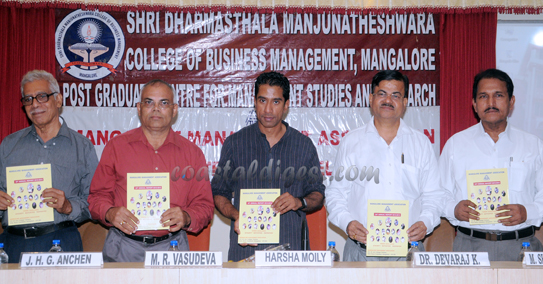
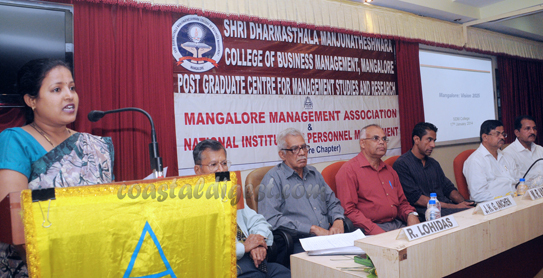
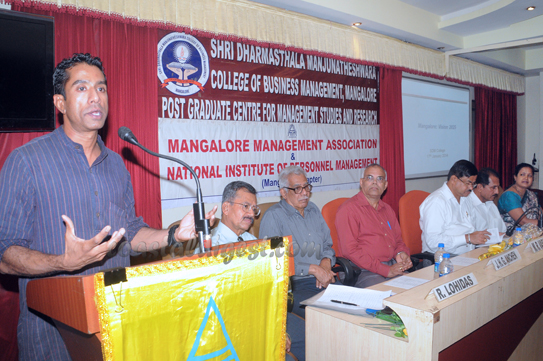
Harsha Moily: Progressive political leadership, communal harmony must for development of Dakshina Kannada

January 18, 2014

Mangalore, Jan 18: Stressing on the need for economic development in Dakshina Kannada, CEO of Milkroute, Bangalore Harsha Moily said that it was important to have progressive political leadership, dynamic leadership, an efficient social sector and communal harmony in the district.

He was speaking on the topic 'Mangalore – Vision 2025' at a programme organised by Mangalore Management Association (MMA) and National Institute of Personnel Management (NIPM) at SDM Law College in the city on Friday.

“To impact the lives of roughly 2.2 million people, create prosperity in 354 villages, make productive use of 320 kms of coastline and 4.866 sq kms of undeveloped land and maintain the rich cultures and historic sites in Dakshina Kannada, we have to make the most of the resources available to make the district economically developed,” he said.

Six key pillars for economic development

He said that there were six strategic plans to act upon, for the realisation of the 'Vision 2025' for Mangalore city and the entire district, including achieving communal harmony, development of ports and fisheries sector, transformation of agriculture sectors, turning Mangalore into an IT hub, building physical and social infrastructure and implementation of government programmes.

It is critical to achieve communal harmony in the district, as high economic prosperity is possible only when there is a stable environment. It is also important to develop the ports and fisheries sector to enable creation of more jobs for youth. There should be focus on deployment of technology in agriculture and cultivation of crops such as paddy, arecanut, coconut and others with minimum water resources, he said.

“Mangalore has the potential to become an IT hub for which there should be increased pool of qualified manpower, power infrastructure and telecom services in the city. The district also needs to focus on increasing quality of primary and secondary schools, quality of healthcare and quality of roads. For effective implementation of governmental programmes, we need to strengthen gram panchayats and get rid of corruption at every level,” he said.

Vision statement

He said that his vision statement included the right to protection, participation in decision and policy-making and prosperity for every citizen in the district.

He also said that Mangalore had a lot of potential that was yet to be tapped, and the factor of utmost importance was the execution of the action plan.

Director of SDM PG Centre Dr Devaraj K made the presidential remarks.
SDM_17_1
SDM_17_2
SDM_17_3

Comments

Add new comment

  • Coastaldigest.com reserves the right to delete or block any comments.
  • Coastaldigset.com is not responsible for its readers’ comments.
  • Comments that are abusive, incendiary or irrelevant are strictly prohibited.
  • Please use a genuine email ID and provide your name to avoid reject.
News Network
May 8,2020

Hassan, May 8: A newly married couple accidentally fell into the Hemavathi river and drowned while clicking selfies near Henneli village in the district, police said on Friday.

The deceased were identified as Kritika (23) of the same village and Artheesh (27) of Belur taluk in the district.

They got married on March 20. Both were working in Bengaluru and were in the village due to the lockdown.

Comments

Add new comment

  • Coastaldigest.com reserves the right to delete or block any comments.
  • Coastaldigset.com is not responsible for its readers’ comments.
  • Comments that are abusive, incendiary or irrelevant are strictly prohibited.
  • Please use a genuine email ID and provide your name to avoid reject.
News Network
May 12,2020

Mangaluru, May 12: Two people hailing from Udupi district tested positive for covid-19 today. The sources of this infection is said to be Mangaluru's First Neuro Hospital.

Fresh bulletin from health and family welfare department revealed that a 52-year-old woman and a 26-year-old man from Karkala in Udupi were tested positive for the deadly coronavirus.

Among them, the woman had undergone treatment at the First Neuro Hospital. She is said to have contracted the infection from P-507 who was also was tested positive  April 27. And the youth was in touch with the woman.

The duo have not visited their home in Karkala for past few days. They were in quarantine and tested positive while being admitted at the same hospital.

With this the total number of COVID-19 cases found in Dakshina Kannada district are 33 now. Three among them have died and 14 have been discharged. Now, the district has 16 active coronavirus cases.

Comments

Add new comment

  • Coastaldigest.com reserves the right to delete or block any comments.
  • Coastaldigset.com is not responsible for its readers’ comments.
  • Comments that are abusive, incendiary or irrelevant are strictly prohibited.
  • Please use a genuine email ID and provide your name to avoid reject.
Wafa Sultana
April 4,2020

Over the last couple of days when the world was occupied with unifying efforts to fight the deadly Covid19 pandemic, sections of Indian media provided viewers a familiar scapegoat – the Indian Muslims – who are often stereotyped as a community being constantly at loggerheads with the citizenry and the State. Biased media channels were quick to resort to blaming the entire Muslim community for the spread of the disease in the country, thanks to an ill-timed Tablighi Jamaat gathering at its international headquarters in Delhi’s Nizamuddin. Unsurprisingly, the opprobrium was also marked by a sudden spike in WhatsApp forwards of videos with people wearing skullcaps licking spoons and performing Sufi breathing rituals, suggesting some sort of wild conspiracy on the part of the community to spread the virus.  Some media channels were quick to formulate, hypothesize and provide loose definitions of a newly discovered form of Jihad i.e. ‘Corona Jihad ’ thereby vilifying the Islamic faith and its followers.

While the investigation on the culpability of the organizers of the Nizamuddin event is still ongoing, there is enough information to suggest that the meeting was held before any lockdown was in force, and the problem began when there was no way of getting people out once the curfew was announced. Be that as it may, there is little doubt that organizing a meet of such a scale when there is a global pandemic smacks of gross misjudgment, and definitely the organizers should be held accountable if laws or public orders were defied. Attendees who attempt to defy quarantine measures must be dealt with strictly. However, what is alarming is that the focus and narrative have now shifted from the unfortunate event at Nizamuddin to the Tablighi Jamaat itself.

For those not familiar with the Tablighi Jamaat, the organization was founded in 1926 in Mewat by scholar Maulana Mohammad Ilyas. The Jamaat’s main objective was to get Muslim youth to learn and practice pristine Islam shorn of external influences. This is achieved through individuals dedicating time for moral and spiritual upliftment secluded from the rest of the world for a brief period of time. There is no formal membership process. More senior and experienced participants typically travel from one mosque to other delivering talks on religious topics, inviting local youth to attend and then volunteer for a spiritual retreat for a fixed number of days to a mosque in a nearby town or village to present the message to their co-religionists. Contrary to ongoing Islamophobic rhetoric, the movement does not actively proselytize. The focus is rather on getting Muslims to learn the teachings and practices of Islam.  This grassroots India-based movement has now grown to almost all countries with substantial Muslim populations. Its annual meets, or ‘ijtemas’ are among the largest Islamic congregations in the world after the annual Haj. One of the reasons for its popularity and wide network in the subcontinent and wordwide is the fact that it has eschewed the need for scholarly intervention, focusing on peer learning of fundamental beliefs and practice rather than high-falutin ideological debates. The Tablighi Jamaat also distinguishes itself from other Islamic movements through its strictly apolitical nature, with a focus on individual self-improvement rather than political mobilization. Hardships and difficulty in the world are expected to be face through ‘sabr’ (patience) and ‘dua’ (supplication),  than through quest for political power or influence. In terms of ideology, it is very much based on mainstream Sunni Islamic principles derived from the Deobandi school.

So, why is all this background important in the current context? While biased media entities have expectedly brought out their Islamophobic paraphernalia out for full display, more neutral commentators have tried to paint the Tablighi Jamaat as a fringe group and have tried to distance it from 'mainstream Muslims'. While the intent is no doubt innocent, this is a trap we must not fall into. This narrative, unfortunately, is also gaining ground due to apathy some Muslims have for the group, accusing it of being “disconnected from the realities of the world”. Unlike other Muslim organizations and movements, the Tablighi Jamat, by virtue of its political indifference, does not boast of high-profile advocates and savvy spokespersons who can defend it in mainstream or social media.  The use of adjectives such as 'outdated' and 'orthodox' by liberal columnists to describe the Jamaat feeds into the malignant attempt to change the narrative from the control of the spread of the pandemic due to the Nizamuddin gathering to 'raison d'etre' of the organization itself.

A large mainstream religious group like the Tablighi Jamaat with nearly a hundred-year history, normally considered to be peaceful, apolitical and minding its own business is now suddenly being villainized owing to unfortunate circumstances. Biased media reactions filled with disgust and hate seem to feed the Indian public conscience with a danngerous misconception - to be a nominal Muslim is okay but being a practicing one is not.  For those committed to the truth and fighting the spread of Islamophobia, the temptation to throw the entire Tablighi Jamaat under the bus must be resisted.

The writer is a lawyer and research scholar at Qatar University. Her research interests include Islamic law and politics.

Comments

zahoorahmed
 - 
Saturday, 4 Apr 2020

great article! provides a great perspective on tableeg jamat

Add new comment

  • Coastaldigest.com reserves the right to delete or block any comments.
  • Coastaldigset.com is not responsible for its readers’ comments.
  • Comments that are abusive, incendiary or irrelevant are strictly prohibited.
  • Please use a genuine email ID and provide your name to avoid reject.