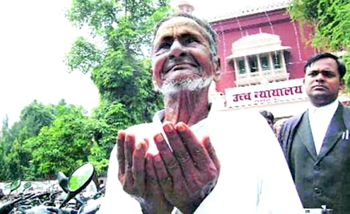
Hashim Ansari, oldest litigant in Babri Masjid case dies at 95

July 20, 2016

ansari

Ayodhya, Jul 20: The oldest litigant in the Ram Janmabhoomi-Babri mosque dispute, Mohammad Hashim Ansari died here today due to heart-related ailments.

Ansari, 95, took his last breath at his residence in the wee hours, according to his son Iqbal.

Ansari had been associated with the Babri mosque dispute case since December 1949.

In 1961, he along with six others became main plaintiff in the 'Ayodhya title suit' filed by the Sunni Central Waqf Board in the court of Faizabad civil judge.

Five other plaintiffs were Mohammad Farooq, Shahabuddin, Maulana Nisaar, Mahmood Sahab and Hashim Ansari.

He was first to file the suit in the court of civil judge of Faizabad on the matter.

Allahabad High Court in 2010 in its majority verdict allotted one-third of the disputed site in Ayodhya to Nirmohi Akahara. The other two-thirds portion has been given equally to be shared by the Waqf Board and the side representing Ram Lalla.

Soon after the verdict, Ansari had called for burying the dispute and making "a fresh start".

Comments

SK
 - 
Wednesday, 20 Jul 2016

Inna lillahi wa inna ilaihi Rajivoon..... The man who fought for the justice as per the constitution of India.......

Add new comment

  • Coastaldigest.com reserves the right to delete or block any comments.
  • Coastaldigset.com is not responsible for its readers’ comments.
  • Comments that are abusive, incendiary or irrelevant are strictly prohibited.
  • Please use a genuine email ID and provide your name to avoid reject.
coastaldigest.com news network
May 22,2020

Mangaluru, May 22: An elderly cardiac patient from Dakshina Kannada, who was stranded in Saudi Arabia due to covid-19 lock-down, has finally reached his homeland thanks to the timely intervention by Humanity Forum Jubail and Indian Social Forum.

The elderly man hailing from Kadaba area of Dakshina Kannada was admitted to a hospital in Madinah. However, his condition continued to worsen due to lack of proper treatment. The efforts by his family members to bring him back home had not yielded results.

Meanwhile, one of the relatives of the patient, Ansari Suratkal, who happens to be a DKSC activist, brought the issue to the notice of the Karnataka unit of the Indian Social Forum in Dammam. ISF contacted Humanity Forum president Zakariya Jokatte, who helped the patient to speak directly union minister D V Sadananda Gowda in a video conference organised by coastaldigest.com.

Humanity Forum also persuaded the Indian Embassy to allow the stranded cardiac patient to fly back to India through Dammam-Bengaluru repatriation flight on May 20. 

However, it was not easy for the patient to travel from Madinah to Dammam International Airport due to lock-down and curfew. ISF not only obtained travel permission for him but also arranged vehicle. Jeddah and Riyadh units of ISF helped in obtaining permission letter in their respective places in spite of travel ban imposed by the police. Madinah unit of ISF arranged vehicle for transportation. Zakariya Jokatte bore the air ticket and other expenses of the patient.

Comments

Add new comment

  • Coastaldigest.com reserves the right to delete or block any comments.
  • Coastaldigset.com is not responsible for its readers’ comments.
  • Comments that are abusive, incendiary or irrelevant are strictly prohibited.
  • Please use a genuine email ID and provide your name to avoid reject.
News Network
July 25,2020

Dubai, Jul 25: The founder of NMC Health, BR Shetty, has had a worldwide freezing order placed on his assets at the request of a lender that claims he has defaulted on a loan of more than $8 million (Dh29.4m).

The order was granted to Credit Europe Bank (Dubai) last month ahead of a claim filed at the DIFC Courts against Mr Shetty, New Medical Centre Trading and NMC Healthcare.

The lender said in its claim they “are jointly and severally liable” for the repayment of money initially secured through a credit agreement in December 2013 and renegotiated in December last year. Credit Europe Bank is an Amsterdam-headquartered institution specialising in trade and commodities finance with operations in nine countries.

The credit agreement was guaranteed by two security cheques which the bank said in its claim were signed by Mr Shetty – one drawn on his personal account and another on the account of New Medical Centre Trading – that have been "dishonoured upon presentation due to insufficient funds".

The bank claimed Mr Shetty “has now fled the jurisdiction of the UAE to India” and that there was a risk of his “substantial” assets in the Emirates being dissipated.

The assets frozen include properties in Abu Dhabi and Dubai, as well as shares in NMC Health, Finablr, BRS Investment Holdings and other companies. It allows for up to $7,000 per week to be spent on “ordinary living expenses and reasonable sum[s] on legal advice and representation”, a DIFC Courts document granting the freezing order shows.

Credit Europe Bank declined to comment when contacted by The National, stating it does not comment on ongoing litigation proceedings. Representatives for Mr Shetty and for NMC Healthcare, which is now being run by administrators Alvarez & Marsal, also declined to comment.

NMC Healthcare was founded by Mr Shetty in 1975 and grew from a single hospital into the UAE’s biggest privately-owned healthcare operator, which employed 2,000 doctors and 20,000 other staff. The company was listed on the London stock exchange and at its peak was valued at £8.58 billion (Dh40bn). However, its shares slumped after short seller Muddy Waters Research issued a report in December 2019 alleging the company had inflated its cash balances, overpaid for assets and understated its debts. This led to a string of damaging revelations by the company, including the fact that its debt was materially higher – at $6.6bn – than the $2.1bn on its balance sheet. NMC Healthcare was placed into administration in April by its biggest creditor, Abu Dhabi Commercial Bank, but its UAE businesses continue to trade as a going concern.

Mr Shetty said in a statement issued in April that he has been a victim of fraud committed by "a small group of current and former executives” at companies owned by him. He said bank accounts were created in his name and transactions were made without his knowledge, and that loans, cheques and bank transfers were also fraudulently guaranteed in his name using his forged signature.

In response to the claim filed by Credit Europe Bank (Dubai) at the DIFC Courts, Mr Shetty says he did not personally guarantee loans made to NMC Trading or NMC Healthcare and that the signatures used on cheques guaranteeing the loans are forgeries. His defence cites the opinion of “Dr Al Bah, an independent, experienced and qualified forensic document examiner”, that someone other than Mr Shetty signed the lending agreements and cheques.

An application by NMC Trading and NMC Healthcare to the DIFC Courts to have the claim against it heard in private for fear of triggering claims by other lenders – the group owes money to around 80 local, regional and international lenders – was dismissed, given that the appointment of administrators at the group and allegations of fraud at the company are already in the public domain.

Both companies have indicated to DIFC Courts that they intend to contest the claim against them.

Comments

UAE Muslim
 - 
Sunday, 26 Jul 2020

give money to RSS now to kill muslim....GOD will turn the table for moran like you BR,...shamed of tulu guy cheated the UAE govennment...not root in hell

ANONYMOUS
 - 
Saturday, 25 Jul 2020

amount should be 8 billion dollar and not 8 million dollar

Add new comment

  • Coastaldigest.com reserves the right to delete or block any comments.
  • Coastaldigset.com is not responsible for its readers’ comments.
  • Comments that are abusive, incendiary or irrelevant are strictly prohibited.
  • Please use a genuine email ID and provide your name to avoid reject.
News Network
March 24,2020

Bangalore , Mar 24: Bizom, India's leading retail intelligence platform, announced free subscription of its retailer app and tele-ordering solutions for consumer businesses in India and other emerging economies. Both solutions enable retailers to send their orders directly to the brand.
In COVID-19 times of social distancing and prophylactic measures, brands are conscious about the safety of their salespersons. Also, retailers don't want travelling salespeople to enter their premises. Consequently, many retail stores are facing stockout situations of fast-moving product categories. Bizom's self-ordering solutions help brands to avoid stockouts of their products.
Bizom trends, which analyses consumption and demand for consumer brands, showed how a near-complete shutdown during the Janta Curfew followed panic buying in early March. The asymmetrical demand and a lack of salespeople for order-taking are driving the industry towards social-distancing-based store-stocking mechanisms.
Bizom provides social-distancing-based store-stocking solutions for consumer businesses. They include the Bizom Retailer App and the Bizom Tele-ordering.
The Bizom Retailer App enables self-ordering for a brand's key retail outlets and can be implemented in under two weeks. The mobile app, a B2B shopping app, is a simple installation for retailers. It lists and groups the brand's products as per its product categories. The app's interface is no different from that of leading e-commerce apps. All the user has to do is select the preferred SKUs and add them to their shopping carts.
The app also allows brands to customize the app to meet the requirements of their continually changing product categories. For instance, if an SKU runs out of stock, the brand can disable the given SKU from the app.
With the Bizom Retailer App, brands can take orders directly from retailers instead of the traditional order-taking approach, which requires high-touch from a salesperson. Some of the key features of the app are, the ability to provide product information directly through retailers including SKUs, competitor comparison and pricing.
It also enables self-ordering from the retailer to maintain the flow of products as per demand, enables scheme rollout information through a notification on the app rather than through salespeople, tracks delivery of goods to the retailer and enables incentive payments to retailers directly rather than through distributor claims.
With Bizom Tele-ordering, as the sales teams go remote, the tele-ordering solution will become useful for brands who want to get salespeople to take orders from retailers, remotely. It ensures continued service to outlets despite not being physically present in the market.
Here, salespeople can discuss product requirements with retailers and enter orders based on specific outlet types (grocery, chemist etc.), outlet class (Class A, Class B etc.) or based on their beat or as per a distributor.
The key features of the Bizom Tele-ordering solution are, its ability to help salespeople collect orders from retailers remotely and enter it for fulfilment into Bizom using a tool, the flexibility offered to salespeople for remote servicing of retailers as per outlet type, beat, distributor area etc., secondary schemes get applied automatically, variable discounts will get applied as applicable at an SKU level.
"At Bizom, we are conscious of our responsibility to help brands run faster during these COVID-19 times. Our solutions of Bizom Retailer App and Bizom Tele-ordering have been built to ensure that brands can leverage this situation of low direct touch with retailers to enable a better way of working, remotely. I am trying to help brands go live in a few days so that they, in turn, can serve consumers better during these testing times," said Lalit Bhise, CEO, Bizom.

Comments

Add new comment

  • Coastaldigest.com reserves the right to delete or block any comments.
  • Coastaldigset.com is not responsible for its readers’ comments.
  • Comments that are abusive, incendiary or irrelevant are strictly prohibited.
  • Please use a genuine email ID and provide your name to avoid reject.