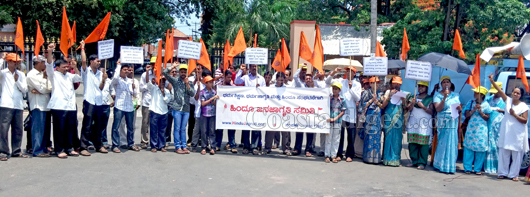
Hindutva outfit launches campaign to ban Fajr Adhan in India

[email protected] (CD Network)
May 25, 2014

Mangalore, May 25: In a controversial demand that may spark widespread uproar, a less popular Hindutva outfit has called for a strict ban on dawn Adhan (Fajr prayer call from Masjids) across India.

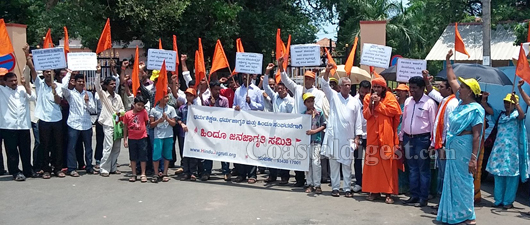
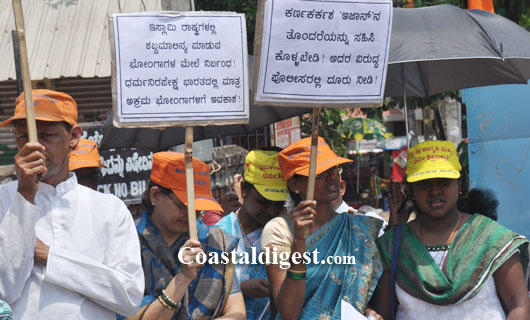
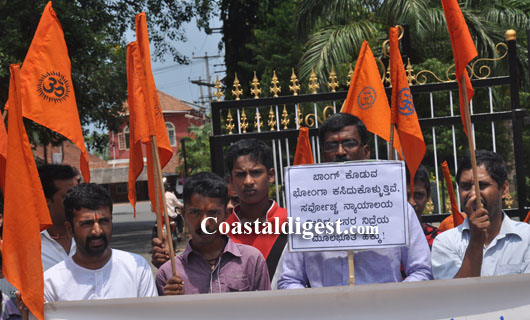
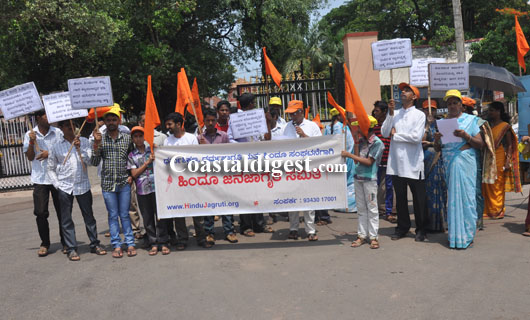
On Sunday morning, dozens of Hindutva activists including a controversial swamiji, who had earlier tried to commit suicide, staged a protest in front of the office of Deputy Commissioner in Mangalore to pressurize the authorities concerned to strictly impose ban on Adhan during early morning.

The protest was held under the banner of Rashtriya Hindu Andolan and some of the protesters were displaying the banner of Hindu Janjagruti Samiti, an extremist Hindutva outfit. The protest comes a day ahead of Prime Minister-designate Narendra Modi 's swearing-in ceremony.

Speaking on the occasion, Sanatan Sanstha activist Vijayalakshmi said that even though India has granted religious freedom for all the people, followers of one religion should not misuse this freedom to disturb the followers of other religions in the society.

Using a derogatory word for Adhan, she said that when Muslims shout using loudspeakers every morning they should know that it would disturb sleep of a majority of people in the society.

Hindu Janajagruti Samiti activist Vivek Pai said that the right to sleep peacefully is also comes under the ambit of fundamental rights of every Indian citizen. “The use of loudspeakers should not be permitted from 10 p.m. to 6 a.m. The supreme court also had directed to impose ban on playing loud music or making any type of noise between 10 p.m. and 6 a.m. However, this ban has not been applied to the early morning Adhan,” he said adding that in some places Muslims deliberately cause noise pollution through loudspeakers in the early morning.  

He said that those who use loudspeakers for Adhan before 6 a.m. in the morning should be arrested and punished.

Rashtriya Hindu Andolan activist Ramesh Nayak said that many Masjids are located in the area of schools, colleges, hostels and hospitals. Loudspeakers used by such Masjids will always cause problems for students and patients, he added.

Bharat Kranti Sena chief Pranavananda Swami, who had tried to commit suicide in January this year to pressurize government to ban a Christian televangelist 's programme in Bangalore, said that protest against morning Adhan will continue until a strict ban on that ritual will come into force in the entire country.

Sri Ram Sena leader Kumar Malemar, Hindu Yuva Sena leader Nagesh Bajalekari were also present among others in the protest.

Hindu Janajagrathi samithi 4

Hindu Janajagrathi samithi 1

Hindu Janajagrathi samithi 2

Hindu Janajagrathi samithi 3

Hindu Janajagrathi samithi 5

Comments

Abdul Rahman
 - 
Sunday, 6 Nov 2016

Fertility Rate : Buddhist 1.6 Jews 2.4 Hindus 2.6 Christians 2.8 Muslims _3.1 - PEW Research Centre . Don't dare to inflict Muslims..2070 is not very far...

Abdul Rahman
 - 
Sunday, 6 Nov 2016

Fertility Rate : Buddhist 1.6 Jews 2.4 Hindus 2.6 Christians 2.8 Muslims _3.1 - PEW Research Centre . Don't dare to inflict Muslims..2070 is not very far...

Abdul Rahman
 - 
Sunday, 6 Nov 2016

Please ban ringing of the bells and geeta recitation on microphone then we will happily stop the fajr azan..

shaikh
 - 
Saturday, 29 Oct 2016

if you want to ban adhan due to noise pollution ..... than what about crackers you use in diwali and colors mixed in water use in holis which may also harm society in the form of pollution....i am sorry to say that if it is wrong..... islam is a religion of peace.....no one have any authority to ban azaan-e-fajr or any other islamic works .......

A Citizen
 - 
Tuesday, 25 Oct 2016

Extremists on either side have rarely any agenda to make welfare of this country, its people. Most are found to be hypocrites. I had seen one of them. Brainwashing youngsters for self gain. These people can't be stopped till the end, but they can be suppressed. If good people fail to prevail, all shall perish with the corruption they would spread in land. As far as their demand is concerned, everyone knows how bad a place they all have made their Mangalore.

aleena fatima
 - 
Wednesday, 19 Oct 2016

Ye sab Jo fajar azaan Ko ban kar rahe hai na wo firaun ka kaam kar rahe hai jab Allah subhanahutala ka azaab in par barsega na tab inko pata lage ga Allah inko nistonabut karde ye sab fanah o fillah hojayeinge or hum dekheinge inko kitni aaram Ki neend soyeinge yeh log or yeh bolte phirte hai k India is a secular state kuch toh seekhte father of the nation gandhiji se unohne kabhi Muslims or non Muslims Main farq nahi kiya

Shouket
 - 
Thursday, 26 May 2016

When india and Pakistan was carved at that time india didn't claim that its going to make a hindu nation. Rather nehru and ghandi asked Muslims to stay in india as this is going to be a secular state. Thats y muslims didn't shift to Pakistan. And now if somebody is forcing muslims to vacate from india then he/she declining the fundamental claims of the founding forefathers of india. If someone denies the dictations of father he/she should be called a bastard who doesnt respect their parents.

Add new comment

  • Coastaldigest.com reserves the right to delete or block any comments.
  • Coastaldigset.com is not responsible for its readers’ comments.
  • Comments that are abusive, incendiary or irrelevant are strictly prohibited.
  • Please use a genuine email ID and provide your name to avoid reject.
News Network
March 5,2020

Mar 5: The Karnataka government on Thursday proposed to increase rate of tax on petrol and diesel by three per cent which would make the fuel dearer by Rs 1.60 and Rs 1.59 per litre, respectively.

Presenting the 2020-21 budget in the Legislative Assembly, Chief Minister B S Yediyurappa proposed to increase rate of tax on petrol from 32 per cent to 35 per cent and diesel from 21 per cent to 24 per cent, as part of additional resource mobilisation measures.

Yediyurappa, who also holds the finance portfolio, increased excise duty on Indian Made Liquor (KML) across 18 slabs by six per cent.

However, to promote affordable housing, the government proposed to reduce stamp duty on first time registration of new apartments/flats costing less than Rs 20 lakh from existing five per cent to two per cent.

This is the first budget of the BJP government after coming to power last year; it's the seventh presented by Yediyurappa.

"For the year 2020-21, a total amount of Rs 55,732 crore is provided for stimulating economic growth sector", the Chief Minister said.

He said the revenue collection target for the Commercial Taxes department for the year 2020-21 is fixed at Rs 82,443 crore.

Stating the government had fixed a revenue target of Rs 20,950 crore for the excise department for the year 2019- 20, he said at the end of February Rs 19,701 crore had been collected.

"We hope to achieve the budget target."

He also hoped with the increase in rates and effective enforcement and regulatory measures, the Excise department would be achieving the target of Rs 22,700 crore fixed for the financial year 2020-21.

On the transport sector, Yediyurappa said it is proposed to levy motor vehicle tax on contract carriages having seating capacity to carry more than 12 passengers, but not more than 20 passengers at the rate of Rs 900 per seat per quarter.

He said it is also proposed to levy vehicle tax on new model sleeper coaches which are granted permits under section 88 (9) of MV Act 1988 at the rate of Rs 4,000 per sleeper per quarter.

Noting that a target of Rs 7,100 crore revenue collection is expected to be achieved in 2019-20 in transport sector, he said for 2020-21 revenue collection target has been fixed at Rs 7,115 crore.

He said the revenue collection target for 2019-20 under stamps and registration was fixed at Rs 11,828 crore and against this Rs 10,248 crore has been collected till the end of February 2020 which is 87 per cent of full year target.

While the revenue collection target for 2020-21 under stamps and registration is fixed at Rs 12,655 crore.

Comments

Add new comment

  • Coastaldigest.com reserves the right to delete or block any comments.
  • Coastaldigset.com is not responsible for its readers’ comments.
  • Comments that are abusive, incendiary or irrelevant are strictly prohibited.
  • Please use a genuine email ID and provide your name to avoid reject.
News Network
January 20,2020

Mysuru, Jan 20: Fears over CAA and proposed NRC have affected the ongoing 7th economic census. Following complaints of violence against enumerators and registration of FIR with people declining to give information, the state government has asked deputy commissioners and superintendents of police to hold awareness programmes about it.

The planning, programme monitoring & statistics department has requested the home department to provide cooperation at the police station level while additional chief secretary P Ravi Kumar, in his letter to all DCs, has asked them to create awareness. According to sources, enumerators in T Narasipura town of Mysuru district faced resistance as some residents misunderstood the reason for this census.

A senior officer of the directorate of economics and statistics said that additional chief secretary (ACS- Planning, Programme Monitoring & Statistics Department) Shalini Rajneesh has written to the home department and superintendents of police of all districts seeking their help to create awareness about the economic census.

According to sources in the directorate, in many places, people are refusing to share information under the misconception that it is related to CAA/ NRC. “Many are mistaken about the economic census. As a precaution, police help has been sought,” an officer said.

Authorities in Mysuru said the 7th economic census began on December 20 and will conclude on March 30.

“In Mysuru city alone, we need to cover a population of 11 lakh. In T Narasipura, we faced problems due to misconceptions about Census and CAA. We reported the incident which happened in an area where minorities reside in large numbers,” he explained. Mysuru SP CB Rishyanth said his office has not received any direction in this matter.

Comments

Add new comment

  • Coastaldigest.com reserves the right to delete or block any comments.
  • Coastaldigset.com is not responsible for its readers’ comments.
  • Comments that are abusive, incendiary or irrelevant are strictly prohibited.
  • Please use a genuine email ID and provide your name to avoid reject.
Ram Puniyani
January 14,2020

In the beginning of January 2020 two very disturbing events were reported from Pakistan. One was the attack on Nankana Sahib, the holy shrine where Sant Guru Nanak was born. While one report said that the place has been desecrated, the other stated that it was a fight between two Muslim groups. Prime Minister of Pakistan Imran Khan condemned the incident and the main accused Imran Chisti was arrested. The matter related to abduction and conversion of a Sikh girl Jagjit Kaur, daughter of Pathi (One who reads Holy Guru Granth Sahib in Gurudwara) of the Gurudwara. In another incident one Sikh youth Ravinder Singh, who was out on shopping for his marriage, was shot dead in Peshawar.

While these condemnable attacks took place on the Sikh minority in Pakistan, BJP was quick enough to jump to state that it is events like this which justify the Citizenship Amendment Act (CAA). Incidentally CAA is the Act which is discriminatory and relates to citizenship with Religion, which is not as per the norms of Indian constitution. There are constant debates and propaganda that population of Hindus has come down drastically in Pakistan and Bangla Desh. Amit Shah, the Home minister stated that in Pakistan the population of Hindus has come down from 23% at the time of partition to 3.7% at present. And in Bangla Desh it has come down from 22% to present 8%.

While not denying the fact that the religious minorities are getting a rough deal in both these countries, the figures which are presented are totally off the mark. These figures don’t take into consideration the painful migrations, which took place at the time of partition and formation of Bangla Desh later. Pakistan census figures tell a different tale. Their first census was held in 1951. As per this census the overall percentage of Non Muslim in Pakistan (East and West together) was 14.2%, of this in West Pakistan (Now Pakistan) it was 3.44 and in Eat Pakistan it was 23.2. In the census held in Pakistan 1998 it became 3.72%. As far as Bangla Desh is concerned the share of Non Muslims has gone down from 23.2 (1951) to 9.6% in 2011.

The largest minority of Pakistan is Ahmadis, (https://minorityrights.org/country/pakistan/) who are close to 4 Million and are not recognised as Muslims in Pakistan. In Bangla Desh the major migrations of Hindus from Bangla Desh took place in the backdrop of Pakistan army’s atrocities in the then East Pakistan.

As far as UN data on refugees in India it went up by 17% between 2016-2019 and largest numbers were from Tibet and Sri Lanka.  (https://www.un.org/en/development/desa/population/migration/publication…)

The state of minorities is in a way the index of strength of democracy. Most South Asian Countries have not been able to sustain democratic values properly. In Pakistan, the Republic began with Jinnah’s classic speech where secularism was to be central credo of Pakistan. This 11th August speech was in a way what the state policy should be, as per which people of all faiths are free to practice their religion. Soon enough the logic of ‘Two Nation theory” and formation of Pakistan, a separate state for Muslim took over. Army stepped in and dictatorship was to reign there intermittently. Democratic elements were suppressed and the worst came when Zia Ul Haq Islamized the state in collusion with Maulanas. The army was already a strong presence in Pakistan. The popular formulation for Pakistan was that it is ruled by three A’s, Army, America and Allah (Mullah).

Bangla Desh had a different trajectory. Its very formation was a nail in the coffin of ‘two nation theory’; that religion can be the basis of a state. Bangla Desh did begin as a secular republic but communal forces and secular forces kept struggling for their dominance and in 1988 it also became Islamic republic. At another level Myanmar, in the grip of military dictatorship, with democratic elements trying to retain their presence is also seeing a hard battle. Democracy or not, the army and Sanghas (Buddhist Sang has) are strong, in Myanmar as well. The most visible result is persecution of Rohingya Muslims.

Similar phenomenon is dominating in Sri Lanka also where Budhhist Sanghas and army have strong say in the political affairs, irrespective of which Government is ruling. Muslim and Christian minorities are a big victim there, while Tamils (Hindus, Christians etc.) suffered the biggest damage as ethnic and religious minorities. India had the best prospect of democracy, pluralism and secularism flourishing here. The secular constitution, the outcome of India’s freedom struggle, the leadership of Gandhi and Nehru did ensure the rooting of democracy and secularism in a strong way.

India so far had best democratic credentials amongst all the south Asian countries. Despite that though the population of minorities rose mainly due to poverty and illiteracy, their overall marginalisation was order of the day, it went on worsening with the rise of communal forces, with communal forces resorting to identity issues, and indulging in propaganda against minorities.

While other South Asian countries should had followed India to focus more on infrastructure and political culture of liberalism, today India is following the footsteps of Pakistan. The retrograde march of India is most visible in the issues which have dominated the political space during last few years. Issues like Ram Temple, Ghar Wapasi, Love Jihad, Beef-Cow are now finding their peak in CAA.

India’s reversal towards a polity with religion’s identity dominating the political scene was nicely presented by the late Pakistani poetess Fahmida Riaz in her poem, Tum bhi Hum Jaise Nikle (You also turned out to be like us). While trying to resist communal forces has been an arduous task, it is becoming more difficult by the day. This phenomenon has been variously called, Fundamentalism, Communalism or religious nationalism among others. Surely it has nothing to do with the religion as practiced by the great Saint and Sufi traditions of India; it resorts mainly to political mobilization by using religion as a tool.


Comments

Ashi
 - 
Tuesday, 14 Jan 2020

If Malaysia implement similar NRC/CAA, India and China are the loser.

Add new comment

  • Coastaldigest.com reserves the right to delete or block any comments.
  • Coastaldigset.com is not responsible for its readers’ comments.
  • Comments that are abusive, incendiary or irrelevant are strictly prohibited.
  • Please use a genuine email ID and provide your name to avoid reject.