


Huge rallies in Turkey mark failed 2016 coup

Agencies
July 16, 2017

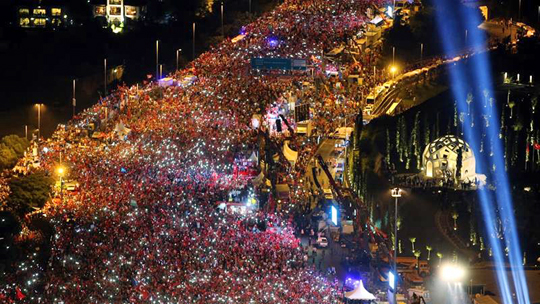
Turkey, Jul 16: Tens of thousands of people gathered at a massive rally in Istanbul, marking one year since the defeat of the coup aimed at ousting President Recep Tayyip Erdogan from power.
Turkey

Joining the crowd gathered on Saturday at the Bosphorus Bridge, now known as the July 15 Martyr's Bridge, Erdogan threatened to "chop off the heads" of those involved in the coup.

"First of all we will chop off the heads of those traitors," Erdogan said as reaffirmed previous comments to sign any bill passed restoring capital punishment.

"We are a state governed by rule of law. If it comes to me after parliament, I will sign it," he said. Restoring the death penalty would effectively end Ankara's European Union membership ambitions.

Erdogan also praised the "people's faith" in facing up the armed coup plotters.

Erdogan arrived from the capital Ankara on his official plane accompanied by an F-16 fighter jet, news agency reported.

The authorities declared July 15 an annual national holiday of "democracy and unity", billing the foiling of the putsch as a historic victory of Turkish democracy.

"It's one year since the darkest night was turned into an epic," Prime Minister Binali Yildirim told a special session of parliament that kicked off a day of celebrations set to last until dawn.

He said the night of July 15 was a "second War of Independence" after the war that led to the creation of the modern Turkish state in the ruins of the Ottoman Empire in 1923.

About 249 people, not including the plotters, were killed when a disgruntled faction of the army sent tanks into the streets and war planes into the sky in a bid to overthrow Erdogan.

But they were thwarted within hours as the authorities regrouped and people poured into the streets in support of Erdogan, who blamed followers of his ally-turned-nemesis, the US-based preacher Fethullah Gulen.

Tens of thousands carried the Turkish flag while others brandished pictures of the "martyrs" who died defeating the coup bid as a sea of people stretched from the bridge.

People chanted "we are soldiers of Tayyip [Erdogan]" and called for the reinstatement of the death penalty for the coup plotters, with some even brandishing nooses.

At 2100 GMT, people across Turkey took part in "democracy watches", rallies commemorating how people poured out into the streets.

'Post-coup purge'

In the wake of the failed coup bid, authorities embarked on the biggest purge in Turkey's history, arresting 50,000 people and sacking almost three times as many. Erdogan also shored up his position by winning a referendum on enhancing his powers earlier this year.

In the latest dismissals, another 7,563 police, soldiers and other state employees were fired late on Friday under the state of emergency that has been in place since July 20 last year.

Turkey's opposition put political disputes aside on the night of the putsch.

Erdogan, who was present at the session, gazed down stonily from the VIP balcony.

Erdogan later returned to Ankara and, at 2300 GMT, gave a speech in parliament to mark the time the building was bombed last year.

Al Jazeera's Sinem Koseoglu, reporting from Ankara, said Erdogan, in his speech in front of the parliament, said the fight against the treason will continue.

"In front of the parliament, the president emphasised its importance. He also said they will continue efforts to clean the institution of the Gulen group within the state," she said.

"Erdogan also named the coup plotters as traitors, saying the fight against treason will conitnue."

The coup bid also frayed ties between the United States and European Union with NATO member Turkey, which accused its allies of failing to show solidarity.

Gulen has always denied involvement and in a new statement Friday said the accusations were "baseless, politically motivated slanders" and slammed a "witch hunt" of Erdogan's critics.

Comments

hussain
 - 
Tuesday, 18 Jul 2017

very funny , promoter of shirk became promoter of peace. ))

Add new comment

  • Coastaldigest.com reserves the right to delete or block any comments.
  • Coastaldigset.com is not responsible for its readers’ comments.
  • Comments that are abusive, incendiary or irrelevant are strictly prohibited.
  • Please use a genuine email ID and provide your name to avoid reject.
News Network
May 7,2020

Dubai, May 7: As India begins the world’s largest evacuation mission by repatriating its overseas citizens stranded due to COVID-19, as many as 354 of them from the UAE will fly into their home country in the first two flights to Kerala today.

An Air India Express flight, which is scheduled to take off from Abu Dhabi to Kochi at 4.15 pm is the first flight, which will be followed by a Dubai-Kozhikode flight of the same airline at 5.10pm. The Indian missions in the UAE finalised the list of passengers, who were chosen based on the compelling reasons they submitted while registering their names.

Selection criteria

These include pregnant women and their accompanying family members in some instances, people with medical emergencies, workers and housemaids in distress, families with cancelled visas, bereaved family members who couldn’t attend funerals back home, a few students and stranded visitors and tourists including two brothers who got stranded in Dubai International Airport for 50 days, the missions said.

Short-listing the first passengers from among a database of more than 200,000 applicants, who include around 6,500 pregnant women, has been a mammoth task which posed several challenges for the missions, Neeraj Agrawal, Consul Press, Information and Culture at the Indian Consulate in Dubai told Gulf News.

He said the consulate set up an operations room in a tie-up with community volunteers from Kerala Muslim Cultural Centre, Indian Association Ajman, AKCAF Task Force, the BAPS Mandir, Indian People’s Forum, and Tamil Ladies’ Sangam.

 “We are trying to accommodate as many deserving people as possible. We expect the understanding of the people. It has been very difficult to sort out everyone’s urgency.”

“We cannot do a lottery system in this and we had to make sub- categories to ensure there is a mix of people with different types of urgencies.”

“Though we want to give priority to pregnant women, it is practically not possible and not good for the health and safety of the applicants to allot a lot of them on the same flight.”

He said 11 pregnant women have been issued tickets on the Dubai-Kozhikode flight.

“That is the threshold we can allow on a flight.”

Volunteer support

The consul appreciated the support of the volunteers in finalising the flight manifest.

“But our response ratio was very less. Many people whose names came up on top of the list were not willing to go on the first flights.”

Due to various constraints like this and sometimes the details of accompanying persons not readily being available, he said the mission was not able to quickly reach out to who might be really in need.

“However, we have given due consideration to people who got in touch with us with their emergency needs. At the time of issuing tickets, we had about 20 such cases.”

He said the Consul General of India in Dubai Vipul led the entire operation and Pankaj Bodkhe, consul, education, was in charge of the Dubai flight.

A big challenge

“It has been a big challenge. Our only concern is that despite our best efforts, sometimes people with more compelling reasons might have got left out on the first flights because of the volume of people who have reached out to us.”

Since there is a chance that some passengers with tickets might not be allowed to fly if they fail the medical screening including blood tests to check antibodies for COVID-19, he said some applicants in the waiting list have been asked to be on standby at the airport.

People with emergencies wishing to fly to other destinations also could not be included, he pointed out.

“We had to ask them to wait. We are unable to send them to other destinations. We can see their desperation. We feel sorry and desperate.”

He said the government is trying to add more flights to un-chartered destinations and a new flight from Dubai to Kannur has been added on May 12.

Passengers of today’s flights have been urged to reach the airport four to five hours prior to departure to facilitate the medical screening.

Comments

Add new comment

  • Coastaldigest.com reserves the right to delete or block any comments.
  • Coastaldigset.com is not responsible for its readers’ comments.
  • Comments that are abusive, incendiary or irrelevant are strictly prohibited.
  • Please use a genuine email ID and provide your name to avoid reject.
Agencies
February 27,2020

Riyadh, Feb 27: Saudi Arabia on Thursday halted travel to the holiest sites in Islam over fears about a new viral epidemic just months ahead of the annual hajj pilgrimage, a move coming as the Mideast has over 220 confirmed cases of the illness.

The extraordinary decision by Saudi Arabia stops foreigners from reaching the holy city of Mecca and the Kaaba, the cube-shaped structure the world's 1.8 billion Muslims pray toward five times a day. It also said travel was suspended to Prophet Muhammad's mosque in Medina.

The decision showed the worry about the outbreak potentially spreading into Saudi Arabia, whose oil-rich monarchy stakes its legitimacy on protecting Islam's holy sites. The epicenter in the Mideast's most-affected country, Iran, appears to be in the holy Shiite city of Qom, where a shrine there sees the faithful reach out to kiss and touch it in reverence.

"Saudi Arabia renews its support for all international measures to limit the spread of this virus, and urges its citizens to exercise caution before traveling to countries experiencing coronavirus outbreaks," the Saudi Foreign Ministry said in a statement announcing the decision.

"We ask God Almighty to spare all humanity from all harm." Disease outbreaks always have been a concern surrounding the hajj, required of all able-bodied Muslims once in their life, especially as pilgrims come from all over the world.

The earliest recorded outbreak came in 632 as pilgrims fought off malaria. A cholera outbreak in 1821, for instance, killed an estimated 20,000 pilgrims. Another cholera outbreak in 1865 killed 15,000 pilgrims and then spread worldwide.

More recently, Saudi Arabia faced a danger from a related coronavirus that caused Middle East respiratory syndrome, or MERS. The kingdom increased its public health measures in 2012 and 2013, though no outbreak occurred.

While millions attend the 10-day hajj, this year set for late July into early August, millions more come during the rest of the year to the holy sites in the kingdom.

"It is unprecedented, at least in recent times, but given the worldwide spread of the virus and the global nature of the umrah, it makes sense from a public health and safety point of view," said Kristian Ulrichsen, a research fellow at the James A Baker III Institute for Public Policy at Rice University. "Especially since the Iranian example illustrates how a religious crossroads can so quickly amplify the spread and reach of the virus." The virus that causes the illness named COVID-19 has infected more than 80,000 people globally, mainly in China. The hardest-hit nation in the Mideast is Iran, where Health Ministry spokesman Kianoush Jahanpour said 19 people have died among 139 confirmed cases.

Experts are concerned Iran may be underreporting cases and deaths, given the illness's rapid spread from Iran across the Persian Gulf. For example, Iran still has not confirmed any cases in Mashhad, even though a number of cases reported in Kuwait are linked to the Iranian city.

In Bahrain, which confirmed 33 cases as of Thursday morning, authorities halted all flights to Iraq and Lebanon. It separately extended a 48-hour ban overflights from Dubai and Sharjah in the United Arab Emirates, through which infected travellers reached the island kingdom off the coast of Saudi Arabia.

Iranian President Hassan Rouhani said there were no immediate plans to quarantine cities but acknowledged it may take "one, two or three weeks” to get control of the virus in Iran.

As Iran's 80 million people find themselves increasingly isolated in the region by the outbreak, the country's sanctions-battered economy saw its currency slump to its lowest level against the US dollar in a year on Wednesday.

Comments

Add new comment

  • Coastaldigest.com reserves the right to delete or block any comments.
  • Coastaldigset.com is not responsible for its readers’ comments.
  • Comments that are abusive, incendiary or irrelevant are strictly prohibited.
  • Please use a genuine email ID and provide your name to avoid reject.
Agencies
June 28,2020

Kuwait, Jun 28: Measures imposed to curb the spread of the novel coronavirus in Kuwait are believed to have increased suicide cases in the country, according to a media report.

Forty suicide cases and 15 failed attempts, mainly among Asian expatriates, have been recorded in Kuwait since late February, Gulf News quoted the Al Qabas newspaper report, citing sources as saying on Saturday.

Investigations into the majority of cases have revealed that those who committed suicide had experienced psychological and economic troubles due to dire financial circumstances after their employers stopped to pay them as a result of economic fallout from the coronavirus-related measures.

In one case, an expat livestreamed his suicide while chatting with his fiancee on a social networking platform, the newspaper report said.

Suicide cases have increased by around 40 per cent since the start of the COVID-19 crisis, according to the sources.

Some 70 to 80 suicide cases are recorded annually in Kuwait. Last year, they reached 80 suicides against 77 in 2018.

"Suicide cases have started to go up in Kuwait during the coronavirus pandemic due to fear, anxiety, isolation and instability experienced by people and absence of daily aims that could help the person to spend time regularly as before," the newspaper quoted social psychology consultant Samira Al Dosari as saying.

Uncertainty for some expatriates, whose countries have refused to take them in, is another motive for attempting suicide, according to Jamil Al Muri, a sociology professor at the Kuwait University.

"This is in addition to greed of the iqamat traders, who have brought into the country workers in names of phantom companies and abandoned them on the streets," he added.

Starting from Tuesday, Kuwait will embark on the second phase of a stepwise plan to bring life to normal, Gulf News reportd.

According to Phase 2, a nationwide night-time curfew will be reduced by one hour to run daily from 8 p.m. until 5 a.m. for three weeks.

Kuwait has so far reported 44,391 COVID-19 cases, with 344 deaths.

Comments

Angry indian
 - 
Tuesday, 30 Jun 2020

YA ALLah save all dispressed people in the earth..

Add new comment

  • Coastaldigest.com reserves the right to delete or block any comments.
  • Coastaldigset.com is not responsible for its readers’ comments.
  • Comments that are abusive, incendiary or irrelevant are strictly prohibited.
  • Please use a genuine email ID and provide your name to avoid reject.