



New Delhi, Jul 5: India will host heads of at least 10 South East Asian nations on its Republic Day next year, making a major outreach to a region often perceived as the “backyard” of China.
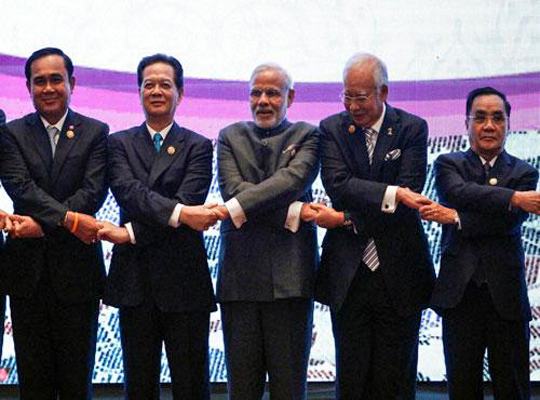
Though New Delhi has since long been hosting a foreign leader as the chief guest on the occasion of the Republic Day every year; this is going to be the first time when as many as 10 heads of states and governments will grace the ceremony on January 26.
New Delhi already started reaching out to the leaders of the Association of South East Asia Nations (or ASEAN) – Brunei, Indonesia, Cambodia, Lao PDR, Malaysia, Myanmar, Phillippines, Singapore, Thailand and Vietnam. Once the successor of President Pranab Mukherjee is elected by the end of this month, the Rashtrapati Bhavan will start the process of sending out the formal invitations to all the ASEAN leaders, sources told the Deccan Herald.
While President will host the South East Asian leaders on the Republic Day ceremony, Prime Minister Narendra Modi will join them in a special India-ASEAN summit, which will commemorate 25 years of New Delhi's dialogue partnership with the 10-nation bloc.
New Delhi's move to invite the ASEAN leaders to the Republic Day ceremony next year is apparently aimed at giving a fillip to implementation of its “Act East” policy for stepping up India's engagement with South East Asia where China seeks to maintain and expand its influence.
“We are making efforts on all fronts to enhance physical and digital connectivity,” External Affairs Minister Sushma Swaraj said on Tuesday. “The future focus areas of cooperation between ASEAN member states and India can be described in term of 3C’s- commerce, connectivity and culture,” she added, while speaking on the “Charting the Course for India-ASEAN relations for the next 25 Years” at an event in New Delhi. She underlined that India and ASEAN were “natural partners”.
Vietnam, Brunei, Malaysia and Phillippines are among countries which have a territorial dispute with China over the South China Sea. Some of the ASEAN nations, however, have close economic relations with China.
“The ASEAN supports India to play a greater role in the political and security domain, and create a regional rules-based region. We hope India will continue to partner our efforts for strategic security and freedom of navigation in the South China Sea on the basis of international law and legal convention,” Pham Binh Minh, Deputy Prime Minister and Foreign Minister of Vietnam, said in New Delhi on Tuesday.
New Delhi's relations with Beijing worsened in the past few months. New Delhi is upset over China's opposition to India's entry to the Nuclear Suppliers Group and its policy to shield Pakistan-based anti-India terrorists from United Nations' sanctions. New Delhi is opposed to Beijing's One-Belt-One-Road connectivity initiative, which includes an economic corridor proposed to pass through areas India claims as its own and accuses Pakistan of illegally occupying.
New Delhi suspects that China's OBOR initiative is in fact aimed at expanding the footprint of the communist country across the continents. India has already been jittery about the strategic assets China is seeking to acquire or build in Indian Ocean region.
“ASEAN and India are natural partners that share geographical, historical and civilisational ties. The cultural highway that linked the rivers Ganga, Brahmaputra, Meghna, Irrawaddy and Mekong and those who dwelt on their banks, enriched our shared civilizational ethos in a two-way process,” said Swaraj, stressing: “It is important to note that this inter-mingling happened without any ‘conquest or colonisation'.”
Beijing is upset over India's growing defence ties and strategic convergence with US and Japan in Asia-Pacific, its calls for maintaining freedom of navigation in the South China Sea and its appeal to China to resolve its maritime disputes in accordance with United Nations Conventions on Law of the Sea. Beijing was also irked by New Delhi's decision to allow Tibetan leader Dalai Lama to visit India's northeastern state Arunachal Pradesh which China claims as a part of its territory.
The current face-off between soldiers of Indian Army and Chinese People's Liberation Army at Doklam Plateau in western Bhutan further strained relations between India and China, which share a long disputed border.
India turned its “Look East” policy into more proactive “Act East” policy in 2014 to add new momentum to its engagement with the ASEAN. New Delhi is of the view that India will have to focus more on its relations with South East Asian nations if it has to emerge as a major power in Asia Pacific and counter the growing influence of China in the region.
“India has been working with ASEAN towards evolving regional security architecture in the Asia Pacific that hinges on emphasising the peaceful settlement of disputes, finding collaborative solutions to emerging and non-traditional challenges, and support for the centrality of ASEAN,” Swaraj said at another event on June 22.
When New Delhi became a dialogue partner of the ASEAN in 1992; India's total trade with all the 10 members of the bloc was worth less than $ 5 billion. But, 25 years later, the ASEAN has become India's 4th largest trading partner, accounting for 10% of its total trade. The trade volume went up to $ 76.53 billion in 2014-15, although it declined to $ 65.04 billion in 2015-16, essentially due to declining commodity prices amidst a general slowing down of the global economy. India-ASEAN trade however registered an 8 % increase in 2016-17 as compared to the previous year. India's exports to ASEAN increased by almost 20% in 2016-17. The ASEAN-India free trade agreement played a major role in giving a boost to trade in goods and services.
India elevated its relations with the ASEAN to the level of strategic partnership in 2012. The special India-ASEAN summit in January 2018 will further boost the ties, sources told the DH in New Delhi.
The choice of the chief guest for the Republic Day ceremony always reflects the foreign policy priority and strategic objective of the Government.
The first Republic Day chief guest for Modi Government was the then United States President Barack Obama. He attended the ceremony on the Rajpath in New Delhi on January 26, 2015. The then French President Francois Hollande and the Crown Prince of Abu Dhabi and de-facto ruler of the United Arab Emirates, Mohammed bin Zayed Al Nahyan, were the chief guests in Republic Day ceremonies in 2016 and 2017 respectively.

Comments
Add new comment