


India tops global slavery index with 18.35 mn people enslaved

May 31, 2016

Melbourne, May 31: India has the dubious distinction of having the highest number of people in the world trapped in modern slavery with 18.35 million victims of forced labour, ranging from prostitution and begging, according to a new report, which estimated that nearly 46 million people are enslaved globally.
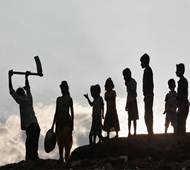
slavery copy copyAccording to the 2016 Global Slavery Index released by Australia-based human rights group Walk Free Foundation today, an estimated 45.8 million people, including women and children, are subject to some form of modern slavery in the world, compared to 35.8 million in 2014.

The report said India has the highest absolute numbers of people trapped in slavery with 18.35 million slaves among its 1.3 billion population while North Korea has the highest incidence (4.37 per cent of the population) and the weakest government response to deal with it.

In the last report in 2014, India had nearly 14.3 million people enslaved.
Incidences of slavery were found in all 167 countries in the index, with Asian countries occupy the top five for people trapped in slavery.

Behind India was China (3.39 million), Pakistan (2.13 million), Bangladesh (1.53 million) and Uzbekistan (1.23 million).

The index said that these five countries combined accounted for almost 58 per cent of the world's enslaved, or 26.6 million people.

The Index presents a ranking of 167 countries based on the proportion of the population that is estimated to be in modern slavery.

Modern slavery refers to situations of exploitation that a person cannot leave because of threats, violence, coercion, abuse of power or deception.

The research included over 42,000 interviews conducted in 53 languages across 25 countries, including 15 state-level surveys in India. These representative surveys covered 44 per cent of the global population.

The countries with the highest estimated prevalence of modern slavery by the proportion of their population are North Korea, Uzbekistan, Cambodia, Cambodia, India, and Qatar.

The countries with the lowest estimated prevalence of modern slavery by the proportion of their population are Luxembourg, Ireland, Norway, Denmark, Switzerland, Austria, Sweden and Belgium, the United States and Canada, and Australia and New Zealand.

The study also tracked the government actions and responses to the modern slavery and of the 161 assessed, 124 nations had criminalised human trafficking in line with the UN trafficking Protocol and 96 nations had developed national action plans to coordinate government response.

It noted that while India had more people enslaved than any other country, it had made significant progress in introducing measures to tackle the problem.

"It has criminalised trafficking, slavery, forced labour, child prostitution and forced marriage. The Indian government is currently tightening legislation against human trafficking, with tougher punishment for repeat offenders. It will offer victims protection and recovery support," it said.

It said that in addition to economic growth in India, ambitious programmes of legal and social reform are being undertaken right across the board, from regulation of labour relations to systems of social insurance for the most vulnerable.

Those governments taking the least action to combat modern slavery are North Korea, Iran, Eritrea, Equatorial Guinea, Hong Kong, Central African Republic, Papua New Guinea, Guinea, the Democratic Republic of the Congo and South Sudan.

The governments that have the strongest response to modern slavery are The Netherlands, the United States of America, the United Kingdom, Sweden, Australia, Portugal, Croatia, Spain, Belgium and Norway.

Seeking strong laws to abolish slavery, Andrew Forrest, Chairman and Founder of Walk Free Foundation, said eradicating slavery makes sense, morally, politically, logically and economically, and called on the governments of the world's leading economies to provide an example to others by enacting and implementing robust anti-slavery measures.

"We call on governments of the top 10 economies of the world to enact laws, at least as strong as the UK Modern Slavery Act 2015, with a budget and capability to ensure organisations are held to account for modern slavery in their supply chains, and to empower independent oversight."

Forrest said leaders of the world's major economies must bring the power of business to this issue, by requiring a focus on supply chain transparency.

"I believe in the critical role of leaders in government, business and civil society. Through our responsible use of power, strength of conviction, determination and collective will, we all can lead the world to end slavery," he said.

Forrest emphasised the key role that business needs to play in eradicating slavery.

"Businesses that don't actively look for forced labour within their supply chains are standing on a burning platform. Business leaders who refuse to look into the realities of their own supply chains are misguided and irresponsible," he said.

Comments

SK
 - 
Thursday, 2 Jun 2016

Since India is facing slavery, Naren has run away to Singapore to enjoy snake/ dog/cat/beef dishes......

Naren kotian
 - 
Tuesday, 31 May 2016

In that mostly 75% are from Muslim community as they enslave women as per their cult following .they have not changed since 6th century ...che papa ...ummah gang ge pitta netti geriruthe ..feku Anthe kumda ...for Muslims he might be feku ..but for nationalist Indians he is true hero who is transforming India .

Add new comment

  • Coastaldigest.com reserves the right to delete or block any comments.
  • Coastaldigset.com is not responsible for its readers’ comments.
  • Comments that are abusive, incendiary or irrelevant are strictly prohibited.
  • Please use a genuine email ID and provide your name to avoid reject.
News Network
April 18,2020

Bengaluru, Apr 18: Amid fears that people from the unorganised sector are running out of cash to meet their daily expenses, the Karnataka government said there was no data available for such labourers, who can be provided financial assistance under the direct benefit transfer (DBT) scheme.

"The government does not have data of people in the unorganised sector such as drivers, farmers, domestic help and others. If we have to deposit directly into their account, we need data..," State Labour minister A Shivaram Hebbar told reporters.

The minister said a situation borne out of the COVID-19, where the entire nation has been lockdown was never anticipated.

To him, the pandemic has given an opportunity to gather information about the unorganised sector.

"This COVID-19 has taught the department and the workers a lesson that we should be prepared for a situation like this. We have learnt that all the information about labourers should be available with the labour department," Hebbar conceded.

The minister opined that the department should have had the list during the good times but nobody bothered to have it.

"During the good times nobody bothered about it -- neither they (beneficiaries) asked for it, nor we thought of it.," Hebbar said.

Now that the pandemic has struck, the government is focusing only on not letting anyone starve to death.

A three-level preparation has been made -- at the village level, Taluk level and the city level, the minister said.

Village anganwadis have been stuffed with food items to be cooked for the needy, whereas in Taluk level, government hostels have been turned into shelters for the labourers, he said, noting that lakhs of philanthropists in cities have come forward to feed the people from unorganised sector.

"The basic objective of our government is that no one should starve to death. The issue of organised or unorganised sector comes next," he explained.

On the fear of large-scale retrenchment, the minister said notices have been served on all the industries that no one should be expelled from the job.

However, Hebbar underlined that the industrialists today are as much in distress as the workers and his department was taking into account everyone's concern.

A decision will be taken in this connection by the government in the next two days, to provide assistance to small enterprises to keep them afloat.

Comments

Add new comment

  • Coastaldigest.com reserves the right to delete or block any comments.
  • Coastaldigset.com is not responsible for its readers’ comments.
  • Comments that are abusive, incendiary or irrelevant are strictly prohibited.
  • Please use a genuine email ID and provide your name to avoid reject.
Media Release
March 10,2020

Mangaluru, Mar 10:  Country’s economic condition is not permanent. All young entrepreneurs can be forward looking persons, because all bad times are followed by good times. In fact, it is good time to start your own industry, said Nitte Deemed to be University Chancellor Dr. N Vinaya Hegde. 

Addressing the gathering after inaugurating a three-day entrepreneurship symposium organized by Mangalore University and Department of M. Com and MBA, University Evening College at University College Mangalore here on Monday, he said that entrepreneurship is something you enjoy. You should belief that there is something in you to achieve your area of choice. You should get pleasure out of it. 

Ex-MLC Capt. Ganesh Karnik believed that our population is definitely a resource, but symposiums are needed to convert ideas to implementation. Coastal Karnataka is best example for successful entrepreneurship in health, education sector, he added. 

Presiding over the function, Mangalore University Vice Chancellor Prof. P Subrahmanya Yadapadithaya said that students should be universally compassionate before being an entrepreneur. There will be challenges, failures in entrepreneurship. One should trust himself, and should have courage and confidence to be innovative. One should have aspiration and passion for excellence, he added.

Young scientist, international awardee Swasthik Padma was felicitated on the occasion. Evening college Principal Dr. Ramakrishna B M, Coordinator  Dr. Yathish Kumar were present among others. Kavya P Hegde mastered the ceremony, Venkatesh Nayak presented vote of thanks.

Comments

Add new comment

  • Coastaldigest.com reserves the right to delete or block any comments.
  • Coastaldigset.com is not responsible for its readers’ comments.
  • Comments that are abusive, incendiary or irrelevant are strictly prohibited.
  • Please use a genuine email ID and provide your name to avoid reject.
Dr Parinitha
January 17,2020

We came on foot, we came on boats, shouting slogans of Azadi.

We stood on roof tops and sat on walls under the burning midday sun,

Listening to the words that we had longed to hear for so long.

Words that had been scripted through the lonely fears of our hearts.

Words that were spoken now with the clarity of courage.

Words that were spoken now with the suppressed strength of pent up anger.

Words that were spoken now with the certainty of belonging to the soil 

Which had become one with the dust of our ancestors.

We stood there in the waves of heat

Feeling the surge and press  of countless bodies around us.

Bodies meshed through the odour of sweat 

And the shared fear of a common persecution.

And hanging from the roof tops,

And tied to the poles,

And clutched in hands slippery with sweat,

And wrapped round the pillars,

And spreading into our blood,

Were three strips of colour with a wheel of spokes,

Sewn together into the shape of our being.

Woven into the folds of our future and the creases of our past. 

Stitched to the seams of the earth, the water, the air and the sky 

That belonged to us and to which we belonged. 

And we stood there from noon to evening,

We the people of India.

Raising our clenched fists like signposts to the future.

Chanting slogans like a new anthem.

Kin to each other through the ties of community.

Born to live and die 

In a nation that was ours to hold on to

And ours to belong to.

Dr Parinitha is a professor of English in Mangalore University. She penned the poem soon after participating in the historic protest against CAA, NPR and NRC at Shah Garden, Adyar, Mangaluru on 15th January, 2020.

Also Read: 

‘The more you try to divide us, the stronger and united we’ll be’: Record turnout in Mangaluru’s anti-NRC protest

Anti-NRC protest in Mangaluru brings ‘media bias’ to the fore

Comments

Abdullah
 - 
Wednesday, 29 Jan 2020

Salute to you siter for your meaningful poem.  This is reality.  However, the enmy is blind/deaf/dumb.   May God give right way of thinking to enmy and in case he is unlucky, let God finish him and let him beg for death.  

Indian
 - 
Thursday, 23 Jan 2020

Waav..What a Heart Touching poetry...


Hats off to you ma'am....


Love from all Indians...


Add new comment

  • Coastaldigest.com reserves the right to delete or block any comments.
  • Coastaldigset.com is not responsible for its readers’ comments.
  • Comments that are abusive, incendiary or irrelevant are strictly prohibited.
  • Please use a genuine email ID and provide your name to avoid reject.