


India tops global slavery index with 18.35 mn people enslaved

May 31, 2016

Melbourne, May 31: India has the dubious distinction of having the highest number of people in the world trapped in modern slavery with 18.35 million victims of forced labour, ranging from prostitution and begging, according to a new report, which estimated that nearly 46 million people are enslaved globally.
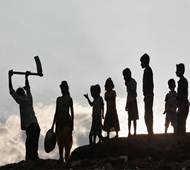
slavery copy copyAccording to the 2016 Global Slavery Index released by Australia-based human rights group Walk Free Foundation today, an estimated 45.8 million people, including women and children, are subject to some form of modern slavery in the world, compared to 35.8 million in 2014.

The report said India has the highest absolute numbers of people trapped in slavery with 18.35 million slaves among its 1.3 billion population while North Korea has the highest incidence (4.37 per cent of the population) and the weakest government response to deal with it.

In the last report in 2014, India had nearly 14.3 million people enslaved.
Incidences of slavery were found in all 167 countries in the index, with Asian countries occupy the top five for people trapped in slavery.

Behind India was China (3.39 million), Pakistan (2.13 million), Bangladesh (1.53 million) and Uzbekistan (1.23 million).

The index said that these five countries combined accounted for almost 58 per cent of the world's enslaved, or 26.6 million people.

The Index presents a ranking of 167 countries based on the proportion of the population that is estimated to be in modern slavery.

Modern slavery refers to situations of exploitation that a person cannot leave because of threats, violence, coercion, abuse of power or deception.

The research included over 42,000 interviews conducted in 53 languages across 25 countries, including 15 state-level surveys in India. These representative surveys covered 44 per cent of the global population.

The countries with the highest estimated prevalence of modern slavery by the proportion of their population are North Korea, Uzbekistan, Cambodia, Cambodia, India, and Qatar.

The countries with the lowest estimated prevalence of modern slavery by the proportion of their population are Luxembourg, Ireland, Norway, Denmark, Switzerland, Austria, Sweden and Belgium, the United States and Canada, and Australia and New Zealand.

The study also tracked the government actions and responses to the modern slavery and of the 161 assessed, 124 nations had criminalised human trafficking in line with the UN trafficking Protocol and 96 nations had developed national action plans to coordinate government response.

It noted that while India had more people enslaved than any other country, it had made significant progress in introducing measures to tackle the problem.

"It has criminalised trafficking, slavery, forced labour, child prostitution and forced marriage. The Indian government is currently tightening legislation against human trafficking, with tougher punishment for repeat offenders. It will offer victims protection and recovery support," it said.

It said that in addition to economic growth in India, ambitious programmes of legal and social reform are being undertaken right across the board, from regulation of labour relations to systems of social insurance for the most vulnerable.

Those governments taking the least action to combat modern slavery are North Korea, Iran, Eritrea, Equatorial Guinea, Hong Kong, Central African Republic, Papua New Guinea, Guinea, the Democratic Republic of the Congo and South Sudan.

The governments that have the strongest response to modern slavery are The Netherlands, the United States of America, the United Kingdom, Sweden, Australia, Portugal, Croatia, Spain, Belgium and Norway.

Seeking strong laws to abolish slavery, Andrew Forrest, Chairman and Founder of Walk Free Foundation, said eradicating slavery makes sense, morally, politically, logically and economically, and called on the governments of the world's leading economies to provide an example to others by enacting and implementing robust anti-slavery measures.

"We call on governments of the top 10 economies of the world to enact laws, at least as strong as the UK Modern Slavery Act 2015, with a budget and capability to ensure organisations are held to account for modern slavery in their supply chains, and to empower independent oversight."

Forrest said leaders of the world's major economies must bring the power of business to this issue, by requiring a focus on supply chain transparency.

"I believe in the critical role of leaders in government, business and civil society. Through our responsible use of power, strength of conviction, determination and collective will, we all can lead the world to end slavery," he said.

Forrest emphasised the key role that business needs to play in eradicating slavery.

"Businesses that don't actively look for forced labour within their supply chains are standing on a burning platform. Business leaders who refuse to look into the realities of their own supply chains are misguided and irresponsible," he said.

Comments

SK
 - 
Thursday, 2 Jun 2016

Since India is facing slavery, Naren has run away to Singapore to enjoy snake/ dog/cat/beef dishes......

Naren kotian
 - 
Tuesday, 31 May 2016

In that mostly 75% are from Muslim community as they enslave women as per their cult following .they have not changed since 6th century ...che papa ...ummah gang ge pitta netti geriruthe ..feku Anthe kumda ...for Muslims he might be feku ..but for nationalist Indians he is true hero who is transforming India .

Add new comment

  • Coastaldigest.com reserves the right to delete or block any comments.
  • Coastaldigset.com is not responsible for its readers’ comments.
  • Comments that are abusive, incendiary or irrelevant are strictly prohibited.
  • Please use a genuine email ID and provide your name to avoid reject.
News Network
June 7,2020

Bengaluru, Jun 7: A mobile app and a portal offering technology-driven solutions to manage and mitigate floods in urban areas were launched here on Saturday by Karnataka Revenue Minister R Ashoka.

The mobile app 'Bengaluru Megha Sandesha' was developed to disseminate information on rainfall and flood forecast, location-specific dynamic weather directly to the public. "The in-built features of the app and the information provided for a city is the first of its kind in the country," a press release said. This is a system of providing rainfall, flood forecasts and early warning to the officials of government agencies in the city through SMS to their mobile phones, social media platforms and a dedicated web portal, the release said.

The information provided would help the civic authorities act in advance and manage the floods, it said. The portal 'Varunamitra' is for information on the weather. The information provided is based on real-time data from 100 telemetric rain gauges installed and maintained at various locations across the state, it said. Rainfall forecast is based on the weather research and forecast models developed by the Indian Space Research Organisation (ISRO), Ahmedabad, the release said.

The information on flood forecast is based on the hydrological model, hydraulic routing and automation of the results. The Karnataka State Natural Disaster Monitoring Centre, along with the Indian Institute of Science (IISc), took up this project on the urban flood model for Bengaluru city. The project was funded by the Central government's department of science and technology, the release added. 

Comments

Add new comment

  • Coastaldigest.com reserves the right to delete or block any comments.
  • Coastaldigset.com is not responsible for its readers’ comments.
  • Comments that are abusive, incendiary or irrelevant are strictly prohibited.
  • Please use a genuine email ID and provide your name to avoid reject.
News Network
April 4,2020

Bengaluru, Apr 4: As calamity struck the nation in the form of coronavirus, many philanthropists have generously opened their wallets to sustain the urban poor, especially the migrant labourers in the city and elsewhere in Karnataka.

These individuals either directly or through organisations opened up their kitchens to ensure that no one goes to bed hungry in this distressing time.

The Bruhat Bengaluru Mahanagara Palike, the nodal agency to feed urban poor, responded positively to requests by these organisations and individuals to supply food to the needy on their behalf.

"We had been serving food through our Indira canteens, which we continue to do even now. However, many philanthropists and corporates have come forward to feed the needy," the BBMP joint commissioner Sarfaraz Khan told reporters.

According to BBMP, Indira canteens used to provide two lakh meals a day on normal occasions.

However, since the lockdown has been clamped, the number swelled by almost 50 per cent.

"On Thursday alone, we served 2.85 lakh food, which comprises breakfast, lunch and breakfast," a Palike officer said.

The major aid came from Jain International Trade Organisation (JITO) and Azim Premji Foundation.

While JITO is feeding around 22,000 people, Azim Premji Foundation is taking care of 20,000 people.

Sajjanraj Mehta, an office bearer of JITO, told reporters that his organisation has been providing packaged cooked food since March 27.

"We got in touch with Bengaluru Mayor M Gautham Kumar, Police Commissioner Bhaskar Rao and the BBMP commissioner B H Anil Kumar. According to their list, 27,000 food packets were required daily," Mehta told.

The JITO members have arranged vehicles of their respective businesses to transport food packets to different locations as part of the campaign named as 'COVID-19 manav seva'.

The organisation has also decided to utilise the kitchen of Princess Golf, a marriage hall on Palace Grounds here to prepare food.

Palike officials said on Thursday alone JITO supplied 53,000 meals.

"We asked them to cover migrant labourers in those areas where Indira Canteen could not reach. We mapped the cluster and provided them info. Now, they are distributing it there," they said.

Another organisation engaged in charitable work is ISKCON Bengaluru.

Ever since the lockdown, it has been working in various parts of India providing food to various people.

"We are providing materials such as rice, wheat flour, Daal, oil, vegetables with long shelf life, salt, sugar and spices. Each packet can sustain for at least 21 days," Madhu Pandit Dasa, president of ISKCON Bengaluru.

The organisation has set a target to cover at least two lakh people but so far it has reached out to 30,000 people including 25,000 in Bengaluru alone.

"We are feeding about 50,000 people in Delhi, with the Telangana government we are feeding about 40,000 people in Hyderabad, about 10,000 people in Ahmedabad in association with the Gujarat government," Dasa told.

According to BBMP, other organisations providing food to the needy are KMFY, TVS Group, Vimal Bhandari, Radisson Blue Atria Hotel, Hitech Ecowood, Mohammed Shajid, Prestige Group.

Wipro Ltd also pitched in to feed the poor by opening up its industrial kitchen infrastructure.

In a statement, Global Head- Operations of the company Hariprasad Hegde said the humanitarian crisis we are faced with as part of the Covid-19 crisis has multiple dimensions to it, of which the need to deliver cooked meals to the stranded migrant workers and other vulnerable communities is probably the most critical and immediate one.

Recognising this, Wipro has decided to use the industrial kitchen infrastructure in our facilities to provide cooked meals, he said.

This kicked off on April 2 with the delivery of 43,000 meals from our Bangalore facility in Kodathi to the government.

"We have made use of our own procurement logistics to source the food provisions. This is a collaborative process, with the government taking responsibility for the logistics of last mile delivery to the communities that need it the most,” he said.

In the case of Bangalore, the Karnataka government has come forward to provide this kind of complementary delivery support. We are reaching out to other state governments and local administrations for similar efforts." he said.

Comments

Add new comment

  • Coastaldigest.com reserves the right to delete or block any comments.
  • Coastaldigset.com is not responsible for its readers’ comments.
  • Comments that are abusive, incendiary or irrelevant are strictly prohibited.
  • Please use a genuine email ID and provide your name to avoid reject.
coastaldigest.com news network
April 19,2020

Mangaluru, Apr 19: The covid-19 being spread by the novel coronavirus has claimed a life in the coastal district of Dakshina Kannada.  

The victim, a 50-year-old woman from Bantwal taluk, breathed her last at Wenlock Hospital today morning. 

She was rushed to a private hospital yesterday after she developed breathing problems. Then she was shifted to Wenlock Hospital's block for suspected coronavirus patients, and placed in the intensive care unit (ICU).

Her throat swab was collected the same day and sent for testing for coronavirus. However, today morning her condition worsened and she passed away.

The report was received on later on Sunday afternoon, which confirmed that she had contracted coronavirus.

The woman's family members including her husband, son and mother-in-law have been placed under quarantine. It is learnt that her mother-in-law's condition is serious and she has been admitted to the ICU.

The throat swabs of all the three family members have been sent for coronavirus test. According to sources, the woman's son had come from Dubai recently.

Meanwhile, a 30-year-old woman from Uppinangady, who is undergoing treatment in a hospital, today tested positive for the covid-19.

With the confirmation of two new cases, the total number of reported covid-19 cases in Dakshina Kannada reached 15. Out of which only two case are currently active and 12 have been discharged. Another one passed away.

Comments

Mohith R
 - 
Monday, 20 Apr 2020

I am her son and I returned from Dubai on FEBRUARY 13, not March 16. What fake source are you referring to?


Add new comment

  • Coastaldigest.com reserves the right to delete or block any comments.
  • Coastaldigset.com is not responsible for its readers’ comments.
  • Comments that are abusive, incendiary or irrelevant are strictly prohibited.
  • Please use a genuine email ID and provide your name to avoid reject.