


India tops global slavery index with 18.35 mn people enslaved

May 31, 2016

Melbourne, May 31: India has the dubious distinction of having the highest number of people in the world trapped in modern slavery with 18.35 million victims of forced labour, ranging from prostitution and begging, according to a new report, which estimated that nearly 46 million people are enslaved globally.
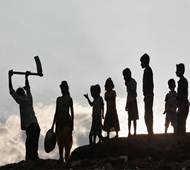
slavery copy copyAccording to the 2016 Global Slavery Index released by Australia-based human rights group Walk Free Foundation today, an estimated 45.8 million people, including women and children, are subject to some form of modern slavery in the world, compared to 35.8 million in 2014.

The report said India has the highest absolute numbers of people trapped in slavery with 18.35 million slaves among its 1.3 billion population while North Korea has the highest incidence (4.37 per cent of the population) and the weakest government response to deal with it.

In the last report in 2014, India had nearly 14.3 million people enslaved.
Incidences of slavery were found in all 167 countries in the index, with Asian countries occupy the top five for people trapped in slavery.

Behind India was China (3.39 million), Pakistan (2.13 million), Bangladesh (1.53 million) and Uzbekistan (1.23 million).

The index said that these five countries combined accounted for almost 58 per cent of the world's enslaved, or 26.6 million people.

The Index presents a ranking of 167 countries based on the proportion of the population that is estimated to be in modern slavery.

Modern slavery refers to situations of exploitation that a person cannot leave because of threats, violence, coercion, abuse of power or deception.

The research included over 42,000 interviews conducted in 53 languages across 25 countries, including 15 state-level surveys in India. These representative surveys covered 44 per cent of the global population.

The countries with the highest estimated prevalence of modern slavery by the proportion of their population are North Korea, Uzbekistan, Cambodia, Cambodia, India, and Qatar.

The countries with the lowest estimated prevalence of modern slavery by the proportion of their population are Luxembourg, Ireland, Norway, Denmark, Switzerland, Austria, Sweden and Belgium, the United States and Canada, and Australia and New Zealand.

The study also tracked the government actions and responses to the modern slavery and of the 161 assessed, 124 nations had criminalised human trafficking in line with the UN trafficking Protocol and 96 nations had developed national action plans to coordinate government response.

It noted that while India had more people enslaved than any other country, it had made significant progress in introducing measures to tackle the problem.

"It has criminalised trafficking, slavery, forced labour, child prostitution and forced marriage. The Indian government is currently tightening legislation against human trafficking, with tougher punishment for repeat offenders. It will offer victims protection and recovery support," it said.

It said that in addition to economic growth in India, ambitious programmes of legal and social reform are being undertaken right across the board, from regulation of labour relations to systems of social insurance for the most vulnerable.

Those governments taking the least action to combat modern slavery are North Korea, Iran, Eritrea, Equatorial Guinea, Hong Kong, Central African Republic, Papua New Guinea, Guinea, the Democratic Republic of the Congo and South Sudan.

The governments that have the strongest response to modern slavery are The Netherlands, the United States of America, the United Kingdom, Sweden, Australia, Portugal, Croatia, Spain, Belgium and Norway.

Seeking strong laws to abolish slavery, Andrew Forrest, Chairman and Founder of Walk Free Foundation, said eradicating slavery makes sense, morally, politically, logically and economically, and called on the governments of the world's leading economies to provide an example to others by enacting and implementing robust anti-slavery measures.

"We call on governments of the top 10 economies of the world to enact laws, at least as strong as the UK Modern Slavery Act 2015, with a budget and capability to ensure organisations are held to account for modern slavery in their supply chains, and to empower independent oversight."

Forrest said leaders of the world's major economies must bring the power of business to this issue, by requiring a focus on supply chain transparency.

"I believe in the critical role of leaders in government, business and civil society. Through our responsible use of power, strength of conviction, determination and collective will, we all can lead the world to end slavery," he said.

Forrest emphasised the key role that business needs to play in eradicating slavery.

"Businesses that don't actively look for forced labour within their supply chains are standing on a burning platform. Business leaders who refuse to look into the realities of their own supply chains are misguided and irresponsible," he said.

Comments

SK
 - 
Thursday, 2 Jun 2016

Since India is facing slavery, Naren has run away to Singapore to enjoy snake/ dog/cat/beef dishes......

Naren kotian
 - 
Tuesday, 31 May 2016

In that mostly 75% are from Muslim community as they enslave women as per their cult following .they have not changed since 6th century ...che papa ...ummah gang ge pitta netti geriruthe ..feku Anthe kumda ...for Muslims he might be feku ..but for nationalist Indians he is true hero who is transforming India .

Add new comment

  • Coastaldigest.com reserves the right to delete or block any comments.
  • Coastaldigset.com is not responsible for its readers’ comments.
  • Comments that are abusive, incendiary or irrelevant are strictly prohibited.
  • Please use a genuine email ID and provide your name to avoid reject.
News Network
March 20,2020

Bengaluru, Mar 20: The high court on Thursday directed the government to notify on its official website the penal provisions to be enforced against private schools violating norms relating to fees and safety of students, among other things. A division bench of chief justice Abhay Shreeniwas Oka granted six weeks to the authorities to comply while disposing of a PIL filed by advocate NP Amrutesh.

Earlier, the state government submitted a memo stating that necessary amendments have been brought to Karnataka Education Act in 2017. It said any breach of students' safety entails a minimum jail term of six months and Rs 1 lakh fine for a convicted employee or member of the management. Any institution found guilty by the District Education Regulatory Authority will face disaffiliation and must pay a fine of Rs 10 lakh, the memo said.

Schools collecting donations and other fees beyond what is prescribed can be fined up to Rs 10 lakh and they must refund the excess fee.

In relation to schools charging for applications and brochures, the state capped their prices at Rs 5 and Rs 20 respectively, by issuing a gazzette notification last year.

Comments

Add new comment

  • Coastaldigest.com reserves the right to delete or block any comments.
  • Coastaldigset.com is not responsible for its readers’ comments.
  • Comments that are abusive, incendiary or irrelevant are strictly prohibited.
  • Please use a genuine email ID and provide your name to avoid reject.
News Network
February 5,2020

Bidar, Feb 5: The police has intensified investigation into the 'sedition case' against the management and staff of a school here, where children are facing chare of insulting Prime Minister Narendra Modi and others, in the context of CAA, in a drama they staged on January 21.

The police again visited Shaheen School on Tuesday and questioned children and staff -- this time in plain clothes, after their questioning of children in uniform on January 28 drew criticism from some quarters, a school official said.

"Morning three police personnel came with two members of Karnataka State Child Rights Protection Commission. Later, the deputy superintendent of police H Basaveshwara joined them.

The cops were in civil dress," the official said.

The police have been questioning the children and staff about those who wrote the script and assigned to deliver specific dialogues.

Police have already arrested Nazbunnisa, the mother of one of the children, who had allegedly delivered the controversial dialogue and their teacher Fareeda Begum, who oversaw the event.

When contacted, the deputy superintendent of police of Bidar H Basaveshwara refused to comment on the matter saying that he was still investigating the case.

Meanwhile in Bengaluru, Congress MLA and former minister U T Khader slammed the BJP government in the state as well as the Centre for "filing sedition charges against people".

Addressing a press conference, he alleged that the Central and state governments were trying to suppress the voice of people in the country using law enforcement agencies.

Khader claimed that the two women who "depicted the problems they were facing" in the drama were booked under the sedition law. During investigation, the children were forced to sit at the police station, he alleged.

Comments

Ahmed Ali K.
 - 
Wednesday, 5 Feb 2020

Why No questions asked in Kalladka Prabhakar Batta school where the school childrens asked to show a demo of Babri Masjid demolition?


Why the police did'nt question the teacher team, Principal and the owner of the school??


because both schools owned by different people....!!

Indian Democracy.........................!!!!!!!!!!!!!!!!!!!!


Add new comment

  • Coastaldigest.com reserves the right to delete or block any comments.
  • Coastaldigset.com is not responsible for its readers’ comments.
  • Comments that are abusive, incendiary or irrelevant are strictly prohibited.
  • Please use a genuine email ID and provide your name to avoid reject.
News Network
May 11,2020

May 11: The Karnataka government appears set to roll out red carpet welcome to foreign companies seeking to move out of China.

The State's Large and Medium Scale Industries Minister Jagadish Shettar said the Government plans to constitute a task force, under the Chairmanship of the Chief Secretary T M Vijay Bhaskar, to spearhead the drive to attract such investment. A proposal to this effect has been sent to the Chief Minister B S Yediyurappa for approval, the Minister told PTI in an interview.

This panel would take feedback and suggestions from a consultative committee to be formed with prominent industrialists from the State and representatives of various countries located here, Shettar said.

In recent days, the Minister held consultations with industrialists such as co-founder and Non-Executive Chairman of Infosys Ltd, Nandan M Nilekani, Executive Chairperson of Biocon Ltd, Kiran Mazumdar-Shaw and Chairman of early-stage startup accelerator and venture fund Axilor Ventures Senapathy (Kris) Gopalakrishnan to fine-tune the States outreach push.

Shettar also held interactions with industry bodies, including Confederation of Indian Industry (CII), the Federation of Karnataka Chambers of Commerce and Industry (FKCCI), Bangalore Chamber of Industry and Commerce (BCIC) and Karnataka Small Scale Industries Association (KASSIA).

Industrialists who took part in the deliberations suggested to the government to focus on ease of doing business and improving the single window clearance system for approvals, as the Minister spelt out government's intent of further improving the investment climate to attract industries to Karnataka.

To boost the industry sentiment in the State, they also stressed the need on easing land acquisition regulations, and leveraging the knowledge base of Bengaluru to promote technology-based manufacturing.

"Given the interest shown by some companies in moving their manufacturing bases out of China, the industry leaders recommended that the State government identify a target list of 100 firms to reach out to for attracting to the State, and work out a strategy to bring them to Karnataka," an Industry department official said.

The industry leaders assured cooperation from the private sector in reaching out to and facilitating interactions with CEOs of these companies.

Shettar said restrictions on acquisition of agriculture land for starting industries have now been relaxed with the passage of an amendment to the land reforms act in the recent Legislature session.

This would facilitate immediate land allotment to industries, he added.

The Minister has also submitted a proposal to the Chief Minister on relaxing labour laws.

Secretary General of industry body ASSOCHAM, Deepak Sood, told news agency recently that there is a broader consensus that the global manufacturing supply chain would be more spread than concentrated in major economies like China.

"If India comes out of the present crisis with minimum of impact, we can be the destination of choice for the global manufacturing giants in different sectors like electronics, computer hardware, pharmaceuticals, including medical devices, automobile, including components and other engineering products," Sood had said.

Gopalakrishnan, also co-founder of Infosys and former CII President, said India has to target companies which have operations in China, reach out to them, understand what their needs are and hold discussions with them.

"We have to make sure that their requirements are addressed, be it with regard to land, office space, faster approvals, and some concessions on local taxes. It depends on the businesses that the companies are in, and if we are able to respond to those requests, I think we will be able to attract them", he told news agency.

"All states will compete for this business (foreign investment)," Gopalakrishnan added.

Comments

Add new comment

  • Coastaldigest.com reserves the right to delete or block any comments.
  • Coastaldigset.com is not responsible for its readers’ comments.
  • Comments that are abusive, incendiary or irrelevant are strictly prohibited.
  • Please use a genuine email ID and provide your name to avoid reject.