


India tops global slavery index with 18.35 mn people enslaved

May 31, 2016

Melbourne, May 31: India has the dubious distinction of having the highest number of people in the world trapped in modern slavery with 18.35 million victims of forced labour, ranging from prostitution and begging, according to a new report, which estimated that nearly 46 million people are enslaved globally.
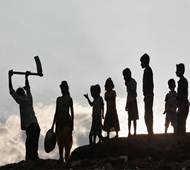
slavery copy copyAccording to the 2016 Global Slavery Index released by Australia-based human rights group Walk Free Foundation today, an estimated 45.8 million people, including women and children, are subject to some form of modern slavery in the world, compared to 35.8 million in 2014.

The report said India has the highest absolute numbers of people trapped in slavery with 18.35 million slaves among its 1.3 billion population while North Korea has the highest incidence (4.37 per cent of the population) and the weakest government response to deal with it.

In the last report in 2014, India had nearly 14.3 million people enslaved.
Incidences of slavery were found in all 167 countries in the index, with Asian countries occupy the top five for people trapped in slavery.

Behind India was China (3.39 million), Pakistan (2.13 million), Bangladesh (1.53 million) and Uzbekistan (1.23 million).

The index said that these five countries combined accounted for almost 58 per cent of the world's enslaved, or 26.6 million people.

The Index presents a ranking of 167 countries based on the proportion of the population that is estimated to be in modern slavery.

Modern slavery refers to situations of exploitation that a person cannot leave because of threats, violence, coercion, abuse of power or deception.

The research included over 42,000 interviews conducted in 53 languages across 25 countries, including 15 state-level surveys in India. These representative surveys covered 44 per cent of the global population.

The countries with the highest estimated prevalence of modern slavery by the proportion of their population are North Korea, Uzbekistan, Cambodia, Cambodia, India, and Qatar.

The countries with the lowest estimated prevalence of modern slavery by the proportion of their population are Luxembourg, Ireland, Norway, Denmark, Switzerland, Austria, Sweden and Belgium, the United States and Canada, and Australia and New Zealand.

The study also tracked the government actions and responses to the modern slavery and of the 161 assessed, 124 nations had criminalised human trafficking in line with the UN trafficking Protocol and 96 nations had developed national action plans to coordinate government response.

It noted that while India had more people enslaved than any other country, it had made significant progress in introducing measures to tackle the problem.

"It has criminalised trafficking, slavery, forced labour, child prostitution and forced marriage. The Indian government is currently tightening legislation against human trafficking, with tougher punishment for repeat offenders. It will offer victims protection and recovery support," it said.

It said that in addition to economic growth in India, ambitious programmes of legal and social reform are being undertaken right across the board, from regulation of labour relations to systems of social insurance for the most vulnerable.

Those governments taking the least action to combat modern slavery are North Korea, Iran, Eritrea, Equatorial Guinea, Hong Kong, Central African Republic, Papua New Guinea, Guinea, the Democratic Republic of the Congo and South Sudan.

The governments that have the strongest response to modern slavery are The Netherlands, the United States of America, the United Kingdom, Sweden, Australia, Portugal, Croatia, Spain, Belgium and Norway.

Seeking strong laws to abolish slavery, Andrew Forrest, Chairman and Founder of Walk Free Foundation, said eradicating slavery makes sense, morally, politically, logically and economically, and called on the governments of the world's leading economies to provide an example to others by enacting and implementing robust anti-slavery measures.

"We call on governments of the top 10 economies of the world to enact laws, at least as strong as the UK Modern Slavery Act 2015, with a budget and capability to ensure organisations are held to account for modern slavery in their supply chains, and to empower independent oversight."

Forrest said leaders of the world's major economies must bring the power of business to this issue, by requiring a focus on supply chain transparency.

"I believe in the critical role of leaders in government, business and civil society. Through our responsible use of power, strength of conviction, determination and collective will, we all can lead the world to end slavery," he said.

Forrest emphasised the key role that business needs to play in eradicating slavery.

"Businesses that don't actively look for forced labour within their supply chains are standing on a burning platform. Business leaders who refuse to look into the realities of their own supply chains are misguided and irresponsible," he said.

Comments

SK
 - 
Thursday, 2 Jun 2016

Since India is facing slavery, Naren has run away to Singapore to enjoy snake/ dog/cat/beef dishes......

Naren kotian
 - 
Tuesday, 31 May 2016

In that mostly 75% are from Muslim community as they enslave women as per their cult following .they have not changed since 6th century ...che papa ...ummah gang ge pitta netti geriruthe ..feku Anthe kumda ...for Muslims he might be feku ..but for nationalist Indians he is true hero who is transforming India .

Add new comment

  • Coastaldigest.com reserves the right to delete or block any comments.
  • Coastaldigset.com is not responsible for its readers’ comments.
  • Comments that are abusive, incendiary or irrelevant are strictly prohibited.
  • Please use a genuine email ID and provide your name to avoid reject.
coastaldigest.com news network
June 28,2020

Bengaluru, Jun 28: Karnataka Minister for Medical Education Dr K Sudhakar faced criticism by netizens after he shared a TikTok video sent by his daughter and wife, who are currently undergoing treatment in a COVID-19 facility.

TikTok is a Chinese video-sharing social networking service owned by ByteDance, a Beijing-based internet technology company founded in 2012 by Zhang Yiming.

Dr Sudhakar’s father, his wife and daughter who tested positive for Covid-19 has been admitted to a designated facility and in order to make his birthday memorable, his daughter sent him greetings through TikTok video.

When the minister shared the TikTok video, people pointed out that the minister should know better and that he should urge his family to boycott the Chinese video-sharing platform and lead by example.

Many were miffed that a BJP leader put up a TikTok video at a time when tensions are running high between India and China along the Line of Actual Control (LAC) in eastern Ladakh.

Comments

Add new comment

  • Coastaldigest.com reserves the right to delete or block any comments.
  • Coastaldigset.com is not responsible for its readers’ comments.
  • Comments that are abusive, incendiary or irrelevant are strictly prohibited.
  • Please use a genuine email ID and provide your name to avoid reject.
News Network
May 4,2020

Davanagere, May 3: Karnataka's Davanagere district on Sunday reported 21 COVID-19 positive cases, said Mahantesh Beelagi, Deputy Commissioner.

The number of COVID-19 patients has suddenly taken a giant leap in the district.

"We had sent 94 samples on May 1, on May 2 we sent 72 samples. Today we sent 164 samples for testing. In the last two days, 21 samples have tested positive for coronavirus, we are tracing to know how did all of them came in contact with COVID-19 infected person," said Mahantesh Beelagi.

"Our surveillance team and police team have started tracing the primary and secondary contacts of all 21 people," he added.
Davanagere is currently in the Green Zone.

Meanwhile, 13 new COVID-19 positive cases were reported in Karnataka till 5 pm on Sunday, taking the total number of cases in the state to 614, according to the State Health Department.

Comments

Add new comment

  • Coastaldigest.com reserves the right to delete or block any comments.
  • Coastaldigset.com is not responsible for its readers’ comments.
  • Comments that are abusive, incendiary or irrelevant are strictly prohibited.
  • Please use a genuine email ID and provide your name to avoid reject.
News Network
May 17,2020

Bengaluru, May 17: Karnataka Deputy Chief Minister and Transport Minister Laxman Savadi on Sunday wrote to Union Minister Nitin Gadkari requesting to issue new lockdown guidelines including permission to operate public transport and said the lockdown has caused a financial loss of Rs 16,00 crore to all four Karnataka Transport Undertakings.

In view of these problems, the state Transport Minister requested Gadkari to permit the deployment of Non-AC buses on scheduled routes to ensure the adequacy of services.

The four State Transport Undertakings (STUs) in Karnataka which are providing bus-based public transport services within the state and to the neighbouring states are Karnataka State Road Transport Corporation (KSRTC), North West Karnataka Road Transport Corporation (NWKRTC), North Eastern Karnataka Road Transport Corporation (NEKRTC) and Bangalore Metropolitan Transport Corporation (BMTC).

"KSRTC, NWKRTC and NEKRTC operate buses for mofussil services i.e. Interdistrict, intradistrict and interstate, whereas BMTC operates only in urban and suburban areas in the city of Bengaluru. The four STUs put together hold a fleet of about 24,900 buses including 1,520 air-conditioned buses and operate about 71.00 lakh km. per day and carries about 98.00 lakh passengers every single day," Savadi outlined in the letter.

The Minister said due to the COVID-19 outbreak and the lockdown that ensued have brought regular bus operations and functioning to a grinding halt.

"This has caused a devastating impact on the operations of all the four STUs due to the combination of lack of revenue and continuing fixed costs such as salaries and pensions to staff, payables against existing loans etc. It has been estimated that the lockdown has caused a financial loss of INR 1,600/- crore to these four STUs," he added.

Savadi said even after post-COVID lockdown, operations and revenues won't reach its previous demand& supply patterns in the next six to eight months due to reduced economic activity and users' perceived risk of contacting COVID in public transport.

In addition to that, "occupancy should be allowed up to seating capacity (without standees). This is essential to meet minimal demand," he said in the letter.

"The crew should wear facemask and hand gloves. The crew with health issues should not be deployed. The face masks should be made mandatory for all the passengers. Only asymptomatic persons should be allowed to travel in public transport. The Government of India may consider staggering working hours for various sectors to reduce peak hour traffic demand," the minister listed out these recommendations in the letter.

Savadi said that with social distancing norm of reduced seating capacity in public transport, it will not be possible to provide transport facility to all the daily passengers. This will create demand for more buses, which cannot be met.

"Restrictions on public transport will lead to passenger commute by overcrowding in smaller vehicles like cars, maxi cabs, goods tempos etc. which will adversely affect preventive measures," he added.

Therefore, Savadi requested Union Minister to look into the above matter and issue fresh guidelines to all the states / UT's.

Comments

Add new comment

  • Coastaldigest.com reserves the right to delete or block any comments.
  • Coastaldigset.com is not responsible for its readers’ comments.
  • Comments that are abusive, incendiary or irrelevant are strictly prohibited.
  • Please use a genuine email ID and provide your name to avoid reject.