


India tops global slavery index with 18.35 mn people enslaved

May 31, 2016

Melbourne, May 31: India has the dubious distinction of having the highest number of people in the world trapped in modern slavery with 18.35 million victims of forced labour, ranging from prostitution and begging, according to a new report, which estimated that nearly 46 million people are enslaved globally.
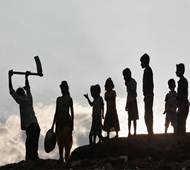
slavery copy copyAccording to the 2016 Global Slavery Index released by Australia-based human rights group Walk Free Foundation today, an estimated 45.8 million people, including women and children, are subject to some form of modern slavery in the world, compared to 35.8 million in 2014.

The report said India has the highest absolute numbers of people trapped in slavery with 18.35 million slaves among its 1.3 billion population while North Korea has the highest incidence (4.37 per cent of the population) and the weakest government response to deal with it.

In the last report in 2014, India had nearly 14.3 million people enslaved.
Incidences of slavery were found in all 167 countries in the index, with Asian countries occupy the top five for people trapped in slavery.

Behind India was China (3.39 million), Pakistan (2.13 million), Bangladesh (1.53 million) and Uzbekistan (1.23 million).

The index said that these five countries combined accounted for almost 58 per cent of the world's enslaved, or 26.6 million people.

The Index presents a ranking of 167 countries based on the proportion of the population that is estimated to be in modern slavery.

Modern slavery refers to situations of exploitation that a person cannot leave because of threats, violence, coercion, abuse of power or deception.

The research included over 42,000 interviews conducted in 53 languages across 25 countries, including 15 state-level surveys in India. These representative surveys covered 44 per cent of the global population.

The countries with the highest estimated prevalence of modern slavery by the proportion of their population are North Korea, Uzbekistan, Cambodia, Cambodia, India, and Qatar.

The countries with the lowest estimated prevalence of modern slavery by the proportion of their population are Luxembourg, Ireland, Norway, Denmark, Switzerland, Austria, Sweden and Belgium, the United States and Canada, and Australia and New Zealand.

The study also tracked the government actions and responses to the modern slavery and of the 161 assessed, 124 nations had criminalised human trafficking in line with the UN trafficking Protocol and 96 nations had developed national action plans to coordinate government response.

It noted that while India had more people enslaved than any other country, it had made significant progress in introducing measures to tackle the problem.

"It has criminalised trafficking, slavery, forced labour, child prostitution and forced marriage. The Indian government is currently tightening legislation against human trafficking, with tougher punishment for repeat offenders. It will offer victims protection and recovery support," it said.

It said that in addition to economic growth in India, ambitious programmes of legal and social reform are being undertaken right across the board, from regulation of labour relations to systems of social insurance for the most vulnerable.

Those governments taking the least action to combat modern slavery are North Korea, Iran, Eritrea, Equatorial Guinea, Hong Kong, Central African Republic, Papua New Guinea, Guinea, the Democratic Republic of the Congo and South Sudan.

The governments that have the strongest response to modern slavery are The Netherlands, the United States of America, the United Kingdom, Sweden, Australia, Portugal, Croatia, Spain, Belgium and Norway.

Seeking strong laws to abolish slavery, Andrew Forrest, Chairman and Founder of Walk Free Foundation, said eradicating slavery makes sense, morally, politically, logically and economically, and called on the governments of the world's leading economies to provide an example to others by enacting and implementing robust anti-slavery measures.

"We call on governments of the top 10 economies of the world to enact laws, at least as strong as the UK Modern Slavery Act 2015, with a budget and capability to ensure organisations are held to account for modern slavery in their supply chains, and to empower independent oversight."

Forrest said leaders of the world's major economies must bring the power of business to this issue, by requiring a focus on supply chain transparency.

"I believe in the critical role of leaders in government, business and civil society. Through our responsible use of power, strength of conviction, determination and collective will, we all can lead the world to end slavery," he said.

Forrest emphasised the key role that business needs to play in eradicating slavery.

"Businesses that don't actively look for forced labour within their supply chains are standing on a burning platform. Business leaders who refuse to look into the realities of their own supply chains are misguided and irresponsible," he said.

Comments

SK
 - 
Thursday, 2 Jun 2016

Since India is facing slavery, Naren has run away to Singapore to enjoy snake/ dog/cat/beef dishes......

Naren kotian
 - 
Tuesday, 31 May 2016

In that mostly 75% are from Muslim community as they enslave women as per their cult following .they have not changed since 6th century ...che papa ...ummah gang ge pitta netti geriruthe ..feku Anthe kumda ...for Muslims he might be feku ..but for nationalist Indians he is true hero who is transforming India .

Add new comment

  • Coastaldigest.com reserves the right to delete or block any comments.
  • Coastaldigset.com is not responsible for its readers’ comments.
  • Comments that are abusive, incendiary or irrelevant are strictly prohibited.
  • Please use a genuine email ID and provide your name to avoid reject.
News Network
March 29,2020

Madikeri, Mar 29: In an alarming situation in neighbouring Kerala State and instances of inter-state migration of Coronavirus suspects, the authorities on Sunday sealed both Dakshina Kannada and Kodagu borders, prohibiting entry of people from Kerala into Karnataka.

Dakshina Kannada had sealed its borders after repeated instances of people misusing ambulance services to travel to Mangalore. Villagers along with the police hauled mud on to the roads that were used as alternate routes.

The road that connects the two States, which people from east Kasargod used to enter into Karnataka, were closed at Mulleria by dumping mud on the road.

Comments

Add new comment

  • Coastaldigest.com reserves the right to delete or block any comments.
  • Coastaldigset.com is not responsible for its readers’ comments.
  • Comments that are abusive, incendiary or irrelevant are strictly prohibited.
  • Please use a genuine email ID and provide your name to avoid reject.
News Network
May 15,2020

Bengaluru, May 15: With lockdown-3 coming to an end in a couple of days, Karnataka Chief Minister B S Yediyurappa on Friday expressed confidence about the Centre announcing relaxation to "many things" after May 17.

"After May 17, the government of India is going to relax so many things, let us wait for it," he said in response to a question from reporters here. "According to me they (centre) will relax everything.... maybe for things like five-star hotels and others they may not give permission for the time being, but for other things they are going to give permission. Let's wait and see."

The nationwide lockdown was initially imposed from March 25 to April 14, then extended to May 3 and again to May 17 to prevent the spread of the novel coronavirus. Karnataka Tourism Minister C T Ravi on Wednesday had hinted at the state government permitting the opening of gyms, fitness centres and golf courses, also certain hotels for local tourism purpose after May 17, when the third phase of the COVID-19 induced lockdown comes to an end.

The Muzrai department (in charge of the administration of temples) was also planning to have a Standard Operating Procedure (SOP) in place, that needs to be followed at temples once they are opened for the public, officials have said. They said the opening of temples for the public is however subject to the MHA (Ministry of Home Affairs) guidelines.

During the recent video conferencing Prime Minister Narendra Modi had with Chief Ministers of various states, Yediyurappa had proposed doing away with district wise colour-coding and instead advocated strict cordoning of containment zones to control the spread of the pandemic.

He had pitched for resuming all economic activities in stand-alone establishments while continuing the restrictions on malls, cinema halls, dining facilities and establishments with centrally controlled air-conditioning. The CM had suggested that 50 to 100 meters around known clusters be declared as containment zones and commercial activities, including public transport, to be allowed in non- containment zones.

Comments

MR
 - 
Sunday, 17 May 2020

Please don't go out until May 31st.

Remember the Politicians and their famiies will stay inside  until May 31'st to protect their families.

If you go out and fall sick your whole family will suffer. So be smart and stay home.

Add new comment

  • Coastaldigest.com reserves the right to delete or block any comments.
  • Coastaldigset.com is not responsible for its readers’ comments.
  • Comments that are abusive, incendiary or irrelevant are strictly prohibited.
  • Please use a genuine email ID and provide your name to avoid reject.
News Network
March 24,2020

Bangalore , Mar 24: Bizom, India's leading retail intelligence platform, announced free subscription of its retailer app and tele-ordering solutions for consumer businesses in India and other emerging economies. Both solutions enable retailers to send their orders directly to the brand.
In COVID-19 times of social distancing and prophylactic measures, brands are conscious about the safety of their salespersons. Also, retailers don't want travelling salespeople to enter their premises. Consequently, many retail stores are facing stockout situations of fast-moving product categories. Bizom's self-ordering solutions help brands to avoid stockouts of their products.
Bizom trends, which analyses consumption and demand for consumer brands, showed how a near-complete shutdown during the Janta Curfew followed panic buying in early March. The asymmetrical demand and a lack of salespeople for order-taking are driving the industry towards social-distancing-based store-stocking mechanisms.
Bizom provides social-distancing-based store-stocking solutions for consumer businesses. They include the Bizom Retailer App and the Bizom Tele-ordering.
The Bizom Retailer App enables self-ordering for a brand's key retail outlets and can be implemented in under two weeks. The mobile app, a B2B shopping app, is a simple installation for retailers. It lists and groups the brand's products as per its product categories. The app's interface is no different from that of leading e-commerce apps. All the user has to do is select the preferred SKUs and add them to their shopping carts.
The app also allows brands to customize the app to meet the requirements of their continually changing product categories. For instance, if an SKU runs out of stock, the brand can disable the given SKU from the app.
With the Bizom Retailer App, brands can take orders directly from retailers instead of the traditional order-taking approach, which requires high-touch from a salesperson. Some of the key features of the app are, the ability to provide product information directly through retailers including SKUs, competitor comparison and pricing.
It also enables self-ordering from the retailer to maintain the flow of products as per demand, enables scheme rollout information through a notification on the app rather than through salespeople, tracks delivery of goods to the retailer and enables incentive payments to retailers directly rather than through distributor claims.
With Bizom Tele-ordering, as the sales teams go remote, the tele-ordering solution will become useful for brands who want to get salespeople to take orders from retailers, remotely. It ensures continued service to outlets despite not being physically present in the market.
Here, salespeople can discuss product requirements with retailers and enter orders based on specific outlet types (grocery, chemist etc.), outlet class (Class A, Class B etc.) or based on their beat or as per a distributor.
The key features of the Bizom Tele-ordering solution are, its ability to help salespeople collect orders from retailers remotely and enter it for fulfilment into Bizom using a tool, the flexibility offered to salespeople for remote servicing of retailers as per outlet type, beat, distributor area etc., secondary schemes get applied automatically, variable discounts will get applied as applicable at an SKU level.
"At Bizom, we are conscious of our responsibility to help brands run faster during these COVID-19 times. Our solutions of Bizom Retailer App and Bizom Tele-ordering have been built to ensure that brands can leverage this situation of low direct touch with retailers to enable a better way of working, remotely. I am trying to help brands go live in a few days so that they, in turn, can serve consumers better during these testing times," said Lalit Bhise, CEO, Bizom.

Comments

Add new comment

  • Coastaldigest.com reserves the right to delete or block any comments.
  • Coastaldigset.com is not responsible for its readers’ comments.
  • Comments that are abusive, incendiary or irrelevant are strictly prohibited.
  • Please use a genuine email ID and provide your name to avoid reject.