


Karnataka Assembly asks Govt not to release Cauvery water

September 23, 2016

Bengaluru, Sep 23: The Karnataka Assembly passed a unanimous resolution on Friday asking the Government not to release Cauvery water to Tamil Nadu.
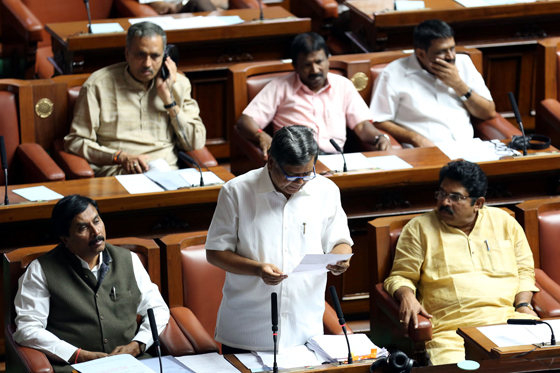
1shettar

The Assembly, at the end of the special session, decided to retain Cauvery water to meet the drinking water needs of the state.

Earlier, a resolution asking the government to use Cauvery water only to meet drinking water needs was moved at a special session of the Karnataka Assembly, implying that the state cannot comply with the latest Supreme Court direction to release water to Tamil Nadu.
Highlighting the "state of acute distress", the resolution, endorsed by all parties, said it was "imperative" that the government ensures that no water from the present storages be drawn "save and except" for meeting drinking water needs of villages and towns in the Cauvery basin and Bengaluru.

The interests of the inhabitants of the state are likely to be gravely jeopardised if water in the four reservoirs in the Cauvery basin was in anyway reduced other than for meeting the drinking water needs of the people in the Cauvery basin, including the entire city of Bengaluru, it said.
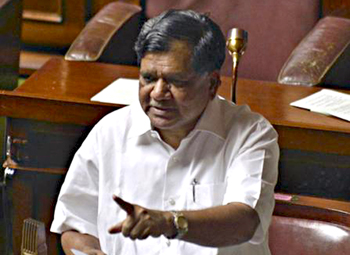
The resolution moved in English by Opposition BJP leader Jagadish Shettar and in Kannada by Y S V Datta of JDS did not refer to the apex Court direction to the state to release 6,000 cusecs of Cauvery water per day to Tamil Nadu but is expected to put Karnataka on a collision course with the judiciary.

The Cauvery Supervisory Committee had on September 19 asked Karnataka to release 3,000 cusecs per day from September 21 to 30, but the apex court had on September 20 doubled the quantum to 6,000 cusecs from September 21 to 27 after Tamil Nadu pressed for water to save its samba paddy crop.

It had also directed the Centre to constitute within four weeks the Cauvery Water Management Board as directed by Cauvery Water Disputes Tribunal in its award.

Backed by an all party meeting mandate, the state cabinet had on Tuesday decided to defer the release of water to Tamil Nadu and convene a day's legislature session amid escalating row between the two neighbouring states.
The resolution noted that in the water year 2016-17, there has been an acute situation of distress but the shortfall in the basin will become known only at the end of the season on January 31, 2017.

It pointed out that the combined storage in four reservoirs in the Cauvery basin -- Krishnaraja Sagar, Hemavathy, Harangi and Kabini -- had reached "alarmingly low levels at 27 TMC ft."

"It is now resolved to direct that in this state of acute distress, it is imperative that the government ensures that no water from the present storages be drawn save and except for meeting drinking water requirements of villages and towns in the cauvery basin and Bengaluru," it said.

Earlier post:

All party resolution asks govt to use water only for drinking needs

Bengaluru, Sep 23: A resolution asking government to use Cauvery water only to meet drinking water needs was moved at a special session of the Karnataka Assembly today, implying that the state cannot comply with the latest Supreme Court direction to release water to Tamil Nadu.

jagadeshHighlighting the "state of acute distress", the resolution, endorsed by all parties, said it was "imperative" that the government ensures that no water from the present storages be drawn "save and except" for meeting drinking water needs of villages and towns in the Cauvery basin and Bengaluru.

The interests of the inhabitants of the state are likely to be gravely jeopardised if water in the four reservoirs in the Cauvery basin was in anyway reduced other than for meeting the drinking water needs of the people in the Cauvery basin, including the entire city of Bengaluru, it said.

 The resolution moved in English by Opposition BJP leader Jagadish Shettar and in Kannada by Y S V Datta of JDS did not refer to the apex Court direction to the state to release 6,000 cusecs of Cauvery water per day to Tamil Nadu but is expected to put Karnataka on a collision course with the judiciary.

The Cauvery Supervisory Committee had on September 19  asked Karnataka to release 3,000 cusecs per day from September 21 to 30, but the apex court had on September 20 doubled the quantum to 6,000 cusecs from September 21 to 27 after Tamil Nadu pressed for water to save its samba paddy crop.

It had also directed the Centre to constitute within four weeks the Cauvery Water Management Board as directed by Cauvery Water Disputes Tribunal in its award.

Backed by an all party meeting mandate, the state cabinet had on Tuesday decided to defer the release of water to Tamil Nadu and convene a day's legislature session amid escalating row between the two neighbouring states.

 The resolution noted that in the water year 2016-17, there has been an acute situation of distress but the shortfall in the basin will become known only at the end of the season on January 31, 2017.

It pointed out that the combined storage in four reservoirs in the Cauvery basin -- Krishnaraja Sagar, Hemavathy, Harangi and Kabini -- had reached "alarmingly low levels at 27 TMC ft."

"It is now resolved to direct that in this state of acute distress, it is imperative that the government ensures that no water from the present storages be drawn save and except for meeting drinking water requirements of villages and towns in the cauvery basin and Bengaluru," it said.


Comments

TRUE INDIAN
 - 
Friday, 23 Sep 2016

Modi is busy with bolochistan.
Modi fooled everybody, but gain there are some fools, chanting har har Modi.

TRUE INDIAN
 - 
Friday, 23 Sep 2016

before they were Shouting Bharat mata. Now what happened Is
tamil nadu not Bharat mata.

Bharat mata all Drama.

Add new comment

  • Coastaldigest.com reserves the right to delete or block any comments.
  • Coastaldigset.com is not responsible for its readers’ comments.
  • Comments that are abusive, incendiary or irrelevant are strictly prohibited.
  • Please use a genuine email ID and provide your name to avoid reject.
Ram Puniyani
January 14,2020

In the beginning of January 2020 two very disturbing events were reported from Pakistan. One was the attack on Nankana Sahib, the holy shrine where Sant Guru Nanak was born. While one report said that the place has been desecrated, the other stated that it was a fight between two Muslim groups. Prime Minister of Pakistan Imran Khan condemned the incident and the main accused Imran Chisti was arrested. The matter related to abduction and conversion of a Sikh girl Jagjit Kaur, daughter of Pathi (One who reads Holy Guru Granth Sahib in Gurudwara) of the Gurudwara. In another incident one Sikh youth Ravinder Singh, who was out on shopping for his marriage, was shot dead in Peshawar.

While these condemnable attacks took place on the Sikh minority in Pakistan, BJP was quick enough to jump to state that it is events like this which justify the Citizenship Amendment Act (CAA). Incidentally CAA is the Act which is discriminatory and relates to citizenship with Religion, which is not as per the norms of Indian constitution. There are constant debates and propaganda that population of Hindus has come down drastically in Pakistan and Bangla Desh. Amit Shah, the Home minister stated that in Pakistan the population of Hindus has come down from 23% at the time of partition to 3.7% at present. And in Bangla Desh it has come down from 22% to present 8%.

While not denying the fact that the religious minorities are getting a rough deal in both these countries, the figures which are presented are totally off the mark. These figures don’t take into consideration the painful migrations, which took place at the time of partition and formation of Bangla Desh later. Pakistan census figures tell a different tale. Their first census was held in 1951. As per this census the overall percentage of Non Muslim in Pakistan (East and West together) was 14.2%, of this in West Pakistan (Now Pakistan) it was 3.44 and in Eat Pakistan it was 23.2. In the census held in Pakistan 1998 it became 3.72%. As far as Bangla Desh is concerned the share of Non Muslims has gone down from 23.2 (1951) to 9.6% in 2011.

The largest minority of Pakistan is Ahmadis, (https://minorityrights.org/country/pakistan/) who are close to 4 Million and are not recognised as Muslims in Pakistan. In Bangla Desh the major migrations of Hindus from Bangla Desh took place in the backdrop of Pakistan army’s atrocities in the then East Pakistan.

As far as UN data on refugees in India it went up by 17% between 2016-2019 and largest numbers were from Tibet and Sri Lanka.  (https://www.un.org/en/development/desa/population/migration/publication…)

The state of minorities is in a way the index of strength of democracy. Most South Asian Countries have not been able to sustain democratic values properly. In Pakistan, the Republic began with Jinnah’s classic speech where secularism was to be central credo of Pakistan. This 11th August speech was in a way what the state policy should be, as per which people of all faiths are free to practice their religion. Soon enough the logic of ‘Two Nation theory” and formation of Pakistan, a separate state for Muslim took over. Army stepped in and dictatorship was to reign there intermittently. Democratic elements were suppressed and the worst came when Zia Ul Haq Islamized the state in collusion with Maulanas. The army was already a strong presence in Pakistan. The popular formulation for Pakistan was that it is ruled by three A’s, Army, America and Allah (Mullah).

Bangla Desh had a different trajectory. Its very formation was a nail in the coffin of ‘two nation theory’; that religion can be the basis of a state. Bangla Desh did begin as a secular republic but communal forces and secular forces kept struggling for their dominance and in 1988 it also became Islamic republic. At another level Myanmar, in the grip of military dictatorship, with democratic elements trying to retain their presence is also seeing a hard battle. Democracy or not, the army and Sanghas (Buddhist Sang has) are strong, in Myanmar as well. The most visible result is persecution of Rohingya Muslims.

Similar phenomenon is dominating in Sri Lanka also where Budhhist Sanghas and army have strong say in the political affairs, irrespective of which Government is ruling. Muslim and Christian minorities are a big victim there, while Tamils (Hindus, Christians etc.) suffered the biggest damage as ethnic and religious minorities. India had the best prospect of democracy, pluralism and secularism flourishing here. The secular constitution, the outcome of India’s freedom struggle, the leadership of Gandhi and Nehru did ensure the rooting of democracy and secularism in a strong way.

India so far had best democratic credentials amongst all the south Asian countries. Despite that though the population of minorities rose mainly due to poverty and illiteracy, their overall marginalisation was order of the day, it went on worsening with the rise of communal forces, with communal forces resorting to identity issues, and indulging in propaganda against minorities.

While other South Asian countries should had followed India to focus more on infrastructure and political culture of liberalism, today India is following the footsteps of Pakistan. The retrograde march of India is most visible in the issues which have dominated the political space during last few years. Issues like Ram Temple, Ghar Wapasi, Love Jihad, Beef-Cow are now finding their peak in CAA.

India’s reversal towards a polity with religion’s identity dominating the political scene was nicely presented by the late Pakistani poetess Fahmida Riaz in her poem, Tum bhi Hum Jaise Nikle (You also turned out to be like us). While trying to resist communal forces has been an arduous task, it is becoming more difficult by the day. This phenomenon has been variously called, Fundamentalism, Communalism or religious nationalism among others. Surely it has nothing to do with the religion as practiced by the great Saint and Sufi traditions of India; it resorts mainly to political mobilization by using religion as a tool.

Comments

Ashi
 - 
Tuesday, 14 Jan 2020

If Malaysia implement similar NRC/CAA, India and China are the loser.

Add new comment

  • Coastaldigest.com reserves the right to delete or block any comments.
  • Coastaldigset.com is not responsible for its readers’ comments.
  • Comments that are abusive, incendiary or irrelevant are strictly prohibited.
  • Please use a genuine email ID and provide your name to avoid reject.
News Network
March 29,2020

Bengaluru, Mar 29: Escoms have been directed neither to penalise its customers nor go for disconnection if one fails to pay the bill. The relief is applicable till June. However, the entire bill will have to be paid at the end of three months.

The revised power tariff, which was to be announced on April 1, has also been deferred.

A similar three-month relief has been given on rentals for APMC and BBMP shops.

Comments

Add new comment

  • Coastaldigest.com reserves the right to delete or block any comments.
  • Coastaldigset.com is not responsible for its readers’ comments.
  • Comments that are abusive, incendiary or irrelevant are strictly prohibited.
  • Please use a genuine email ID and provide your name to avoid reject.
News Network
January 25,2020

Mangaluru, Jan 25: Orange vendor Harekala Hajabba, popularly known as 'Akshara Santha' (the saint of alphabets), who went on to build a school at Newpadpu village on the city’s outskirts in 1999 is among this year’s Padma Shri awardees.

When Hajabba received the call on being nominated for the award, he was standing in a queue to buy rations.

As he is not fluent in Hindi, Hajabba handed over the phone to an auto driver, who conveyed the news that the Padma Shri award will be conferred on him.

The unlettered achiever set up a primary school from his meagre savings of Rs 150 per day,  selling oranges in Mangaluru. 

“The first time I felt bad for being an illiterate was when a foreigner enquired about the price of oranges in English. I did not know what he meant. So, I decided to start a school in my village,” Hajabba had said during a felicitation programme.

When Hajabba decided to start a school, he did not get any support. He started the school with 28 children.

The school today has been upgraded to a composite high school and is catering to the educational needs of hundreds of children in and around Newpadpu.

He ran from pillar to post in the Zilla Panchayat to make his dream come true. All cash awards he had received went into building the school. The United Christians Association, moved by the sight of his dilapidated house, built a 760-square-foot house costing Rs 15 lakh for him. 

Hajabba’s life was prescribed for the syllabus of three universities - Davangere, Kuvempu and Mangalore. His success story is also included in a Tulu textbook.

He won the Karnataka Rajyotsava award in 2013, Real Heroes award from TV channel CNN-IBN.

Hajabba, when contacted, said he could not believe his ears when told about the award.

New dreams

The frail vendor, in his 60s, humbly declared that he could achieve all this because of the support of all. Hajabba now dreams of upgrading the school into a full-fledged PU college.

Comments

Meethal Kasaragod
 - 
Sunday, 26 Jan 2020

A big Salute to him!

Great effort,

fairman
 - 
Sunday, 26 Jan 2020

Where there is will, there is way

May God help him.

Add new comment

  • Coastaldigest.com reserves the right to delete or block any comments.
  • Coastaldigset.com is not responsible for its readers’ comments.
  • Comments that are abusive, incendiary or irrelevant are strictly prohibited.
  • Please use a genuine email ID and provide your name to avoid reject.