Khandwali mourns Junaid, wears black bands during Eid namaz

Agencies
June 26, 2017

Khandawali, Jun 26: As villagers today wore black bands to protest the killing of a Muslim youth onboard a Mathura-bound train, his elder brother, Hashim, struggled to come to terms with the reality that he would be celebrating this Eid without his sibling.
band

Despair hung like a shroud over Khandawali village, lying on the outskirts of the national capital, as the family and other locals remained in a state of shock over the brutal killing of their 17-year-old "son" Junaid.

The Muslim residents, who wore black bands during the special morning namaz today, said Eid has lost all its meaning and wondered if "the spate of lynchings" would ever end.

Junaid's father Jallaludin (55) told reporters that Eid would never be the same for the family.

Though prayers were offered in the morning, no Eid celebrations were held here. The villagers gathered around Jallaludin and other family members, consoling them in their hour of grief.

Reports stated that people also wore black bands at some other places, including Mewat, as a mark of protest against the horrific killing.

Junaid's cousin, Sanovar Khan, said they had posted about the protest on social media.

Hashim (20) broke down several times as he recalled the fateful Thursday evening when he along with his other siblings boarded the train from Delhi's Sadar Bazaar after finishing Eid shopping.

"They killed him in cold blood. All of a sudden, a group of 20-25 persons who had boarded the train from Okhla station pushed my brother Junaid and he fell down," he recalled, his voice choking with emotion.

"When Junaid and I asked why they were pushing, they pointed to the skull cap on my head. They said we are Muslims, anti-nationals, Pakistanis, that we eat beef. Then they pulled my cap, threw it down and they also tried to pull my beard," he said.

Jallaludin, while trying to console Hashim, dismissed the police's claim that Junaid was killed because of a dispute over the sharing of a seat.

"Junaid had, in fact, vacated a seat for an elderly person. The seat theory is being cooked up as an excuse. The incident is purely communal in nature and my son was targeted because of his religious identity," he said.

"We offered namaaz but we won't celebrate the festival. We want those responsible for our son's death to be punished," he said when asked about the 'black Eid' in the village.

Jallaludin, when asked if anyone from the Haryana government had met family yet, said, "Not even a lower rank official of the state government has visited us, what to say about the chief minister. We have not even heard anybody from the government condemning the incident."

The also villagers who sat in protest with the grieving family.

Shakeel, a resident of Khandawli in Ballabgarh near Delhi, told reporters, "We could not have celebrated Eid with the usual sense of joy considering how Junaid was killed. So we decided to mark our protest by wearing black bands around our arms."

"When will this stop? After every such incident, the government offers some compensation and people move on. But the question is, will it ever stop?" asked a villager in his 20s.

He also questioned the efficacy of the administration in acting against the accused, wondering why only one arrest had been made in four days.

The police had yesterday announced a reward of Rs one lakh for credible information leading to the arrest of other accused in the case.

The family was yesterday given a cheque for Rs 5 lakh by the District Red Cross while Wakf Board chairman announced another Rs 5 lakh and a job to one of Jallaludin's sons.

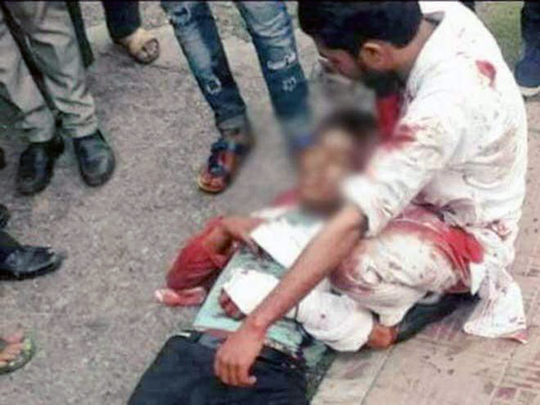
Junaid was stabbed to death while his brothers, Hashim and Sakir--were injured by a mob which also allegedly hurled slurs against them onboard the Delhi-Mathura passenger train between Ballabgarh and Mathura stations on Thursday night.

The arrested accused, before being remanded to police custody by a court in Faridabad district earlier, had told reporters that he was in an inebriated state at the time of the incident and attacked the teenager on being allegedly instigated by fellow passengers.

Also Read: Communal hate crime: Family in shock after 16-yr-old Hafiz-ul-Quran murdered on train

Comments

Mohammed Imran
 - 
Monday, 26 Jun 2017

Now time has came to unite and fight against such goons till our last breath. Will sacrifice for humanity, not be tolerate.

Unseen Baig
 - 
Tuesday, 27 Jun 2017

Suspect state sponsored actions to consolidate Hindu votes. Wondering if all Hindus accept this and throw alliance. Steadfastness and fear of Allah shall prevail against all these pseudo nationalist plans.

Ranjan shetty
 - 
Tuesday, 27 Jun 2017

what is so shocking in this ? it was a street brawl . they taunted and might have hurt hindu sentiments or eve teased Hindu women as it is in their blood .

Ahmed K.C.
 - 
Tuesday, 27 Jun 2017

Mohammed Imran, Udupi,
As soon as you start fighting against such goons, they will label you as 'Terrorist" and you know what happens after that?
According to them:-
One wearing skull cap is a Terrorist
One goes to Madrasa is a Terrorist
One reads Qur'an is a Terrorist
One with Islamic beard is a Terrorist
One who transports a cattle is a Terrorist

All come under one umbrella called "RADICAL ISLAMIC TERRORISM"

Add new comment

  • Coastaldigest.com reserves the right to delete or block any comments.
  • Coastaldigset.com is not responsible for its readers’ comments.
  • Comments that are abusive, incendiary or irrelevant are strictly prohibited.
  • Please use a genuine email ID and provide your name to avoid reject.
Ram Puniyani
March 14,2020

In the wake of Citizenship Amendment Act (CAA) UN High Commissioner, Michele Bachelet, has filed an intervention in the Supreme Court petition challenging the constitutionality of the Citizenship Amendment Act, as she is critical of CAA. Responding to her, India’s Foreign Minister S. Jai Shanker strongly rebutted her criticism, saying that the body (UNHCR) has been wrong and is blind to the problem of cross border terrorism. The issue on hand is the possibility of scores of people, mainly Muslims, being declared as stateless. The problem at hand is the massive exercise of going through the responses/documents from over 120 crore of Indian population and screening documents, which as seen in Assam, yield result which are far from truthful or necessary.

The issue of CAA has been extensively debated and despite heavy critique of the same by large number of groups and despite the biggest mass opposition ever to any move in Independent India, the Government is determined on going ahead with an exercise which is reminiscent of the dreaded regimes which are sectarian and heartless to its citizens, which have indulged in extinction of large mass of people on grounds of citizenship, race etc. The Foreign minister’s assertion is that it is a matter internal to India, where India’s sovereignty is all that matters! As far as sovereignty is concerned we should be clear that in current times any sovereign power has to consider the need to uphold the citizenship as per the principle of non-discrimination which is stipulated in Art.26 of the International Covenant on Civil and Political (ICCPR) rights.

Can such policies, which affect large number of people and are likely to affect their citizenship be purely regarded as ‘internal’? With the World turning into a global village, some global norms have been formulated during last few decades. The norms relate to Human rights and migrations have been codified. India is also signatory to many such covenants in including ICCPR, which deals with the norms for dealing with refugees from other countries. One is not talking of Chicago speech of Swami Vivekanand, which said that India’s greatness has been in giving shelter to people from different parts of the World; one is also not talking of the Tattariaya Upanishad’s ‘Atithi Devovhav’ or ‘Vasudhaiva Kutumbkam’ from Mahaupanishad today.

What are being talked about are the values and opinions of organizations which want to ensure to preserve of Human rights of all people Worldwide. In this matter India is calling United Nations body as ‘foreign party’; having no locus standi in the case as it pertains to India’s sovereignty. The truth is that since various countries are signatories to UN covenants, UN bodies have been monitoring the moves of different states and intervening at legal level as Amicus (Friend of the Court) to the courts in different countries and different global bodies. Just to mention some of these, UN and High Commissioner for Human Rights has often submitted amicus briefs in different judicial platforms. Some examples are their intervention in US Supreme Court, European Court of Human Rights, International Criminal Court, and the Inter-American Court of Human Rights. These are meant to help the Courts in areas where UN bodies have expertise.

 Expertise on this has been jointly formulated by various nations. These interventions also remind the nations as to what global norms have been evolved and what are the obligations of individual states to the values which have evolved over a period of time. Arvind Narrain draws our attention to the fact that, “commission has intervened in the European Court of Human Rights in cases involving Spain and Italy to underscore the principle of non-refoulement, which bars compulsory expulsion of illegal migrants… Similarly, the UN has intervened in the International Criminal Court in a case against the Central African Republic to explicate on the international jurisprudence on rape as a war crime.”

From time to time organizations like Amnesty International and Human Rights Watch have been monitoring the status of Human rights of different countries. This puts those countries in uncomfortable situation and is not welcome by those establishments. How should this contradiction between ‘internal matter’, ‘sovereignty’ and the norms for Human rights be resolved? This is a tough question at the time when the freedom indices and democratic ethos are sliding downwards all over the world. In India too has slid down on the scale of these norms.

In India we can look at the intervention of UN body from the angle of equality and non discrimination. Democratic spirit should encourage us to have a rethink on the matters which have been decided by the state. In the face of the greatest mass movement of Shaheen bagh, the state does need to look inwards and give a thought to international morality, the spirit of global family to state the least.

The popular perception is that when Christians were being persecuted in Kandhmal the global Christian community’s voice was not strong enough. Currently in the face of Delhi carnage many a Muslim majority countries have spoken. While Mr. Modi claims that his good relations with Muslim countries are a matter of heartburn to the parties like Congress, he needs to relook at his self gloating. Currently Iran, Malaysia, Indonesia and many Muslim majority countries have spoken against what Modi regime is unleashing in India. Bangladesh, our neighbor, has also seen various protests against the plight of Muslims in India. More than the ‘internal matter’ etc. what needs to be thought out is the moral aspect of the whole issue. We pride ourselves in treading the path of morality. What does that say in present context when while large section of local media is servile to the state, section of global media has strongly brought forward what is happening to minorities in India.   

The hope is that Indian Government wakes up to its International obligations, to the worsening of India’s image in the World due to CAA and the horrific violence witnessed in Delhi.

Comments

Add new comment

  • Coastaldigest.com reserves the right to delete or block any comments.
  • Coastaldigset.com is not responsible for its readers’ comments.
  • Comments that are abusive, incendiary or irrelevant are strictly prohibited.
  • Please use a genuine email ID and provide your name to avoid reject.
News Network
January 5,2020

Mangaluru, Jan 5: To keep an hawk's eye on the city, 15 prominent and crowded junctions in the city will have the most advanced CCTV cameras installed under the Smartcity project.

The junctions are-- Bejai KSRTC, Pumpwell, Vamanjoor, Padil, Mullikatte, Bejai, Bendoor, Falnir, Morgans Gate, Kulashekara-Shakthinagar Cross, Kottara Chowki, Kuntikan, Rao & Rao Circle, Padavinangady and Kavoor junctions.

According to top police officials, these junctions will receive approximately 75 cameras to check crime and aid in solving the cases of murder and robbery in the city.

A ‘smartpole’ will be installed there with each pole containing about five cameras along with a 360 degree swivelling camera.

Comments

Angry Indian
 - 
Sunday, 5 Jan 2020

One camera need inside the poilce cabin..


this will revel whom the police meet 

nidhin
 - 
Sunday, 5 Jan 2020

Better to install in Police station itself, at least it can reveal undisclosed Bhaithak. 

Add new comment

  • Coastaldigest.com reserves the right to delete or block any comments.
  • Coastaldigset.com is not responsible for its readers’ comments.
  • Comments that are abusive, incendiary or irrelevant are strictly prohibited.
  • Please use a genuine email ID and provide your name to avoid reject.
coastaldigest.com news network
July 30,2020

Mangaluru, July 30: Medical doctor turned IAS officer K V Rajendra assumed charge as the 130th deputy commissioner of Dakshina Kannada district here today.

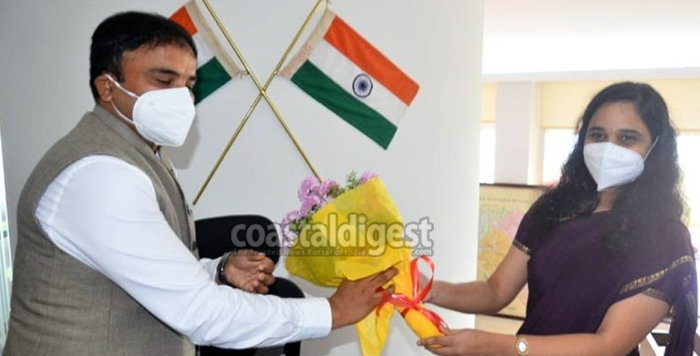
The 2013 batch Karnataka cadre officer succeeds Sindhu B Rupesh, who was transferred as Director of Electronic Delivery of Citizen Services (EDCS), Bengaluru. The outgoing DC welcomed the new DC in the presence of staff. 

Dr Rajendra said that he expects cooperation from all stakeholders in administering the district, amidst the mounting Covid-19 cases.

Rajendra, an alumnus of JJM Medical College, Davanagere, was serving as the CEO of Belagavi zilla panchayat before being posted as DC of this coastal district. 

Having served as assistant commissioner of Puttur sub-division for nearly a year from December 2015, Dr Rajendra, hails from Thirthahalli in Shivamogga district, had his probationary training in Bidar. He posted as CEO of Ballari ZP where he worked for nearly three till 21, 2019.

He also had a brief stint as assistant secretary in the department of fertiliser with the ministry of chemicals and fertilisers.

Sindhu who was the CEO of Udupi zilla panchayat had succeeded Sasikanth Senthil, who resigned from the Indian Administrative Service on September 6, 2019. She had taken charge on September 7, 2019.

Comments

Add new comment

  • Coastaldigest.com reserves the right to delete or block any comments.
  • Coastaldigset.com is not responsible for its readers’ comments.
  • Comments that are abusive, incendiary or irrelevant are strictly prohibited.
  • Please use a genuine email ID and provide your name to avoid reject.