


Killing in name of cow against Hindutva; need national policy on beef: Shiv Sena

Agencies
July 4, 2017

New Delhi, Jul 4: Days after Prime Minister Narendra Modi strongly decried violence in the name of cow protection, BJP ally Shiv Sena too has spoken out against incidents of lynching in the name of cow.shivsena
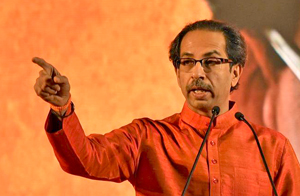
The Sena said said lynching people in the name of cow protection is against Hindutva and urged PM Modi to come up with a national policy on beef.

The Maharashtra-focused party's comments were published in its mouthpiece 'Saamana' today and come after a number of a incidents of lynching over either alleged transport of cow for slaughter or beef consumption in parts of India.

The incidents, also reported from several Bharatiya Janata Party-ruled states including Jharkhand, Haryana and Uttar Pradesh, have promoted protests, most notably the #NotInMyName rallies that took place in several cities across the country.

Commenting in an editorial in 'Saamana' today, the Shiv Sena said, "The issue of beef is related to eating habits, business and employment. Hence, there should be a national policy over the issue." "Those who were safeguarding cows were Hindus till yesterday. Today, they have become murderers."

Shiv Sena welcomed the prime minister's comments from last week, when a visible charged up Modi admonished the so-called 'gau rakshaks' and said that killing in the name of cow is not acceptable.

"We welcome the stand taken by the prime minister over the issue. Nobody has the right to take law in his hands in the name of cow protection. Lynching people is against the principles of Hindutva," the Sena said in its editorial.

"We thank him (Modi) for clearly defining Hindutva. He should now come up with a national policy on beef to ease tensions," the Sena said.

Previously, BJP chief Amit Shah and Rashtriya Swayamsevak Sangh head Mohan Bhagwat have both hit out at cow vigilante violence. Bhagwat, while demanding a national law to ban cow slaughter, said killing someone in the name of cow protection is wrong.

Shah has struck a more subdued note. The BJP chief recently termed incidents of lynching as "serious", but claimed more of these happened under the previous governments than the three years of NDA rule.

Modi's comments last week followed the lynching of a teenager, Junaid Khan, who was stabbed to death by a group of men on a train when he was returning home to Ballabhgarh in Haryana after shopping for Eid. His assailants termed Junaid, his brother and friends as "beef eaters".

In Jharkhand's Ramgarh, a Muslim meat trader was beaten to death last week by cow vigilantes who alleged he was carrying beef in his vehicle. Nityanand Mahto, a local BJP leader is among those arrested in connection with the incident.

Earlier this year, a cattle farmer - Pehlu Khan - died after being attacked by so-called gau rakshaks who suspected him of illegally ferrying cattle for the purpose of slaughter in Rajasthan's Alwar.

In September 2015, Mohammad Akhlaq was beaten to death at Dadri in Uttar Pradesh over suspicion of storing and consuming beef. Modi had spoken up against cow-related violence even then, but did not explicitly mention the Dadri incident.

Comments

Abdullah
 - 
Saturday, 8 Jul 2017

Only barking like Modi.
What action you people have taken against BD, RSS goons from these many years???

Add new comment

  • Coastaldigest.com reserves the right to delete or block any comments.
  • Coastaldigset.com is not responsible for its readers’ comments.
  • Comments that are abusive, incendiary or irrelevant are strictly prohibited.
  • Please use a genuine email ID and provide your name to avoid reject.
News Network
January 27,2020

Bagalkote, Jan 27: The bank of Krishna River in front of Sangamantha Temple at Koodalasangama in Karnataka today witnessed the launch of women’s indefinite strike demanding liquor ban in the state.

Thousands of women from various parts of Karnataka have taken part in the strike being organised under the banner of 'Karnataka Madya Nisheda Andolana'.

The strike was launched to draw the attention of the state government to press for a complete ban on the sale of liquor across the state.

About 50 various organizations and religious pontiffs have extended their support for the strike. Food is being cooked on the bank of the river for the agitating women.

The women from Chikmagalur, Tumakuru, Raichur and Ballari districts are taking part in it.

Comments

SK
 - 
Tuesday, 28 Jan 2020

Change the Heading........


The protest is for Liquor ban and not against .......  Please edit the articles before posting

FAIRMAN
 - 
Monday, 27 Jan 2020

Thanks to God,

At least now, people wokeup., which should have been done immediattely after independence or during implementation of constitution.


Shame to men who drink more.

Add new comment

  • Coastaldigest.com reserves the right to delete or block any comments.
  • Coastaldigset.com is not responsible for its readers’ comments.
  • Comments that are abusive, incendiary or irrelevant are strictly prohibited.
  • Please use a genuine email ID and provide your name to avoid reject.
coastaldigest.com web desk
May 19,2020

Mangaluru, May 19: Officials at the Karnataka State Natural Disaster Monitoring Centre (KSNDMC) said that Dakshina Kannada, Udupi and Uttara Kannada along with Kodagu, Chikkamagaluru have been alerted about possible heavy rains.

Dr GS Srinivasa Reddy, Director, KSNDMC, said, “Coastal districts have already been witnessing heavy downpour since Monday morning. This will continue for another two days depending on the cyclonic movement along the east coast.”

Until last evening, Haleyangadi and Surathkal in Dakshina Kannada district had received 83 mm and 82.5 mm of rainfall, respectively. Several other areas in Udupi also witnessed heavy rainfall of about 60 to 70 mm rainfall.

The India Meteorological Department (IMD) attributed the rain, which intensified on Monday, to a cyclonic circulation over parts of the Arabian Sea (Comorin area) off the coast of Kerala.

The weather department said the sudden convergence of wind over the peninsular region was due to Super Cyclone Amphan, which is set to barrel into the east coast. The IMD issued an Yellow Alert for coastal Karnataka and Malnad, warning of moderate to heavy rainfall in the next few days.

Comments

Add new comment

  • Coastaldigest.com reserves the right to delete or block any comments.
  • Coastaldigset.com is not responsible for its readers’ comments.
  • Comments that are abusive, incendiary or irrelevant are strictly prohibited.
  • Please use a genuine email ID and provide your name to avoid reject.
Media Release
February 14,2020

Veteran journalist P. Sainath has said that the nation is in a crisis. And this crisis is not limited to just the rural area. It has become a national crisis at various areas such as agriculture, education, economy, job creation etc.

He was delivering the endowment lecture on the topic ‘Indian democracy at the post-liberalization and post-truth era’ at Media Manthan 2020 organized by the PG department of journalism and mass communication at St Aloysius College (Autonomous). 

Mr Sainath said that the many policies adopted in the 90s led to India becoming unusually unequal. Referring to the speech Ambedkar had made at the Constituent Assembly while handing over the draft of the Constitution, Mr Sainath said, “Ambedkar had warned about the weakness of Indian democracy that liberty without equality allows the supremacy of a few over the multitude. Liberty, equality and fraternity must be kept together as we cannot have one without the other.” 

Mr Sainath stated that the agrarian crisis was no longer about the loss of productivity, employment or about farmer suicide; it was a societal, civilizational crisis. Commenting on the lopsided policies such as cow-slaughter ban, he explained how cow slaughter ban had adversely affected many industries due to their interdependency. While Muslims who slaughtered cows were rendered helpless, the cattle traders who were mostly OBCs lost their earnings as the cattle prices crashed. An important industry like Kolhapur sandals industry in Maharashtra went bankrupt as a result of the cow slaughter ban in Maharashtra. He said the policymakers had no idea how the rural industries were interconnected. Demonetisation too devastated the rural economy as 98 percent of rural transactions happen through cash. 

Mr Sainath also spoke about the crisis of inequality which affects the Dalits and the Adivasis far more than anyone else as 90 percent of the rural households take home less than Rs 10,000/- per month. “Women are yet another group whose labour is never counted in the gross domestic product. Women and girls globally do unpaid work which amounts to about 12.5 billion working hours per year. Monetarily speaking, this is worth 10.8 trillion dollars,” Mr Sainath added. 

Speaking about the crisis of jobs Mr Sainath said that major companies were laying off employees just to create more profits for the investors and the adoption of artificial intelligence in the industry would further destroy millions of jobs.

Rector of St Aloysius College Institutions Fr Dionysius Vaz SJ, Principal Dr (Fr) Praveen Martis SJ, HOD of Journalism and Mass Communication department Dr (Fr) Melwyn Pinto SJ were present.

‘Veerappan and Vijay Mallya’s business models are interesting!’

Addressing the gathering during his endowment lecture on Friday, Mr Sainath made an interesting comment on the so called ‘revenue model’. “Whenever I visit IIMs and IITs for lectures on my PARI project, the students there ask me what my revenue model for my project is. I tell them that I do not have a revenue model. In fact, journalism does not begin with a revenue model. Gandhiji, Ambedkar, Bhagat Singh were all great journalists. But they did not have a revenue model,” Mr Sainath said.

On a lighter note, he said that the best revenue model that he liked was that of forest brigand Veerappan and liquor baron Vijay Mallya. “Veerappan ruled the forest for forty years and from the top ministers to the villagers he could dictate terms and liver royally. Similarly, Mallya’s revenue model was to steal the banks and run away abroad and live like a king,” Mr Sainath added.

Journalism is not and can never be a business. It is a calling, he opined. While newspaper can be a business, television can be a business, journalism per se cannot be reduced to a business. “Unfortunately today, journalists are recruited on a contract basis and they have no bargaining power; and there are no unions to fight for their cause. Hence, they are at the mercy of the corporate media houses for their survival and are made to write stories that cannot be called journalism,” Mr Sainath said.

Answering a question as to the pressures he faced as a journalist, he said that external pressures from the government or others could be very well handled. It is the internal pressures from once own media house that journalists find it difficult to manage.


Comments

Add new comment

  • Coastaldigest.com reserves the right to delete or block any comments.
  • Coastaldigset.com is not responsible for its readers’ comments.
  • Comments that are abusive, incendiary or irrelevant are strictly prohibited.
  • Please use a genuine email ID and provide your name to avoid reject.