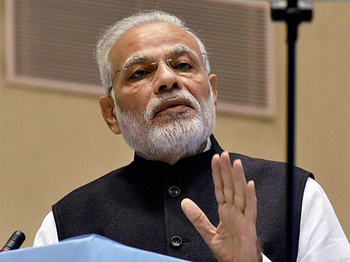
'Killing in the name of cow worship is not acceptable,' says PM Modi

News Network
June 29, 2017

New Delhi, Jun 29: Prime Minister Narendra Modi finally broke his silence on recent incidents of cow protection-related lynchings and violence, saying on Thursday he was "sad" they happened and that "killing in the name of cow worship is not acceptable".modi copy

"No person in this nation has the right to take the law in his or her own hands in this country," Modi said.

Modi said that protecting cows "should be done" and that "no one spoke about protecting cows more than Mahatma Gandhi and Acharya".

He added though that Gandhi wouldn't approve of killing people to protect cows.

"Killing people in the name of Gau Bhakti is not acceptable. This is not something Mahatma Gandhi would approve of," the PM said in an address in Ahmedabad.

Killing people in the name of Gau Bhakti is not acceptable. This is not something Mahatma Gandhi would approve: PM @narendramodi

— PMO India (@PMOIndia) June 29, 2017

Referring to cow vigilantism, Modi said violence won't solve any problems.

"We are a land of non violence. We are the land of Mahatma Gandhi. Why do we forget that...As a society, there is no place for violence. Violence never has and never will solve any problem:," Modi said.

He called for creating a country of "Mahatma Gandhi's dreams".

"Let's all work together. Let's create the India of Mahatma Gandhi's dreams. Let's create an India our freedom fighters would be proud of," he added.

Comments

Wonder Kotian
 - 
Wednesday, 5 Jul 2017

Really it is condemnable, our smartest police forces keeping very closely the real Criminals, do not think \every dogs has its own day\"
master Buffoon which part of the al ain you are leaving???
that's the Head quarters to that, looks fishy in that Criminals all are involved.
Jai Hoo Siddaramanna."

PAR
 - 
Wednesday, 5 Jul 2017

Ranjan Shetty:

Dont make bow bow without fact... It was stabbed by your own hindu brother who was drunken and came to collect his belongings ... When he did not get the item or damaged ... Stupid drunken militant hit him with the knife.

Cheddi color will not work here to destabilize the society... Please stop this evil of your masters here and in mangalore.

Add new comment

  • Coastaldigest.com reserves the right to delete or block any comments.
  • Coastaldigset.com is not responsible for its readers’ comments.
  • Comments that are abusive, incendiary or irrelevant are strictly prohibited.
  • Please use a genuine email ID and provide your name to avoid reject.
News Network
April 20,2020

Thiruvananthapuram, Apr 20: The Kerala government announced the relaxation of COVID-19 lockdown restrictions in two zones, allowing among other private vehicles movement in an odd-even basis and dine-in services at hotels from Monday.

State police chief Loknath Behera said the relaxations of restrictions imposed would come into effect in the Green and Orange-B zones in the state from Monday,an official release said.

Earlier, the Left government had colour-coded 14 districts of the state into four zones-- Red, Green, Orange-A and Orange-B, for containing the Covid-19 pandemic. Red zone comprises Kasaragod, Kannur, Kozhikode and Malappuram districts. In this zone, a complete lockdown will be in place until May 3 while two entry and exit points are allowed for carrying essential commodities to coronavirus hotspots. Orange-A zone comprises Pathanamthitta, Ernakulam and Kollam while orange-B zone comprises Alappuzha, Thiruvananthapuram, Palakkad, Thrissur and Wayanad.

The lockdown will be in effect until April 24 in this zone and then partial relaxation will be allowed. Kottayam and Idukki come under the Green zone, in which lockdown will be in effect until April 20 and then regulations will be eased. However, large gatherings, the functioning of educational institutions, religious functions, celebrations and travel outside the district will not be allowed in this zone.

Not more than 20 people are allowed to take part in weddings and funerals, according to government instructions. On the functioning of courts, the release said, "Courts in the Green and Orange-B zones will re-open on April 21 while that in Orange-A zone will start functioning from April 25. The courts will function with 33 per cent of staff. The cases will be heard via video conferencing."

Meanwhile, the Bankers' Council has announced that banks will function as per the usual timings from Monday in the state except four districts falling under the Red zone. The Transport Ministry has clarifiedthat public transport won't be allowed to ply in the state during the lockdown period. "Inter-district travel will not be allowed despite relaxations in the state, but essential services such as medical services, food supplies will not be stopped. However, in case of emergency, inter-district travel will be allowed with an affidavit prepared by the traveller," Behra said in a release.

On the implementation of the odd-even scheme for private vehicles, the police said, "Vehicles with odd numbers will be permitted on Mondays, Wednesdays and Fridays. Those with even numbers will be allowed on Tuesdays, Thursdays and Saturdays." Woman drivers travelling solo or with dependants are also exempted from it, police said. On Sundays, only those working for essential services are allowed to use their vehicles.

All education institutions, cinema halls, shopping malls, public parks, bars, places of worship will remain closed in all zones of the state. The health department and local administration, which carry out sanitation work before the monsoon, are allowed to operate. Four-wheelers are permitted to carry two passengers besides the driver and in case of a two-wheeler, only the driver will be allowed while the pillion rider is allowed in case the person is a family member.

On Dine-in services, a government order said it is allowed at hotels and restaurants until 7 PM in Green and Orange-B zone from Monday and in Orange-A zone from April 24. However, take-away counters can function until 8 PM, it said. Kerala on Sunday reported two positive cases of Covid-19 in the state taking the total number of affected to 401 while the health department announced that 13 people were cured.


Comments

Add new comment

  • Coastaldigest.com reserves the right to delete or block any comments.
  • Coastaldigset.com is not responsible for its readers’ comments.
  • Comments that are abusive, incendiary or irrelevant are strictly prohibited.
  • Please use a genuine email ID and provide your name to avoid reject.
News Network
June 8,2020

Bengaluru, Jun 8: Facing a shortage of labour, some top builders in the city have initiated efforts to bring back the migrant workers, who have returned to their native places following the COVID-19 lockdown, and are holding parleys with Railway authorities for operation of special trains to ferry them.

After the lockdown was announced, many construction projects came to a halt and accordingly the labourers were rendered jobless. These migrant workers preferred to go back to their home state as they were not paid when the projects were stopped and were caught in the big financial mess. Many of these migrants even chose to cover thousands of kilometres by foot when even trains, buses or any motor vehicles were not operating.

Keeping their woes in view, the Centre decided to run the Shramik Special trains to ferry them to their native places. But, after they were gone, the builders found themselves in a lurch. An executive of a builder told PTI "Yes, our builder and a few others are in talks with the Railways to run the special train to bring back the labourers." She said nothing has been materialised as of now.

According to her, the builders took the contact numbers of the workers when they left the city to their home states and are now contacting them one by one. The South Western Railway has so far sent 3.11 lakh migrant workers in 216 Shramik Special trains starting from May 3 to June 6.

Comments

Add new comment

  • Coastaldigest.com reserves the right to delete or block any comments.
  • Coastaldigset.com is not responsible for its readers’ comments.
  • Comments that are abusive, incendiary or irrelevant are strictly prohibited.
  • Please use a genuine email ID and provide your name to avoid reject.
Wafa Sultana
April 4,2020

Over the last couple of days when the world was occupied with unifying efforts to fight the deadly Covid19 pandemic, sections of Indian media provided viewers a familiar scapegoat – the Indian Muslims – who are often stereotyped as a community being constantly at loggerheads with the citizenry and the State. Biased media channels were quick to resort to blaming the entire Muslim community for the spread of the disease in the country, thanks to an ill-timed Tablighi Jamaat gathering at its international headquarters in Delhi’s Nizamuddin. Unsurprisingly, the opprobrium was also marked by a sudden spike in WhatsApp forwards of videos with people wearing skullcaps licking spoons and performing Sufi breathing rituals, suggesting some sort of wild conspiracy on the part of the community to spread the virus.  Some media channels were quick to formulate, hypothesize and provide loose definitions of a newly discovered form of Jihad i.e. ‘Corona Jihad ’ thereby vilifying the Islamic faith and its followers.

While the investigation on the culpability of the organizers of the Nizamuddin event is still ongoing, there is enough information to suggest that the meeting was held before any lockdown was in force, and the problem began when there was no way of getting people out once the curfew was announced. Be that as it may, there is little doubt that organizing a meet of such a scale when there is a global pandemic smacks of gross misjudgment, and definitely the organizers should be held accountable if laws or public orders were defied. Attendees who attempt to defy quarantine measures must be dealt with strictly. However, what is alarming is that the focus and narrative have now shifted from the unfortunate event at Nizamuddin to the Tablighi Jamaat itself.

For those not familiar with the Tablighi Jamaat, the organization was founded in 1926 in Mewat by scholar Maulana Mohammad Ilyas. The Jamaat’s main objective was to get Muslim youth to learn and practice pristine Islam shorn of external influences. This is achieved through individuals dedicating time for moral and spiritual upliftment secluded from the rest of the world for a brief period of time. There is no formal membership process. More senior and experienced participants typically travel from one mosque to other delivering talks on religious topics, inviting local youth to attend and then volunteer for a spiritual retreat for a fixed number of days to a mosque in a nearby town or village to present the message to their co-religionists. Contrary to ongoing Islamophobic rhetoric, the movement does not actively proselytize. The focus is rather on getting Muslims to learn the teachings and practices of Islam.  This grassroots India-based movement has now grown to almost all countries with substantial Muslim populations. Its annual meets, or ‘ijtemas’ are among the largest Islamic congregations in the world after the annual Haj. One of the reasons for its popularity and wide network in the subcontinent and wordwide is the fact that it has eschewed the need for scholarly intervention, focusing on peer learning of fundamental beliefs and practice rather than high-falutin ideological debates. The Tablighi Jamaat also distinguishes itself from other Islamic movements through its strictly apolitical nature, with a focus on individual self-improvement rather than political mobilization. Hardships and difficulty in the world are expected to be face through ‘sabr’ (patience) and ‘dua’ (supplication),  than through quest for political power or influence. In terms of ideology, it is very much based on mainstream Sunni Islamic principles derived from the Deobandi school.

So, why is all this background important in the current context? While biased media entities have expectedly brought out their Islamophobic paraphernalia out for full display, more neutral commentators have tried to paint the Tablighi Jamaat as a fringe group and have tried to distance it from 'mainstream Muslims'. While the intent is no doubt innocent, this is a trap we must not fall into. This narrative, unfortunately, is also gaining ground due to apathy some Muslims have for the group, accusing it of being “disconnected from the realities of the world”. Unlike other Muslim organizations and movements, the Tablighi Jamat, by virtue of its political indifference, does not boast of high-profile advocates and savvy spokespersons who can defend it in mainstream or social media.  The use of adjectives such as 'outdated' and 'orthodox' by liberal columnists to describe the Jamaat feeds into the malignant attempt to change the narrative from the control of the spread of the pandemic due to the Nizamuddin gathering to 'raison d'etre' of the organization itself.

A large mainstream religious group like the Tablighi Jamaat with nearly a hundred-year history, normally considered to be peaceful, apolitical and minding its own business is now suddenly being villainized owing to unfortunate circumstances. Biased media reactions filled with disgust and hate seem to feed the Indian public conscience with a danngerous misconception - to be a nominal Muslim is okay but being a practicing one is not.  For those committed to the truth and fighting the spread of Islamophobia, the temptation to throw the entire Tablighi Jamaat under the bus must be resisted.

The writer is a lawyer and research scholar at Qatar University. Her research interests include Islamic law and politics.

Comments

zahoorahmed
 - 
Saturday, 4 Apr 2020

great article! provides a great perspective on tableeg jamat

Add new comment

  • Coastaldigest.com reserves the right to delete or block any comments.
  • Coastaldigset.com is not responsible for its readers’ comments.
  • Comments that are abusive, incendiary or irrelevant are strictly prohibited.
  • Please use a genuine email ID and provide your name to avoid reject.