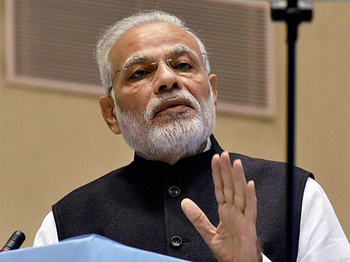
'Killing in the name of cow worship is not acceptable,' says PM Modi

News Network
June 29, 2017

New Delhi, Jun 29: Prime Minister Narendra Modi finally broke his silence on recent incidents of cow protection-related lynchings and violence, saying on Thursday he was "sad" they happened and that "killing in the name of cow worship is not acceptable".modi copy

"No person in this nation has the right to take the law in his or her own hands in this country," Modi said.

Modi said that protecting cows "should be done" and that "no one spoke about protecting cows more than Mahatma Gandhi and Acharya".

He added though that Gandhi wouldn't approve of killing people to protect cows.

"Killing people in the name of Gau Bhakti is not acceptable. This is not something Mahatma Gandhi would approve of," the PM said in an address in Ahmedabad.

Killing people in the name of Gau Bhakti is not acceptable. This is not something Mahatma Gandhi would approve: PM @narendramodi

— PMO India (@PMOIndia) June 29, 2017

Referring to cow vigilantism, Modi said violence won't solve any problems.

"We are a land of non violence. We are the land of Mahatma Gandhi. Why do we forget that...As a society, there is no place for violence. Violence never has and never will solve any problem:," Modi said.

He called for creating a country of "Mahatma Gandhi's dreams".

"Let's all work together. Let's create the India of Mahatma Gandhi's dreams. Let's create an India our freedom fighters would be proud of," he added.

Comments

Wonder Kotian
 - 
Wednesday, 5 Jul 2017

Really it is condemnable, our smartest police forces keeping very closely the real Criminals, do not think \every dogs has its own day\"
master Buffoon which part of the al ain you are leaving???
that's the Head quarters to that, looks fishy in that Criminals all are involved.
Jai Hoo Siddaramanna."

PAR
 - 
Wednesday, 5 Jul 2017

Ranjan Shetty:

Dont make bow bow without fact... It was stabbed by your own hindu brother who was drunken and came to collect his belongings ... When he did not get the item or damaged ... Stupid drunken militant hit him with the knife.

Cheddi color will not work here to destabilize the society... Please stop this evil of your masters here and in mangalore.

Add new comment

  • Coastaldigest.com reserves the right to delete or block any comments.
  • Coastaldigset.com is not responsible for its readers’ comments.
  • Comments that are abusive, incendiary or irrelevant are strictly prohibited.
  • Please use a genuine email ID and provide your name to avoid reject.
News Network
April 13,2020

Lucknow, Apr 13: Muslims in Uttar Pradesh are now worried that the intense communal profiling of the Corona patients by the official agencies could lead to lynching incidents once the lockdown is lifted.

Muslim scholar and former SP spokesman, Abdul Hafiz Gandhi, on Monday said, "The manner in which the government agencies are identifying persons belonging to Tablighi Jamaat in the list of Covid-19 patients is now translating into intense communal profiling which has been prohibited by the World Health Organization and the central government. A very small percentage of Muslims subscribe to the Tablighi Jamaat ideology but the impression going around is that the Muslim community, in general, is spreading coronavirus."

He said that there was a strong possibility of Muslims, in general, being attacked after the lockdown is lifted.

"This is exactly what happened on the cow slaughter issue. Even a small rumour led to people being lynched by mobs across the country. Corona is a pandemic and should be treated like one. We should fight against the virus together instead of creating a communal divide. Every day, the government spokesman lays down the number of Corona positive cases and then goes on to say how many of them are from Tablighi Jamaat," he explained.

Amir Haider, a social activist and also a veteran Congress leader, echoed similar sentiments when he said, "We strongly condemn the Tablighi Jamaat for ignoring the protocols and holding the congregation but why is the state government repeatedly harping on the religious angle. Shia and Sunni clerics are repeatedly asking the people to adhere to government guidelines and follow safety protocols.

He said that efforts to create a communal divide on the corona issue could have dangerous ramification after the lockdown is lifted."

A retired IAS officer, who did not wish to be named, said, that people have already started objecting to taking home deliveries from Muslim employees.

"My neighbours refused to take delivery of groceries from a Muslim boy. This is just the beginning of the narrative that is being drilled into the minds. We must check this before it explodes into something very dangerous," he said.

Comments

Wellwisher
 - 
Tuesday, 14 Apr 2020

What ever yogi want to do let him and keep faith on the creator and live fear lessly. Almighty is watching you and your faith.His decision  is vast  and he will protect his believer's always.


Add new comment

  • Coastaldigest.com reserves the right to delete or block any comments.
  • Coastaldigset.com is not responsible for its readers’ comments.
  • Comments that are abusive, incendiary or irrelevant are strictly prohibited.
  • Please use a genuine email ID and provide your name to avoid reject.
coastaldigest.com news network
May 22,2020

Mangaluru, May 22: An elderly cardiac patient from Dakshina Kannada, who was stranded in Saudi Arabia due to covid-19 lock-down, has finally reached his homeland thanks to the timely intervention by Humanity Forum Jubail and Indian Social Forum.

The elderly man hailing from Kadaba area of Dakshina Kannada was admitted to a hospital in Madinah. However, his condition continued to worsen due to lack of proper treatment. The efforts by his family members to bring him back home had not yielded results.

Meanwhile, one of the relatives of the patient, Ansari Suratkal, who happens to be a DKSC activist, brought the issue to the notice of the Karnataka unit of the Indian Social Forum in Dammam. ISF contacted Humanity Forum president Zakariya Jokatte, who helped the patient to speak directly union minister D V Sadananda Gowda in a video conference organised by coastaldigest.com.

Humanity Forum also persuaded the Indian Embassy to allow the stranded cardiac patient to fly back to India through Dammam-Bengaluru repatriation flight on May 20. 

However, it was not easy for the patient to travel from Madinah to Dammam International Airport due to lock-down and curfew. ISF not only obtained travel permission for him but also arranged vehicle. Jeddah and Riyadh units of ISF helped in obtaining permission letter in their respective places in spite of travel ban imposed by the police. Madinah unit of ISF arranged vehicle for transportation. Zakariya Jokatte bore the air ticket and other expenses of the patient.

Comments

Add new comment

  • Coastaldigest.com reserves the right to delete or block any comments.
  • Coastaldigset.com is not responsible for its readers’ comments.
  • Comments that are abusive, incendiary or irrelevant are strictly prohibited.
  • Please use a genuine email ID and provide your name to avoid reject.
News Network
July 28,2020

Hounde, Jul 28: Coronavirus and its restrictions are pushing already hungry communities over the edge, killing an estimated 10,000 more young children a month as meager farms are cut off from markets and villages are isolated from food and medical aid, the United Nations warned Monday.

In the call to action shared with The Associated Press ahead of publication, four UN agencies warned that growing malnutrition would have long-term consequences, transforming individual tragedies into a generational catastrophe.

Hunger is already stalking Haboue Solange Boue, an infant from Burkina Faso who lost half her former body weight of 5.5 pounds (2.5 kilograms) in just a month. Coronavirus restrictions closed the markets, and her family sold fewer vegetables. Her mother was too malnourished to nurse.

“My child,” Danssanin Lanizou whispered, choking back tears as she unwrapped a blanket to reveal her baby's protruding ribs.

More than 550,000 additional children each month are being struck by what is called wasting, according to the UN — malnutrition that manifests in spindly limbs and distended bellies. Over a year, that's up 6.7 million from last year's total of 47 million. Wasting and stunting can permanently damage children physically and mentally.

“The food security effects of the COVID crisis are going to reflect many years from now,” said Dr. Francesco Branca, the WHO head of nutrition. “There is going to be a societal effect.”

From Latin America to South Asia to sub-Saharan Africa, more poor families than ever are staring down a future without enough food.

In April, World Food Program head David Beasley warned that the coronavirus economy would cause global famines “of biblical proportions” this year. There are different stages of what is known as food insecurity; famine is officially declared when, along with other measures, 30% of the population suffers from wasting.

The World Food Program estimated in February that one Venezuelan in three was already going hungry, as inflation rendered salaries nearly worthless and forced millions to flee abroad. Then the virus arrived.

“Every day we receive a malnourished child,” said Dr. Francisco Nieto, who works in a hospital in the border state of Tachira.

In May, Nieto recalled, after two months of quarantine, 18-month-old twins arrived with bodies bloated from malnutrition. The children's mother was jobless and living with her own mother. She told the doctor she fed them only a simple drink made with boiled bananas.

“Not even a cracker? Some chicken?” he asked.

“Nothing,” the children's grandmother responded. By the time the doctor saw them, it was too late: One boy died eight days later.

The leaders of four international agencies — the World Health Organization, UNICEF, the World Food Program and the Food and Agriculture Organization — have called for at least dollar 2.4 billion immediately to address global hunger.

But even more than lack of money, restrictions on movement have prevented families from seeking treatment, said Victor Aguayo, the head of UNICEF's nutrition program.

“By having schools closed, by having primary health care services disrupted, by having nutritional programs dysfunctional, we are also creating harm,” Aguayo said. He cited as an example the near-global suspension of Vitamin A supplements, which are a crucial way to bolster developing immune systems.

In Afghanistan, movement restrictions prevent families from bringing their malnourished children to hospitals for food and aid just when they need it most. The Indira Gandhi hospital in the capital, Kabul, has seen only three or four malnourished children, said specialist Nematullah Amiri. Last year, there were 10 times as many.

Because the children don't come in, there's no way to know for certain the scale of the problem, but a recent study by Johns Hopkins University indicated an additional 13,000 Afghans younger than 5 could die.

Afghanistan is now in a red zone of hunger, with severe childhood malnutrition spiking from 690,000 in January to 780,000 — a 13% increase, according to UNICEF.

In Yemen, restrictions on movement have blocked aid distribution, along with the stalling of salaries and price hikes. The Arab world's poorest country is suffering further from a fall in remittances and a drop in funding from humanitarian agencies.

Yemen is now on the brink of famine, according to the Famine Early Warning Systems Network, which uses surveys, satellite data and weather mapping to pinpoint places most in need.

Some of the worst hunger still occurs in sub-Saharan Africa. In Sudan, 9.6 million people live from one meal to the next — a 65% increase from the same time last year.

Lockdowns across Sudanese provinces, as around the world, have dried up work and incomes for millions. With inflation hitting 136%, prices for basic goods have more than tripled.

“It has never been easy but now we are starving, eating grass, weeds, just plants from the earth,” said Ibrahim Youssef, director of the Kalma camp for internally displaced people in war-ravaged south Darfur.

Adam Haroun, an official in the Krinding camp in west Darfur, recorded nine deaths linked with malnutrition, otherwise a rare occurrence, over the past two months — five newborns and four older adults, he said.

Before the pandemic and lockdown, the Abdullah family ate three meals a day, sometimes with bread, or they'd add butter to porridge. Now they are down to just one meal of “millet porridge” — water mixed with grain. Zakaria Yehia Abdullah, a farmer now at Krinding, said the hunger is showing “in my children's faces.”

“I don't have the basics I need to survive,” said the 67-year-old, who who hasn't worked the fields since April. “That means the 10 people counting on me can't survive either.”


Comments

Add new comment

  • Coastaldigest.com reserves the right to delete or block any comments.
  • Coastaldigset.com is not responsible for its readers’ comments.
  • Comments that are abusive, incendiary or irrelevant are strictly prohibited.
  • Please use a genuine email ID and provide your name to avoid reject.