


Kolkata flyover collapse: Toll rises to 24, rescue ops on through night

April 1, 2016

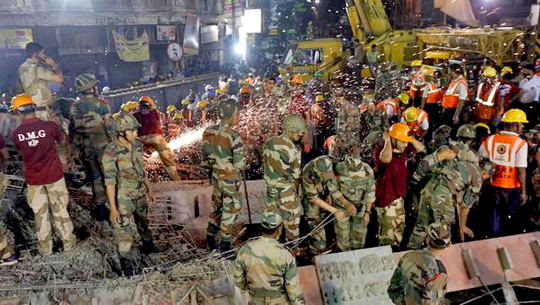
Kolkata, Apr 1: Death toll in the flyover collapse in Kolkata rose to 24 on Friday as the army and other emergency workers battled through Thursday night to rescue dozens of people still trapped under the debris.
flyover1

Doctors and paramedics of the army worked throughout the night to treat those rescued from the debris even as the state government ordered a high-level probe into the incident. The official death toll was 21.

Around 250 metres of the under-construction 2.2 kilometre-long Vivekananda Road flyover crashed onto dense traffic around 12.30 pm on Thursday near one of the city's most important business districts, Burrabazar.

PTI, quoting police, said 15 of the dead were identified while the identification process of the rest were on.

Anil Shekhawat, a spokesman for the National Disaster Response Force (NDRF), said seventeen survivers out of 92 rescued were still undergoing treatment at hospital, according to AFP.

Most suffered multiple fractures and were in a critical condition, Shekhawat added, saying that the death toll was expected to rise, with an unknown number of people still trapped under the wreckage.

Specialist rescue teams armed with concrete and metal cutters, drilling machines, sensors to detect life and sniffer dogs were sifting through the rubble.

Anurag Gupta, a spokesman for the National Disaster Management Authority, told AFP hundreds of rescuers would work through the night to rescue the trapped victims.

“Four hundred men from NDRF and 300 Indian army men along with hundreds of police and local officials are at the spot,” Gupta said.

Authorities sealed off the accident site to members of the public, who in the initial hours were seen trying to pull away concrete slabs with their bare hands.

Workers struggled to get cranes and other large machinery through the narrow streets of Burrabazar, one of the oldest and most congested parts of the city, where locals desperately waited for news of missing loved ones.

Like a bomb blast'

“Everything is finished,” screamed Parbati Mondal, whose fruit-seller husband had not been seen since the accident.

An injured builder told AFP at the scene that he had been working on the structure before it collapsed and had seen bolts come out of the metal girders.

“We were cementing two iron girders for the pillars, but the girders couldn't take the weight of the cement,” said 30-year-old Milan Sheikh before being taken away to hospital.

“The bolts started coming out this morning and then the flyover came crashing down.”

Many locals said they were fleeing their houses for fear that more of the damaged structure could collapse.

“We heard a massive bang sound and our house shook violently. We thought it was an earthquake,” 45-year-old resident Sunita Agarwal told AFP.

“We're leaving -- who knows what will happen next.”

An eyewitness at the scene described a loud bang “like a bomb blast and suddenly there was a lot of smoke and dust”.

Problem started during concrete casting

Problems started with the under-construction Vivekanand Road flyover here during midnight of Wednesday-Thursday when concrete casting was being done, construction workers said, reports IANS.

Sunil Sarkar, who was among those doing the concrete casting, said: “The bolt was coming apart as the bucket could not hold it. I think the sunshade in that particular place was made too big.”

Sarkar, now in hospital after sustaining injury, said a technician was called who welded the bolt in place.

“Our supervisors assured us that everything was in order and asked us to go ahead with the concrete casting.”

“The casting continued till noon today (Thursday). When the work was almost complete, the same part caved in and the flyover gave away,” said the resident of Murshidabad district.

Probe ordered

Meanwhile, chief secretary Basudeb Banerjee said on Thursday that a high level inquiry has been ordered into the flyover collapse while the city police commissioner Rajeev Kumar handed over a report about the incident to the chief minister Mamata Banerjee.

West Bengal Governor K N Tripathi, who visited the spot, has sought a report of the incident from the state government.

Comments

Pramod
 - 
Thursday, 31 Mar 2016

thank god before finishing only its collapsed, incase vehicle s movable so many lives would have been lost, please find the contractor and cancel his license.

Add new comment

  • Coastaldigest.com reserves the right to delete or block any comments.
  • Coastaldigset.com is not responsible for its readers’ comments.
  • Comments that are abusive, incendiary or irrelevant are strictly prohibited.
  • Please use a genuine email ID and provide your name to avoid reject.
Ram Puniyani
January 14,2020

In the beginning of January 2020 two very disturbing events were reported from Pakistan. One was the attack on Nankana Sahib, the holy shrine where Sant Guru Nanak was born. While one report said that the place has been desecrated, the other stated that it was a fight between two Muslim groups. Prime Minister of Pakistan Imran Khan condemned the incident and the main accused Imran Chisti was arrested. The matter related to abduction and conversion of a Sikh girl Jagjit Kaur, daughter of Pathi (One who reads Holy Guru Granth Sahib in Gurudwara) of the Gurudwara. In another incident one Sikh youth Ravinder Singh, who was out on shopping for his marriage, was shot dead in Peshawar.

While these condemnable attacks took place on the Sikh minority in Pakistan, BJP was quick enough to jump to state that it is events like this which justify the Citizenship Amendment Act (CAA). Incidentally CAA is the Act which is discriminatory and relates to citizenship with Religion, which is not as per the norms of Indian constitution. There are constant debates and propaganda that population of Hindus has come down drastically in Pakistan and Bangla Desh. Amit Shah, the Home minister stated that in Pakistan the population of Hindus has come down from 23% at the time of partition to 3.7% at present. And in Bangla Desh it has come down from 22% to present 8%.

While not denying the fact that the religious minorities are getting a rough deal in both these countries, the figures which are presented are totally off the mark. These figures don’t take into consideration the painful migrations, which took place at the time of partition and formation of Bangla Desh later. Pakistan census figures tell a different tale. Their first census was held in 1951. As per this census the overall percentage of Non Muslim in Pakistan (East and West together) was 14.2%, of this in West Pakistan (Now Pakistan) it was 3.44 and in Eat Pakistan it was 23.2. In the census held in Pakistan 1998 it became 3.72%. As far as Bangla Desh is concerned the share of Non Muslims has gone down from 23.2 (1951) to 9.6% in 2011.

The largest minority of Pakistan is Ahmadis, (https://minorityrights.org/country/pakistan/) who are close to 4 Million and are not recognised as Muslims in Pakistan. In Bangla Desh the major migrations of Hindus from Bangla Desh took place in the backdrop of Pakistan army’s atrocities in the then East Pakistan.

As far as UN data on refugees in India it went up by 17% between 2016-2019 and largest numbers were from Tibet and Sri Lanka.  (https://www.un.org/en/development/desa/population/migration/publication…)

The state of minorities is in a way the index of strength of democracy. Most South Asian Countries have not been able to sustain democratic values properly. In Pakistan, the Republic began with Jinnah’s classic speech where secularism was to be central credo of Pakistan. This 11th August speech was in a way what the state policy should be, as per which people of all faiths are free to practice their religion. Soon enough the logic of ‘Two Nation theory” and formation of Pakistan, a separate state for Muslim took over. Army stepped in and dictatorship was to reign there intermittently. Democratic elements were suppressed and the worst came when Zia Ul Haq Islamized the state in collusion with Maulanas. The army was already a strong presence in Pakistan. The popular formulation for Pakistan was that it is ruled by three A’s, Army, America and Allah (Mullah).

Bangla Desh had a different trajectory. Its very formation was a nail in the coffin of ‘two nation theory’; that religion can be the basis of a state. Bangla Desh did begin as a secular republic but communal forces and secular forces kept struggling for their dominance and in 1988 it also became Islamic republic. At another level Myanmar, in the grip of military dictatorship, with democratic elements trying to retain their presence is also seeing a hard battle. Democracy or not, the army and Sanghas (Buddhist Sang has) are strong, in Myanmar as well. The most visible result is persecution of Rohingya Muslims.

Similar phenomenon is dominating in Sri Lanka also where Budhhist Sanghas and army have strong say in the political affairs, irrespective of which Government is ruling. Muslim and Christian minorities are a big victim there, while Tamils (Hindus, Christians etc.) suffered the biggest damage as ethnic and religious minorities. India had the best prospect of democracy, pluralism and secularism flourishing here. The secular constitution, the outcome of India’s freedom struggle, the leadership of Gandhi and Nehru did ensure the rooting of democracy and secularism in a strong way.

India so far had best democratic credentials amongst all the south Asian countries. Despite that though the population of minorities rose mainly due to poverty and illiteracy, their overall marginalisation was order of the day, it went on worsening with the rise of communal forces, with communal forces resorting to identity issues, and indulging in propaganda against minorities.

While other South Asian countries should had followed India to focus more on infrastructure and political culture of liberalism, today India is following the footsteps of Pakistan. The retrograde march of India is most visible in the issues which have dominated the political space during last few years. Issues like Ram Temple, Ghar Wapasi, Love Jihad, Beef-Cow are now finding their peak in CAA.

India’s reversal towards a polity with religion’s identity dominating the political scene was nicely presented by the late Pakistani poetess Fahmida Riaz in her poem, Tum bhi Hum Jaise Nikle (You also turned out to be like us). While trying to resist communal forces has been an arduous task, it is becoming more difficult by the day. This phenomenon has been variously called, Fundamentalism, Communalism or religious nationalism among others. Surely it has nothing to do with the religion as practiced by the great Saint and Sufi traditions of India; it resorts mainly to political mobilization by using religion as a tool.

Comments

Ashi
 - 
Tuesday, 14 Jan 2020

If Malaysia implement similar NRC/CAA, India and China are the loser.

Add new comment

  • Coastaldigest.com reserves the right to delete or block any comments.
  • Coastaldigset.com is not responsible for its readers’ comments.
  • Comments that are abusive, incendiary or irrelevant are strictly prohibited.
  • Please use a genuine email ID and provide your name to avoid reject.
News Network
April 18,2020

Mangaluru, Apr 18: Mangaluru Police have registered a case against two foreign nationals, who were under home quarantine in Kodailbail, for allegedly spitting in the lift of their apartment building on Friday.

The two men, along with three of their roommates, have now been sent to a quarantine facility.

The residents of the residential complex have mentioned in their complaint that they have the CCTV footage of the two spitting in the lift.
Further investigation in the case is underway.

Comments

Add new comment

  • Coastaldigest.com reserves the right to delete or block any comments.
  • Coastaldigset.com is not responsible for its readers’ comments.
  • Comments that are abusive, incendiary or irrelevant are strictly prohibited.
  • Please use a genuine email ID and provide your name to avoid reject.
News Network
March 7,2020

Mysuru, Mar 7: Karnataka Minister for Medical Education K Sudhakar on Saturday said that State Government may consider suspending the touch-based Biometric time and Attendance system for its employees in view of the COVID-19 threat.

Speaking to media persons while inspecting the medical infrastructure at KR Hospital here on Saturday, he said that many IT companies have already suspended the Biometric Attendance system in a bid to prevent the spread of the virus. Given the threat perception, the government was also contemplating the same and would consider it. However, he did not specify the date.

With regard to the preparedness to handle the threat, the Minister said the government was extremely cautious since last 20 days and had taken all precautionary measures. “All international passengers at the airport are being screened and so far nearly 1 lakh passengers have been screened and anyone with symptoms will be quarantined for 28 days.’’

Comments

Add new comment

  • Coastaldigest.com reserves the right to delete or block any comments.
  • Coastaldigset.com is not responsible for its readers’ comments.
  • Comments that are abusive, incendiary or irrelevant are strictly prohibited.
  • Please use a genuine email ID and provide your name to avoid reject.