


Less than 8% Indian engineers fit for core engg roles

June 14, 2016

New Delhi, Jun 14: Significant efforts need to be made to improve employability in the engineering sector as less than 8 per cent of Indian engineers are employable in core engineering roles, reveals an Aspiring Minds' report.college-students
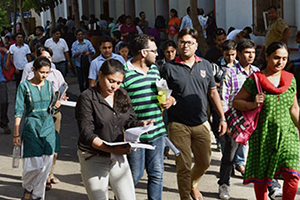
The National Employability Report for the first time this year looked into the employability of specialised and new careers, which are available to engineers, other than core IT and software roles.

The nationwide analysis based on a sample of 1,50,000 engineers showed there was a huge gap in skills of engineers, as needed, to work in the large industry.

"There are several problems with regard to employability in core engineering roles. We need to excite students about these jobs. Everyone's focus today is on IT. We want students to design and build things. We need emphasis on the basics, for instance, basic electrical engineering, basic concepts of mechanics and so on," Varun Aggarwal CTO Aspiring Minds said.

The government's Make in India initiative aspires to create manufacturing capacity in India and generate 100 million jobs by 2022.

Low employability of engineers, however, will impede the growth of manufacturing in India in a big way and requires immediate intervention, the employability assessment firm said.

Aggarwal noted that students do not have these basic concepts right. There is a huge need of a curriculum revamp and to bring in new teaching methods and technology.

"The science of manufacturing has moved way ahead but we continue to teach outdated concepts to students. For India to become the world's manufacturing hub, we need to lead from the front in our understanding of cutting edge methods, knowledge- driven management and implementation capability," he added.

Employability for roles like mechanical design engineer and civil engineer stand at a meagre 5.55 per cent and 6.48 per cent respectively.

The lowest employability percentage was recorded for the Chemical Design Engineer role at 1.64 per cent.

Employability in the domain specific roles is the highest for Electronics engineers at 7.07 per cent.

This percentage is considerably lower compared to employability in IT roles like Software Engineer - IT services and Associate ITeS Operations (Hardware Networking) which stood at 17.91 per cent and 37.06 per cent respectively.

The study on employability across metros reveals higher employability in Delhi and Mumbai with employability for the electronics design engineer role as high as 19 per cent followed by cities like Bengaluru, Kolkata and Hyderabad.

The lowest employability figures across roles is observed in Chennai with employability for the Civil Design Engineer role as low as 1 per cent, the report said.

Comments

Jamal
 - 
Thursday, 16 Jun 2016

Students passing out of IT engineering colleges in mangalore don't know how to code. Its like someone completing a driving course from driving school. But, when u give him a car to drive, he doesn't know how to drive.

I wonder what these so-called \engineering colleges\" teach."

Zahoor Ahmed
 - 
Wednesday, 15 Jun 2016

Our Honourable HRD Minister Dear Smriti is not interest to curriculam revamp,new teaching method or technology. instead she is interesting in Yoga, Sanskrit,dancing,acting to introduce in IIT and Engineering Institutions. LOL

Add new comment

  • Coastaldigest.com reserves the right to delete or block any comments.
  • Coastaldigset.com is not responsible for its readers’ comments.
  • Comments that are abusive, incendiary or irrelevant are strictly prohibited.
  • Please use a genuine email ID and provide your name to avoid reject.
News Network
March 15,2020

While it makes perfect sense for IT employees to work from remote locations via video conferencing and collaboration tools seamlessly - especially in the case of tech giants like Google or Microsoft -- workers from the non-IT companies and small and medium enterprises (SMBs) are the worst-hit in India as most of them have little or no clue about how these messaging and collaboration tools work amid the coronavirus pandemic.

Small companies -- from corporate to education verticals -- are scrambling to get their act together as new coronavirus threat has reached their premises, prompting them to send employees home who have age-old laptops, poor network and connectivity with no UPS backups and little knowledge about how to handle group chat and collaboration software like Zoom, Google Hangouts Meet, Microsoft Teams and Flock etc.

Instead of halting operations, however, businesses can choose to shift towards remote working methods with teaching non-IT staff on how to use the latest digital software to connect and work, say industry experts.

The training will take some time and may hamper productivity in the short run but is a win-win situation for the non-tech companies in the long run, in case any such global emergency arises in the future.

According to a latest report by Gartner, 54 per cent of HR leaders have cited that poor technology and/or infrastructure for remote working is the biggest barrier to effective remote working.

Sandy Shen, Senior Director Analyst, Gartner, says that with COVID-19 disrupting the business landscape, CIOs should relook at the digital fulfillment of market demand.

"The value of digital channels, products and operations is immediately obvious to companies everywhere right now. This is a wake-up call for organisations that have placed too much focus on daily operational needs at the expense of investing in digital business and long-term resilience," warned Shen.

Businesses that can shift technology capacity and investments to digital platforms will mitigate the impact of the outbreak and keep their companies running smoothly now, and over the long term.

"Videoconferencing, messaging, collaboration tools and document sharing are just a few examples of technologies that facilitate remote work. Additional bandwidth and network capacity may also be needed, given the increasing number of users and volume of communications," informed Shen.

The IT industry's apex body Nasscom has asked the government to relax norms for a month to allow work-from-home for technology and back-office employees as a measure to deal with the spread of Covid-19 in India.

Networking giant Cisco said that it has seen "significant growth" in the usage of its web conferencing and video-conferencing service Webex in India.

According to Muneer Ahmad, Business Head, ViewSonic India, due to COVID-19 pandemic, the corporate and educational sector is severely getting affected in the country.

"ViewSonic IFP has a cloud-based software which help teachers and corporates to connect through video conferencing to multiple people at the same time and can split the screen into six screens. It can also connect with various tools like Skype, Cisco WebEx, Zoom, Google Hangouts and GoToMeeting," Ahmad told IANS.

Co-working sector has also taken a hit and the industry is looking at several measures to tackle it -- from ensuring supply of juices rich in Vitamin C to supply of disinfectants and giving work from home facilities.

"The scheduled visits of the clients at our co-working offices have been postponed. Few of our clients have cancelled their outstation meetings and have now started audio/video conferencing for virtual meetings," said Nakul Mathur, MD, Avanta India.

According to reports, India has approximately 1,000 co-working locations (as of September 2019) and is the second-largest market for the co-working industry after China.

As India's first licensed B2B Virtual Network Operator, CloudConnect Communications offers a collaborative platform that allows companies to overcome the COVID-19 threat while maintaining seamless business continuity and optimum employee productivity.

"We offer a secure, robust, reliable, scalable and trackable mobile-first unified communication infrastructure that aids remote teleworking so that businesses can continue operating even under any unforeseen circumstances," said Gokul Tandon, Executive Chairman, CloudConnect Communications.

Comments

Add new comment

  • Coastaldigest.com reserves the right to delete or block any comments.
  • Coastaldigset.com is not responsible for its readers’ comments.
  • Comments that are abusive, incendiary or irrelevant are strictly prohibited.
  • Please use a genuine email ID and provide your name to avoid reject.
coastaldigest.com web desk
July 6,2020

Wayanad, Jul 6: DM Education and Research Foundation (DMERF), headed by Dr Azad Moopen, has come forward to handover DM WIMS Medical College, Nursing and Pharmacy Colleges and its associated institutions in Wayanad to the Kerala Government. 

According to Azad Moopen, Managing Trustee, DMERF, the Kerala Government has been deliberating to set up a medical college in the area over the last 7-8 years to address the challenges being faced by the local population due to lack of local availability of advanced healthcare facilities under the government sector. 

The handover by DMERF would address the Government's need. DM WIMS is one of the few NABH accredited medical colleges in the country, he said.

The DM WIMS Medical College and its associated institutions were established by the DMERF Trust 10 years ago to help the backward community of the district. 

Run in a charitable manner, the medical college has a capacity of 150 seats and has seen two batches of doctors graduate from the institution. With a total built up area of 14 lakh sq feet, it also has a 700-bed super-specialty hospital catering to the local community and helping in training healthcare professionals, a 100-bed specialty hospital, a pharmacy college, and a nursing college.

A new medical college by the government will require substantial investments and minimum of 5 years to become functional. “We think that DM WIMS can cater to the requirement of the government and setting up another medical college might not be required to cater to the existing population,” he said.

Moopen also announced a donation of Rs 250 crore out of the total investment in the institutions to the government to provide treatment to the needy population in the backward, landlocked district and to train good quality doctors from the State.

Comments

Add new comment

  • Coastaldigest.com reserves the right to delete or block any comments.
  • Coastaldigset.com is not responsible for its readers’ comments.
  • Comments that are abusive, incendiary or irrelevant are strictly prohibited.
  • Please use a genuine email ID and provide your name to avoid reject.
News Network
April 28,2020

Bengaluru, Apr 28: Providing respite, Karnataka has decided to ‘conditionally’ allow economic activities to restart in green zones.

The green zones of Chamarajanagar, Koppal, Chikkamagaluru, Raichur, Chitradurga, Ramanagara, Hassan, Shivamogga, Haveri, Yadgir, Kolar, Davangere, Udupi and Kodagu will now see shops and industrial activities starting operations, according to an order issued by Chief Secretary TM Vijay Bhaskar on Tuesday.

Lockdown restrictions in the wake of COVID-19 will continue in Bengaluru Urban, Belagavi, Mysuru, Vijayapura, Bagalkot, Kalaburagi, Bidar and Dakshina Kannada. Here, only essential services and supplies will be allowed.

In green zones, all shops that include neighbourhood shops, standalone shops, shops in residential complexes within the limits of municipal corporations and municipalities can open with 50 per cent manpower but with masks and social distancing mandatory.

Shops in residential and marketing complexes are allowed to open in areas located outside municipal limits, the order states.

Multi-brand and single-brand malls will remain shut across Karnataka.

Industries operating in rural areas of these green zones (except Ramanagara) have been allowed to start. Also, manufacturing and other industrial establishments with access control in special economic zones and export-oriented units, industrial estates and industrial townships will be allowed to operate.

“These establishments shall make arrangements for stay of workers within their premises as far as possible and/ or adjacent buildings. The transportation of workers to workplace shall be arranged by the employers in dedicated transport by ensuring social distancing (sic),” Bhaskar said in the order.

This order comes a day after Chief Minister BS Yediyurappa participated in a video conference with Prime Minister Narendra Modi, and with all deputy commissioners.

No decision on relaxing lockdown restrictions has been taken for Ballari, Mandya, Bengaluru Rural, Gadag, Tumakuru, Chikkaballapur, Uttara Kannada and Dharwad. “The decision regarding opening of shops and industries in taluks where there are no active COVID-19 cases will be taken by the concerned district in-charge minister,” Bhaskar said.

Comments

Add new comment

  • Coastaldigest.com reserves the right to delete or block any comments.
  • Coastaldigset.com is not responsible for its readers’ comments.
  • Comments that are abusive, incendiary or irrelevant are strictly prohibited.
  • Please use a genuine email ID and provide your name to avoid reject.