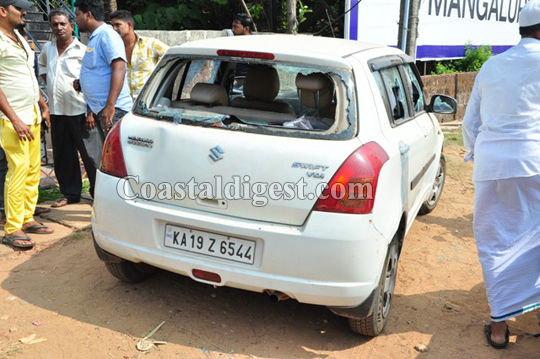
Mangaluru: Cong leader's car damaged by miscreants in Ullal

[email protected] (CD Network | Photos by Moany Gutty)
January 12, 2017

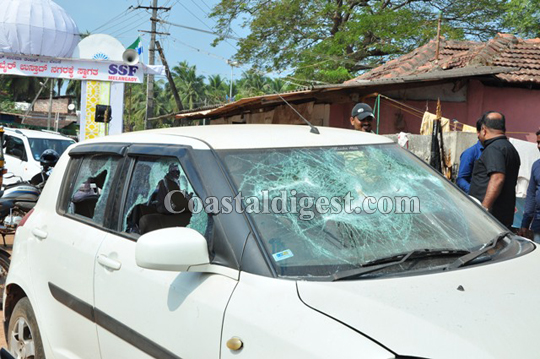
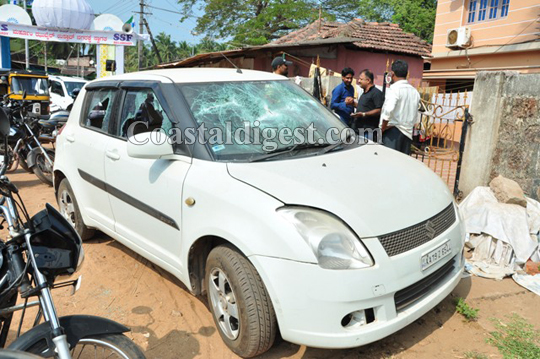
Mangaluru, Jan 12: A swift car belonging to a Congress leader was attacked and damaged by unidentified miscreants at Ullal Melangady in Mangaluru taluk in the intervening night of Wednesday and Thursday.

car 2

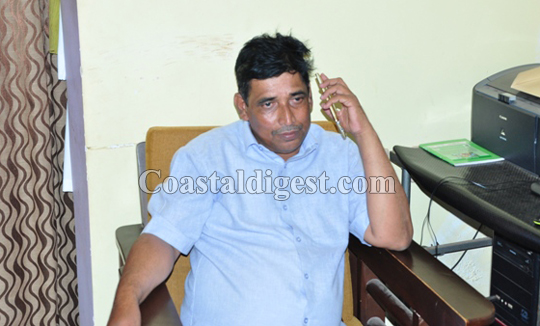
Farooq Ullal, spokesperson of Dakshina Kannada District Congress Committee and member of Ullal City Municipal Council had parked his Swift car outside his home last night.

When he came out of home early morning on Thursday to attendant Fajr namaz at a nearby mosque, he found his car was damaged with the windshield and all the windows shattered.

Mr Farooq, who is also the president of a local mosque, has ruled out the communal angle in the attack and held a gang of drunkards responsible for the act.

“I do not have any personal rivalry or animosity with anyone in any community. I am sure that no one wants to harm me or my property. This is the act of a few drunkards who has been troubling the people in the area,” he said urging the police to nab the culprits.

He said that a gang of miscreants has been extorting money from pilgrims who visit Ullal Dargah. “The same gang now started demanding hafta from local shopkeepers and issuing threats. They are drunkards. This might be the act of same gang,” he said.

A case has been registered at Ullal police station and investigations are on.

car 3

car 1

car 4

car 5

Comments

shaji
 - 
Sunday, 15 Jan 2017

Dear Rikaz, please try to be a human being.

Rikaz
 - 
Thursday, 12 Jan 2017

He is more upset that his car is not burnt....otherwise he would have got a new car from insurance.....

Add new comment

  • Coastaldigest.com reserves the right to delete or block any comments.
  • Coastaldigset.com is not responsible for its readers’ comments.
  • Comments that are abusive, incendiary or irrelevant are strictly prohibited.
  • Please use a genuine email ID and provide your name to avoid reject.
Ram Puniyani
January 14,2020

In the beginning of January 2020 two very disturbing events were reported from Pakistan. One was the attack on Nankana Sahib, the holy shrine where Sant Guru Nanak was born. While one report said that the place has been desecrated, the other stated that it was a fight between two Muslim groups. Prime Minister of Pakistan Imran Khan condemned the incident and the main accused Imran Chisti was arrested. The matter related to abduction and conversion of a Sikh girl Jagjit Kaur, daughter of Pathi (One who reads Holy Guru Granth Sahib in Gurudwara) of the Gurudwara. In another incident one Sikh youth Ravinder Singh, who was out on shopping for his marriage, was shot dead in Peshawar.

While these condemnable attacks took place on the Sikh minority in Pakistan, BJP was quick enough to jump to state that it is events like this which justify the Citizenship Amendment Act (CAA). Incidentally CAA is the Act which is discriminatory and relates to citizenship with Religion, which is not as per the norms of Indian constitution. There are constant debates and propaganda that population of Hindus has come down drastically in Pakistan and Bangla Desh. Amit Shah, the Home minister stated that in Pakistan the population of Hindus has come down from 23% at the time of partition to 3.7% at present. And in Bangla Desh it has come down from 22% to present 8%.

While not denying the fact that the religious minorities are getting a rough deal in both these countries, the figures which are presented are totally off the mark. These figures don’t take into consideration the painful migrations, which took place at the time of partition and formation of Bangla Desh later. Pakistan census figures tell a different tale. Their first census was held in 1951. As per this census the overall percentage of Non Muslim in Pakistan (East and West together) was 14.2%, of this in West Pakistan (Now Pakistan) it was 3.44 and in Eat Pakistan it was 23.2. In the census held in Pakistan 1998 it became 3.72%. As far as Bangla Desh is concerned the share of Non Muslims has gone down from 23.2 (1951) to 9.6% in 2011.

The largest minority of Pakistan is Ahmadis, (https://minorityrights.org/country/pakistan/) who are close to 4 Million and are not recognised as Muslims in Pakistan. In Bangla Desh the major migrations of Hindus from Bangla Desh took place in the backdrop of Pakistan army’s atrocities in the then East Pakistan.

As far as UN data on refugees in India it went up by 17% between 2016-2019 and largest numbers were from Tibet and Sri Lanka.  (https://www.un.org/en/development/desa/population/migration/publication…)

The state of minorities is in a way the index of strength of democracy. Most South Asian Countries have not been able to sustain democratic values properly. In Pakistan, the Republic began with Jinnah’s classic speech where secularism was to be central credo of Pakistan. This 11th August speech was in a way what the state policy should be, as per which people of all faiths are free to practice their religion. Soon enough the logic of ‘Two Nation theory” and formation of Pakistan, a separate state for Muslim took over. Army stepped in and dictatorship was to reign there intermittently. Democratic elements were suppressed and the worst came when Zia Ul Haq Islamized the state in collusion with Maulanas. The army was already a strong presence in Pakistan. The popular formulation for Pakistan was that it is ruled by three A’s, Army, America and Allah (Mullah).

Bangla Desh had a different trajectory. Its very formation was a nail in the coffin of ‘two nation theory’; that religion can be the basis of a state. Bangla Desh did begin as a secular republic but communal forces and secular forces kept struggling for their dominance and in 1988 it also became Islamic republic. At another level Myanmar, in the grip of military dictatorship, with democratic elements trying to retain their presence is also seeing a hard battle. Democracy or not, the army and Sanghas (Buddhist Sang has) are strong, in Myanmar as well. The most visible result is persecution of Rohingya Muslims.

Similar phenomenon is dominating in Sri Lanka also where Budhhist Sanghas and army have strong say in the political affairs, irrespective of which Government is ruling. Muslim and Christian minorities are a big victim there, while Tamils (Hindus, Christians etc.) suffered the biggest damage as ethnic and religious minorities. India had the best prospect of democracy, pluralism and secularism flourishing here. The secular constitution, the outcome of India’s freedom struggle, the leadership of Gandhi and Nehru did ensure the rooting of democracy and secularism in a strong way.

India so far had best democratic credentials amongst all the south Asian countries. Despite that though the population of minorities rose mainly due to poverty and illiteracy, their overall marginalisation was order of the day, it went on worsening with the rise of communal forces, with communal forces resorting to identity issues, and indulging in propaganda against minorities.

While other South Asian countries should had followed India to focus more on infrastructure and political culture of liberalism, today India is following the footsteps of Pakistan. The retrograde march of India is most visible in the issues which have dominated the political space during last few years. Issues like Ram Temple, Ghar Wapasi, Love Jihad, Beef-Cow are now finding their peak in CAA.

India’s reversal towards a polity with religion’s identity dominating the political scene was nicely presented by the late Pakistani poetess Fahmida Riaz in her poem, Tum bhi Hum Jaise Nikle (You also turned out to be like us). While trying to resist communal forces has been an arduous task, it is becoming more difficult by the day. This phenomenon has been variously called, Fundamentalism, Communalism or religious nationalism among others. Surely it has nothing to do with the religion as practiced by the great Saint and Sufi traditions of India; it resorts mainly to political mobilization by using religion as a tool.


Comments

Ashi
 - 
Tuesday, 14 Jan 2020

If Malaysia implement similar NRC/CAA, India and China are the loser.

Add new comment

  • Coastaldigest.com reserves the right to delete or block any comments.
  • Coastaldigset.com is not responsible for its readers’ comments.
  • Comments that are abusive, incendiary or irrelevant are strictly prohibited.
  • Please use a genuine email ID and provide your name to avoid reject.
coastaldigest.com news network
January 19,2020

Mangaluru, Jan 19: ‘Ride For Rotary’ convoy of motor vehicles was flagged off from Hotel Ocean Pearl Inn at Bejai-Kapikad, Mangaluru on Sunday, 19th January, 2020 at 9.00 a.m. Rotary district governor Joseph Mathew flagged off the event along with Assistant Governors Sumith S. Rao, Geethanand Pai and Ritesh Baliga. The riders headed for Puttur after topping up their fuel tanks at Lady Hill Petrol Pump.

2019-20 Ride For Rotary includes 28 motorbikes and 5 cars. 38 Rotarians from 14 countries are participating, in this, the fourth edition of the event. They will traverse through Madikeri, Mysore, Wayanad, Ooty, Coimbatore, Munnar, Thekkady and Allepey before terminating at Kochi on 29th of January, 2020. The participating nationalities are India, Norway, Sweden, Canada, France, Germany, USA, UK, Switzerland, Austria, Denmark, Poland and Belgium. They belong to ages 21 to 78, with 78-year old Otto Rieve from Canada being the senior most enthusiast. Swiss national of Indian origin Raj Patholi and Mangalorean Abraham Zacharias are among the riders. 

Mangalore was chosen as the starting point for the convoy route this year which will cover Kerala, Karnataka and Tamil Nadu. On the eve of the event, the organizers hosted a gala dinner for the riders at Citi Beech, Bolar. The riders were given a glimpse of the traditional dance forms and were treated to some wonderful songs in Tulu and Kannada along with local coastal cuisine.

They were also given a glimpse of the major service projects undertaken in our district by Rotary, such as the Rotary Blood Bank on Wheels, the Physiotherapy Clinic at Wenlock Hospital, the Schools adopted by Rotary and the Ashrams and Villages that are being served by Rotary. The idea behind this is to see that riders carry these memories and think of helping Rotarians in India through their matching contributions for future service projects.

‘Ride For Rotary’

Ride for Rotary is a charity event conceived by Rotary District 3181 which comprises of the revenue districts of Mysore, Kodagu, Dakshina Kannada and Chamarajanagar covering 85 Rotary Clubs in 9 zones. Rotarians from across the world will come together for twelve exhilarating days. They will traverse through the meticulously arranged routes, enjoy the natural beauty of the places and experience the varied cultures and cuisines of the region. Ride for Rotary connects people and places like no other - Rotary Connects the World.

The proceeds from the event go to The Rotary Foundation, a charitable organisation that works tirelessly for the upliftment of the society.

Comments

Add new comment

  • Coastaldigest.com reserves the right to delete or block any comments.
  • Coastaldigset.com is not responsible for its readers’ comments.
  • Comments that are abusive, incendiary or irrelevant are strictly prohibited.
  • Please use a genuine email ID and provide your name to avoid reject.
coastaldigest.com news network
June 24,2020

Riyadh, June 24: Thousands of expatriates who managed to return to their home countries from Saudi Arabia during covid-19 lockdown are now in a dilemma as the Kingdom has clarified that it will not allow their re-entry till the end of the corona crisis. 

The Directorate General of Passports (Jawazat) announced on Tuesday that the mechanism to resume extension of the exit and re-entry visas for expatriates who are outside the Kingdom will be announced only after the end of the pandemic crisis.

The Jawazat stated this on its Twitter account while responding to queries from a number of expatriates who are currently outside the Kingdom and whose exit and re-entry visas have expired.

They inquired about the possibility of returning to the Kingdom after the resumption of international flight service. 

The Jawazat reiterated that the return of expatriates who left Saudi Arabia will be only after the end of the pandemic and in accordance with the process to obtain a valid re-entry visa.

The directorate said that in the event of any new decisions or instructions in this regard, they will be announced through the official channels.

It is noteworthy that the Jawazat had previously confirmed that its electronic services are continuing through the Absher and Muqeem online portals of the Ministry of Interior and that the service for messages and requests is still available and continuing through Absher for all the beneficiaries of its services.

Comments

Add new comment

  • Coastaldigest.com reserves the right to delete or block any comments.
  • Coastaldigset.com is not responsible for its readers’ comments.
  • Comments that are abusive, incendiary or irrelevant are strictly prohibited.
  • Please use a genuine email ID and provide your name to avoid reject.