Mangaluru: MLA J R Lobo lauds PFI's national scholarship scheme

[email protected] (CD Network)
January 16, 2017

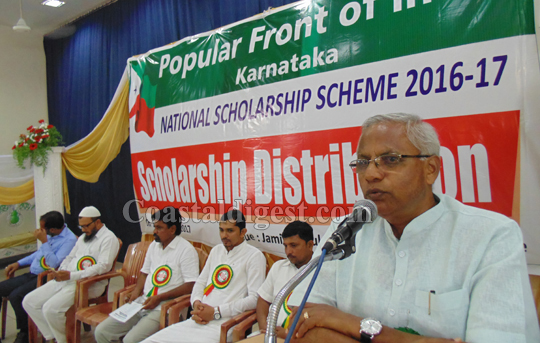
Mangaluru, Jan 16: The Popular Front of India's national scholarship scheme (NSS) through which economically backward meritorious students across the country are identified and provided scholarship is commendable, said J R Lobo, Mangaluru South MLA.

pfi 4

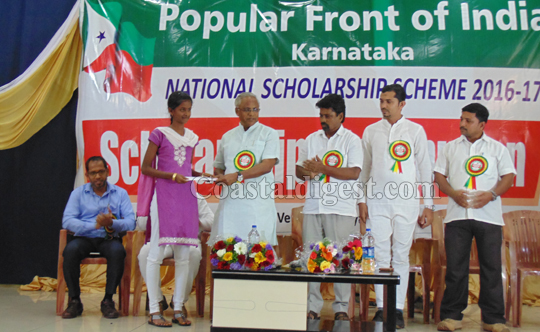
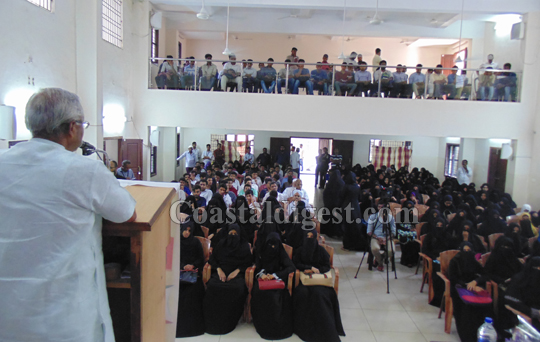
He was speaking after inaugurating a scholarship distribution programme organized as part of NSS at Jamiatul Falah Auditorium, Mangaluru on Sunday. Scholarships worth Rs 12.93 lakh were distributed among 180 students on the occasion.

M A Gafoor, president, Minority Development Corporation, said that the development of our country is possible if all social organizations give prominence to education by taking up such initiatives. “In our county which is known for unity in diversity, the Muslim community has contributed enormously since pre-independence period,” he added.

“As our organization is working for the development of the Muslim community and backward communities, it is giving due importance to educational development” said Shafi Bellare, State Secretary of PFI in his presidential speech.

Ajaz Krishnapura, Corporater, Mangaluru, Nazir Tumbe, Director of Community Development unit, PFI were also present. Hanif Katipalla welcomed and Siraj Kavuru proposed vote of thanks.

pfi 2

pfi 3

Comments

Mohammad
 - 
Monday, 16 Jan 2017

Khader Should Learn from Lobo what is PFI?

Think Tank
 - 
Monday, 16 Jan 2017

Well done PFI....Good initiatives

Think Tank
 - 
Monday, 16 Jan 2017

Well done Mr.Lobo ......this is the real secularism............you deserve to be our guest for this occasion................

Add new comment

  • Coastaldigest.com reserves the right to delete or block any comments.
  • Coastaldigset.com is not responsible for its readers’ comments.
  • Comments that are abusive, incendiary or irrelevant are strictly prohibited.
  • Please use a genuine email ID and provide your name to avoid reject.
News Network
January 2,2020

Mysuru, Jan 2: Mysuru-based Karnataka State Open University is gearing up to offer courses online from this year onwards and a proposal in this connection will be placed before the University Grants Commission (UGC) this month, after approval from the board of management.

As of now, the university offers 31 courses, including undergraduate, postgraduate, and diploma programmes.

Vice-chancellor Vidyashankar S Said that the university will submit its proposal to the UGC soon.

“This is being done to make learning convenient and help students study their courses of choices from the comfort of their homes.”

After launching online admissions for courses, this is another step to go paperless and towards an e-campus, the V-C explained.

The university has also proposed to launch 12 new courses for 2020-21.

A proposal in this regard will be placed before the board for approval on Thursday and the same will be submitted to the UGC for its nod.

Prof. Vidyashankar said the these courses will be in addition to the 31 already available.

The new courses include LLM, MA in Education, BBA, BSc, BCA, diploma in Information Technology, postgraduate diploma in Information Technology, BSc in Information Technology, MSc in Information Technology, MSc in Botany, PG diploma in Banking and Insurance, MSc in Zoology, MA in Telugu, Executive MBA, and MSc in Food Sciences and Nutrition.

The new courses had been proposed based on students’ feedback and the trend.

The V-C said the admissions for the January cycle have begun and over 380 students had so far taken admissions online.

“We are hoping for good admissions this cycle and are expecting around 12,000 admissions,” he replied.

Comments

Add new comment

  • Coastaldigest.com reserves the right to delete or block any comments.
  • Coastaldigset.com is not responsible for its readers’ comments.
  • Comments that are abusive, incendiary or irrelevant are strictly prohibited.
  • Please use a genuine email ID and provide your name to avoid reject.
Ram Puniyani
January 14,2020

In the beginning of January 2020 two very disturbing events were reported from Pakistan. One was the attack on Nankana Sahib, the holy shrine where Sant Guru Nanak was born. While one report said that the place has been desecrated, the other stated that it was a fight between two Muslim groups. Prime Minister of Pakistan Imran Khan condemned the incident and the main accused Imran Chisti was arrested. The matter related to abduction and conversion of a Sikh girl Jagjit Kaur, daughter of Pathi (One who reads Holy Guru Granth Sahib in Gurudwara) of the Gurudwara. In another incident one Sikh youth Ravinder Singh, who was out on shopping for his marriage, was shot dead in Peshawar.

While these condemnable attacks took place on the Sikh minority in Pakistan, BJP was quick enough to jump to state that it is events like this which justify the Citizenship Amendment Act (CAA). Incidentally CAA is the Act which is discriminatory and relates to citizenship with Religion, which is not as per the norms of Indian constitution. There are constant debates and propaganda that population of Hindus has come down drastically in Pakistan and Bangla Desh. Amit Shah, the Home minister stated that in Pakistan the population of Hindus has come down from 23% at the time of partition to 3.7% at present. And in Bangla Desh it has come down from 22% to present 8%.

While not denying the fact that the religious minorities are getting a rough deal in both these countries, the figures which are presented are totally off the mark. These figures don’t take into consideration the painful migrations, which took place at the time of partition and formation of Bangla Desh later. Pakistan census figures tell a different tale. Their first census was held in 1951. As per this census the overall percentage of Non Muslim in Pakistan (East and West together) was 14.2%, of this in West Pakistan (Now Pakistan) it was 3.44 and in Eat Pakistan it was 23.2. In the census held in Pakistan 1998 it became 3.72%. As far as Bangla Desh is concerned the share of Non Muslims has gone down from 23.2 (1951) to 9.6% in 2011.

The largest minority of Pakistan is Ahmadis, (https://minorityrights.org/country/pakistan/) who are close to 4 Million and are not recognised as Muslims in Pakistan. In Bangla Desh the major migrations of Hindus from Bangla Desh took place in the backdrop of Pakistan army’s atrocities in the then East Pakistan.

As far as UN data on refugees in India it went up by 17% between 2016-2019 and largest numbers were from Tibet and Sri Lanka.  (https://www.un.org/en/development/desa/population/migration/publication…)

The state of minorities is in a way the index of strength of democracy. Most South Asian Countries have not been able to sustain democratic values properly. In Pakistan, the Republic began with Jinnah’s classic speech where secularism was to be central credo of Pakistan. This 11th August speech was in a way what the state policy should be, as per which people of all faiths are free to practice their religion. Soon enough the logic of ‘Two Nation theory” and formation of Pakistan, a separate state for Muslim took over. Army stepped in and dictatorship was to reign there intermittently. Democratic elements were suppressed and the worst came when Zia Ul Haq Islamized the state in collusion with Maulanas. The army was already a strong presence in Pakistan. The popular formulation for Pakistan was that it is ruled by three A’s, Army, America and Allah (Mullah).

Bangla Desh had a different trajectory. Its very formation was a nail in the coffin of ‘two nation theory’; that religion can be the basis of a state. Bangla Desh did begin as a secular republic but communal forces and secular forces kept struggling for their dominance and in 1988 it also became Islamic republic. At another level Myanmar, in the grip of military dictatorship, with democratic elements trying to retain their presence is also seeing a hard battle. Democracy or not, the army and Sanghas (Buddhist Sang has) are strong, in Myanmar as well. The most visible result is persecution of Rohingya Muslims.

Similar phenomenon is dominating in Sri Lanka also where Budhhist Sanghas and army have strong say in the political affairs, irrespective of which Government is ruling. Muslim and Christian minorities are a big victim there, while Tamils (Hindus, Christians etc.) suffered the biggest damage as ethnic and religious minorities. India had the best prospect of democracy, pluralism and secularism flourishing here. The secular constitution, the outcome of India’s freedom struggle, the leadership of Gandhi and Nehru did ensure the rooting of democracy and secularism in a strong way.

India so far had best democratic credentials amongst all the south Asian countries. Despite that though the population of minorities rose mainly due to poverty and illiteracy, their overall marginalisation was order of the day, it went on worsening with the rise of communal forces, with communal forces resorting to identity issues, and indulging in propaganda against minorities.

While other South Asian countries should had followed India to focus more on infrastructure and political culture of liberalism, today India is following the footsteps of Pakistan. The retrograde march of India is most visible in the issues which have dominated the political space during last few years. Issues like Ram Temple, Ghar Wapasi, Love Jihad, Beef-Cow are now finding their peak in CAA.

India’s reversal towards a polity with religion’s identity dominating the political scene was nicely presented by the late Pakistani poetess Fahmida Riaz in her poem, Tum bhi Hum Jaise Nikle (You also turned out to be like us). While trying to resist communal forces has been an arduous task, it is becoming more difficult by the day. This phenomenon has been variously called, Fundamentalism, Communalism or religious nationalism among others. Surely it has nothing to do with the religion as practiced by the great Saint and Sufi traditions of India; it resorts mainly to political mobilization by using religion as a tool.


Comments

Ashi
 - 
Tuesday, 14 Jan 2020

If Malaysia implement similar NRC/CAA, India and China are the loser.

Add new comment

  • Coastaldigest.com reserves the right to delete or block any comments.
  • Coastaldigset.com is not responsible for its readers’ comments.
  • Comments that are abusive, incendiary or irrelevant are strictly prohibited.
  • Please use a genuine email ID and provide your name to avoid reject.
Media Release
March 8,2020

Mangaluru, Mar 8: The Saraswat Co-operative Bank Ltd., celebrated International Women’s Day with a special seminar on Financial Planning for the banks’ women customers. The programme was held on Friday, March 6, 2020 from 4.00 to 6.00 p.m. at Hotel Ocean Pearl Inn, Bejai, Mangalore. Dr. Sukanya Rao, academician and financial planner, was the chief guest and resource person for the seminar. Mr. Srinivas C., Karnataka State Head, Future Generali India Insurance Company Ltd., was the guest of honour.  Mrs. Vimala Anchan, Senior Manager and Branch Head of M. G. Road Branch of Saraswat Bank presided over the function.

In her chief guest’s address, Dr. Sukanya Rao defined empowerment of women as the ability of take one’s own decisions and utilize resources. Quoting global rankings, she said India enjoys a high ranking of being 9th in the world in political empowerment of women, whereas in other sectors we stand abysmally low. In social empowerment of women, India ranks at 120th, in economic empowerment at 124th and health and survival at 135th.

She suggested that the best tool for enhancing these empowerment rankings is education, which will lead to earning potential and result in enhancing social status. “Every year spent in school boosts girl’s wages by 10-20%,” she said “When a girl receives 7+ years of education, marriage gets postponed by four years and she has 2.2 less children.” She advised women to learn to take one’s own decisions. “Learn to take decisions, especially financial decisions, on your own instead of depending on significant others to do the decision making,” she said.

She followed up her talk with an interactive session on personal financial planning. She enlightened the audience on factors influencing our financial decision making and gave different perspectives on prioritizing savings, spending and investment. 

Srinivas C., Karnataka State Head, Future Generali India Insurance Company Ltd., along with Deepak enlightened the women regarding financial safeguards available under Married Women's Property Act (1874).

Established in 1918, Saraswat Bank was the first co-operative bank to provide merchant banking services after it was recognized as a scheduled bank by RBI in 1988. The bank enjoys high proportion of women employees (nearly 75%) and it is a recipient of Best Cooperative Bank Award in 2016.

Fun games were conducted and prizes were distributed to the winners. Bhavanthi Street Branch Head Karthik Shetty welcomed the gathering. Prithvi Pai and Aishwarya rendered the invocation. Naina Shenoy expressed the bank’s Women’s Day greetings. Chilimbi Branch Head Kishore Shetty gave a vote of thanks. Mahesh Nayak compered the programme. Past Branch Head Mamtha Rao was present.

Comments

Add new comment

  • Coastaldigest.com reserves the right to delete or block any comments.
  • Coastaldigset.com is not responsible for its readers’ comments.
  • Comments that are abusive, incendiary or irrelevant are strictly prohibited.
  • Please use a genuine email ID and provide your name to avoid reject.