Mangaluru: South Zone inter-university youth festival gets underway

[email protected] (CD Network)
January 19, 2016

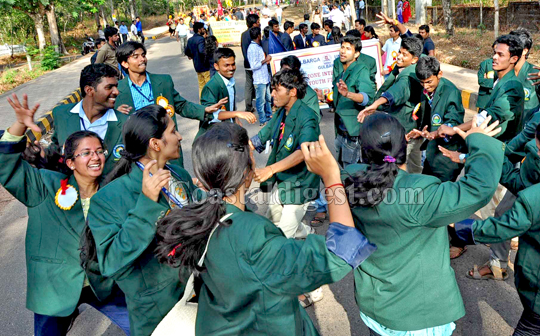
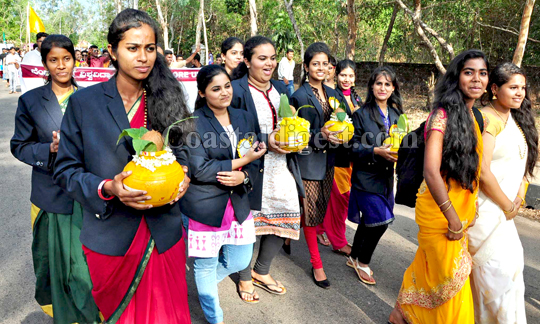
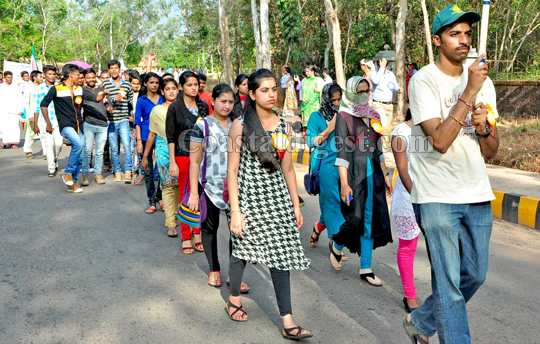
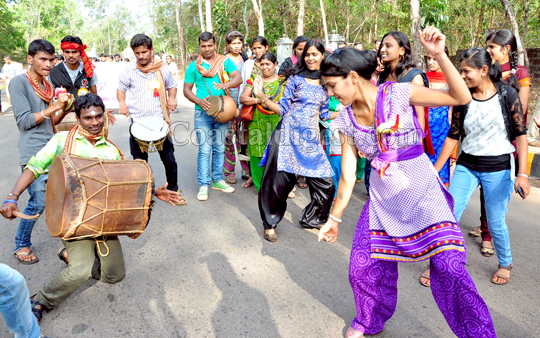
Mangaluru, Jan 19: The 31st South Zone inter-university Youth Festival ‘Waves 2015’ kicked off at Mangalagangotri campus of Mangalore University on the outskirts of the city with great zeal and competitive fervour.

university 11

Yakshagana scholar Dr M Prabhakar Joshi formally inaugurated the five day festival on Monday and called upon the youth to preserve and promote Indian culture and traditions. Applauding the University for hosting Waves-2015, he said that such festivals necessary to promote the culture.

“It is a misconception to say that youth are not interersted in culture, but in reality youth are interested in such cultural festivals,” he added

Chief guest Yenepoya Abdulla Kunhi, Chancellor, Yenepoya University, said that youth festivals are the need of the hour as such festivals promote communal harmony, national integration and brotherhood.

university 13

Samson David, Joint Secretary, AIU, New Delhi in his introductory address said, “Every year two lakh students participate in youth festival directly or indirectly. The main purpose is to promote human values through culture and language.”

Prof. T P M Pakkala, Vice-Chancellor in chanrge, Mangalore University in his presidential address said that India has the largest number of youth and the whole world is looking at this vast potential for future use.

Prof. Arun Patil, Observer, AIU, Prof. T. D. Kemparaju, Registrar, Mangalore University. Prof. P. L. Dharma, Convener, SZYF 2015, Prof. K. M. Lokesh, Organising Secretary, were present. Prof. A. M. Khan, Registrar (Evaluation) proposed vote of thanks.

The event is being held in association with the Association of Indian Universities (AIU) and the Ministry of Youth Affairs and Sports, Government of India, New Delhi from January 18 to 22, 2016.

About 1500 participants from 23 universities of states of Andhra Pradesh, Telangala, Tamilnadu, Kerala, Karnataka and Pondicherry are participating in the youth festival.

Mimicry, Mime, Group song(Western), Classical vocal solo, Quiz, On the spot painting / Photogrphy events will be held tomorrow. Emenint Jurists will evaluate the performances.


university 6

university 1

university 12

university 2

university 3

university 4

university 5

university 7

university 8

university 9

university 10

university 12

university 14

university 16

university 17

university 18

university 19

university 20

university 21

university 22

university 23

university 24

university 25

university 26

university 27

university 28

university 29

university 30

university 31

Comments

Jonnie
 - 
Tuesday, 14 Jun 2016

Today, I went to the beach with my kids. I found a sea shell and gave it to my 4 year old daughter and
said \You can hear the ocean if you put this to your ear.\"
She put the shell to her ear and screamed. There was a hermit crab inside and it pinched her ear.
She never wants to go back! LoL I know this is completely off topic but I had to
tell someone!

my homepage ... Cindi: http://little-cottage.over-blog.com/"

Add new comment

  • Coastaldigest.com reserves the right to delete or block any comments.
  • Coastaldigset.com is not responsible for its readers’ comments.
  • Comments that are abusive, incendiary or irrelevant are strictly prohibited.
  • Please use a genuine email ID and provide your name to avoid reject.
coastaldigest.com web desk
February 1,2020

Shivamogga, Feb 1: A three-year-old girl who fell out of a moving vehicle had a miraculous escape in Agumbe Ghat section in Teerthahalli taluk of Shivamogga district of Karnataka.

The incident took place in the early hours of Friday when 12 members from three different families were returning from a tour of Kerala and Tamil Nadu. The girl was reunited with her family after 30 minutes of high drama.

The child, identified as Anavi, is believed to have fallen from the vehicle as it negotiated hairpin bends on the Agumbe Ghat road, 350km from Bengaluru. The child's parents, Binu and Lincy, from NR Pura in Chikkamagaluru district, and other family members reportedly dozed off and did not realize the child had fallen off the vehicle until they covered a distance of about 20km.

One of the family members noticed that child was missing from the seat next to the door. When the driver realized the door latch had given way, they suspected the child could have slipped out of the vehicle.

Then the family started searching along the road and learnt from a forest guard at the Agumbe checkpost that a missing child was found and it had been handed over to Agumbe police station.

An advocate who identified himself as Vinay spotted the girl child as he passed the deserted stretch minutes after the vehicle left and picked her up and handed her over to Agumbe police.

The child sustained minor injuries in the fall. She was provided medical treatment before she was handed over to the parents.

Sources said it wasn't known how the vehicle door opened. One theory is that the girl could have accidentally unlocked the door while clutching the latch in the bumpy ride on the ghat. Police did not file any complaint.

Similar incident

This incident is almost a rerun of a Kerala incident in which a one-year-old baby fell off a moving jeep and was reunited with its mother hours later in September 2019 in Idukki district.

The baby had slipped off the mother's arms while she dozed off in the vehicle. CCTV footage showed the baby, after falling on the road, crawling towards a lit-up area close by, which turned out to be a forest checkpost. Family realised child was missing after 20km.

Comments

Add new comment

  • Coastaldigest.com reserves the right to delete or block any comments.
  • Coastaldigset.com is not responsible for its readers’ comments.
  • Comments that are abusive, incendiary or irrelevant are strictly prohibited.
  • Please use a genuine email ID and provide your name to avoid reject.
News Network
April 2,2020

The current physical distancing guidelines provided by the World Health Organisation (WHO) and by the US Centers for Disease Control and Prevention (CDC) may not be adequate to curb the coronavirus spread, according to a research which says the gas cloud from a cough or sneeze may help virus particles travel up to 8 metres. The research, published in the Journal of the American Medical Association, noted that the the current guidelines issued by the WHO and CDC are based on outdated models from the 1930s of how gas clouds from a cough, sneeze, or exhalation spread.

Study author, MIT associate professor Lydia Bourouiba, warned that droplets of all sizes can travel 23 to 27 feet, or 7-8 metres, carrying the pathogen.

According to Bourouiba, the current guidelines are based on "arbitrary" assumptions of droplet size, "overly simplified", and "may limit the effectiveness of the proposed interventions" against the deadly pandemic.

 She explained that the old guidelines assume droplets to be one of two categories, small or large, taking short-range semi-ballistic trajectories when a person exhales, coughs, or sneezes.

However based on more recent discoveries, the MIT scientist said, sneezes and coughs are made of a puff cloud that carries ambient air, transporting within it clusters of droplets of a wide range of sizes.

Bourouiba warned that this puff cloud, with ambient air entrapped in it, can offer the droplets moisture and warmth that can prevent it from evaporation in the outer environment.

"The locally moist and warm atmosphere within the turbulent gas cloud allows the contained droplets to evade evaporation for much longer than occurs with isolated droplets," she said.

"Under these conditions, the lifetime of a droplet could be considerably extended by a factor of up to 1000, from a fraction of a second to minutes," the researcher explained in the study.

The MIT scientist, who has researched the dynamics of coughs and sneezes for years, added that these droplets settle along the trajectory of a cough or sneeze contaminating surfaces, with their residues staying suspended in the air for hours.

"Even when maximum containment policies were enforced, the rapid international spread of COVID-19 suggests that using arbitrary droplet size cutoffs may not accurately reflect what actually occurs with respiratory emissions, possibly contributing to the ineffectiveness of some procedures used to limit the spread of respiratory disease," Bourouiba wrote in the study

Comments

Add new comment

  • Coastaldigest.com reserves the right to delete or block any comments.
  • Coastaldigset.com is not responsible for its readers’ comments.
  • Comments that are abusive, incendiary or irrelevant are strictly prohibited.
  • Please use a genuine email ID and provide your name to avoid reject.
News Network
January 25,2020

New Delhi, Jan 25: The latest edition of the Oxford Advanced Learner's Dictionary features 26 new Indian English words, including Aadhaar, chawl, dabba, hartal and shaadi.

The 10th edition of the dictionary, which was launched on Friday, has 384 Indian English words and incorporates over 1,000 new words such as chatbot, fake news and microplastic.

The dictionary focuses on language change and its evolution through the years, and has ensured that the language and examples used in the new edition are relevant and up to date with the times, Oxford University Press (OUP) said.

The new edition comes with interactive online support through the Oxford Learner's Dictionaries website and an app. The website includes advanced features such as audio-video tutorials, video walkthroughs, self-study activities and enhanced iWriter and iSpeaker tools.

"This edition has 26 new Indian English words of which 22 figure in the printed dictionary. The other four are in the digital version," said Fathima Dada, Managing Director (Education Division) at OUP.

Some of other new Indian words in the dictionary are auntie (while aunty already figures in the English dictionary, auntie is an Indianism), bus stand, deemed university, FIR, non-veg, redressal, tempo, tube light, veg and videograph.

The four new Indian English words in the online version of the dictionary are current (for electricity), looter, looting and upazila (one of the areas that a district is divided into for administration purposes).

According to OUP, the new edition provides better, more accurate and understandable definitions with examples, usage notes and additional resources to help the learner use the right word in the right context.

"Prevalence and common usage are the main criteria for enlisting new words. We scan the globe for words which are often used by people while speaking English. Then these words go through a rigorous testing process," Dada said.

"As OUP is the custodian of English language globally, these words have to go through its processes," she told PTI.

The Oxford Advanced Learner's Dictionary, she said, has been reinventing itself for nearly eight decades, anticipating the growing learning requirements of learners.

"The 10th edition also is equipped with a strong digital support system, including an app," she said.

It is equipped with several digital tools. With iSpeaker, learners can get help preparing for speaking exams and presentations. With iWriter, learners can plan, write and review their written work. Text Checker allows the teacher to check any text against the Oxford 3000, 5000, and OPAL (Oxford Phrasal Academic Lexicon) written word list.

Resources accessible through online premium access include lesson plans, worksheets, video walkthroughs, and classroom and self-study activities. With the OALD app one can find 86,000 words, 95,000 phrases, 112,000 meanings and 237,000 examples.

The dictionary, which spans 77 years, was originally published in Japan in 1942 and was first brought out by OUP in 1948. The learner's dictionary is based on the original values of its creator, Albert Sydney Hornby, whose aim was to help language learners worldwide understand the meaning of English words.

Comments

Add new comment

  • Coastaldigest.com reserves the right to delete or block any comments.
  • Coastaldigset.com is not responsible for its readers’ comments.
  • Comments that are abusive, incendiary or irrelevant are strictly prohibited.
  • Please use a genuine email ID and provide your name to avoid reject.