


Rising gold prices threaten some factories with closure

August 12, 2013

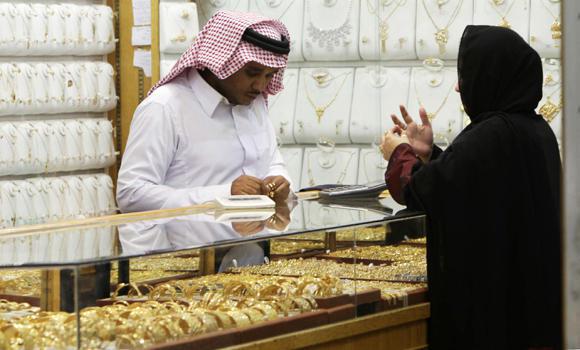
Rising_gold_pricesJeddah, Aug 12: The rising prices of gold during the past two weeks caused stagnation in the Saudi market, and pushed gold merchants to activate sales because factories didn’t halt their production, according to the National Committee for Precious Metals.

The price of the precious metal has registered the second weekly decline, while the dollar has recovered from its lowest value since seven weeks ago.

Speculation about the US Federal Reserve to reduce the bonds purchase program with a value of $85 billion a month was triggered by the low price of gold, which reached its lowest levels this week.

“Gold merchants didn’t lose because of the declining world prices, because most of them deal with gold as physical balance, and most merchants have sufficient gold accounts,” said Ahmad Al-Sharif, member of the National Committee for Precious Metals.

Gold prices declined by 0.2 percent, to $1,308 per ounce, and the market is about to close at 0.25 percent. Delayed US gold contracts, which will be delivered in December declined by $2, to $1,307.90 per ounce.

Silver prices stabilized at $20.19 per ounce, while platinum gained 0.1 percent to $1,488 per ounce. Palladium rose 0.1 percent to $736.97 per ounce.

Meanwhile, the National Committee for Precious Metals is attempting to ferret out illegal gold sellers, which had controlled as much as one-quarter of the gold market.

“Workshops have been organized, which held unknown names in the gold trade, or operated from places that didn’t have defined headquarters contained products with ambiguous origins were combated,” said Al-Sharif. “We are working on a mechanism to combat violating workshops, and educate consumers and merchants who deal with such workshops. We advise merchants, and gold market clients to buy gold from approved individuals.”

He pointed to the existence of “workshops alien to the market” that had a large share before prices rose, which control 25 percent of the market.

“After the rising prices a large number of these workshops sold their stocks and changed their activities because they were illegal dealers,” he said. “After strict controls and the correction of labor status these violating workshops will be eliminated, because most of them are illegal workers who practice their business in un licensed areas.”

“At the present time, and because of the strict control of the Passport Department and the Ministry of Labor, these workshops have 10 percent of the market share,” he said.

Comments

Add new comment

  • Coastaldigest.com reserves the right to delete or block any comments.
  • Coastaldigset.com is not responsible for its readers’ comments.
  • Comments that are abusive, incendiary or irrelevant are strictly prohibited.
  • Please use a genuine email ID and provide your name to avoid reject.
Agencies
July 31,2020

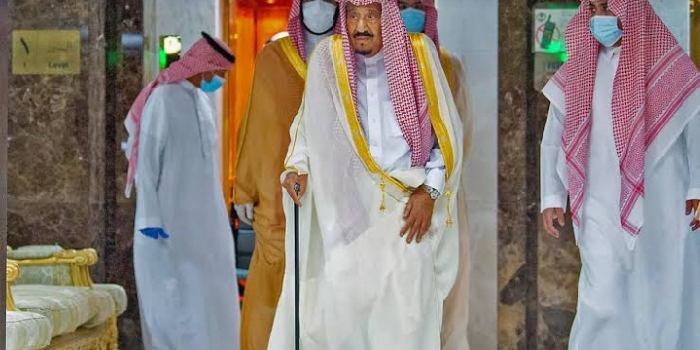
Makkah, Jul 31: Organising this year's scaled-down hajj required "double efforts" by Saudi authorities amid the coronavirus pandemic, King Salman said Friday after being discharged from hospital following gall bladder surgery.

Only up to 10,000 people already residing in the kingdom are participating in this year's pilgrimage, compared with 2019's gathering of some 2.5 million from around the world.

"Holding the ritual in the shadow of this pandemic... required reducing the numbers of pilgrims, but it obliged various official agencies to put in double efforts," 84-year-old King Salman said in a speech read out on state television by acting media minister Majid Al-Qasabi.

"The hajj this year was restricted to a very limited number of people from multiple nationalities, ensuring the ritual was completed despite the difficult circumstances," he said.

The speech came on the occasion of Eid al-Adha, the Muslim festival of sacrifice, a day after the king left hospital following a 10-day stay for surgery to remove his gall bladder.

The hajj, which began on Wednesday, is one of the five pillars of Islam and a must for able-bodied Muslims at least once in their lifetime.

Authorities implemented the "highest health precautions" during the rituals, the king said.

Pilgrims, who were all tested for the virus, are required to wear masks and observe social distancing.

For Friday's "stoning of the devil", the last major ritual of the hajj, Saudi authorities offered the pilgrims pebbles that were sanitised to protect against the pandemic.

In a sign that its strict measures were working, the health ministry reported no coronavirus cases in the holy sites on Wednesday or Thursday.

Comments

Add new comment

  • Coastaldigest.com reserves the right to delete or block any comments.
  • Coastaldigset.com is not responsible for its readers’ comments.
  • Comments that are abusive, incendiary or irrelevant are strictly prohibited.
  • Please use a genuine email ID and provide your name to avoid reject.
Agencies
March 23,2020

Riyadh, Mar 23: King Salman on Sunday issued an order imposing a curfew across Saudi Arabia from Monday evening to control the spread of the COVID-19 disease.

A royal court statement carried by the Saudi Press Agency (SPA) said the curfew will start at 7 p.m. until 6 a.m. every day for 21 days from the evening of 28 Rajab 1441 in the Hijri calendar, equivalent to March 23, 2020 in the Gregorian calendar.

King Salman's order followed an announcement by the Health Ministry of 119 new coronavirus cases on Sunday, raising the total number in the Kingdom to 511.

The order enjoins citizens and residents alike to stay in their homes during the curfew hours for their own safety.

The statement said the Ministry of Interior will undertake the necessary measures to implement the curfew, and all civil and military authorities are ordered to cooperate fully.

Exclusions

A subsequent statement issued by the Ministry of Interior and carried by SPA said those excluded from the curfew are workers from the following vital industries and government services:

• Food sector (points of sale) such as catering and supermarkets And poultry and vegetable shops, meat, bakeries, food factories and laboratories;

• Health sector, such as pharmacies and the like, medical clinics (dispensaries), hospitals, laboratories, factories, factories and materials and medical devices;

• Media sector in its various means;

• Transportation sector, such as those transporting goods, parcels, customs clearance, warehouses, warehouses, logistics services, supply chains for the health sector, the food sector, and port operations;

• E-commerce activities such as those working in the electronic procurement applications for the excluded activities and those working in the delivery applications of the excluded activities;

• Accommodation services activities such as hotels and furnished apartments;

• Energy sector such as gas stations and emergency services for the electric company;

• Financial services and insurance sector, such as direct accidents (Najm), urgent health insurance services (approvals), and other insurance services;

• Telecom sector as Internet and communication network operators;

• Water sector, such as the water company emergency services and home drinking water delivery service (graying).

Additional exclusions

The Interior Ministry statement also said movement during the curfew time will be allowed for security, military and health cars, government regulatory services vehicles, and activity vehicles excluded in the vital industries and services mentioned above. 

Delivery services through smart device applications (express delivery services) during the curfew will be allowed for food and drug needs and other essential goods and services that are excluded and delivered to homes. Excluded activities can be known by calling the toll-free number in all regions of the Kingdom 999, except for the Makkah Al-Mukarramah region, which is called at 911.

Muezzins will be allowed to access mosques to lift the call to prayer at the time of the curfew.

Workers in diplomatic missions and international organizations and the like residing in the Diplomatic Quarter will be allowed to move during the curfew period to and from their business headquarters in the neighborhood.

Comments

Add new comment

  • Coastaldigest.com reserves the right to delete or block any comments.
  • Coastaldigset.com is not responsible for its readers’ comments.
  • Comments that are abusive, incendiary or irrelevant are strictly prohibited.
  • Please use a genuine email ID and provide your name to avoid reject.
News Network
July 6,2020

Dubai, July 6: Even as the world’s one of the most sought after tourist destinations is gearing up to welcome foreign tourists from July 7, the authorities have taken necessary measures to prevent the spread of covid-19.

If the foreign tourists want to avoid self-isolation after landing in Dubai International Airport, they have to fetch covid-negative certificates from their home country. The certificate ought to have been issued up to 96 hours prior to the travel.

Those without a cvid-negative certificate, however, will need to undergo a PCR test on arrival at the Dubai airports and self-isolate until they receive their negative results.

"If passengers opt to take the PCR test on arrival in Dubai, they must self-isolate until test results are received. If the test result is negative, passengers can leave the hotel and enjoy the trip as normal. However, if the test result is positive, passengers are asked to follow the advice of the Dubai Health Authority and self-isolate," Emirates said in a statement.

Budget carrier flydubai said if a passenger tests positive for Covid-19, he/she would need to observe a 14-day quarantine. The airline also advised passengers to comply with all the precautionary Covid-19 measures in place in Dubai "including wearing a mask, observing social distancing and washing your hands regularly".

Tourists with Covid-19 symptoms

* If a traveller is suspected to have Covid-19 symptoms, Dubai Airports has the right to re-test to ensure the tourist is free of the virus

*It is mandatory for Covid-positive tourists to isolate themselves at an institutional facility provided by the government for 14 days at their own expense.

Other requirements

*Travel insurance: Tourists must have a travel insurance with Covid-19 cover or declare that they would bear the costs for treatment and isolation if required. "Bring an insurance certificate stating Covid-19 coverage to present at check-in," Emirates said.

*Visa: Referring to visa requirements, Emirates said: "Depending on your nationality you can get a visa on arrival, or you can apply for your visit visa from Dubai Immigration before you travel."

*Health Declaration Form: Tourists need to complete the form that states they are free from Covid-19 symptoms. This must be done before embarking.

*Tracing app: Tourists must download the Covid-19 DXB app and register details. "This is critically important since it facilitates easy coordination and communication with the health authorities if tourists experience Covid-19 symptoms," Dubai authorities had said earlier.

Comments

Add new comment

  • Coastaldigest.com reserves the right to delete or block any comments.
  • Coastaldigset.com is not responsible for its readers’ comments.
  • Comments that are abusive, incendiary or irrelevant are strictly prohibited.
  • Please use a genuine email ID and provide your name to avoid reject.