


Modi govt may meet same fate as that of Indira's: Yashwant

January 31, 2016

Dona Paula (Goa), Jan 31: Veteran BJP leader Yashwant Sinha today tore into Prime Minister Narendra Modi and his government, saying there is no dialogue and they may meet the same fate as the Indira Gandhi-led Congress which was drubbed in the elections after Emergency.yashwant
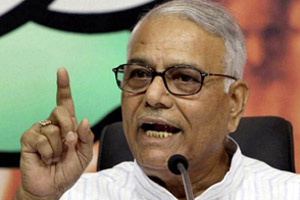
Sinha, who along with some other BJP veterans has been marginalised in the party, was speaking at a panel discussion at the 'Difficult Dialogues' conference here, where CPI-M general secretary Sitaram Yechury also spoke.

"There is absolutely no scope of no dialogue... This is the great strength of Indian democracy. There will be aberrations here and there, there might be concerns about the present situation. But the great Indian society will take care of it and consign to dust those who do not believe in dialogue in India," Sinha said.

"The people of India will consign him to the dust, you just have to wait for the next elections," Sinha, who was finance minister in Atal Bihari Vajpayee government, said without naming Modi.

Alluding to the general elections in 1977 when Congress was ousted from power, he said such a neglect (of dialogue) will make the government last "19 months", the same duration as the Emergency.

We all know how the people of India reacted to the Emergency which was the "most concerted democratic effort in our country to still the voice of dissent", he said.

Replying to intervention from Yechury on need to ensure that dialogue in the society doesn't get stifled, he said, "I would only say that the stifler is in for serious trouble."

The veteran BJP leader also rued the fact that Opposition was not letting Parliament function. Without naming, he took a potshot at a Congress leader, who he said never raised concerns on the GST Bill in the standing committee meetings but later raised objections.

Under Vajpayee, the NDA government was able to pass several important legislations with the help of dialogue (with opposition), Sinha said.

His onslaught comes on the same day when another BJP leader, actor-MP Shatrughan Sinha, said that veteran leaders Vajpayee, L K Advani and Murli Manohar Joshi "deserve much more than what they have been given".

"Currently these leaders including me are trapped between oppression and respect," Shatrughan said in Pune.

Comments

aharkul
 - 
Sunday, 31 Jan 2016

Just wait and see.... within one year what happen Indian democracy..

Goodman
 - 
Sunday, 31 Jan 2016

BJP built on wrong ideology, wrong foundation. So tower can not stand on cracking foundation.

Add new comment

  • Coastaldigest.com reserves the right to delete or block any comments.
  • Coastaldigset.com is not responsible for its readers’ comments.
  • Comments that are abusive, incendiary or irrelevant are strictly prohibited.
  • Please use a genuine email ID and provide your name to avoid reject.
News Network
February 19,2020

New Delhi, Feb 19: India will switch to the world's cleanest petrol and diesel from April 1 as it leapfrogs straight to Euro-VI emission compliant fuels from Euro-IV grades now - a feat achieved in just three years and not seen in any of the large economies around the globe.

India will join the select league of nations using petrol and diesel containing just 10 parts per million of sulphur as it looks to cut vehicular emissions that are said to be one of the reasons for the choking pollution in major cities.

Sanjiv Singh, Chairman of Indian Oil Corp (IOC) - the firm that controls roughly half of the country's fuel market, said almost all refineries began producing ultra-low sulphur BS-VI (equivalent to Euro-VI grade) petrol and diesel by the end of 2019 and oil companies have now undertaken the tedious task of replacing every drop of fuel in the country with the new one.

"We are absolutely on track for supplying BS-VI fuel from April 1. Almost all refineries have begun supplying BS-VI fuel and the same has reached storage depots across the country," he said.

From storage depots, the fuel has started travelling to petrol pumps and in the next few weeks all of them will only have BS-VI grade petrol and diesel, he said. "We are 100 per cent confident that fuel that will flow from nozzles at all the petrol pumps in the country on April 1 will be BS-VI emission compliant fuel."

India adopted Euro-III equivalent (or Bharat Stage-III) fuel with a sulphur content of 350 ppm in 2010 and then took seven years to move to BS-IV that had a sulphur content of 50 ppm. From BS-IV to BS-VI it took just three years.

"It was a conscious decision to leapfrog to BS-VI as first upgrading to BS-V and then shifting to BS-VI would have prolonged the journey to 4 to 6 years. Besides, oil refineries, as well as automobile manufacturers, would have had to make investments twice - first to producing BS-V grade fuel and engines and then BS-VI ones," he said.

State-owned oil refineries spent about Rs 35,000 crore to upgrade plants that could produce ultra-low sulphur fuel. This investment is on top of Rs 60,000 crore they spent on refinery upgrades in the previous switchovers.

BS-VI has a sulphur content of just 10 ppm and emission standards are as good as CNG.

Originally, Delhi and its adjoining towns were to have BS-VI fuel supplies by April 2019 and the rest of the country was to get same supplies from April 2020.

But oil marketing companies switched over to supply of BS-VI grade fuels in the national capital territory of Delhi on April 1, 2018.

The supply of BS-VI fuels was further extended to four contiguous districts of Rajasthan and eight of Uttar Pradesh in the National Capital Region (NCR) on April 1, 2019, together with the city of Agra.

BS-VI grade fuels were made available in 7 districts of Haryana from October 1, 2019.

Singh said the new fuel will result in a reduction in NOx in BS-VI compliant vehicles by 25 per cent in petrol cars and by 70 per cent in diesel cars.

The switchover, he said, is a tedious task as every drop of old, higher-sulphur content fuel has to be flushed out in depots, pipelines and tanks before being replaced by BS-VI.

"We are confident of disruption-free switchover to BS-VI supplies across the country," he said. "What we will be supplying is the best quality available anywhere in the world. You don't have any better fuel that is supplied in any part of the world. Perhaps our BS-VI fuel will be better than equivalent fuel in some parts of the US and Europe."

India adopted a fuel upgradation programme in the early 1990s. Low lead gasoline (petrol) was introduced in 1994 in Delhi, Mumbai, Kolkata and Chennai. On February 1, 2000, unleaded gasoline was mandated nationwide.

Similarly, BS-2000 (Euro-I equivalent, BS-1) vehicle emission norms were introduced for new vehicles from April 2000. BS-II (Euro-II equivalent) emission norms for new cars were introduced in Delhi from 2000 and extended to the other metro cities in 2001.

Benzene limits have been reduced progressively from 5 per cent in 2000 to 1 per cent nationwide. Lead content in gasoline was removed in phases and only unleaded gasoline is being produced and sold from February 1, 2000.

The octane number of gasoline signifies the improved performance of the engine. Loss in octane number due to phasing out of lead was made up by installing new facilities in the refinery and changes in refinery operation. RON (Research Octane Number) of gasoline for BS-2000 spec was increased to 88. This has over time been increased to 91.

Singh said sulphur reduction will reduce Particulate Matter (PM) emissions even in the in-use older generation diesel vehicles.

Comments

Add new comment

  • Coastaldigest.com reserves the right to delete or block any comments.
  • Coastaldigset.com is not responsible for its readers’ comments.
  • Comments that are abusive, incendiary or irrelevant are strictly prohibited.
  • Please use a genuine email ID and provide your name to avoid reject.
Agencies
May 22,2020

New Delhi, May 22: The number of COVID-19 cases averted due to the lockdown is in the range of 14-29 lakh, while the number of lives saved is between 37,000 and 78,000, the government said on Friday citing various studies, and asserted that the unprecedented shutdown has paid “rich dividends” in the fight against the pandemic.

The lockdown in India has been a timely, graded, proactive and pre-emptive public health measure to fight the COVID-19 pandemic and has been part and parcel of the government’s overall strategy, Dr V K Paul, Member (Health), NITI Aayog, and Chairman, Empowered Group 1, said at a media briefing on the COVID-19 situation.

The government imposed the nationwide lockdown from March 25 to prevent the spread of the novel coronavirus and it is currently in its fourth phase.

Like the number of cases, the growth rate of number of COVID-19 deaths too has fallen significantly due to the lockdown, marking a notable difference between pre-lockdown and post-lockdown situations, he said.

At the briefing, Pravin Srivastava, Secretary, Ministry of Statistics and Programme Implementation gave model-based estimates on COVID-19 cases and deaths which have been prevented due to the lockdown.

As per Boston Consulting Group's model, the lockdown saved between 1.2 lakh and 2.1 lakh lives, while the number of COVID-19 cases averted is between 36 lakh and 70 lakh, he said.

According to Public Health Foundation of India, nearly 78,000 lives have been saved due to the lockdown, Srivastava said.

Citing a model by two independent economists, he said that around 23 lakh COVID-19 cases and 68,000 deaths have been averted due to the lockdown.

Some independent experts, including retired scientists, have calculated that around 15.9 lakh cases and 51,000 deaths have been averted due to the lockdown, Srivastava said.

A joint study by the Ministry of Statistics and Programme Implementation and the Indian Statistical Institute found that around 20 lakh COVID-19 cases and 54,000 deaths were averted due to lockdown, he said.

The number of COVID-19 cases averted due to the lockdown is in the range of 14-29 lakh, while the number of lives saved is between 37,000 and 78,000, the official said.

“We are fully confident that the lockdown, with full public cooperation, has reaped rich dividends,” Srivastava said.

The strong defence of the lockdown, comes a day after the health ministry said the period of lockdown has been gainfully utilized to ramp up the health infrastructure, with around 3,027 dedicated COVID-19 hospitals and 7,013 care centres being readied across the country to fight the disease.

The announcement on Thursday came after some media reports questioned the country's preparedness to deal with the highly infectious disease.

"There are reports in a section of the media about some decisions of the government regarding the lockdown implementation and response to COVID-19 management. The period of the lockdown has been gainfully utilised to ramp up the health infrastructure in the country," the ministry had said.

Addressing the press briefing on Friday, joint secretary in the health ministry Lav Agarwal said 48,534 COVID-19 patients, which is about 41 per cent of the total cases, have recovered so far. As many as 3,234 patients have recovered in the last 24 hours, he said’

The COVID-19 mortality rate has dropped from 3.13 per cent on May 19 to 3.02 per cent as focus was on containment measures andclinical management of cases, Agarwal said.

An ICMR official said 27,55,714 tests for COVID-19 have been conducted till 1 pm Friday with 1,03,829 tests done in one day. Over 1 lakh tests for COVID-19 have been done each day for the last four days, the official said.

The growth rate of novel coronavirus cases witnessed a steep decline from Apr 4 when lockdown put a brake on the speed of increase of cases, V K Paul said.

The number of COVID-19 cases would have risen exponentially had the lockdown not been implemented, he said, adding that the doubling rate of cases was 3.4 days when the lockdown started and it is 13.3 days at present.

The COVID-19 outbreak in India has remained confined to limited areas with 80 per cent of active cases in just five states, Paul said

He said around 80 pc of COVID-19 deaths have been in Maharashtra, Gujarat, Madhya Pradesh, West Bengal and Delhi. 

Comments

Add new comment

  • Coastaldigest.com reserves the right to delete or block any comments.
  • Coastaldigset.com is not responsible for its readers’ comments.
  • Comments that are abusive, incendiary or irrelevant are strictly prohibited.
  • Please use a genuine email ID and provide your name to avoid reject.
News Network
July 14,2020

Kathmandu, Jul 14: After staking claim to Indian territories of Lipulekh-Kalapani in  a new controversial map,  Nepal Prime Minister KP Sharma Oli on Monday claimed that Ayodhya, the birthplace of Lord Rama, is in Nepal and Lord Rama was Nepali.

“Although real Ayodhya lies at Thori, city in the west of Birgunj, India has claimed that Lord Rama was born there. Due to these continuous claims, even we have believed that deity Sita got married to Prince Rama of India. However, in reality, Ayodhya is a village lying west of Birgunj,” Oli claimed at an event organised at Prime Minister's residence in Kathmandu.

The Prime Minister also blamed India of cultural encroachment by “creating a fake Ayodhya.”

“Balmiki Ashram is in Nepal and the holy place where King Dashrath had executed the rites to get the son is in Ridi. Dashrath’s son Ram was not an Indian and Ayodhya is also in Nepal,” he claimed.

In an attempt to save self from criticism, Oli questioned how Lord Rama could come to Janakpur to marry Sita when there were "no means" of communication. He further said that it to be impossible for Lord Rama to come to Janakpur from present Ayodhya that lies in India.

“Janakpur lies here and Ayodhya there and there is talk of marriage. There was neither telephone nor mobile then how could he know about Janakpur,” Oli said.

Comments

Ahmed Ali Kulai
 - 
Tuesday, 14 Jul 2020

New controversy

 
BJP got next election Muddah

Farhan
 - 
Tuesday, 14 Jul 2020

Ab Ram Mandir Kaha Banega???

Add new comment

  • Coastaldigest.com reserves the right to delete or block any comments.
  • Coastaldigset.com is not responsible for its readers’ comments.
  • Comments that are abusive, incendiary or irrelevant are strictly prohibited.
  • Please use a genuine email ID and provide your name to avoid reject.