Mother Teresa declared saint by Pope Francis

September 4, 2016

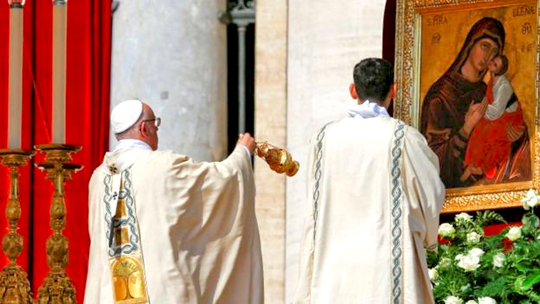
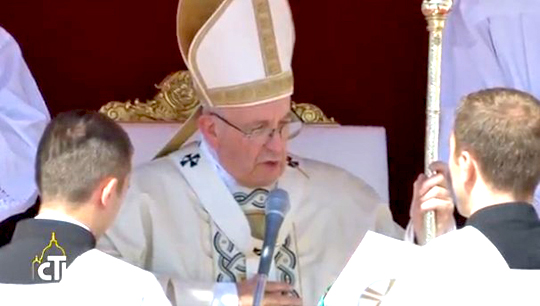
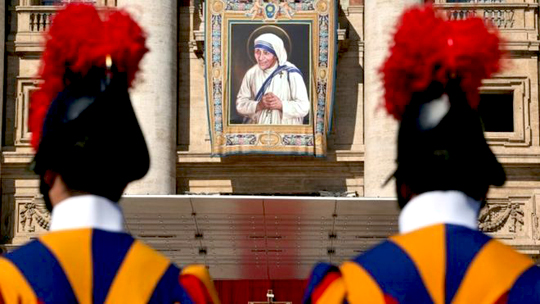
Vatican City, Sep 4: Pope Francis on Sunday declared revered nun Mother Teresa a saint in a canonization mass at St Peter's square.

"For the honour of the Blessed Trinity... we declare and define Blessed Teresa of Calcutta (Kolkata) to be a Saint and we enroll her among the Saints, decreeing that she is to be venerated as such by the whole Church," the pontiff said in Latin.
teresav 5

For Francis, Mother Teresa put into action his ideal of the church as a merciful "field hospital" for the poorest of the poor, those suffering both material and spiritual poverty.

The elevation of one of the icons of 20th Century Christianity came a day before the 19th anniversary of her death in Kolkata, where she spent nearly four decades working with the dying and the destitute.

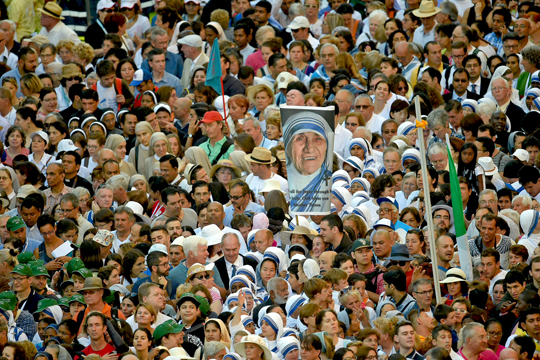
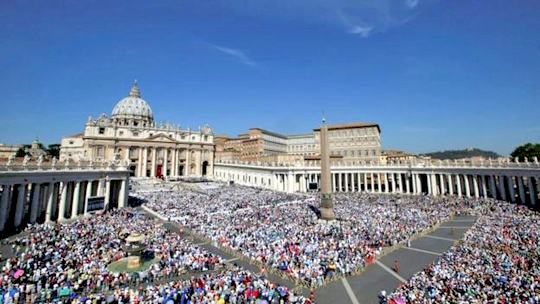
Tens of thousands of pilgrims — rich and poor, powerful and homeless — filled St. Peter's Square on Sunday for the canonization of Mother Teresa, the tiny nun who cared for the world's most destitute and became an icon of a Catholic Church that goes to the peripheries to find lost souls.

Throughout the night, pilgrims prayed at vigils in area churches and flocked before dawn to the Vatican to try to get a good spot for the Mass being celebrated under a searing hot sun and blue skies.

"Her heart, she gave it to the world," said Charlotte Samba, a 52-year-old mother of three who travelled with a church group from Gabon for the Mass. "Mercy, forgiveness, good works: It is the heart of a mother for the poor."

One group of 40 Indian nationals traveled from Macerata, Italy to honor a woman given India's highest civilian and humanitarian awards for her work in the slums of Kolkata. Another group of 100 drove from Kosovo toting a banner that read: "Mother Teresa: Pray for Us."

In addition, 13 heads of state and government led official delegations while 1,500 homeless people invited by Pope Francis had VIP seats and were going to be treated by the pope to a Neapolitan pizza lunch in the Vatican auditorium afterward.

While Francis is clearly keen to hold Mother Teresa up as a model for her joyful dedication to society's outcasts, he is also recognizing holiness in a nun who lived most of her adult life in spiritual agony sensing that God had abandoned her.

According to correspondence that came to light after she died in 1997, Mother Teresa experienced what the church calls a "dark night of the soul" — a period of spiritual doubt, despair and loneliness that many of the great mystics experienced. In Mother Teresa's case, it lasted for nearly 50 years — an almost unheard of trial.

For the Rev. Brian Kolodiejchuk, the Canadian priest who spearheaded Mother Teresa's saint-making campaign, the revelations were further confirmation of Mother Teresa's heroic saintliness. He said that by canonizing her, Francis is recognizing that Mother Teresa not only shared the material poverty of the poor but the spiritual poverty of those who feel "unloved, unwanted, uncared for."

"What she described as the greatest poverty in the world today (of feeling unloved) she herself was living in relationship with Jesus," he said in an interview on the eve of the canonization.

Francis has in many ways modeled his papacy on Mother Teresa's simple lifestyle and selfless service to the poor: He eschewed the Apostolic Palace for a hotel room, he has made welcoming migrants and the poor a hallmark and has fiercely denounced today's "throwaway" culture that discards the unborn, the sick and the elderly with ease.

Sunday's festivities honoring Mother Teresa weren't limited to Rome: In Kolkata, where Mother Teresa spent a lifetime dedicated to the poor, a special Sunday Mass was held at the order's Mother House. Volunteers and admirers converged on Mother House to watch the canonization ceremony, which was being broadcast on giant TV screens in Kolkata and elsewhere.

Sisters of Charity volunteers planned to distribute food to the poor nearby after the ceremony, and community meals were being served across Catholic parishes in India on Sunday — a symbolic reference to Mother Teresa's lifetime of service to humanity, said the Rev. Savarimuthu Sankar of the archdiocese of New Delhi.

"Let the example of Mother Teresa inspire all of us to dedicate ourselves to the welfare of mankind," said Indian President Pranab Mukherjee.

Ceremonies were also expected in Skopje, Macedonia, where Mother Teresa was born, and also in Albania and Kosovo, where people of her same ethnic Albanian background live.

Born Agnes Gonxhe Bojaxhiu on August 26, 1910, Mother Teresa came to India in 1929 as a sister of the Loreto order. In 1946, she received what she described as a "call within a call" to found a new order dedicated to caring for the most unloved and unwanted, the "poorest of the poor."
teresav 1

teresav 2

teresav 3

teresav 4

Comments

TRUE INDIAN
 - 
Sunday, 4 Sep 2016

Rss and sanghis exposed. Saint mother theresa and sita mata both used to wear hijab.

And hindus also put hijab on sita matas idols too.

MSS
 - 
Sunday, 4 Sep 2016

Recognizing sainthood is OK.

First of religion does not need innovation. Because the religion means to way of life as per the command of GOD(1 single God).

But why in the name of TRINITY, when there is only 1 God and none others have the capability of God. Jesus himself said, don't worship me. Then no question of duality of trinity. In trinity the other 2 for Christians are, Holy Spirirt and Jesus. Christians associated these 2 with the real God.
Both the 2 are most respected, but they don't at all equal to God.
Trinity is the invention of people, it is not by the God.

Therefore trinity does not deserve worship. They deserve definitely a worship. But one and only who deserve for worship is the God, who is the GOD for all religions.

Add new comment

  • Coastaldigest.com reserves the right to delete or block any comments.
  • Coastaldigset.com is not responsible for its readers’ comments.
  • Comments that are abusive, incendiary or irrelevant are strictly prohibited.
  • Please use a genuine email ID and provide your name to avoid reject.
News Network
June 17,2020

Bengaluru, Jun 17: The Opposition leader in the Karnataka Assembly Siddaramaiah on Wednesday strongly urged Chief Minister B S Yediyurappa to desist from invoking amendment to the Land Reforms Act, saying it would make buying land easier for the corporate companies and the rich.

In a hard-hitting letter to the Chief Minister, a copy of which was released to the media, the Congress leader had urged to rescind the decision from amending to the Karnataka Land Reforms Act and also Agriculture Produces Marketing Committee Act.

Asserting that the state government's move was only intending to help to the land grabbers, Siddaramaiah, also the former chief minister, said easing of restrictions to buy land to the tune of over 216 acres per individual would sound a death knell to the farm sector.

Comments

Add new comment

  • Coastaldigest.com reserves the right to delete or block any comments.
  • Coastaldigset.com is not responsible for its readers’ comments.
  • Comments that are abusive, incendiary or irrelevant are strictly prohibited.
  • Please use a genuine email ID and provide your name to avoid reject.
News Network
June 2,2020

Mangaluru, Jun 2: Karnataka-Kerala border at Talapady is yet to be opened for traffic despite lifting lockdown. Only those, who have registered on ‘Seva Sindhu’ portal, are given one-time permission to enter the district.

With the relaxation of the lock-down many, especially the labour class, were anticipating free movement. However, both the States have not allowed free movement of vehicles. Hundreds of people from bordering villages of Kerala arrive in Mangaluru for work and likewise many from bordering villages of Mangaluru too work in Kasargod district.

It has become a routine for the labourers of both the States living in border villages to daily assemble at the check post in the morning and return after the authorities refuse free movement.

Comments

Add new comment

  • Coastaldigest.com reserves the right to delete or block any comments.
  • Coastaldigset.com is not responsible for its readers’ comments.
  • Comments that are abusive, incendiary or irrelevant are strictly prohibited.
  • Please use a genuine email ID and provide your name to avoid reject.
Ram Puniyani
January 14,2020

In the beginning of January 2020 two very disturbing events were reported from Pakistan. One was the attack on Nankana Sahib, the holy shrine where Sant Guru Nanak was born. While one report said that the place has been desecrated, the other stated that it was a fight between two Muslim groups. Prime Minister of Pakistan Imran Khan condemned the incident and the main accused Imran Chisti was arrested. The matter related to abduction and conversion of a Sikh girl Jagjit Kaur, daughter of Pathi (One who reads Holy Guru Granth Sahib in Gurudwara) of the Gurudwara. In another incident one Sikh youth Ravinder Singh, who was out on shopping for his marriage, was shot dead in Peshawar.

While these condemnable attacks took place on the Sikh minority in Pakistan, BJP was quick enough to jump to state that it is events like this which justify the Citizenship Amendment Act (CAA). Incidentally CAA is the Act which is discriminatory and relates to citizenship with Religion, which is not as per the norms of Indian constitution. There are constant debates and propaganda that population of Hindus has come down drastically in Pakistan and Bangla Desh. Amit Shah, the Home minister stated that in Pakistan the population of Hindus has come down from 23% at the time of partition to 3.7% at present. And in Bangla Desh it has come down from 22% to present 8%.

While not denying the fact that the religious minorities are getting a rough deal in both these countries, the figures which are presented are totally off the mark. These figures don’t take into consideration the painful migrations, which took place at the time of partition and formation of Bangla Desh later. Pakistan census figures tell a different tale. Their first census was held in 1951. As per this census the overall percentage of Non Muslim in Pakistan (East and West together) was 14.2%, of this in West Pakistan (Now Pakistan) it was 3.44 and in Eat Pakistan it was 23.2. In the census held in Pakistan 1998 it became 3.72%. As far as Bangla Desh is concerned the share of Non Muslims has gone down from 23.2 (1951) to 9.6% in 2011.

The largest minority of Pakistan is Ahmadis, (https://minorityrights.org/country/pakistan/) who are close to 4 Million and are not recognised as Muslims in Pakistan. In Bangla Desh the major migrations of Hindus from Bangla Desh took place in the backdrop of Pakistan army’s atrocities in the then East Pakistan.

As far as UN data on refugees in India it went up by 17% between 2016-2019 and largest numbers were from Tibet and Sri Lanka.  (https://www.un.org/en/development/desa/population/migration/publication…)

The state of minorities is in a way the index of strength of democracy. Most South Asian Countries have not been able to sustain democratic values properly. In Pakistan, the Republic began with Jinnah’s classic speech where secularism was to be central credo of Pakistan. This 11th August speech was in a way what the state policy should be, as per which people of all faiths are free to practice their religion. Soon enough the logic of ‘Two Nation theory” and formation of Pakistan, a separate state for Muslim took over. Army stepped in and dictatorship was to reign there intermittently. Democratic elements were suppressed and the worst came when Zia Ul Haq Islamized the state in collusion with Maulanas. The army was already a strong presence in Pakistan. The popular formulation for Pakistan was that it is ruled by three A’s, Army, America and Allah (Mullah).

Bangla Desh had a different trajectory. Its very formation was a nail in the coffin of ‘two nation theory’; that religion can be the basis of a state. Bangla Desh did begin as a secular republic but communal forces and secular forces kept struggling for their dominance and in 1988 it also became Islamic republic. At another level Myanmar, in the grip of military dictatorship, with democratic elements trying to retain their presence is also seeing a hard battle. Democracy or not, the army and Sanghas (Buddhist Sang has) are strong, in Myanmar as well. The most visible result is persecution of Rohingya Muslims.

Similar phenomenon is dominating in Sri Lanka also where Budhhist Sanghas and army have strong say in the political affairs, irrespective of which Government is ruling. Muslim and Christian minorities are a big victim there, while Tamils (Hindus, Christians etc.) suffered the biggest damage as ethnic and religious minorities. India had the best prospect of democracy, pluralism and secularism flourishing here. The secular constitution, the outcome of India’s freedom struggle, the leadership of Gandhi and Nehru did ensure the rooting of democracy and secularism in a strong way.

India so far had best democratic credentials amongst all the south Asian countries. Despite that though the population of minorities rose mainly due to poverty and illiteracy, their overall marginalisation was order of the day, it went on worsening with the rise of communal forces, with communal forces resorting to identity issues, and indulging in propaganda against minorities.

While other South Asian countries should had followed India to focus more on infrastructure and political culture of liberalism, today India is following the footsteps of Pakistan. The retrograde march of India is most visible in the issues which have dominated the political space during last few years. Issues like Ram Temple, Ghar Wapasi, Love Jihad, Beef-Cow are now finding their peak in CAA.

India’s reversal towards a polity with religion’s identity dominating the political scene was nicely presented by the late Pakistani poetess Fahmida Riaz in her poem, Tum bhi Hum Jaise Nikle (You also turned out to be like us). While trying to resist communal forces has been an arduous task, it is becoming more difficult by the day. This phenomenon has been variously called, Fundamentalism, Communalism or religious nationalism among others. Surely it has nothing to do with the religion as practiced by the great Saint and Sufi traditions of India; it resorts mainly to political mobilization by using religion as a tool.

Comments

Ashi
 - 
Tuesday, 14 Jan 2020

If Malaysia implement similar NRC/CAA, India and China are the loser.

Add new comment

  • Coastaldigest.com reserves the right to delete or block any comments.
  • Coastaldigset.com is not responsible for its readers’ comments.
  • Comments that are abusive, incendiary or irrelevant are strictly prohibited.
  • Please use a genuine email ID and provide your name to avoid reject.