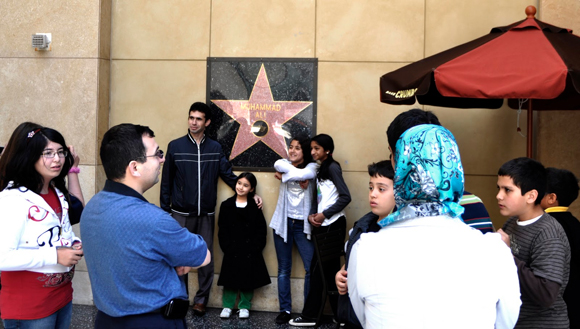
Muhammad' Ali, the only STAR mounted on Walk of Fame wall, not on floor

[email protected] (CD Network)
June 4, 2016

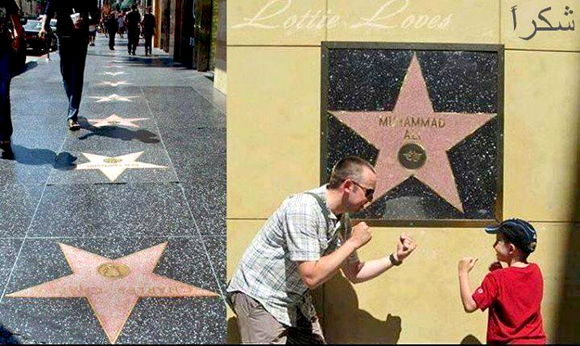
Boxing legend Muhammad Ali who passed away yesterday after a 32-year battle with Parkinson's disease, is in fact the only star' situated on a wall at Hollywood Walk of Fame and not the floor.
ali4

The Hollywood Walk of Fame comprises more than 2,500 five-pointed terrazzo and brass stars embedded in the sidewalks along 15 blocks of Hollywood Boulevard and three blocks of Vine Street in Hollywood, California.

The stars are permanent public monuments to achievement in the entertainment industry, bearing the names of a mix of actors, musicians, directors, producers, musical and theatrical groups, fictional characters, and others. The Walk of Fame is administered by the Hollywood Chamber of Commerce and maintained by the self-financing Hollywood Historic Trust. It is a popular tourist destination, with a reported 10 million visitors in 2003.

When Muhammad Ali was offered a star with his name on this Walk of Fame' he refused and said: “I bear the name of our honourable Prophet Muhammad (peace be upon him), and it is impossible that I allow people to trample on his name."

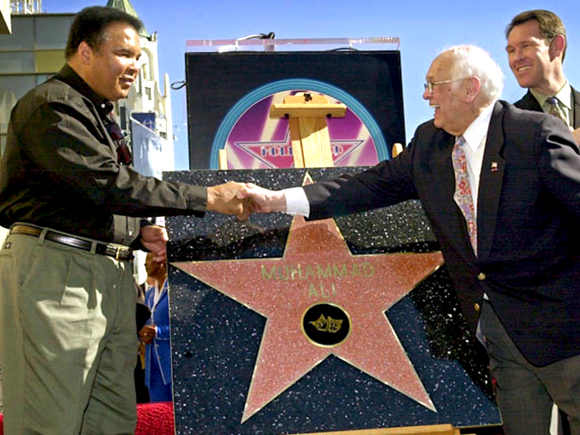
Muhammad Ali's star was granted after the committee decided that boxing could be considered a form of "live performance". Its placement, on a wall of the Dolby Theatre, makes it the only star mounted on a vertical surface, acceding to the legend's request that his name not be walked upon.

After accepting Islam decades ago, Muhammad Ali had motivated thousands of American Christians to embrace Islam. Mr Ali, who was called by Americans and the global fans as “the greatest”, had openly proclaimed that “Allah is the Greatest. We are just human beings.”

charlize1 

ali3

clay1

Comments

Yasir
 - 
Monday, 6 Jun 2016

A man of true faith, RIP

Satyameva Jayate
 - 
Sunday, 5 Jun 2016

See the respect for Islam on the height.....not on the floor..............
Great Muhammad Ali, he understood islam and came to the relegion of peace and see the respect of the name \Muhammad\" today where it is."

Mohamed Ali Uchil
 - 
Saturday, 4 Jun 2016

The legend of Legends,great human being,My heartfelt condolences,May Allah grant him Jannatul Firdouse

UMMAR
 - 
Saturday, 4 Jun 2016

GREAT PERSON WIL SHOW GREAT, HE IS LUCKY GUY HE CONVERTED TO ISLAM ..

Add new comment

  • Coastaldigest.com reserves the right to delete or block any comments.
  • Coastaldigset.com is not responsible for its readers’ comments.
  • Comments that are abusive, incendiary or irrelevant are strictly prohibited.
  • Please use a genuine email ID and provide your name to avoid reject.
News Network
March 11,2020

Bengaluru, Mar 11: Jyotiraditya Scindia has not betrayed the Congress, but he has been betrayed by the Congress and Kamal Nath, said on Wednesday Madhya Pradesh Congress MLAs who are camping here after tendering the resignations.

"It is not Jyotraditya Scindia who has betrayed. Instead, he has been betrayed by the Congress and Kamal Nath. Despite the fact that it was his hard work that enabled Congress to form the government in MP after 15 years, yet he was being sidelined. His people were sidelined," Mahendra Singh Sisodia was heard saying in a video.

Taking a veiled jibe at Chief Minister Nath, Sisodia said: "On one hand, you claim that treasury is empty and on the other, works worth Rs 12,000 crore is done in Chhindwara constituency. Are the rest of MLAs and ministers just killing time?"

He also warned other Congress MLAs that the party would be decimated in the state in the future.

"Did not the Congress trick people in MP? What happened to the farm loan waiver announced? When we go to our region, people ask us what happened to loan-waiver.
What happened to curb corruption, Vyapam? Whichever party Scindia joins, we will go with him," he said.

Former MP Minister Imarti Devi said that all 22 MLAs are in Bengaluru out of their own choice.

"All 22 MLAs are here (in Bengaluru) on their own will. We are happy Scindiaji has taken this decision. I will always stay with him even if I had to jump in a well. Kamal Nathji never heard us," she said.

Another leader dismissed talks of being in touch with anyone and said that they are happy with the decision of Scindia, who joined the BJP earlier today. He had resigned from the Congress on Tuesday.

Comments

Add new comment

  • Coastaldigest.com reserves the right to delete or block any comments.
  • Coastaldigset.com is not responsible for its readers’ comments.
  • Comments that are abusive, incendiary or irrelevant are strictly prohibited.
  • Please use a genuine email ID and provide your name to avoid reject.
News Network
January 25,2020

New Delhi, Jan 25: The latest edition of the Oxford Advanced Learner's Dictionary features 26 new Indian English words, including Aadhaar, chawl, dabba, hartal and shaadi.

The 10th edition of the dictionary, which was launched on Friday, has 384 Indian English words and incorporates over 1,000 new words such as chatbot, fake news and microplastic.

The dictionary focuses on language change and its evolution through the years, and has ensured that the language and examples used in the new edition are relevant and up to date with the times, Oxford University Press (OUP) said.

The new edition comes with interactive online support through the Oxford Learner's Dictionaries website and an app. The website includes advanced features such as audio-video tutorials, video walkthroughs, self-study activities and enhanced iWriter and iSpeaker tools.

"This edition has 26 new Indian English words of which 22 figure in the printed dictionary. The other four are in the digital version," said Fathima Dada, Managing Director (Education Division) at OUP.

Some of other new Indian words in the dictionary are auntie (while aunty already figures in the English dictionary, auntie is an Indianism), bus stand, deemed university, FIR, non-veg, redressal, tempo, tube light, veg and videograph.

The four new Indian English words in the online version of the dictionary are current (for electricity), looter, looting and upazila (one of the areas that a district is divided into for administration purposes).

According to OUP, the new edition provides better, more accurate and understandable definitions with examples, usage notes and additional resources to help the learner use the right word in the right context.

"Prevalence and common usage are the main criteria for enlisting new words. We scan the globe for words which are often used by people while speaking English. Then these words go through a rigorous testing process," Dada said.

"As OUP is the custodian of English language globally, these words have to go through its processes," she told PTI.

The Oxford Advanced Learner's Dictionary, she said, has been reinventing itself for nearly eight decades, anticipating the growing learning requirements of learners.

"The 10th edition also is equipped with a strong digital support system, including an app," she said.

It is equipped with several digital tools. With iSpeaker, learners can get help preparing for speaking exams and presentations. With iWriter, learners can plan, write and review their written work. Text Checker allows the teacher to check any text against the Oxford 3000, 5000, and OPAL (Oxford Phrasal Academic Lexicon) written word list.

Resources accessible through online premium access include lesson plans, worksheets, video walkthroughs, and classroom and self-study activities. With the OALD app one can find 86,000 words, 95,000 phrases, 112,000 meanings and 237,000 examples.

The dictionary, which spans 77 years, was originally published in Japan in 1942 and was first brought out by OUP in 1948. The learner's dictionary is based on the original values of its creator, Albert Sydney Hornby, whose aim was to help language learners worldwide understand the meaning of English words.

Comments

Add new comment

  • Coastaldigest.com reserves the right to delete or block any comments.
  • Coastaldigset.com is not responsible for its readers’ comments.
  • Comments that are abusive, incendiary or irrelevant are strictly prohibited.
  • Please use a genuine email ID and provide your name to avoid reject.
Agencies
June 13,2020

New Delhi, Jun 13: Loss of smell or taste has been added to the list of COVID-19 symptoms, according to the revised clinical management protocols released by the Union Health Ministry on Saturday.

The ministry said that coronavirus-infected patients reporting to various COVID-19 treatment facilities have been reporting symptoms like fever, cough, fatigue, shortness of breath, expectoration, myalgia, rhinorrhea, sore throat and diarrhea.

They have also complained of loss of smell (anosmia) or loss of taste (ageusia) preceding the onset of respiratory symptoms.

Older people and immune-suppressed patients in particular may present with atypical symptoms such as fatigue, reduced alertness, reduced mobility, diarrhoea, loss of appetite, delirium, and absence of fever, the ministry said.

Children might not have reported fever or cough as frequently as adults.

The US's national public health institute, the Centers for Disease Control and Prevention (CDC), had in early May incorporated "a new loss of taste or smell" in the list of COVID-19 symptoms.

According to the data from Integrated Health Information Platform and Integrated Disease Surveillance Programme, portal case investigation forms for COVID 19 (n=15,366), the details on the signs and symptoms reported are (as on June 11), fever (27 per cent), cough (21 pc), sore throat (10 pc), breathlessness (8 pc), Weakness (7 pc), running nose (3pc ) and others 24 pc.

According to the health ministry, people infected by the novel coronavirus are the main source of infection.

Direct person-to-person transmission occurs through close contact, mainly through respiratory droplets that are released when the infected person coughs, sneezes, or talks.

These droplets may also land on surfaces, where the virus remains viable. Infection can also occur if a person touches an infected surface and then touches his or her eyes, nose, or mouth.

The median incubation period is 5.1 days (range 2–14 days). The precise interval during which an individual with COVID-19 is infectious is uncertain.

As per the current evidence, the period of infectivity starts 2 days prior to onset of symptoms and lasts up to 8 days.

The extent and role played by pre-clinical/ asymptomatic infections in transmission still remain under investigation.

Comments

Add new comment

  • Coastaldigest.com reserves the right to delete or block any comments.
  • Coastaldigset.com is not responsible for its readers’ comments.
  • Comments that are abusive, incendiary or irrelevant are strictly prohibited.
  • Please use a genuine email ID and provide your name to avoid reject.