



Mumbai blasts convict Mustafa Dossa dies of cardiac arrest

Agencies
June 28, 2017

Mumbai, Jun 28: Mustafa Dossa, one of the six convicts in the 1993 Mumbai serial blasts case, has died hours after he was admitted to the JJ Hospital in Mumbai after complaining of chest pain.
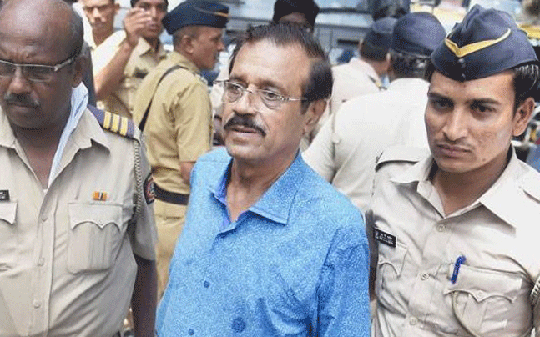
mustafa

The channel quoted Mumbai Police as saying that Dossa succumbed to hypertension and chest pain at around 2.30 pm on Wednesday.

JJ Hospital dean Dr TP Lahane confirmed the news and told Firstpost, "Dossa died of a cardiac arrest. The post-mortem is at underway under the supervision of a three-doctor panel. It is being conducted as per the jail manual. Further details will only emerge after post-mortem is complete."

Early in the morning, Dossa was admitted to JJ Hospital after he complained of chest pain and hypertension.

"Dossa was admitted to the jail ward of the hospital at 3 am," Lahane said. Dossa (lodged in Arthur Road Jail) complained of chest pain and had hypertension, diabetes and infection, Lahane added.

Dossa also informed the special Terrorist and Disruptive Activities (Prevention) Act (TADA) court about his heart condition and said he wanted to undergo a bypass surgery. On Tuesday, the CBI sought capital punishment for Dossa, arguing that his role in the blasts was "more severe" than that of hanged convict Yakub Memon.

In fact, the family of the deceased feared for his life after he was convicted by the TADA court. Reacting to the verdict, Dossa's son, Shahnawaz said, “Everything is over... My dad is not going to come back now.”

Special CBI counsel Deepak Salvi told the special TADA court that Dossa was one of the "brains" behind the conspiracy and that his degree of responsibility towards the commission of the crime was the highest. "If not for him (and other absconding accused), the crime would never have taken place," Salvi had told the court.

He told the court that first conspiracy meeting held at Dossa's Dubai residence had sowed the first seeds of the conspiracy. Salvi had argued that Dossa was one of the masterminds and was in a position of authority.

"Dossa was from among the prime conspirators giving instructions to others," the counsel had told the court. He had argued that Dossa financed for landing of arms and explosives and sending people to Pakistan for arms training etc.

Dossa had the effective control over the incident and he was one of the architects of the blasts, he had said.

"Just like the supreme court had held that Yakub Memon's deeds cannot be viewed distinct from the act of Tiger Memon (a wanted accused in the blasts case), the same can be attributed to Dossa and other suggestion would be futile and worth discarding at the first glance," Salvi argued.

He had said Dossa was among the "archers wearing the quiver and releasing arrows and one of the principal perpetrators who got the work done through others."

"The offence could have been averted had it not been hatched by the absconders (including Dossa) or if he had not initiated it by sending the first consignment of arms," Salvi said.

The CBI counsel had said that from the execution of the conspiracy, there is a clear instigation by Dossa and he was directly responsible for the blasts as he was one of the brains behind plotting the attacks.

"The crime of terrorism is in itself the aggravating circumstances as it carries a special stigmatisation due to the deliberate form of inhuman treatment it represents and the severity of the pain and suffering inflicted," Salvi had argued.

He had said Dossa was a known smuggler and has criminal antecedents.

"The crime committed by him is of the utmost gravity, heinous, dastardly, diabolical and demonic with no regard towards the country and her citizens, and was carried out pruriently relishing the act of spilling the blood and slaughtering," Salvi had argued.

In the second installment of the trial, the court had on 16 June convicted five accused, including Dossa and extradited gangster Abu Salem, under the charges of murder, conspiracy and sections of now repealed TADA, while the sixth accused Riyaz Siddiqui was convicted only under TADA Act.

As many as 257 people were killed in the coordinated blasts that ripped through the city on 12 March, 1993.

The trial of the seven accused — Abu Salem, Mustafa Dossa, Karimullah Khan, Firoz Abdul Rashid Khan, Riyaz Siddiqui, Tahir Merchant and Abdul Quayyum — was separated from the main case as they were arrested at the time of conclusion of the main trial. The court had acquitted Abdul Quayyum of all the charges.

Comments

Add new comment

  • Coastaldigest.com reserves the right to delete or block any comments.
  • Coastaldigset.com is not responsible for its readers’ comments.
  • Comments that are abusive, incendiary or irrelevant are strictly prohibited.
  • Please use a genuine email ID and provide your name to avoid reject.
Agencies
June 6,2020

United Nations, Jun 6: The coronavirus disease has not "exploded" in India, but the risk of that happening remains as the country moves towards unlocking its nationwide lockdown that was imposed in March to contain the Covid-19, according to a top WHO expert.

WHO Health Emergencies Programme Executive Director Michael Ryan on Friday said the doubling time of the coronavirus cases in India is about three weeks at this stage.

“So the direction of travel of the epidemic is not exponential but it is still growing,” he said, adding that the impact of the pandemic is different in different parts of India and varies between urban and rural settings.

“In South Asia, not just in India but in Bangladesh and...in Pakistan, other countries in South Asia, with large dense populations, the disease has not exploded. But there is always the risk of that happening,” Ryan said in Geneva.

He stressed that as the disease generates and creates a foothold in communities, it can accelerate at any time as has been seen in a number of settings.

Ryan noted that measures taken in India such as the nationwide lockdown have had an impact in slowing transmission but the risk of an increase in cases looms as the country opens up.

“The measures taken in India certainly had an impact in dampening transmission and as India, as in other large countries, open up and as people begin to move again, there's always a risk of the disease bouncing back up,” he said.

He added that there are specific issues in India regarding the large amount of migration, the dense populations in the urban environment and the fact that many workers have no choice but to go to work every day.

India went past Italy to become the sixth worst-hit nation by the COVID-19 pandemic.

India saw a record single-day jump of 9,887 coronavirus cases and 294 deaths on Saturday, pushing the nationwide infection tally to 2,36,657 and the death toll to 6,642, according to the health ministry.

The lockdown in India, was first clamped on March 25 and spanned for 21 days, while the second phase of the curbs began on April 15 and stretched for 19 days till May 3. The third phase of the lockdown was in effect for 14 days and ended on May 17. The fourth phase ended on May 31.

The country had registered 512 coronavirus infection cases till March 24.

The nation-wide lockdown in containment zones will continue till June 30 in India but extensive relaxations in a phased manner from June 8 are listed in the Union home ministry's fresh guidelines on tackling the Covid-19 pandemic issued last week.

WHO Chief Scientist Soumya Swaminathan said the over 200,000 current coronavirus cases in India, a country of over 1.3 billion people, "look big but for a country of this size, it's still modest.”

She stressed that it is important for India to keep track of the growth rate, the doubling time of the virus and to make sure that that number doesn't get worse.

She said that India is a “heterogeneous and huge country” with very densely populated cities and much lower density in some rural areas and varying health systems in different states and these offer challenges to the control of Covid-19.

Swaminathan added that as the lockdown and restrictions are lifted, it must be ensured that all precautions are taken by people.

“We've been making this point repeatedly that really if you want behaviour change at a large level, people need to understand the rationale for asking them to do certain things (such as) wearing masks,” she said.

In many urban areas in India, it's impossible to maintain physical distancing, she said adding that it then becomes very important for people to wear appropriate face coverings when they are out, in office settings, in public transport and educational institutions.

“As some states are thinking about opening, every institution, organisation, industry and sector needs to think about what are the measures that need to be put in place before you can allow a functioning and it may never be back to normal.”

She said that in many professions working from home can be encouraged but in several jobs, people have to go to work and in such cases measures must be put in place that allow people to protect themselves and others.

“I think communication and behaviour change is a very large part of this whole exercise,” she added.

Comments

Add new comment

  • Coastaldigest.com reserves the right to delete or block any comments.
  • Coastaldigset.com is not responsible for its readers’ comments.
  • Comments that are abusive, incendiary or irrelevant are strictly prohibited.
  • Please use a genuine email ID and provide your name to avoid reject.
Agencies
March 3,2020

Lucknow, Mar 3: Two days after wife of Kafeel Khan, who is booked under the National Security Act, alleged that her husband faced a threat to life in Mathura jail, where he is lodged for anti-CAA protests, the District Magistrate claimed that Khan was 'fully secure' in the jail.

"Kafeel Khan, who has been booked under the National Security Act (NSA) for alleged inflammatory statements during an anti-CAA protest in Aligarh, is absolutely fine and fully secure in Mathura jail. Allegations of 'inhuman' treatment being meted out to him are baseless," Mathura District Magistrate Sarvagya Ram Mishra said on Monday.

Also Read: Kafeel Khan’s wife fears threat to his life
Senior Superintendent of Mathura district prison, Shailendra Maitrey, said that Khan's condition is being monitored every half an hour and the report is written in the gate book. He said, his ECG is normal and blood pressure was also in control.

He said that Khan was demanding checkup from a cardiologist.

"Since no specialist is available in the government sector here, his request could not be complied with. However, the jail authorities have sent his request to chief medical officer and have asked him to make a specialist available," the jail official said.

He said Khan is in barrack, which is fully ventilated, and he shares it with 50-60 'good behaviour' prisoners.

It may be recalled that in a letter to the Chief Justice of Allahabad High Court, Additional Chief Secretary (Home), and Director General (Jail), Shabista Khan, wife of the jailed doctor, had alleged that her husband was being treated inhumanely in the jail.

She feared that an attempt could be made on her husband's life inside the jail. She had demanded adequate security for him and had urged that her husband should be kept away from active criminals lodged in the jail.

Khan was booked by Aligarh police on December 13 for delivering a provocative speech in Aligarh Muslim University (AMU) during an anti-CAA protest in the campus, a day earlier, and was arrested from Mumbai airport on January 29 by Uttar Pradesh special task force.

The Aligarh police had slapped the stringent National Security Act (NSA) against Khan on February 13 night, hours before he was expected to walk free from the Mathura jail, after he was granted bail by Aligarh's chief judicial magistrate on February 10.

Comments

Add new comment

  • Coastaldigest.com reserves the right to delete or block any comments.
  • Coastaldigset.com is not responsible for its readers’ comments.
  • Comments that are abusive, incendiary or irrelevant are strictly prohibited.
  • Please use a genuine email ID and provide your name to avoid reject.
Agencies
February 11,2020

New Delhi, Feb 11: Votes between Hindus and Muslims were ''completely polarised'', said Congress party's Alka Lamba, as she trailed at Chandni Chowk assembly seat on Tuesday.

"I accept the result, but don't give up. Hindu-Muslim votes were completely polarised. The #Congress Party will now have to prepare for a new fight with new faces and a long struggle for the people of #Delhi. If you fight today, you will also win tomorrow," Ms. Lamba tweeted in Hindi.

As per the Election Commission (EC) website, Ms. Lamba is in third position with just 1,229 votes so far. AAP's Parlad Singh Sawhney is ahead with 23,281 votes followed by Suman Kumar Gupta of BJP.

Ms. Lamba, who had won from Chandni Chowk on an AAP ticket in the 2015 polls, was expelled from AAP last year after she joined Congress, citing differences with Delhi Chief Minister Arvind Kejriwal.

As per the EC official trends, AAP is maintaining a strong lead on 58 seats, while the BJP is far behind at 12. Congress has failed to open its account so far.

The counting of votes for 70 seats of the Delhi Assembly began at 8 am today amid tight security.

Delhi went to polls in a single-phase on February 8. AAP, BJP, Congress are the main political parties in the fray.

Comments

Add new comment

  • Coastaldigest.com reserves the right to delete or block any comments.
  • Coastaldigset.com is not responsible for its readers’ comments.
  • Comments that are abusive, incendiary or irrelevant are strictly prohibited.
  • Please use a genuine email ID and provide your name to avoid reject.