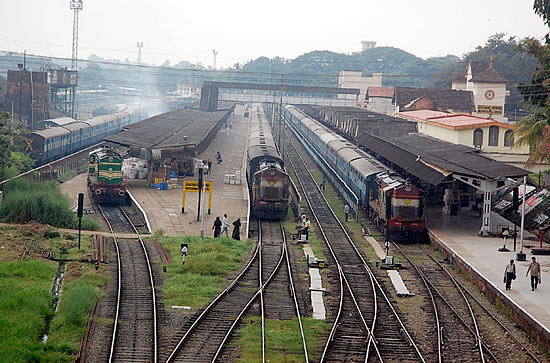
Southern Railway changes timings of 12 trains

July 3, 2011

southern-railways

Mangalore, July 3: The Southern Railway has changed the departure timings of 12 trains, 11 leaving Mangalore Central Station and one passing through Mangalore Junction.

The departure timings of Thiruvanthapuram-Lokmanya Tilak Terminal (Mumbai, train no 16346) has been advanced by 50 minutes. It will leave Mangalore Junction at 11.30 pm instead of 12.20 am.

The release said the departure of Mangalore Central-Kabaka Puttur Passenger (train no 56647) had been advanced from 10.20 am to 10.15 am.

Though the non-monsoon departure time of Mangalore Central-Lokmanya Tilak Matsyagandha Express (train no. 12620) too had been advanced (to leave at 2.35 pm instead of 2.40 pm), the new departure time would come into effect only from November 1. With the monsoon timings for the Konkan railway route, the train would leave at 12.50 pm till October 1.

Chennai superfast (train no 12686) and Puducherry Express (train no 16044) would leave Mangalore at 4.10 pm instead of 4 pm. Mangalore Central-Jammu Tawi Navyug Express (train no 16687) will leave at 5.05 pm instead of 4.20 pm. Mangalore Central-Chennai Egmore Express (train no 16108) will leave at 6.50 pm instead of 6.40 pm and Mangalore Central-Chennai West Coast Express (train no 16628) will leave at 9.45 pm instead of 9.30 pm.

Maveli Express (train no 16603) will leave at 5.45 pm instead of 5.40 pm. Ernad Express (train no 16605) will leave at 7.20 am instead of 7.10 am, Malbar Express (train no 16630) will leave at 6.25 pm instead of 6.15 pm and Parasuram Express (train no 16649) will leave at 4.40 am instead of 4.15 am, the press release informed.

Daily train

Mumbai-Chatrapathi Shivaji terminus -Mangalore Junction Express train (12134) which was running three days in a week will be a daily train from Saturday.

The train number 12134 will leave Mangalore Junction at 2 pm. The train 12133 from Mumbai will reach Mangalore at 12.25 pm.

Though Yeshwanthpura-Mangalore Central Express (day train) will be extended to Karwar, the date has not yet been decided. The train will stop at Mangalore Junction, Udupi, Mookambika Road, Bhatkal and Kumta.

Mangalore Central-Palakkad Superfast train (Train number 22609/22610) will leave Mangalore at 1.40 pm. The train will leave from Palakkad at 7.25 am. However, the date of commencement of the train will be announced later.

Mangalore-Howrah superfast (22852/22851) will run once in a week. The train will leave Mangalore at 10.45 pm on every Saturday. The date of commencement of the train is yet to be announced.

The train will ply via Kasargod-Kannur-Vadagara-Calicut-Shornoor-Palakkad-Coimbatore-Erode-Salem-Kattadi-Chithur-Thirupathi-Renigunta-Vishakhapattanam-Srikakulam road-Brahmapura-Bhuvaneshwar-Katak-Balasore-Kharagapura and Santhragachi.

Comments

Sarath
 - 
Tuesday, 5 Jul 2016

My name is sarath.Am from ernakulam.i am telling about the train maveli express.i travel ernakulam to manglore 2times in a week.mostly i choose maveli express.Now the traveling condition in this train is changing day by day.Reservaton ticket availability of this train is very less and also passengers are increasing day by day.when the train enters in ernakulam station general coaches becomes full than the local passengers enters into reservations coaches.i am telling that please changes or covert the maveli express into maveli express superfast and also reduce the departure time from trivandrum.Now the train has 30 more stops .please reduce the stops into 15 or 20.This will helps the long trip passengers from trivandrum to manglore,trivandrum to ernakulam,kozhikode,ernakulam to manglore etc.There are many longtrip passenger choosing these train.The arrival time of this train is good but stations and traveling time is more.so change this train to superfast category.And also change malabar express into mail.so the local passengers from maveli express goes to malabar express.malabar express runs like an ordinary train.it has 40 more stops 10hours takes for running.reduce the time of malabar express.I am humbly requesting to indian railway for make this changes.i heard about the southern railway changing 16 train into superfast category on july onwards.please makes maveli express to superfast.i request you to make this changes as fast you can. THANKS

Add new comment

  • Coastaldigest.com reserves the right to delete or block any comments.
  • Coastaldigset.com is not responsible for its readers’ comments.
  • Comments that are abusive, incendiary or irrelevant are strictly prohibited.
  • Please use a genuine email ID and provide your name to avoid reject.
News Network
July 19,2020

Bengaluru, Jul 19: Karnataka Chief Minister B S Yediyurappa convened a meeting with Private Medical College Hospitals on Saturday to assess COVID-19 management and directed them to provide 50 per cent of the beds, as promised, with effect from Sunday.

The chief minister said that private medical college hospitals need to cooperate as there is a sharp rise in COVID-10 cases in the city. He further said that it has come to the notice of the government that some institutes are denying treatment of COVID-19 as well as non-COVID patients.

The chief minister expressed his concerns over media reports stating several people died as they didn't get timely treatment due to denial from the hospitals. He said that Bengaluru should continue to lead the country as a role model in COVID-19 management.

During previous meetings, private medical colleges had agreed upon providing around 4,500 beds, which would make the total beds available in government and private medical colleges 6,500.

The chief minister expressed dismay over some colleges not providing the number of beds as promised and also about certain lacunae which were noticed by ministers during their visit.
During this emergency situation, we should show humanity. COVID and non-COVID patients shall not be denied treatment and the balance in healthcare system shall be maintained, he advised.

He assured them of all support, including providing doctors and nurses if need be.
The private medical colleges had assured to provide 50 per cent of beds and some colleges offered 80 per cent of the beds for COVID treatment.

Nodal officers have already been appointed to monitor the availability of beds in these medical colleges.

It was decided to issue a notice to Vaidehi Medical College for their absence in the meeting.

Comments

Add new comment

  • Coastaldigest.com reserves the right to delete or block any comments.
  • Coastaldigset.com is not responsible for its readers’ comments.
  • Comments that are abusive, incendiary or irrelevant are strictly prohibited.
  • Please use a genuine email ID and provide your name to avoid reject.
Ram Puniyani
January 14,2020

In the beginning of January 2020 two very disturbing events were reported from Pakistan. One was the attack on Nankana Sahib, the holy shrine where Sant Guru Nanak was born. While one report said that the place has been desecrated, the other stated that it was a fight between two Muslim groups. Prime Minister of Pakistan Imran Khan condemned the incident and the main accused Imran Chisti was arrested. The matter related to abduction and conversion of a Sikh girl Jagjit Kaur, daughter of Pathi (One who reads Holy Guru Granth Sahib in Gurudwara) of the Gurudwara. In another incident one Sikh youth Ravinder Singh, who was out on shopping for his marriage, was shot dead in Peshawar.

While these condemnable attacks took place on the Sikh minority in Pakistan, BJP was quick enough to jump to state that it is events like this which justify the Citizenship Amendment Act (CAA). Incidentally CAA is the Act which is discriminatory and relates to citizenship with Religion, which is not as per the norms of Indian constitution. There are constant debates and propaganda that population of Hindus has come down drastically in Pakistan and Bangla Desh. Amit Shah, the Home minister stated that in Pakistan the population of Hindus has come down from 23% at the time of partition to 3.7% at present. And in Bangla Desh it has come down from 22% to present 8%.

While not denying the fact that the religious minorities are getting a rough deal in both these countries, the figures which are presented are totally off the mark. These figures don’t take into consideration the painful migrations, which took place at the time of partition and formation of Bangla Desh later. Pakistan census figures tell a different tale. Their first census was held in 1951. As per this census the overall percentage of Non Muslim in Pakistan (East and West together) was 14.2%, of this in West Pakistan (Now Pakistan) it was 3.44 and in Eat Pakistan it was 23.2. In the census held in Pakistan 1998 it became 3.72%. As far as Bangla Desh is concerned the share of Non Muslims has gone down from 23.2 (1951) to 9.6% in 2011.

The largest minority of Pakistan is Ahmadis, (https://minorityrights.org/country/pakistan/) who are close to 4 Million and are not recognised as Muslims in Pakistan. In Bangla Desh the major migrations of Hindus from Bangla Desh took place in the backdrop of Pakistan army’s atrocities in the then East Pakistan.

As far as UN data on refugees in India it went up by 17% between 2016-2019 and largest numbers were from Tibet and Sri Lanka.  (https://www.un.org/en/development/desa/population/migration/publication…)

The state of minorities is in a way the index of strength of democracy. Most South Asian Countries have not been able to sustain democratic values properly. In Pakistan, the Republic began with Jinnah’s classic speech where secularism was to be central credo of Pakistan. This 11th August speech was in a way what the state policy should be, as per which people of all faiths are free to practice their religion. Soon enough the logic of ‘Two Nation theory” and formation of Pakistan, a separate state for Muslim took over. Army stepped in and dictatorship was to reign there intermittently. Democratic elements were suppressed and the worst came when Zia Ul Haq Islamized the state in collusion with Maulanas. The army was already a strong presence in Pakistan. The popular formulation for Pakistan was that it is ruled by three A’s, Army, America and Allah (Mullah).

Bangla Desh had a different trajectory. Its very formation was a nail in the coffin of ‘two nation theory’; that religion can be the basis of a state. Bangla Desh did begin as a secular republic but communal forces and secular forces kept struggling for their dominance and in 1988 it also became Islamic republic. At another level Myanmar, in the grip of military dictatorship, with democratic elements trying to retain their presence is also seeing a hard battle. Democracy or not, the army and Sanghas (Buddhist Sang has) are strong, in Myanmar as well. The most visible result is persecution of Rohingya Muslims.

Similar phenomenon is dominating in Sri Lanka also where Budhhist Sanghas and army have strong say in the political affairs, irrespective of which Government is ruling. Muslim and Christian minorities are a big victim there, while Tamils (Hindus, Christians etc.) suffered the biggest damage as ethnic and religious minorities. India had the best prospect of democracy, pluralism and secularism flourishing here. The secular constitution, the outcome of India’s freedom struggle, the leadership of Gandhi and Nehru did ensure the rooting of democracy and secularism in a strong way.

India so far had best democratic credentials amongst all the south Asian countries. Despite that though the population of minorities rose mainly due to poverty and illiteracy, their overall marginalisation was order of the day, it went on worsening with the rise of communal forces, with communal forces resorting to identity issues, and indulging in propaganda against minorities.

While other South Asian countries should had followed India to focus more on infrastructure and political culture of liberalism, today India is following the footsteps of Pakistan. The retrograde march of India is most visible in the issues which have dominated the political space during last few years. Issues like Ram Temple, Ghar Wapasi, Love Jihad, Beef-Cow are now finding their peak in CAA.

India’s reversal towards a polity with religion’s identity dominating the political scene was nicely presented by the late Pakistani poetess Fahmida Riaz in her poem, Tum bhi Hum Jaise Nikle (You also turned out to be like us). While trying to resist communal forces has been an arduous task, it is becoming more difficult by the day. This phenomenon has been variously called, Fundamentalism, Communalism or religious nationalism among others. Surely it has nothing to do with the religion as practiced by the great Saint and Sufi traditions of India; it resorts mainly to political mobilization by using religion as a tool.


Comments

Ashi
 - 
Tuesday, 14 Jan 2020

If Malaysia implement similar NRC/CAA, India and China are the loser.

Add new comment

  • Coastaldigest.com reserves the right to delete or block any comments.
  • Coastaldigset.com is not responsible for its readers’ comments.
  • Comments that are abusive, incendiary or irrelevant are strictly prohibited.
  • Please use a genuine email ID and provide your name to avoid reject.
News Network
February 6,2020

Bengaluru, Feb 6: A 33 -year-old techie who was on the run after allegedly bludgeoning her mother to death and attempting to murder her brother at their house near KR Puram early on Sunday was arrested along with her friend from a hotel in Port Blair, Andaman and Nicobar Islands, on Wednesday morning.

C Amruta and Sridhar Rao were produced before a court in Port Blair to get a transit warrant, deputy commissioner of police (Whitefield) MN Anuchet said. Police initially thought she had committed the crime as she was unable to repay a loan of Rs 15 lakh and feared being humiliated by the lenders.

"But now we strongly suspect that Amruta and Rao were in a relationship, which was opposed by her mother and brother. We don't see any other reason for her to attack her family members. We can get more details only after questioning the duo," another police officer said, adding, "The most important question is: Did Rao know Amruta was going to kill her mother? Or he got to know about it only later? He'd booked their air tickets to Port Blair on January 31 itself."

Rao and Amruta worked together in a software company in Whitefield till 2017. "Then they joined different firms and were in constant touch," police said.

Preliminary probe revealed the duo flew to Port Blair by catching a flight from Kempegowda International Airport (KIA) at 6.30am on Sunday. CCTV footage had shown Rao - wearing a full-face helmet and carrying a backpack - waiting near Amruta's house on a gearless scooter on Sunday morning. After she arrived, they chatted for a while before riding away. They arrived at KIA on the same bike, police said.

"We checked the passengers' list at KIA for that day and found Amruta's name. With the help of Port Blair police, we traced the duo to a hotel," an investigating officer said.

On Sunday morning, Amruta hit her 54-year-old mother C Nirmala on the head with a digging bar. She later stabbed her younger brother C Harish in the neck. Harish collapsed and thinking that he was dead, she left the house.

In his statement to police, Harish stated, "Around 4.30am, Amruta entered my room and stabbed me. I asked her what was wrong. She said she had a debt of Rs 15 lakh and didn't want the debtors to harass me and our mother."

Comments

Add new comment

  • Coastaldigest.com reserves the right to delete or block any comments.
  • Coastaldigset.com is not responsible for its readers’ comments.
  • Comments that are abusive, incendiary or irrelevant are strictly prohibited.
  • Please use a genuine email ID and provide your name to avoid reject.