Adichunchanagiri seer's 68th birth anniversary celebrated

January 29, 2012

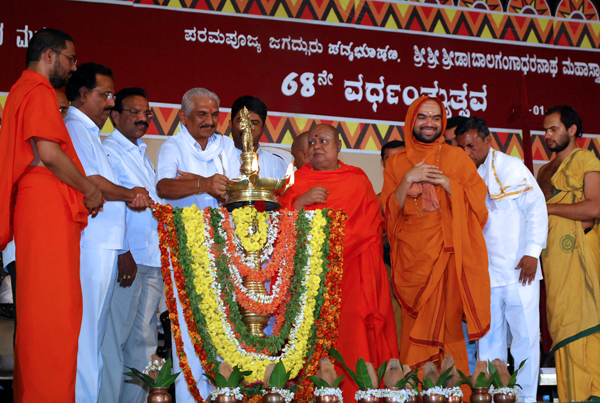
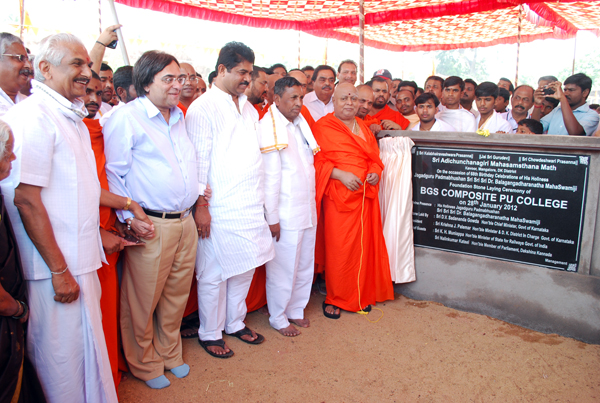
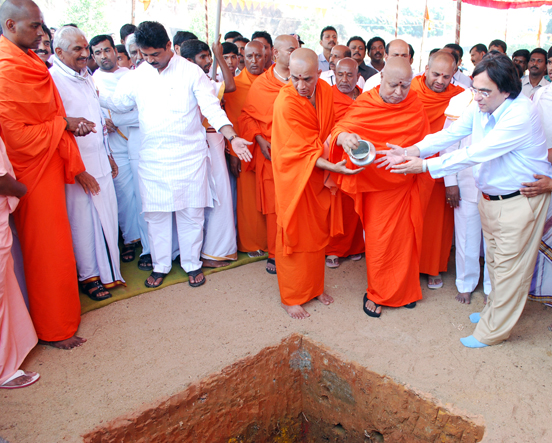
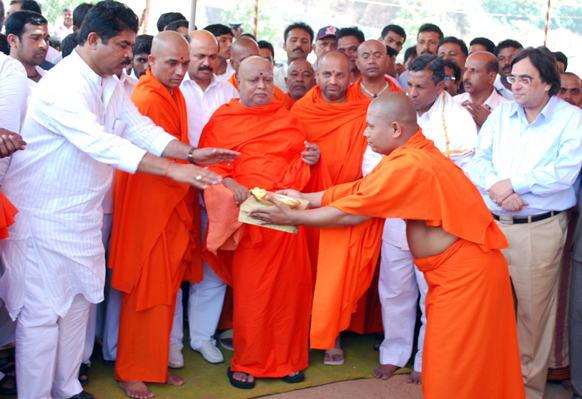
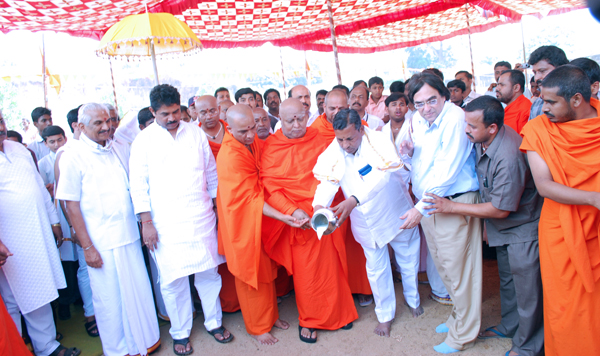
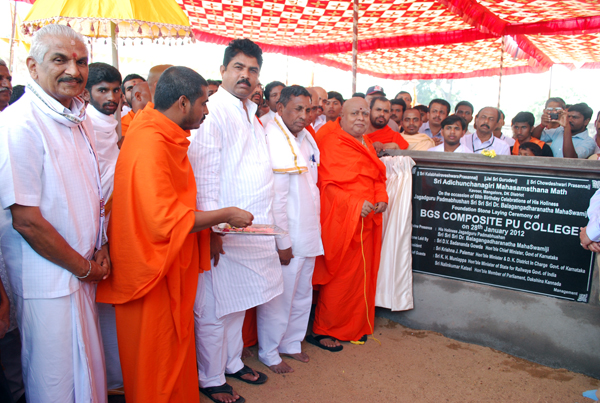
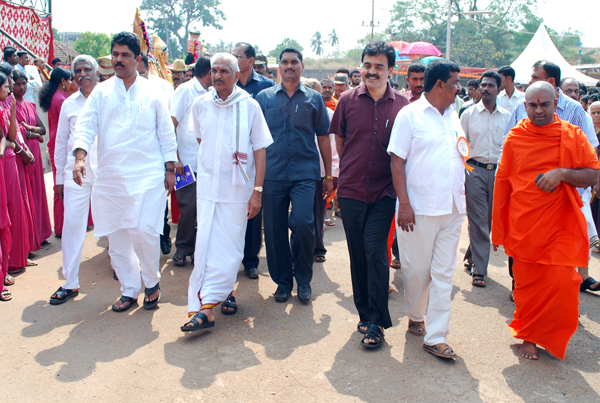
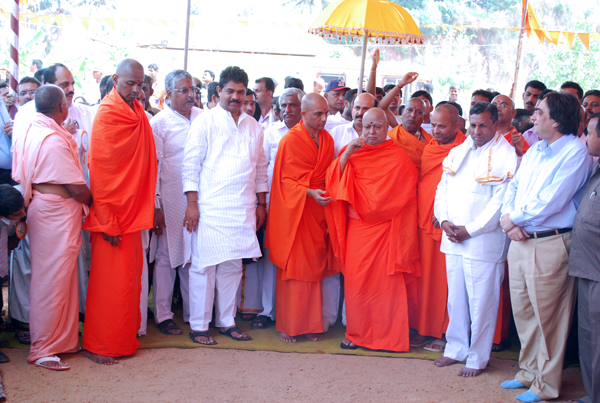
Mangalore, January 29: The 68th birth anniversary of Balaganghadharanatha Swamiji of Shri Adichunchanagiri Mahasamsthana Mutt was celebrated at Abhiman Green Lawns, backyard of BGS School in the city on Saturday.

Participating in the grand event Chief Minister D V Sadananda Gowda lauded the role of Sri Adhichunchanagiri Maha Samsthana Mutt in unity of the nation.

Mr Gowda also opined that the Adhichunchanagiri Mutt has been rendering a great help to the poor in getting medical care. “The service of the mutt has reduced the burden of the government”, he said.

Speaking on the occasion, Union Railway Minister of State KH Muniyappa opined that Sri Adhichunchanagiri Maha Samsthana Mutt has been implementing the words of Basavanna by serving the people without any discrimination.

Sri Rama Vidya Kendra Kaladka Convener Dr. Kaladka Prabhakar Bhat said that many political leaders were motivated by the religious leaders during freedom fight. Balagangadharanatha Maha Swamiji is following the words of Swamy Vivekananda and giving his best to the society. Sri Adhichunchanagiri Maha Samsthana Mutt is trying to protect Hindu community. “We should be proud to have such a Swamiji” he added.

NICE managing Director Ashok Kheni demanded the State Government to give subsidy for the visitors of Kashi, a holy place for Hindus. He also demanded Chief Minister to give green signal for a road project between Mangalore and Bangalore through which one can reach the other city n just three hours.

Speaking on Balagangadharanatha Maha Swamiji birth anniversary, Hosanagar Raghaveshwara Bharathi Swamiji said that the seer lives for the society. “He is immortal as he lives for the society.”

Speaking after receiving all honours, Balagangadharanatha Maha Swamiji hailed Chief Minister. He said that Chief Minister has a good team with him and he is working without any discrimination in the society. He hoped that the good work of CM would continue for the next three years too.

Audio of the movie 'Sri Kshetra Adhichunchanagiri' was released on the occasion. The movie is being produced by BV Narasihmayya and directed by Saiprakash.

CM_K29Jan_1

CM_K29Jan_2

CM_K29Jan_3

CM_K29Jan_4

CM_K29Jan_5

CM_K29Jan_6

CM_K29Jan_7

CM_K29Jan_8

Comments

Raghu
 - 
Thursday, 14 Jan 2016

jhgfbdf vmbduygvuysdhjklfhduigh kdfn uihj[

]
kfisdhfjkdg
kfdhjgd,

Add new comment

  • Coastaldigest.com reserves the right to delete or block any comments.
  • Coastaldigset.com is not responsible for its readers’ comments.
  • Comments that are abusive, incendiary or irrelevant are strictly prohibited.
  • Please use a genuine email ID and provide your name to avoid reject.
News Network
March 28,2020

Thiruvananthapuram, Mar 28: A man from Kerala was among the terrorists affiliated to Islamic State (IS) who allegedly attacked a Gurdwara in Kabul earlier this week in which 27 people were killed.

The IS has claimed that one of the suicide bombers was Abu Khalid al-Hindi.

According to sources, investigation agencies on Friday have identified him as 29-year-old Mohammed Sajid Kuthirummal of Padne in Kasargod. He was among the 14 persons, who left from Kerala to join IS in Nangarhar province of Afghanistan.

"IS had released the name Abu Khalid al-Hindi through its media agency soon after the attack. The photograph of him holding a rifle was also published by IS in their propaganda magazine Al Naba. From that, we have identified the person as Mohammed Sajid Kuthirummal. We are investigating the matter and in touch with the investigating agencies in Afghanistan for tracking his trail," sources told ANI.

The National Investigation Agency (NIA) probe had earlier revealed that Mohammed Sajid was recruited by Abdul Rashid Abdulla of Chandera, who was killed in Afghanistan last year.

Sajid worked as a shop keeper in a gulf country and returned to Kerala. Based on a complaint by Sajid's father Mahamood, the FIR was registered at Chendara Police Station, Kasaragod in 2016 regarding Sajid joining IS and leaving for Afghanistan.

He was among the 14 member team that left from Kerala to join IS in Khorasan Province' in Nangarhar.

ANI had earlier reported that two of these members Ayesha alias Sonia Sebastian and Fathima alias Nimisha who were in IS had expressed their interest in returning to Kerala. Out of 14, seven including Sajid is dead.

Comments

Abdul Gaffar Bolar
 - 
Saturday, 28 Mar 2020

First, investigate truly who is behind this? Then hang all of them. 


Add new comment

  • Coastaldigest.com reserves the right to delete or block any comments.
  • Coastaldigset.com is not responsible for its readers’ comments.
  • Comments that are abusive, incendiary or irrelevant are strictly prohibited.
  • Please use a genuine email ID and provide your name to avoid reject.
Ram Puniyani
February 4,2020

As democracy is seeping in slowly all over the world, there is an organization which is monitoring the degree of democracy in the individual countries, The Economist Intelligence Unit. As such in each country there are diverse factors which on one hand work to deepen it, while others weaken it. Overall there is a march from theoretical democracy to substantive one. The substantive democracy will herald not just the formal equality, freedom and community feeling in the country but will be founded on the substantive quality of these values. In India while the introduction of modern education, transport, communication laid the backdrop of beginning of the process, the direction towards deepening of the process begins with Mahatma Gandhi when he led the non-cooperation movement in 1920, in which average people participated. The movement of freedom for India went on to become the ‘greatest ever mass movement’ in the World.

The approval and standards for democracy were enshrined in Indian Constitution, which begins ‘We the people of India’, and was adopted on 26th January 1950. With this Constitution and the policies adopted by Nehru the process of democratization started seeping further, the dreaded Emergency in 1975, which was lifted later restored democratic freedoms in some degree. This process of democratisation is facing an opposition since the decade of 1990s after the launch of Ram Temple agitation, and has seen the further erosion with BJP led Government coming to power in 2014. The state has been proactively attacking civil liberties, pluralism and participative political culture with democracy becoming flawed in a serious way. And this is what got reflected in the slipping of India by ten places, to 51st, in 2019. On the index of democracy India slipped down from the score of 7.23 to 6.90. The impact of sectarian BJP politics is writ on the state of the nation, country.

Ironically this lowering of score has come at a time when the popular protests, the deepening of democracy has been given a boost and is picking up with the Shaheen Bagh protests. The protest which began in Shaheen Bagh, Delhi in the backdrop of this Government getting the Citizenship amendment Bill getting converted into an act and mercilessly attacking the students of Jamia Milia Islamia, Aligarh Muslim University along with high handed approach in Jamia Nagar and neighbouring areas.  From 15th December 2019, the laudable protest is on.

It is interesting to note that the lead in this protest has been taken by the Muslim women, from the Burqa-Hijab clad to ‘not looking Muslim’ women and was joined by students and youth from all the communities, and later by the people from all the communities. Interestingly this time around this Muslim women initiated protest has contrast from all the protests which earlier had begun by Muslims. The protests opposing Shah Bano Judgment, the protests opposing entry of women in Haji Ali, the protests opposing the Government move to abolish triple Talaq. So far the maulanas from top were initiating the protests, with beard and skull cap dominating the marches and protests. The protests were by and large for protecting Sharia, Islam and were restricted to Muslim community participating.

This time around while Narendra Modi pronounced that ‘protesters can be identified by their clothes’, those who can be identified by their external appearance are greatly outnumbered by all those identified or not identified by their appearance.

The protests are not to save Islam or any other religion but to protect Indian Constitution. The slogans are structured around ‘Defence of democracy and Indian Constitution’. The theme slogans are not Allahu Akbar’ or Nara-E-Tadbeer’ but around preamble of Indian Constitution. The lead songs have come to be Faiz Ahmad Faiz’s ‘Hum Dekhenge’, a protest against Zia Ul Haq’s attempts to crush democracy in the name of religion. Another leading protest song is from Varun Grover, ‘Tanashah Aayenge…Hum Kagaz nahin Dikhayenge’, a call to civil disobedience against the CAA-NRC exercise and characterising the dictatorial nature of the current ruling regime.

While BJP was telling us that primary problem of Muslim women is Triple talaq, the Muslim women led movements has articulated that primary problem is the very threat to Muslim community. All other communities, cutting across religious lines, those below poverty line, those landless and shelter less people also see that if the citizenship of Muslims can be threatened because of lack of some papers, they will be not far behind in the victimization process being unleashed by this Government.

While CAA-NRC has acted as the precipitating factor, the policies of Modi regime, starting from failure to fulfil the tall promises of bringing back black money, the cruel impact of demonetisation, the rising process of commodities, the rising unemployment, the divisive policies of the ruling dispensation are the base on which these protest movements are standing. The spread of the protest movement, spontaneous but having similar message is remarkable. Shaheen Bagh is no more just a physical space; it’s a symbol of resistance against the divisive policies, against the policies which are increasing the sufferings of poor workers, the farmers and the average sections of society.

What is clear is that as identity issues, emotive issues like Ram Temple, Cow Beef, Love Jihad and Ghar Wapasi aimed to divide the society, Shaheen Bagh is uniting the society like never before. The democratisation process which faced erosion is getting a boost through people coming together around the Preamble of Indian Constitution, singing of Jan Gan Man, waving of tricolour and upholding the national icons like Gandhi, Bhagat Singh, Ambedkar and Maulana Azad. One can feel the sentiments which built India; one can see the courage of people to protect what India’s freedom movement and Indian Constitution gave them.

Surely the communal forces are spreading canards and falsehood against the protests. As such these protests which is a solid foundation of our democracy. The spontaneity of the movement is a strength which needs to be channelized to uphold Indian Constitution and democratic ethos of our beloved country.


Comments

Add new comment

  • Coastaldigest.com reserves the right to delete or block any comments.
  • Coastaldigset.com is not responsible for its readers’ comments.
  • Comments that are abusive, incendiary or irrelevant are strictly prohibited.
  • Please use a genuine email ID and provide your name to avoid reject.
News Network
June 26,2020

Bengaluru, Jun 26: All efforts would be made to control the spread of coronavirus in the city and there will be no fresh lockdown, Karnataka Chief Minister B S Yediyurappa on Friday said, asserting that improving economic situation of the state is also equally important.

Though the state capital was considered a model for the entire country in COVID management and has seen a spike in cases during the last few days, the pandemic can be controlled if everyone cooperated, he said.

His remarks come a day after Revenue Minister R Ashoka said Bengaluru is still 'safe' compared to the COVID-19 situation in other cities and states and had ruled out a fresh lockdown for now, putting to rest speculations that it was planning such a move in view of spike in cases.

As of Thursday evening, a total of 1,791 COVID-19 cases, including 78 deaths and 505 discharges, had been reported in the city while the state's tally stood at 10,560 compared to just 3,408 cases as on June 1. The state capital has the highest number of cases among the districts.

"There is no question of imposing lockdown for any reason. In some areas (with high case load) we have already implemented lockdown, other than those places there is no question of it being implemented in other places," Yediyurappa told reporters here.

Improving the economic situation of the state was also equally important, he said ahead of his meeting with Ministers, MLAs and MPs of all parties from Bengaluru to discuss measures to control COVID-19.

"I will discuss with all MLAs including those from opposition and Ministers from Bengaluru and come to some decision. With their cooperation we will make all honest efforts to control the pandemic in Bengaluru," he added.

Earlier, there had been intense speculation after some ministers said the government may have to consider re-imposing the lockdown, eased in phases from the middle of last month, in view of continuing spike in new cases in the past several days. Bengaluru was a "model" to the entire country in COVID management, but in recent days cases have increased, Yediyurappa said, adding to control it cooperation from everyone was necessary.

"I have confidence that if everyone (MLAs) pays special attention in their respective assembly constituency, COVID can be controlled," he said. Meanwhile, official sources said the Chief Minister has given Revenue Minister Ashoka the charge of overseeing the COVID management in the city.

Comments

Add new comment

  • Coastaldigest.com reserves the right to delete or block any comments.
  • Coastaldigset.com is not responsible for its readers’ comments.
  • Comments that are abusive, incendiary or irrelevant are strictly prohibited.
  • Please use a genuine email ID and provide your name to avoid reject.