Trade Unions come together to fight for labour rights

[email protected] (CD Network, Photos by Suresh Vamanjoor)
September 20, 2013
citu_protest_20_1
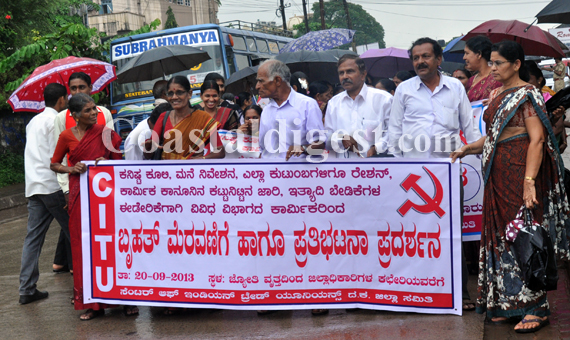
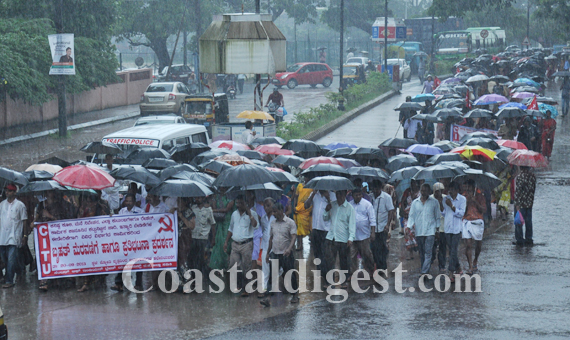
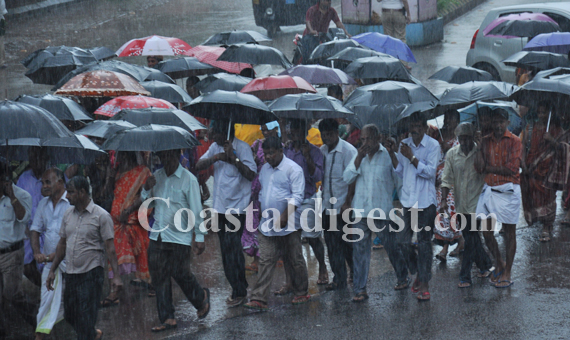
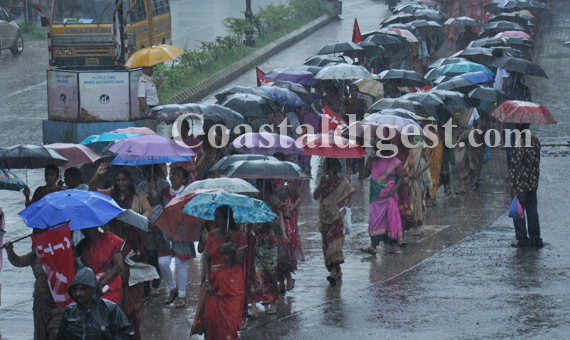
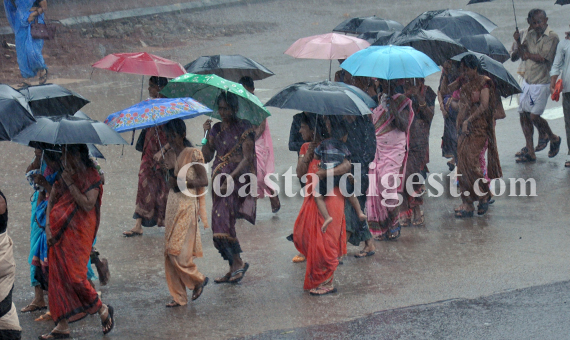
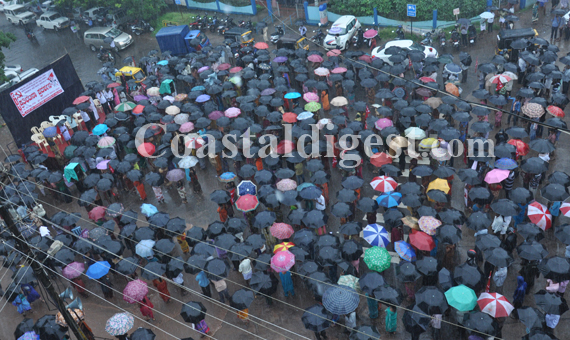
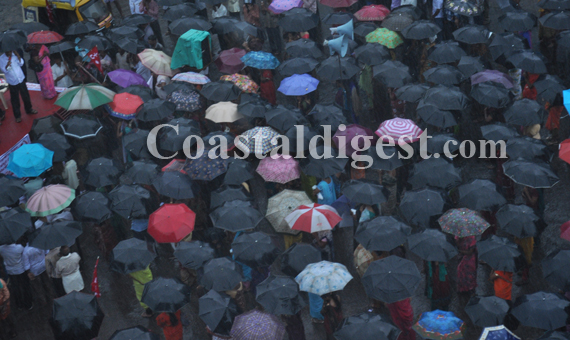
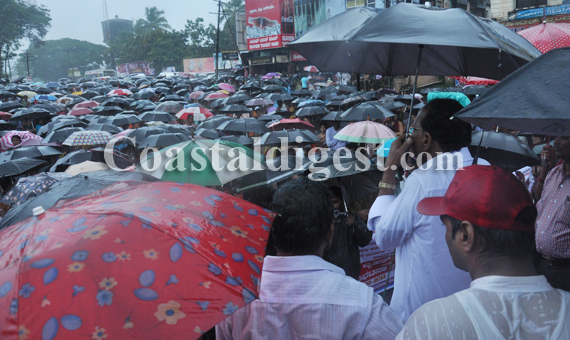
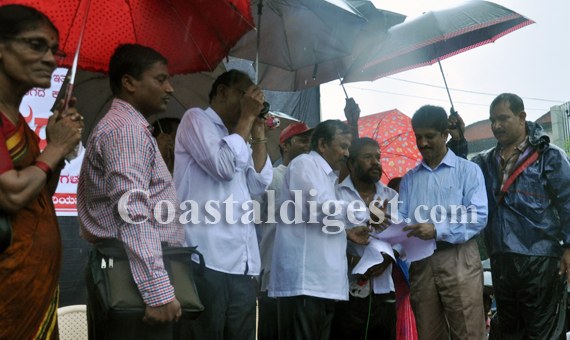
Mangalore, Sep 20: Members of several labour organisations, who came together under the banner of CITU, took out a protest march from Ambedkar circle (Jyothi Circle) to the Deputy Commissioner's office here on Friday, demanding minimum wage, check on price hike of essential commodities, implementation of labour laws and signing an agreement which gives the right to labourers to form unions and have their rights at work place.

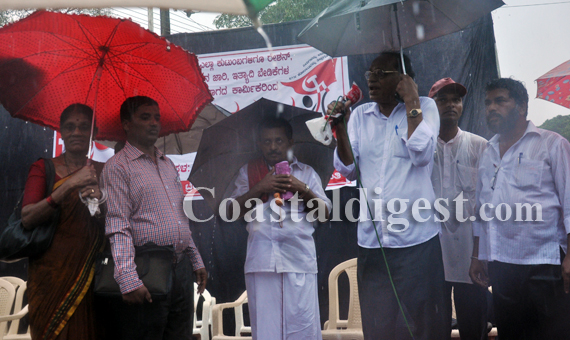
Addressing the protesters at a public meeting in front of the office of Deputy Commissioner after the protest march, State unit president of the CITU B Madhava said that state government is not bothered about the working class.

"Issues concerning beedi workers, Anganwadi workers, Auto drivers, other daily wage labourers and construction workers have to be discussed in detail in the Assembly. Wages fixed in 2009 have to be revised,” he demanded.

Recalling the signature campaign by unorganised workers who had submitted a memorandum with 10 lakh signatures to the State Government, he said that the Government had failed to respond to it.

Sunil Kumar Bajal of Centre of Indian Trade Unions (CITU) said that entry of multi-national consumer malls will affect vendors. Street vendors are seeking mercy. He said that since the auto drivers are not provided with proper auto stands in the city they have been paying heavy amount as penalty to the RTO.

K Balakrishna Shetty, CITU district general secretary handed over a memorandum to Assistant labour commissioner Nagesh during the protest meet.

citu_protest_20_2
citu_protest_20_3
citu_protest_20_4
citu_protest_20_5
citu_protest_20_6
citu_protest_20_7
citu_protest_20_8
citu_protest_20_9
citu_protest_20_10

Comments

Eugenia
 - 
Tuesday, 12 Apr 2016

Excellent goods from you, man. I've understand your sstuff previous to and you're just extremely great.

I really like what you've acquired here,
reaally like what you're saying aand the way in which you ssay it.

You make it enjoyable aand you still care for to keep it smart.
I canjt wait to read much more from you. This is actually a wolnderful website.

Also visit my web site: sunsetsandsurf: http://gloria.uio.no/~stud002/occupoly/index.php/Usuario:Angelita65W

Lorie
 - 
Wednesday, 13 Jan 2016

I'm not sure exactly why but this blog is loading very slow for me.
Is anyone else having this issue or iss it
a problem oon mmy end? I'll check back later and see if
the problem still exists.

Here is my website ... life insurance quotes: http://create.freepressmaster.com/User:ReganEsposito

Add new comment

  • Coastaldigest.com reserves the right to delete or block any comments.
  • Coastaldigset.com is not responsible for its readers’ comments.
  • Comments that are abusive, incendiary or irrelevant are strictly prohibited.
  • Please use a genuine email ID and provide your name to avoid reject.
coastaldigest.com news network
May 22,2020

Mangaluru, May 22: An elderly cardiac patient from Dakshina Kannada, who was stranded in Saudi Arabia due to covid-19 lock-down, has finally reached his homeland thanks to the timely intervention by Humanity Forum Jubail and Indian Social Forum.

The elderly man hailing from Kadaba area of Dakshina Kannada was admitted to a hospital in Madinah. However, his condition continued to worsen due to lack of proper treatment. The efforts by his family members to bring him back home had not yielded results.

Meanwhile, one of the relatives of the patient, Ansari Suratkal, who happens to be a DKSC activist, brought the issue to the notice of the Karnataka unit of the Indian Social Forum in Dammam. ISF contacted Humanity Forum president Zakariya Jokatte, who helped the patient to speak directly union minister D V Sadananda Gowda in a video conference organised by coastaldigest.com.

Humanity Forum also persuaded the Indian Embassy to allow the stranded cardiac patient to fly back to India through Dammam-Bengaluru repatriation flight on May 20. 

However, it was not easy for the patient to travel from Madinah to Dammam International Airport due to lock-down and curfew. ISF not only obtained travel permission for him but also arranged vehicle. Jeddah and Riyadh units of ISF helped in obtaining permission letter in their respective places in spite of travel ban imposed by the police. Madinah unit of ISF arranged vehicle for transportation. Zakariya Jokatte bore the air ticket and other expenses of the patient.

Comments

Add new comment

  • Coastaldigest.com reserves the right to delete or block any comments.
  • Coastaldigset.com is not responsible for its readers’ comments.
  • Comments that are abusive, incendiary or irrelevant are strictly prohibited.
  • Please use a genuine email ID and provide your name to avoid reject.
Ram Puniyani
January 14,2020

In the beginning of January 2020 two very disturbing events were reported from Pakistan. One was the attack on Nankana Sahib, the holy shrine where Sant Guru Nanak was born. While one report said that the place has been desecrated, the other stated that it was a fight between two Muslim groups. Prime Minister of Pakistan Imran Khan condemned the incident and the main accused Imran Chisti was arrested. The matter related to abduction and conversion of a Sikh girl Jagjit Kaur, daughter of Pathi (One who reads Holy Guru Granth Sahib in Gurudwara) of the Gurudwara. In another incident one Sikh youth Ravinder Singh, who was out on shopping for his marriage, was shot dead in Peshawar.

While these condemnable attacks took place on the Sikh minority in Pakistan, BJP was quick enough to jump to state that it is events like this which justify the Citizenship Amendment Act (CAA). Incidentally CAA is the Act which is discriminatory and relates to citizenship with Religion, which is not as per the norms of Indian constitution. There are constant debates and propaganda that population of Hindus has come down drastically in Pakistan and Bangla Desh. Amit Shah, the Home minister stated that in Pakistan the population of Hindus has come down from 23% at the time of partition to 3.7% at present. And in Bangla Desh it has come down from 22% to present 8%.

While not denying the fact that the religious minorities are getting a rough deal in both these countries, the figures which are presented are totally off the mark. These figures don’t take into consideration the painful migrations, which took place at the time of partition and formation of Bangla Desh later. Pakistan census figures tell a different tale. Their first census was held in 1951. As per this census the overall percentage of Non Muslim in Pakistan (East and West together) was 14.2%, of this in West Pakistan (Now Pakistan) it was 3.44 and in Eat Pakistan it was 23.2. In the census held in Pakistan 1998 it became 3.72%. As far as Bangla Desh is concerned the share of Non Muslims has gone down from 23.2 (1951) to 9.6% in 2011.

The largest minority of Pakistan is Ahmadis, (https://minorityrights.org/country/pakistan/) who are close to 4 Million and are not recognised as Muslims in Pakistan. In Bangla Desh the major migrations of Hindus from Bangla Desh took place in the backdrop of Pakistan army’s atrocities in the then East Pakistan.

As far as UN data on refugees in India it went up by 17% between 2016-2019 and largest numbers were from Tibet and Sri Lanka.  (https://www.un.org/en/development/desa/population/migration/publication…)

The state of minorities is in a way the index of strength of democracy. Most South Asian Countries have not been able to sustain democratic values properly. In Pakistan, the Republic began with Jinnah’s classic speech where secularism was to be central credo of Pakistan. This 11th August speech was in a way what the state policy should be, as per which people of all faiths are free to practice their religion. Soon enough the logic of ‘Two Nation theory” and formation of Pakistan, a separate state for Muslim took over. Army stepped in and dictatorship was to reign there intermittently. Democratic elements were suppressed and the worst came when Zia Ul Haq Islamized the state in collusion with Maulanas. The army was already a strong presence in Pakistan. The popular formulation for Pakistan was that it is ruled by three A’s, Army, America and Allah (Mullah).

Bangla Desh had a different trajectory. Its very formation was a nail in the coffin of ‘two nation theory’; that religion can be the basis of a state. Bangla Desh did begin as a secular republic but communal forces and secular forces kept struggling for their dominance and in 1988 it also became Islamic republic. At another level Myanmar, in the grip of military dictatorship, with democratic elements trying to retain their presence is also seeing a hard battle. Democracy or not, the army and Sanghas (Buddhist Sang has) are strong, in Myanmar as well. The most visible result is persecution of Rohingya Muslims.

Similar phenomenon is dominating in Sri Lanka also where Budhhist Sanghas and army have strong say in the political affairs, irrespective of which Government is ruling. Muslim and Christian minorities are a big victim there, while Tamils (Hindus, Christians etc.) suffered the biggest damage as ethnic and religious minorities. India had the best prospect of democracy, pluralism and secularism flourishing here. The secular constitution, the outcome of India’s freedom struggle, the leadership of Gandhi and Nehru did ensure the rooting of democracy and secularism in a strong way.

India so far had best democratic credentials amongst all the south Asian countries. Despite that though the population of minorities rose mainly due to poverty and illiteracy, their overall marginalisation was order of the day, it went on worsening with the rise of communal forces, with communal forces resorting to identity issues, and indulging in propaganda against minorities.

While other South Asian countries should had followed India to focus more on infrastructure and political culture of liberalism, today India is following the footsteps of Pakistan. The retrograde march of India is most visible in the issues which have dominated the political space during last few years. Issues like Ram Temple, Ghar Wapasi, Love Jihad, Beef-Cow are now finding their peak in CAA.

India’s reversal towards a polity with religion’s identity dominating the political scene was nicely presented by the late Pakistani poetess Fahmida Riaz in her poem, Tum bhi Hum Jaise Nikle (You also turned out to be like us). While trying to resist communal forces has been an arduous task, it is becoming more difficult by the day. This phenomenon has been variously called, Fundamentalism, Communalism or religious nationalism among others. Surely it has nothing to do with the religion as practiced by the great Saint and Sufi traditions of India; it resorts mainly to political mobilization by using religion as a tool.


Comments

Ashi
 - 
Tuesday, 14 Jan 2020

If Malaysia implement similar NRC/CAA, India and China are the loser.

Add new comment

  • Coastaldigest.com reserves the right to delete or block any comments.
  • Coastaldigset.com is not responsible for its readers’ comments.
  • Comments that are abusive, incendiary or irrelevant are strictly prohibited.
  • Please use a genuine email ID and provide your name to avoid reject.
News Network
March 27,2020

Kollam, Mar 27: A young IAS officer in Kerala has been booked by police after he left the state violating instructions to remain under home quarantine following his recent return from honeymoon abroad, officials said on Friday.

A First Information Report has been registered against Kollam sub-collector Anupam Mishra, who hails from Uttar Pradesh, based on a report from the Health department about the violation, Kollam Superintendent of Police T Narayanan said.

Describing the action of the officer as a “serious matter”, District Collector B. Abdul Nasser said Mishra had returned to Kerala on March 19 from his Malaysia-Singapore trip and was advised to remain under quarantine, as per the protocol for overseas returnees in the backdrop of coronavirus outbreak.

On his return to Kerala from the foreign trip, Mishra had undergone medical examination and did not show symptoms. His personal staff, including gunman, have also been kept under observation.

However, the officer had left for his brother’s place in Bengaluru without informing anyone, Nasser said.

When the Collector got in touch with him, Mishra informed him that he was in Bengaluru.

“He was on leave after his marriage and took permission to travel to Malaysia and Singapore. On his return I advised him to remain under home quarantine. Seems like he left to be with his family at Bengaluru,” Nasser told PTI.

However, police said Mishra’s mobile tower location shows Kanpur in Uttar Pradesh.

Authorities came to know on Thursday that Mishra, who had been staying alone in his quarters at Kollam, was not there after health department staff, who regularly visit people in quarantine, found the lights in his house switched off, police sources said.

“The officer has gone without prior permission or leave. He did not have any symptoms of the virus. Without informing us, he left. It is a serious matter, the collector said adding Mishra has been asked to provide his current address and travel details to Bengaluru.”

When an officer leaves his jurisdiction, he is supposed to inform the government, which Mishra did not do. He has also not taken prior permission for leaving the state, the later told reporters.

Coronavirus: Conflicts on hold for now as players face a common enemy
 China bars foreign visitors as imported COVID-19 cases rise
The state government has sought an explanation from the officer in this regard.

A case has been registered against him under various sections of the Indian Penal Code including 188 (disobedience to order duly promulgated by public servant), 269 (Negligent Act likely to spread infection of disease dangerous to life) and 271 (disobedience to quarantine rule), police said.

Kollam, is the only district in the state, which has not reported any positive case of COVID-19 so far. A total of 176 positive cases have been reported in the state so far.

Comments

Add new comment

  • Coastaldigest.com reserves the right to delete or block any comments.
  • Coastaldigset.com is not responsible for its readers’ comments.
  • Comments that are abusive, incendiary or irrelevant are strictly prohibited.
  • Please use a genuine email ID and provide your name to avoid reject.