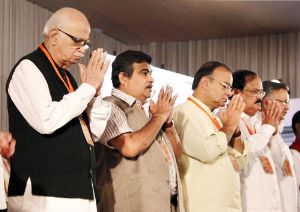
With eye on early Lok Sabha elections, BJP shedding saffron image?

September 30, 2012

BJP-Saffron

New Delhi, September 30: While anticipating that elections may be held earlier than scheduled, BJP has been trying to soften its "hardline Hindutva" image in what appears to be a move to blunt the hostility of Muslims, and reassure its existing allies while reaching out to new partners.


The three-day session of BJP's national executive saw both party president Nitin Gadkari and veteran leader LK Advani condemning the anti-Islam film that has triggered violence in different parts of the globe.


Gadkari on Thursday cited Swami Vivekananda, whose 150th birth anniversary is being planned by the party in a big way, to condemn the film that denigrates Prophet Mohammad.


"It's wrong to spread disrespect towards anybody who is revered by members of a faith. We should with full conviction reassure our brethren belonging to the minority communities that we brook no discrimination or injustice in dealing with different sections of our diverse society," Advani said in a speech that was well received by the audience.


He suggested that doing so would help reassure party's potential allies that "they have nothing to be apprehensive about partnering with BJP". Advani also emphasized the need for broadening the NDA, saying that the grouping has to be transformed into "NDA Plus".


The remark acquires significance in view of the apprehension of an existing ally, Bihar CM Nitish Kumar, as well as the recognition that the fear of losing Muslim support forces some of the anti-Congress players to maintain a distance from the saffron outfit. In fact, Advani's advice that party should undergo an image makeover to appear "secular" appears to articulate especially Kumar's anxiety.


The Bihar CM is apprehensive that the projection of his Gujarat counterpart Narendra Modi as BJP's choice for the PM will deal a setback to his assiduous attempts to woo Muslims away from his rival Lalu Prasad.


Regional players like TDP chief N Chandrababu Naidu and Odisha CM Naveen Patnaik, who are hostile to Congress, are loath to be seen in BJP's company because of the latter's "communal tag".


Though a handicap for the BJP, the "communal" brand works to the advantage of its allies, who cite it to justify their flexibility in choosing allies and taking positions.


On a larger plane, the same factor helps the "secular" rivals to seek to mobilize Muslims against the saffron party.


Comments

Hubert
 - 
Friday, 29 Jan 2016

Whatever might be your alternative, it's better that you simply
do a little analysis relating to the fame and customer help
provided by the binary brokers before you open an account with them to avoid any final minute hassles.

Review my webpage binary trading software review [Angela: http://s3.amazonaws.com/tradoptions/index/182.html]

Add new comment

  • Coastaldigest.com reserves the right to delete or block any comments.
  • Coastaldigset.com is not responsible for its readers’ comments.
  • Comments that are abusive, incendiary or irrelevant are strictly prohibited.
  • Please use a genuine email ID and provide your name to avoid reject.
News Network
January 13,2020

Jan 13: India lost more than $1.33 billion to internet restrictions in 2019 as Prime Minister Narendra Modi’s government pushed ahead with his party’s Hindu nationalist agenda, raising tensions and sparking nationwide protests.

The worst shutdown has been in Kashmir, where after intermittent closures in the first half of the year, the internet has been cut off since Aug. 5 following the government’s decision to revoke the special autonomous status of the country’s only Muslim-majority state, a study said. The prologued closure was criticized by India’s highest court, which ruled Friday that the “limitless” internet shutdown enforced by the government for the last five months was illegal and asked that it be reviewed.

India imposed more internet restrictions than any other large democracy, according to the Cost of Internet Shutdowns 2019 report released by Top10VPN, a U.K.-based digital privacy and security research group. The South Asian nation recorded the third-highest losses after Iraq and Sudan, which lost $2.31 billion and $1.86 billion respectively to disruptions. Worldwide internet restrictions caused losses worth $8.05 billion, the report said.

The cost of internet blackouts was calculated using indicators from groups including the World Bank, International Telecommunication Union, and the Delhi-based Software Freedom Law Center. It includes social media shutdowns in its calculations.

India’s ministry of information and technology didn’t respond to an email seeking a response to the report’s findings.

‘Conservative Estimates’

Through 2019, India shut access to the internet for over 4,000 hours. The report added shutdowns in India were often narrowly targeted, down to the level of blocking city districts for a few hours to allow security forces to restore order. Many of these incidents were not included in the report.

“These are conservative estimates,” said Simon Migliano, head of research at U.K.-based Top10VPN. “Internet shutdowns are increasing and it shows a damaging trend.”

India’s other major internet disruptions coincided with two moves by the government that affect India’s Muslim minority. The first disruption took place in November in the states of Uttar Pradesh and Rajasthan after the Supreme Court handed a victory to Hindu groups over Muslim petitioners in a long-simmering dispute over a plot of land.

There were further disruptions in December when protests erupted against the introduction of a religion-based law that allows undocumented migrants of all faiths except Islam from neighbouring countries to seek Indian citizenship. The government enforced shutdowns across Uttar Pradesh and some Northeastern states in order to quell the protests, the report said.

Comments

Add new comment

  • Coastaldigest.com reserves the right to delete or block any comments.
  • Coastaldigset.com is not responsible for its readers’ comments.
  • Comments that are abusive, incendiary or irrelevant are strictly prohibited.
  • Please use a genuine email ID and provide your name to avoid reject.
News Network
July 12,2020

Gurugram, Jul 12: Union Home Minister Amit Shah on Sunday said that the whole world was appreciating India's successful fight against the COVID-19 pandemic.

Speaking ahead of the mega tree plantation drive of the Central Armed Police Forces (CAPFs) at the Central Reserve Police Force (CRPF) Officers' Training Academy in Kadarpur village here, the Home Minister also lauded the contribution of security forces in the battle against COVID-19 in the country.

"India is one of the most populous countries. Everyone thought how will a country like India battle COVID-19, there were apprehensions but today the whole world is witnessing how one of the most successful battles against COVID-19 has been fought here," the Home Minister said.

"In India's battle against COVID-19, all of our security forces are playing a huge role, nobody can deny it. Today, I salute these corona warriors. They have proved that they not only know how to fight terrorism but also against COVID with help of people," he added.

The Union Home Minister said that many jawans have given up their lives during the COVID-19 crisis phase and paid tributes to them.

"I have talked to families of those jawans and today once again I thank them, your sacrifice will not go waste. Whenever the history of the human race's fight against COVID-19 is written, the contribution of India's security forces will be mentioned in golden ink," he said.

He also hailed the plantation drive and said that trees planted today should be taken care of by the jawans till they reach maturity, he added the trees chosen for plantation today consisted mostly those which had a long life and would help the generations to come.

Together the CAPFs have targeted to plant around 10 lakh tree saplings across the country today. Heads of all the CAPFs or their representatives were present in the event held at Gurugram. 

Comments

Add new comment

  • Coastaldigest.com reserves the right to delete or block any comments.
  • Coastaldigset.com is not responsible for its readers’ comments.
  • Comments that are abusive, incendiary or irrelevant are strictly prohibited.
  • Please use a genuine email ID and provide your name to avoid reject.
News Network
June 12,2020

Jun 12: There have been complaints of non-availability of beds or denial of treatment to coronavirus patients in the national capital despite nearly 70 per cent of beds in five designated hospitals run by the Delhi government lying vacant, with experts attributing it to people''s aversion towards state-run facilities.

As per the latest information shared on the Delhi Corona app on Thursday afternoon, more than 3,000 beds are lying vacant in these five dedicated COVID-19 hospitals that have a total capacity of 4,344 beds.

However, almost all beds at several big private hospitals are shown to be occupied.

Families of many COVID-19 patients, confirmed or suspected, have alleged in the past few weeks that they have been denied admission at many facilities or have not been able to get a bed for their kin.

Medical and public health experts feel it may be because of the image associated with government hospitals, related to infrastructure and hygiene conditions, and perhaps shortage of staff.

According to the latest data available on Delhi Corona app on Thursday afternoon, a total of 9,444 beds are available in private facilities and hospitals run by the central and Delhi governments. Out of these, 4,371 are vacant.

The app shows that beds are available at Delhi government-run hospitals dedicated for COVID-19 treatment such as LNJP Hospital (1,219), GTB Hospital (1,314), Rajiv Gandhi Super Speciality Hospital or RGSSH (242).

However, almost all beds at several big private hospitals are shown to be occupied.

At LNJP Hospital, there are a total of 2,000 beds, out of these 781 are occupied. GTB Hospital has total 1,500 beds, only 186 of which are occupied. Even at RGSSH, 258 of the 500 beds are occupied.

Beds are available at other dedicated COVID-19 facilities in the national capital too, according to the app. Deep Chand Bandhu Hospital has 94 unoccupied beds out of a total 176 and Satyawadi Raja Harishchandra Hospital has 145 vacant beds out of a total 168.

This makes a total of 4,344 COVID-19 beds at these five dedicated Delhi government hospitals, out of which 3,014 or 69.38 per cent are vacant.

A senior doctor at the RGSSH said, "We are only admitting very serious COVID-19 patients in the hospital. Those with mild symptoms, or asymptomatic ones, are either being home quarantined or being sent to COVID Care Centres. Our beds are on stand-by also to accommodate serious patients in case there is a sudden rush."

Delhi Heath Minster Satyendar Jain had recently said that some private hospitals could have been denying admission, but the Delhi government-run hospitals have not denied beds to any needy COVID-19 patient.

He had also said that main private hospitals are almost full to their capacity in terms of number of COVID-19 beds.

According to the app, at prominent private hospitals like Indraprastha Apollo, Max Hospital in Shalimar Bagh, Fortis Hospital in Shalimar Bagh, BL Kapur Hospital are fully occupied.

Max Hospital in Saket has a total of 200 beds for COVID-19 patients, and only one is vacant.

On June 9, the Delhi government had directed 22 private hospitals in the national capital to dedicate a total of 2,015 extra beds for treatment of coronavirus patients, revising its earlier allocation limit of 20 per cent.

Lawyer and public heath activist Ashok Agarwal said infrastructure and hygiene are two main factors, and people still want to "avoid government facilities".

"I know of cases, where people were willing to be on waiting list of private hospitals but did not go to a government hospital, even though beds were available," he said.

Even those who went to a government hospital for COVID-19 treatment, complained of "dirty toilets, and these being used by multiple patients", Agarwal said.

"Also, as the cases erupted successively over the months, many people got scared and were in two minds to go to a government hospital, as admitted patients were making allegations in videos and on social media about lack of proper services. Besides, there is shortage of medical staff at various facilities, and each patient needs to be attended to," he argued.

Delhi government hospitals and private facilities were directed to prominently display information about the availability of beds on a flex board at their main gates.

Delhi Lt Governor Anil Baijal on Wednesday ordered Delhi hospitals to display the availability of COVID and non-COVID beds, charges for rooms or beds along with contact details on a LED board outside the hospital.

Max Hospital sources said they were already displaying the status of beds on LED screens near their reception area even before the government order.

A spokesperson from Fortis Hospital said, "We are in the process of arranging to put up the displays as per the prescribed format."

Delhi recorded 1,501 fresh coronavirus cases on Wednesday, taking the COVID-19 tally in the city to over 32,000, and the death toll due to the disease mounted to 984, authorities said.


Comments

Add new comment

  • Coastaldigest.com reserves the right to delete or block any comments.
  • Coastaldigset.com is not responsible for its readers’ comments.
  • Comments that are abusive, incendiary or irrelevant are strictly prohibited.
  • Please use a genuine email ID and provide your name to avoid reject.