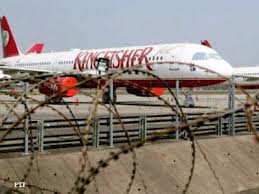
Kingfisher Airlines has lost licence: DGCA chief

January 1, 2013

Mumbai, Jan 1: India's troubled Kingfisher Airlines has lost its permit to fly after a deadline to renew its suspended licence expired, the national aviation regulator said on Tuesday.

The news is a fresh blow for the debt-laden carrier whose operations have been grounded since October after employees went on strike over unpaid wages.

"Kingfisher's flying permit has lapsed," DGCA chief Arun Mishra told AFP.

"They failed to provide additional details on the funding of operations," Mishra added, referring to Kingfisher's revival plan submitted to the DGCA last month.

But the airline said there is no "cause for concern" as the rules allow for the renewal of a permit within two years of expiry.kf

"Kingfisher is confident of securing approval from the regulator on the restart plan, licence approval and reinstatement of its operating permit," its spokesman Prakash Mirpuri said in a statement late Monday.

Kingfisher, controlled by liquor baron Vijay Mallya, owes millions of dollars to banks, airports, fuel suppliers and its staff and has been looking for a foreign investor to inject fresh funds.

The firm has been the worst-hit of India's airlines in 2012, with the industry plagued by high jet fuel prices, fierce competition, price wars and shabby airport infrastructure.

The carrier was India's second-largest until a year ago but its share shrank to just 3.5% — the smallest in the country —before operations stalled completely.

Kingfisher said it was in talks with foreign investors including Abu Dhabi-based Etihad Airways after the government cleared investment by foreign airlines in the key transport sector.

Aviation analysts have expressed doubt over Etihad's purported interest in Bangalore-based Kingfisher given the Indian firm's debt load, which is estimated at $2.5 billion by the consultancy firm Centre for Asia Pacific Aviation.

Comments

Add new comment

  • Coastaldigest.com reserves the right to delete or block any comments.
  • Coastaldigset.com is not responsible for its readers’ comments.
  • Comments that are abusive, incendiary or irrelevant are strictly prohibited.
  • Please use a genuine email ID and provide your name to avoid reject.
News Network
February 11,2020

Aligarh, Feb 11: Paediatrician Dr Kafeel Khan, who was arrested from Mumbai on January 29 after he delivered a speech at Aligarh Muslim University (AMU) against communalism and politics of hate, will be released from jail on Tuesday after he was granted bail by an Aligarh court.

Khan will be released from Mathura jail on Tuesday after legal formalities are completed.

Chief judicial magistrate Karuna Singh granted bail to Khan on Monday on a bail bond of Rs 60,000. Two surety bonds of Rs 60,000 each would also be furnished by the guarantors.

Dr Khan's lawyer, Mohammad Irfan Gazi, told reporters, "The court was told that Khan was falsely implicated by police under political pressure. After hearing the arguments, the court granted him bail."

The suspended doctor was arrested by special task force (STF) of the UP police from Mumbai on January 29, when he reached the city to attend a protest against the Citizenship (Amendment) Act.

He was arrested in connection with a case registered against him in Aligarh under section 153-A (promoting enmity between different groups on ground of religion) of the Indian Penal Code at Civil Lines police station on December 13

The case was filed after his speech at Aligarh Muslim University (AMU).

According to the FIR, while addressing students, without naming anyone, Dr Kafeel Khan said that 'Mota Bhai' is teaching everyone to become Hindu or Muslim but not a human being. "This is a fight for our existence. We have to fight."

The FIR also said that Dr Kafeel Khan made an attempt to vitiate the peaceful atmosphere and disturb the communal harmony with his speech.

Dr Khan was in the news in 2017 when he was named as one of the nine accused in a case involving deaths of several children due to alleged disruption in supply of oxygen at the BRD Medical College in Gorakhpur. Though he was granted clean chit in a departmental inquiry, his suspension has not yet been revoked.

Comments

Add new comment

  • Coastaldigest.com reserves the right to delete or block any comments.
  • Coastaldigset.com is not responsible for its readers’ comments.
  • Comments that are abusive, incendiary or irrelevant are strictly prohibited.
  • Please use a genuine email ID and provide your name to avoid reject.
Agencies
June 8,2020

New Delhi, Jun 8: Abortion access to around 1.85 million women was compromised across the country due to the nationwide restrictions imposed in response to the COVID-19 outbreak, a study conducted by Ipas Development Foundation (IDF) revealed.

These abortions were compromised at all points of care, including public and private sector facilities and chemist outlets during 68-day lockdown and the first week of Unlock 0.1 period. The study assesses the near-term impact of COVID-19 on abortion access in India since March 25 when the lockdown was imposed across the country with the announcement of Prime Minister Narendra Modi to contain the spread of novel coronavirus of COVID-19 pandemic.

It also highlights the need for a specially designed and integrated recovery plan for improving abortion services at facilities. The study estimates that access to abortion was highly compromised during lockdown 1 and 2 ( between March 25 and May 3) in which around 59 per cent of women seeking an abortion could not access the services.

However, with the Unlock phase or the recovery period as mentioned in the study starting on June 1, the situation is expected to improve - with 33 per cent abortions being compromised in 24 days. A huge number of women could not access safe abortion services during the lockdown, therefore it is extremely important that the healthcare system, public and private, is prepared to meet the needs of these women, the Ipas foundation says.

The model of the study strives to quantify the reduced access to abortions across three different points of care -public health facilities, private health facilities, and chemist outlets, said Vinoj Manning, CEO, Ipas Development Foundation in a statement.

"Majority of public health facilities and their staff are now focused on COVID-19 treatments and closures of private health facilities have compromised the access to safe abortions, which is a time-sensitive procedure."

He said that the study conducted by his foundation was to get a clearer picture of how COVID-19 restrictions have affected women seeking safe abortion services and what are the areas that would need focused efforts in the days to come.

Speaking on the methodology, Dr Sushanta Kumar Banerjee from Ipas Development Foundation said: "We conducted telephonic surveys and consulted with several experts from FOGSI leadership and social marketing organizations like PSI India Private Limited."

"After careful analysis of the data received from them, we have concluded that of the 3.9 million abortions that would have taken place in 3 months, access to around 1.85 million was compromised due to COVID-19 restrictions."

To facilitate the process Ipas Development Foundation has issued some initial recommendations which include: rapid mapping of facilities for first and second trimester abortions, assessing facilities' preparedness especially for second-trimester abortions, improving referral linkage and spread the word about the availability of the service, streamlining the supply chain for medical abortion drugs, and lastly including mechanisms to offset additional travel and out of pocket expenditures.

Ipas Development Foundation will be holding consultations with other partners and key stakeholders to facilitate meaningful collaborations to ensure access to safe abortions and ensure that no woman suffers long-term harm to her health due to lack of services.

Comments

Add new comment

  • Coastaldigest.com reserves the right to delete or block any comments.
  • Coastaldigset.com is not responsible for its readers’ comments.
  • Comments that are abusive, incendiary or irrelevant are strictly prohibited.
  • Please use a genuine email ID and provide your name to avoid reject.
News Network
March 21,2020

Mar 21: India’s economy, already in the grip of a slowdown, is in for more pain after Prime Minister Narendra Modi appealed to citizens to stay at and work from home to curb the coronavirus outbreak.

The services sector, which accounts for about 55% of India’s gross domestic product, is poised to be the worst hit after Modi, in a late evening address on Thursday, urged citizens to go on a self-imposed curfew for a day and private companies to allow employees to work from home for longer. In the country’s vast informal sector, social-distancing measures could mean a dent to productivity and consumption because of job or pay losses.

“The impact of a partial lock-down or social distancing will be significant,” said Rahul Bajoria, a senior economist at Barclays Plc in Mumbai. “If there’s a widespread community outbreak, GDP could fall as low as 3.5% in the year starting April 1.”

Shrinking output may limit growth in an economy that’s already set to expand at an 11-year low of 5% in the current year to March 31. Before the virus outbreak, India had forecast growth to recover to 6%-6.5% in the next fiscal year. S&P Global Ratings and Fitch Ratings have already slashed their growth forecast by 50 basis points.

“The current social-distancing measures will severely impact airlines, hotels, malls, multiplexes, restaurants and retailers,” according to analysts at Crisil Ltd., the local unit of S&P Global. “Lower footfalls and occupancies, decline in business volume and sub-optimal operating efficiencies will impact cash flows of companies in these sectors,” wrote the analysts led by Chief Economist Dharmakirti Joshi.

The government will try to announce a relief package for virus-affected sectors as early as possible, Finance Minister Nirmala Sitharaman said Friday.

In a televised address, Modi advised all citizens to stay at home for a day on March 22, as he sought to stem the spread of the coronavirus -- cases of which are relatively low in India at about 200, compared with more than 200,000 infected people globally. His government also barred incoming flights for a week from that day, joining a growing list of countries effectively sealing their borders.

What Bloomberg’s Economists Say

We had only earlier this week lowered our GDP outlook to consider the direct impact of the local outbreak as confirmed virus cases exceeded 100 as of March 15 and the federal and state governments announced social distancing measures that have already started to crimp economic activity. We are now revising down our GDP estimate for 4Q fiscal 2020 to 3.3%, from our 3.5%.

-- Abhishek Gupta, India economist

For more, click here

“Consumption being the biggest component of GDP, a lock-down is bound to have a big impact on the economy,” said Devendra Kumar Pant, chief economist at India Ratings and Research, the local unit of Fitch. “Modeling uncertainty in any system will be very difficult, but one can say the slowdown could deepen or prolong further.”

Work From Home

While companies, including billionaire Mukesh Ambani-controlled Reliance Industries Ltd., are asking employees to work from home, the option isn’t feasible in India’s vast informal sector.

“The option to work remotely simply won’t exist for most,” said Shilan Shah, an economist with Capital Economics Pte. in Singapore.

As many households don’t have savings buffers, the government would probably have to back this up with large-scale cash handouts that reach the poorest, he said.

Work from home is posing implementation challenges for the manufacturing sector where workers are required to be physically present at the production sites. The services sector, such as banking and information technology, also needs employees to be present in offices as confidential data is used, according to industry group Federation of Indian Chambers of Commerce and Industry.


Comments

Add new comment

  • Coastaldigest.com reserves the right to delete or block any comments.
  • Coastaldigset.com is not responsible for its readers’ comments.
  • Comments that are abusive, incendiary or irrelevant are strictly prohibited.
  • Please use a genuine email ID and provide your name to avoid reject.