


No evidence for seer’s allegation against singer Premalatha: CID

[email protected] (CD Network)
February 22, 2017

Karwar, Feb 22: Central Investigation Department (CID) has given clean chit to singer Premalatha and her husband Divakar in connection with alleged blackmail case filed by Sri Ramachandrapura Mutt and its Seer Raghaveshwara Bharathi Swami.
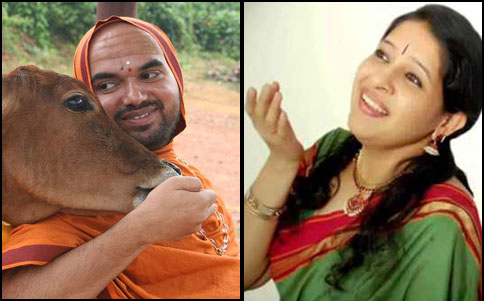
1seerlathaOn Wednesday, the CID team submitted ‘B’ report to the Honnavara JMFC court stating that there was no solid evidence to prove the allegations made against Premalatha and her husband by the seer.

Premalatha had earlier filed a complaint against the seer accusing him of sexually exploiting her for many times in the mutt.

In his complaint to Honnavar police in August, 2014, the seer had claimed that Premalatha and Divakar had demanded Rs 2 crore to "not to lodge rape complaint against him".

Following the complaint filed at Honnavar police station in 2014, after an enquiry by the police department, the state government had transferred the case to CID for further investigation.

Background

It could be recalled here that last year a local court had given clean chit to the same seer in the rape case filed against him by Premalatha.

Prior to that the CID charge sheet in the case (164/2014) registered with the Girinagar police station in Bengaluru, had established that the seer has sexually abused the singer repeatedly during the Rama Katha discourses across the country since 2011.

The vital evidence in the case claimed by the CID was the Forensic Science Laboratory (FSL) report. The CID stated that the FSL report confirmed that the DNA sample found on the material evidence matched with the DNA of the seer. The charge sheet also stated that the seer repeatedly threatened the victim of incurring divine displeasure (if she did not comply). Hence, section 508 of IPC was also included.

The court had taken cognisance of the charge sheet and had summoned the accused. Before the stage of Hearing Before Charge (HBC), the seer had filed a discharge application. The CID objected stating that since the charges against the accused were serious, only a trial would unearth the facts. The court, however, discharged him of all the offences.

The victim had stated that after the Rama Katha programme at Gokarna in Uttara Kannada, in September 2011, the seer had made the first sexual advances at her.

Later, during the Rama Katha discourses held at Jodhpur in Rajasthan in October 2011, the seer had called her to his private room and given her some prasadam. The victim stated that the sexual abuse had taken place in Kolkata, Mumbai and in nine districts of Karnataka. The victim was a prominent singer in the Rama Katha programmes and the seer was also present during these programmes. The CID had conducted mahazar and recorded the statements of witnesses at all the places stated by the victim.

In July 2014, a woman by name Deepika, who participated in Rama Katha discourses, filed a complaint with the Honnavar police saying she got threatening calls asking her not to participate in the discourse.

In August 2014, Mutt staffer Raghavendra Madhyasta filed a complaint with the Puttur town police stating he got threat calls asking him not to support the seer.

In August 2014, one Chandrashekhar of Ramachandrapura Mutt filed a complaint with the Honnavar police against the victim in FIR number 164/2014 and her husband of blackmailing the seer for Rs 3 crore. The couple was arrested by Honnavar police and kept in judicial custody.

In August 2014, victim's daughter filed a complaint with the Girinagar (Bengaluru) police stating the seer had sexually abused her mother. The CID filed a charge sheet against the seer; the court (on Thursday) discharged the seer.

In August 2014, victim's brother-in-law Shyamprasad Shastry committed suicide by shooting himself at his residence in Puttur, Dakshina Kannada district. Shastry’s wife Sandhya Lakshmi filed a complaint stating that her husband was threatened by the mutt staff to ask the victim to withdraw the rape case against the seer.

Comments

S. Sultan
 - 
Thursday, 23 Feb 2017

Still do we need such a KAPATA SWAMY?????????

Why is he yet not stripped, naked, garlanded, processioned.

The society does not need such swamy.

Add new comment

  • Coastaldigest.com reserves the right to delete or block any comments.
  • Coastaldigset.com is not responsible for its readers’ comments.
  • Comments that are abusive, incendiary or irrelevant are strictly prohibited.
  • Please use a genuine email ID and provide your name to avoid reject.
News Network
January 25,2020

New Delhi, Jan 25: The latest edition of the Oxford Advanced Learner's Dictionary features 26 new Indian English words, including Aadhaar, chawl, dabba, hartal and shaadi.

The 10th edition of the dictionary, which was launched on Friday, has 384 Indian English words and incorporates over 1,000 new words such as chatbot, fake news and microplastic.

The dictionary focuses on language change and its evolution through the years, and has ensured that the language and examples used in the new edition are relevant and up to date with the times, Oxford University Press (OUP) said.

The new edition comes with interactive online support through the Oxford Learner's Dictionaries website and an app. The website includes advanced features such as audio-video tutorials, video walkthroughs, self-study activities and enhanced iWriter and iSpeaker tools.

"This edition has 26 new Indian English words of which 22 figure in the printed dictionary. The other four are in the digital version," said Fathima Dada, Managing Director (Education Division) at OUP.

Some of other new Indian words in the dictionary are auntie (while aunty already figures in the English dictionary, auntie is an Indianism), bus stand, deemed university, FIR, non-veg, redressal, tempo, tube light, veg and videograph.

The four new Indian English words in the online version of the dictionary are current (for electricity), looter, looting and upazila (one of the areas that a district is divided into for administration purposes).

According to OUP, the new edition provides better, more accurate and understandable definitions with examples, usage notes and additional resources to help the learner use the right word in the right context.

"Prevalence and common usage are the main criteria for enlisting new words. We scan the globe for words which are often used by people while speaking English. Then these words go through a rigorous testing process," Dada said.

"As OUP is the custodian of English language globally, these words have to go through its processes," she told PTI.

The Oxford Advanced Learner's Dictionary, she said, has been reinventing itself for nearly eight decades, anticipating the growing learning requirements of learners.

"The 10th edition also is equipped with a strong digital support system, including an app," she said.

It is equipped with several digital tools. With iSpeaker, learners can get help preparing for speaking exams and presentations. With iWriter, learners can plan, write and review their written work. Text Checker allows the teacher to check any text against the Oxford 3000, 5000, and OPAL (Oxford Phrasal Academic Lexicon) written word list.

Resources accessible through online premium access include lesson plans, worksheets, video walkthroughs, and classroom and self-study activities. With the OALD app one can find 86,000 words, 95,000 phrases, 112,000 meanings and 237,000 examples.

The dictionary, which spans 77 years, was originally published in Japan in 1942 and was first brought out by OUP in 1948. The learner's dictionary is based on the original values of its creator, Albert Sydney Hornby, whose aim was to help language learners worldwide understand the meaning of English words.

Comments

Add new comment

  • Coastaldigest.com reserves the right to delete or block any comments.
  • Coastaldigset.com is not responsible for its readers’ comments.
  • Comments that are abusive, incendiary or irrelevant are strictly prohibited.
  • Please use a genuine email ID and provide your name to avoid reject.
coastaldigest.com news network
May 31,2020

Mangaluru, May 31:  Even as the worst locust attack on India in recent years raised concerns over its impact on crops, swarms of locusts have triggered panic in Karnataka’s Dakshina Kannada too. 

Farmers in the coastal district were taken aback when they found the swarms of locusts, which they feared as the arrival of desert locusts in the region.

According to reports, Renjalady village under the limits of Nuji Baltila Gramp Panchayats in Kadaba taluk and Shirlalu village in Belthangady taluk witnessed locust attacks in last couple of days. 

“Locust swarms were seen in many areas. We have also alerted agriculture department. Already insects have destroyed crops of many farmers,” said a farmer in Shirlalu village.  

Joint director of Dakshina Kannada district agriculture department MC Seetha confirmed that officials have received information from villagers about the locust scare and entemologists have already visited the place to collect more information.

Not Desert Locusts?

“We contacted entemologists and forwarded the pictures that farmers sent to us. Looking at the picture, entemologists have opined that it may be calotropis locust or colour grasshopper. Desert locusts usually arrive in lakhs,” said Ms Seetha. Desert locusts that are destroying crops in other parts of India may not come to Dakshina Kannada, she added.

Comments

Add new comment

  • Coastaldigest.com reserves the right to delete or block any comments.
  • Coastaldigset.com is not responsible for its readers’ comments.
  • Comments that are abusive, incendiary or irrelevant are strictly prohibited.
  • Please use a genuine email ID and provide your name to avoid reject.
News Network
August 7,2020

Bengaluru, Aug 7: Amid the rising number of COVID-19 cases in Karnataka, the state's health department issued fresh guidelines for the disposal of bodies of COVID patients.

"Although an increased risk of COVID infection from a dead body to health workers or family members who follow standard precautions while handling the body is unlikely, the lack of scientific data requires the utmost care to avoid the inadvertent spread of COVID-19 during these times," the statement from the health department's press release read, emphasising on the dignity of the dead and the religious and cultural tradition.

The 23-page press release elaborated on guidelines regarding testing, handling of dead bodies and other specificities in relation to the management of COVID-19 bodies.

"Testing should not be insisted in every case of death, but only when they have a recorded history of influenza-like symptoms. The body should be handed over to the family members/ relatives in a dignified manner immediately after swab collection and hospitals should provide handouts with a list of dos and don'ts in English and Kannada laying down relevant information," the statement said.

It added, "At the mortuary, health care workers, mortuary staff and the family of the deceased body shall not come in direct contact with the dead body and must wear full personal protective equipment (PPE). If the family or relative are for any reason unable to cremate or bury the body, the local health authority shall arrange for the dignified last rites as per the religious traditions of the family."

Regarding autopsies (post mortem) on COVID-19 bodies, the state department said that they should be avoided, except in necessary circumstances.

The statement also gave detailed guidelines regarding the appropriate recording of COVID-19 deaths in line with the Indian Council of Medical Research (ICMR) guidelines.

Additionally, the health department made a statement about the admission procedure for COVID positive patients referred by other district administrations saying, "It is now mandatory for all the referrals from the BBMP admission and discharge of COVID positive patients to be done through the online COVID Hospital Bed Management System (CHBMS)."

The state's count of coronavirus cases was 1,51,449 in the past 24 hours.

So far, a total of 2,804 people have died due to COVID-19 in the state, while the average recovery rate in Karnataka is 49.3 per cent.

Comments

Add new comment

  • Coastaldigest.com reserves the right to delete or block any comments.
  • Coastaldigset.com is not responsible for its readers’ comments.
  • Comments that are abusive, incendiary or irrelevant are strictly prohibited.
  • Please use a genuine email ID and provide your name to avoid reject.