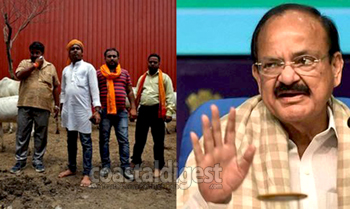
No religious angle linked to lynchings: Venkaiah Naidu

Agencies
June 30, 2017

New Delhi, Jun 30: Union minister M Venkaiah Naidu today dubbed incidents of lynchings in the country as "barbaric" and said they should not be seen from a religious angle.naidu

Law enforcement agencies at the district and the state level must take effective steps to prevent such incidents in future, the minister said, a day after a man was killed in Jharkhand for allegedly transporting beef.

"It has been condemned by and one all. The prime minister also, for the second time, spoke about it. It is happening in different parts of the country and it is barbaric and atrocious. No religious angle is linked to it," he told reporters here.

The latest incident of lynching has been reported from Ramgarh in Jharkhand where the victim, identified as Alimuddin Asghar, was intercepted by a mob on suspicion of transporting beef in his van.

Asghar's lynching yesterday came even as Prime Minister Narendra Modi condemned acts of violence in the name of cow vigilantism. Addressing a gathering at Sabarmati Ashram, Modi had said that "killing people in the name of ‘gaubhakti’ (cow worship) is not acceptable. This is not something Mahatma Gandhi would approve."

Comments

Hanni
 - 
Wednesday, 5 Jul 2017

Ranjan cheddi ,we can undreastand your mentality cool down... your Israeli trained cheddi militant killed our brother Ashraf,but we will not follow your way.. your way of killing innocent Muslims.. rickshaw driver helpers but we are not like you mind it. RSS and islamic militants like ISIS is one coin and 2 face.

PK
 - 
Wednesday, 5 Jul 2017

Indians should read

Masters of Deception by Zander C. Fuerza ... Online

And also \Israel was established based on oppression, deception and massacre\".. read online"

Add new comment

  • Coastaldigest.com reserves the right to delete or block any comments.
  • Coastaldigset.com is not responsible for its readers’ comments.
  • Comments that are abusive, incendiary or irrelevant are strictly prohibited.
  • Please use a genuine email ID and provide your name to avoid reject.
coastaldigest.com news network
April 17,2020

The unexpected lockdown to prevent spread of covid–19 has caused a serious damage to the lives of Indian expatriates irrespective of laborers and entrepreneurs in Kingdom of Saudi Arabia. Different stories of expatriates' ordeals are emerging from the region. 

Abdul Razaq, hailing from Udupi in Karnataka has been running small scale business at Jeddah, Saudi Arabia, based on oil refinery projects of the government. He was undergoing medical treatment for his cancer which is in fist stage. He explaines his ordeals caused by lockdown and stopping the flight facility. 

“I was regularly visiting home country for the treatment of cancer. Now I cannot go as international flight service has been stopped. I expect that government will hear problems of expatriates and will arrange facilities to take us back to home”, he said.

Mubeen from Bengaluru was working on temporary basis  for a company in Jubail. He had lost his jobs like some of his colleagues due to the lockdown.

“As everything was alright, I had brought my parents recently to Saudi Arabia on a visit visa. Things changed drastically with covid-19 attack. Continuous lockdown caused burden over the company and they removed temporary employees like me to control possible losses” he said.

“Now owner of the flat has been harassing me for the rent. I do not have money either to pay rent or to cover daily family expenses. I do not know what to do further”, he added. 

Iqbal from Mangaluru left for Saudi Arabia to help his family. He got a job in a juce centre in Dammam recently. Corona lockdown made his life difficult. He is eager to return his home country. 

“I came to Saudi Arbia because of financial difficulties as I had not found any job with good salary there. I thought I can earn well by going to Saudi Arabia. However, here too the salary was not so good. Now juice center is closed due to lockdown and sponsor is giving very small amount of money as salary through which we cannot afford our expenses and our families back in home,” he said.

“Here It is not easy get help of fellow Indians since most of them have their own ordeals. I would like to return home country; there however we can manage to get help of friends and relatives. I am looking forward the help of Indian government to start air facility for stranded NRIs,” he said. 

Mohsin from Mysuru is a taxi driver in Dammam, Saudi Arabia. He was earning on commission basis. Now Saudi government banned movement of taxis in the region, which pushed him and his fellow taxi drivers into trouble.

“We were earning commissions daily on the basis of trips. Now we cannot move outside with taxi since it may cause us to pay the fine of SR.10000. How can I manage my expenses and family members in home?”, he asked.

There are cases of pregnant women who have to return India for delivery. Those who brought family here on visit visa will not have insurance. Delivery charges and any kind of medical facilities without insurance in Saudi Arabia is very expensive. Expatriate Indians with such problems are awaiting government's help.

“I had brought my wife on one year visit visa. Now she is pregnant and I have to send her back to home for delivery. If lockdown continues, it is difficult to send back and we have to spend big amounts for delivery without insurance. It is a big burden to me as I work for small salary in a company”, said Yunus from Hyderabad, who is living in Jeddah, Saudi Arabia.

Lockdown is haunting even entrepreneurs in Saudi Arabia. Most of expatriates in the industrial hub of Jubail are doing business based on Saudi Government’s oil refinery projects. Saudi Arabia temporarily stopped most of the projects as part of public health safety measures to maintain social distance. 

“We are doing business based on oil refinery projects. Now projects are stopped. We brought around 1100 people on work permit visa on temporary basis. And also, we have around 1200 permanent workers. It is a big burden to provide them with food, accommodation and salary. It may cause a big loss for our company”, said owner of expatriates company, Sheikh Mohammed.

Saudi Arabia had reported first corona virus affected case in March 2, 2020. At the end of March, it was 1600 and now it already corssed 6000. Saudi Health ministry has cautioned the number of affected people may rise 10000 to 200,000 and directed for more precautionary measures. In such case, the Indian expatriates may have to face crisis in the region. 

Indian expatriate organizations are demanding for immediate intervention of Indian government to ensure better quarantine facility and treatment of NRIs in Saudi Arabia as the cases are increasing rapidly. The condition of laborers in some of the camps are such that seven to eight people should share a single bed room. 

“Normally if there is a flat, it will consist three to four bed rooms. In single bedroom companies will provide three four bunk beds and six to eight people should share the room. In such cases, if a person affected with virus it will spread quickly to others. Thus, Indian government should ensure quarantine facility for NRIs”, says Wasim Rabbani, president of Indian Social Forum, Eastern Region, Saudi Arabia. 

President of Karnataka Non Residential Indians, A forum for the NRI organizations of Karnataka, Zakaria Muzain says Indian Government should immediately interfere to bring back those stranded NRIs who wish to return home. Government should intervene to pressure Indian embassy to take the issues of troubled expatriates. 

“Government should make special flight arrangement for such NRIs in trouble. It should also arrange quarantine facility for those who return to India. Already there are many Non-Governmental charity organization which have come forward to give their facilities for NRIs”, he said. 

NRIs from all categories are looking forward for the help of Indian government. It is important to Indian government to take quick action as the problem is increasing in Saudi Arabia.


Comments

Althaf
 - 
Monday, 20 Apr 2020

Help from modi government is a nightmare 

Add new comment

  • Coastaldigest.com reserves the right to delete or block any comments.
  • Coastaldigset.com is not responsible for its readers’ comments.
  • Comments that are abusive, incendiary or irrelevant are strictly prohibited.
  • Please use a genuine email ID and provide your name to avoid reject.
coastaldigest.com news network
July 16,2020

Bengaluru, Jul 16: People volunteering as civil police wardens with the city police department will not receive any remuneration, an official said on Wednesday.

“We wish to clarify the rumours floating on social media and confirm that the volunteers helping local police as civil police wardens in enforcement of anti-Covid measures will not be paid any remuneration,” said an official.

On Tuesday, Bengaluru city police commissioner Bhaskar Rao had urged interested people to volunteer for the department, indicating how strained the department has been amid Covid.

“Inviting physically fit and service minded residents of Bengaluru, both men and women, between the age of 18-45 to volunteer as civil police wardens,” said Rao.

The department is offering a choice of the police division, jurisdiction and the shifts one wants to choose to be a civil police warden.

Additional Commissioner of Police Hemant Nimbalkar said volunteers are a welcome support to the police in their field duty but should not be left alone.

“Volunteers are a support to the police in the field and shall not work standalone. They shall be attached with duty police as assistance. A jacket and a cap should be provided to them,” said Nimbalkar.

He reminded that the safety of the volunteers is the responsibility of the policemen.

Many city policemen have been infected with the virus and quarantined while more than six have succumbed.

“It is a tough time for all policemen irrespective of the rank. Four hundred and fifty active cases across the state and the loss of six lives speak volumes about their involvement in the war against Covid,” said Director General of Police Praveen Sood recently.

He expressed hope that the difficult times will pass, saying all the members of the police department are a family.

Comments

Add new comment

  • Coastaldigest.com reserves the right to delete or block any comments.
  • Coastaldigset.com is not responsible for its readers’ comments.
  • Comments that are abusive, incendiary or irrelevant are strictly prohibited.
  • Please use a genuine email ID and provide your name to avoid reject.
Ram Puniyani
February 4,2020

As democracy is seeping in slowly all over the world, there is an organization which is monitoring the degree of democracy in the individual countries, The Economist Intelligence Unit. As such in each country there are diverse factors which on one hand work to deepen it, while others weaken it. Overall there is a march from theoretical democracy to substantive one. The substantive democracy will herald not just the formal equality, freedom and community feeling in the country but will be founded on the substantive quality of these values. In India while the introduction of modern education, transport, communication laid the backdrop of beginning of the process, the direction towards deepening of the process begins with Mahatma Gandhi when he led the non-cooperation movement in 1920, in which average people participated. The movement of freedom for India went on to become the ‘greatest ever mass movement’ in the World.

The approval and standards for democracy were enshrined in Indian Constitution, which begins ‘We the people of India’, and was adopted on 26th January 1950. With this Constitution and the policies adopted by Nehru the process of democratization started seeping further, the dreaded Emergency in 1975, which was lifted later restored democratic freedoms in some degree. This process of democratisation is facing an opposition since the decade of 1990s after the launch of Ram Temple agitation, and has seen the further erosion with BJP led Government coming to power in 2014. The state has been proactively attacking civil liberties, pluralism and participative political culture with democracy becoming flawed in a serious way. And this is what got reflected in the slipping of India by ten places, to 51st, in 2019. On the index of democracy India slipped down from the score of 7.23 to 6.90. The impact of sectarian BJP politics is writ on the state of the nation, country.

Ironically this lowering of score has come at a time when the popular protests, the deepening of democracy has been given a boost and is picking up with the Shaheen Bagh protests. The protest which began in Shaheen Bagh, Delhi in the backdrop of this Government getting the Citizenship amendment Bill getting converted into an act and mercilessly attacking the students of Jamia Milia Islamia, Aligarh Muslim University along with high handed approach in Jamia Nagar and neighbouring areas.  From 15th December 2019, the laudable protest is on.

It is interesting to note that the lead in this protest has been taken by the Muslim women, from the Burqa-Hijab clad to ‘not looking Muslim’ women and was joined by students and youth from all the communities, and later by the people from all the communities. Interestingly this time around this Muslim women initiated protest has contrast from all the protests which earlier had begun by Muslims. The protests opposing Shah Bano Judgment, the protests opposing entry of women in Haji Ali, the protests opposing the Government move to abolish triple Talaq. So far the maulanas from top were initiating the protests, with beard and skull cap dominating the marches and protests. The protests were by and large for protecting Sharia, Islam and were restricted to Muslim community participating.

This time around while Narendra Modi pronounced that ‘protesters can be identified by their clothes’, those who can be identified by their external appearance are greatly outnumbered by all those identified or not identified by their appearance.

The protests are not to save Islam or any other religion but to protect Indian Constitution. The slogans are structured around ‘Defence of democracy and Indian Constitution’. The theme slogans are not Allahu Akbar’ or Nara-E-Tadbeer’ but around preamble of Indian Constitution. The lead songs have come to be Faiz Ahmad Faiz’s ‘Hum Dekhenge’, a protest against Zia Ul Haq’s attempts to crush democracy in the name of religion. Another leading protest song is from Varun Grover, ‘Tanashah Aayenge…Hum Kagaz nahin Dikhayenge’, a call to civil disobedience against the CAA-NRC exercise and characterising the dictatorial nature of the current ruling regime.

While BJP was telling us that primary problem of Muslim women is Triple talaq, the Muslim women led movements has articulated that primary problem is the very threat to Muslim community. All other communities, cutting across religious lines, those below poverty line, those landless and shelter less people also see that if the citizenship of Muslims can be threatened because of lack of some papers, they will be not far behind in the victimization process being unleashed by this Government.

While CAA-NRC has acted as the precipitating factor, the policies of Modi regime, starting from failure to fulfil the tall promises of bringing back black money, the cruel impact of demonetisation, the rising process of commodities, the rising unemployment, the divisive policies of the ruling dispensation are the base on which these protest movements are standing. The spread of the protest movement, spontaneous but having similar message is remarkable. Shaheen Bagh is no more just a physical space; it’s a symbol of resistance against the divisive policies, against the policies which are increasing the sufferings of poor workers, the farmers and the average sections of society.

What is clear is that as identity issues, emotive issues like Ram Temple, Cow Beef, Love Jihad and Ghar Wapasi aimed to divide the society, Shaheen Bagh is uniting the society like never before. The democratisation process which faced erosion is getting a boost through people coming together around the Preamble of Indian Constitution, singing of Jan Gan Man, waving of tricolour and upholding the national icons like Gandhi, Bhagat Singh, Ambedkar and Maulana Azad. One can feel the sentiments which built India; one can see the courage of people to protect what India’s freedom movement and Indian Constitution gave them.

Surely the communal forces are spreading canards and falsehood against the protests. As such these protests which is a solid foundation of our democracy. The spontaneity of the movement is a strength which needs to be channelized to uphold Indian Constitution and democratic ethos of our beloved country.

Comments

Add new comment

  • Coastaldigest.com reserves the right to delete or block any comments.
  • Coastaldigset.com is not responsible for its readers’ comments.
  • Comments that are abusive, incendiary or irrelevant are strictly prohibited.
  • Please use a genuine email ID and provide your name to avoid reject.