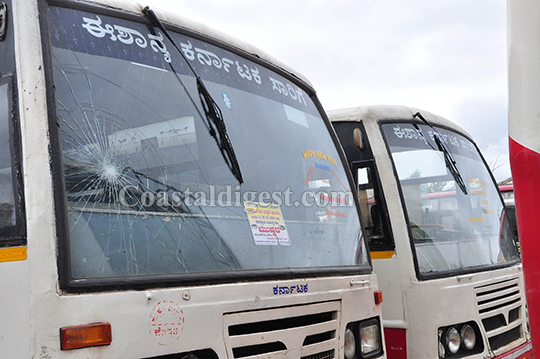
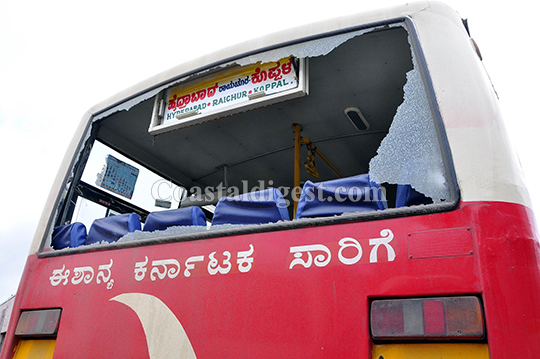
Over 100 buses damaged by protesters across Karnataka amidst strike

[email protected] (CD Network | Suresh)
July 25, 2016

Bengaluru/Mangaluru, Jul 25: Protestors damaged over 100 buses across Karnataka on Monday the first day of the strike called by employees of all four transport corporations in the state: KSRTC, BMTC, NEKRTC and NWKRTC.

Bus stone 1

49 KSRTC buses, 4 BMTC buses, 12 NWKRTC and 27 NEKRTC buses were damaged as of 9 am this morning, causing a loss of Rs 8,97,300 for all corporations. Later more buses were damaged.

In view of the violence and damage to public property, the police have deployed over 3000 police men to ensure law and order and maintain peace in the state.

Employees of transport corporations are on an indefinite protest demanding a 30% increase in DA given to them, along with about 44 other demands, including intercorporation transfers, creches of the children of corporation employees, rest room for ladies in all depots and so on.

The traffic police, taking note of complaints of auto drivers fleecing commuters by taking advantage of the opportunity and charging extra, have promised action if passengers can bring this to the attention of the police.

South Western Railway has planned to halt all passenger and express trains at Byappanahalli, Carmelaram, Whitefield and Channasandra stations to benefit citizens in the wake of transport strike on Monday, according to a statement from the south western railways.

With barely any buses on the streets, Namma Metro pitched in by increasing the frequency of trains to five minutes.

Both employees union and the management including the state government are firm on their respective stands with the transport corporations as well as the management saying that increasing the wages of workers will result in losses for the corporations.


Bus stone 2

Bus stone 3

1raichur 1 1

1raichur 1 2

Comments

True commentator
 - 
Monday, 25 Jul 2016

Who are the losers,
Not anybody other than we citizens of the state.

Toll of foolishness.

Add new comment

  • Coastaldigest.com reserves the right to delete or block any comments.
  • Coastaldigset.com is not responsible for its readers’ comments.
  • Comments that are abusive, incendiary or irrelevant are strictly prohibited.
  • Please use a genuine email ID and provide your name to avoid reject.
Ram Puniyani
January 14,2020

In the beginning of January 2020 two very disturbing events were reported from Pakistan. One was the attack on Nankana Sahib, the holy shrine where Sant Guru Nanak was born. While one report said that the place has been desecrated, the other stated that it was a fight between two Muslim groups. Prime Minister of Pakistan Imran Khan condemned the incident and the main accused Imran Chisti was arrested. The matter related to abduction and conversion of a Sikh girl Jagjit Kaur, daughter of Pathi (One who reads Holy Guru Granth Sahib in Gurudwara) of the Gurudwara. In another incident one Sikh youth Ravinder Singh, who was out on shopping for his marriage, was shot dead in Peshawar.

While these condemnable attacks took place on the Sikh minority in Pakistan, BJP was quick enough to jump to state that it is events like this which justify the Citizenship Amendment Act (CAA). Incidentally CAA is the Act which is discriminatory and relates to citizenship with Religion, which is not as per the norms of Indian constitution. There are constant debates and propaganda that population of Hindus has come down drastically in Pakistan and Bangla Desh. Amit Shah, the Home minister stated that in Pakistan the population of Hindus has come down from 23% at the time of partition to 3.7% at present. And in Bangla Desh it has come down from 22% to present 8%.

While not denying the fact that the religious minorities are getting a rough deal in both these countries, the figures which are presented are totally off the mark. These figures don’t take into consideration the painful migrations, which took place at the time of partition and formation of Bangla Desh later. Pakistan census figures tell a different tale. Their first census was held in 1951. As per this census the overall percentage of Non Muslim in Pakistan (East and West together) was 14.2%, of this in West Pakistan (Now Pakistan) it was 3.44 and in Eat Pakistan it was 23.2. In the census held in Pakistan 1998 it became 3.72%. As far as Bangla Desh is concerned the share of Non Muslims has gone down from 23.2 (1951) to 9.6% in 2011.

The largest minority of Pakistan is Ahmadis, (https://minorityrights.org/country/pakistan/) who are close to 4 Million and are not recognised as Muslims in Pakistan. In Bangla Desh the major migrations of Hindus from Bangla Desh took place in the backdrop of Pakistan army’s atrocities in the then East Pakistan.

As far as UN data on refugees in India it went up by 17% between 2016-2019 and largest numbers were from Tibet and Sri Lanka.  (https://www.un.org/en/development/desa/population/migration/publication…)

The state of minorities is in a way the index of strength of democracy. Most South Asian Countries have not been able to sustain democratic values properly. In Pakistan, the Republic began with Jinnah’s classic speech where secularism was to be central credo of Pakistan. This 11th August speech was in a way what the state policy should be, as per which people of all faiths are free to practice their religion. Soon enough the logic of ‘Two Nation theory” and formation of Pakistan, a separate state for Muslim took over. Army stepped in and dictatorship was to reign there intermittently. Democratic elements were suppressed and the worst came when Zia Ul Haq Islamized the state in collusion with Maulanas. The army was already a strong presence in Pakistan. The popular formulation for Pakistan was that it is ruled by three A’s, Army, America and Allah (Mullah).

Bangla Desh had a different trajectory. Its very formation was a nail in the coffin of ‘two nation theory’; that religion can be the basis of a state. Bangla Desh did begin as a secular republic but communal forces and secular forces kept struggling for their dominance and in 1988 it also became Islamic republic. At another level Myanmar, in the grip of military dictatorship, with democratic elements trying to retain their presence is also seeing a hard battle. Democracy or not, the army and Sanghas (Buddhist Sang has) are strong, in Myanmar as well. The most visible result is persecution of Rohingya Muslims.

Similar phenomenon is dominating in Sri Lanka also where Budhhist Sanghas and army have strong say in the political affairs, irrespective of which Government is ruling. Muslim and Christian minorities are a big victim there, while Tamils (Hindus, Christians etc.) suffered the biggest damage as ethnic and religious minorities. India had the best prospect of democracy, pluralism and secularism flourishing here. The secular constitution, the outcome of India’s freedom struggle, the leadership of Gandhi and Nehru did ensure the rooting of democracy and secularism in a strong way.

India so far had best democratic credentials amongst all the south Asian countries. Despite that though the population of minorities rose mainly due to poverty and illiteracy, their overall marginalisation was order of the day, it went on worsening with the rise of communal forces, with communal forces resorting to identity issues, and indulging in propaganda against minorities.

While other South Asian countries should had followed India to focus more on infrastructure and political culture of liberalism, today India is following the footsteps of Pakistan. The retrograde march of India is most visible in the issues which have dominated the political space during last few years. Issues like Ram Temple, Ghar Wapasi, Love Jihad, Beef-Cow are now finding their peak in CAA.

India’s reversal towards a polity with religion’s identity dominating the political scene was nicely presented by the late Pakistani poetess Fahmida Riaz in her poem, Tum bhi Hum Jaise Nikle (You also turned out to be like us). While trying to resist communal forces has been an arduous task, it is becoming more difficult by the day. This phenomenon has been variously called, Fundamentalism, Communalism or religious nationalism among others. Surely it has nothing to do with the religion as practiced by the great Saint and Sufi traditions of India; it resorts mainly to political mobilization by using religion as a tool.

Comments

Ashi
 - 
Tuesday, 14 Jan 2020

If Malaysia implement similar NRC/CAA, India and China are the loser.

Add new comment

  • Coastaldigest.com reserves the right to delete or block any comments.
  • Coastaldigset.com is not responsible for its readers’ comments.
  • Comments that are abusive, incendiary or irrelevant are strictly prohibited.
  • Please use a genuine email ID and provide your name to avoid reject.
News Network
January 7,2020

Mangaluru, Jan 7: Kasturba Medical College Mangaluru, a constituent unit of Manipal Academy of Higher Education (MAHE), in association with Pai Family Endowment (in memory of Shri Suhas Gopal Pai) as its social initiative opens a newborn hearing assessment centre at Govt Lady Goshen Hospital on Tuesday.

Dr M Venkatraya Prabhu, Dean of KMC Mangaluru addressing the media persons said that the project is made possible by the generous philanthropic contribution of Mrs Anuradha (Shanthi)Gopal Pai and will be inaugurated by her in Presence of Dr H Vinod Bhat, Vice-Chancellor of MAHE.

Dr Deepak Madi, Deputy Medical Superintendent KMC Hospital Attavar explained that the facility will be managed by the departments from Audiology, ENT and Paediatrics of Kasturba Medical College, Mangaluru. The Centre aims to screen all the babies born in the hospital for hearing loss.

This is the maiden initiative of the MAHE-Pai Family endowment which has been set up to find solutions for the numerous challenges faced by the hearing handicapped in & around Dakshina Kannada district.

Comments

Add new comment

  • Coastaldigest.com reserves the right to delete or block any comments.
  • Coastaldigset.com is not responsible for its readers’ comments.
  • Comments that are abusive, incendiary or irrelevant are strictly prohibited.
  • Please use a genuine email ID and provide your name to avoid reject.
News Network
January 8,2020

Bengaluru, Jan 8: The second instalment of flood relief funds from the Centre, announced on Monday, has left BS Yediyurappa less than cheerful, with the chief minister insisting that it is barely adequate. The CM on Tuesday said he will urge the Union government to release more.

On Monday, the Centre announced it will release Rs 669.8 crore in addition to the Rs 1,200 crore it had released earlier towards flood relief and rehabilitation. The total sum is a small fraction of the loss, which the government pegged at a staggering Rs 38,000 crore.

“The Centre has released assistance in two instalments so far, but it is inadequate given the magnitude of the damage. I will request for more funds and I am confident the Centre will oblige,” Yediyurappa told reporters.

When Prime Minister Narendra Modi had visited the state last week, Yediyurappa had urged him — even openly at a function — to release funds. This followed several pleas over the past four months, which barely drew a response from the Centre. Now, the CM himself suggests it’s barely a drop in the ocean.

The opposition has been criticizing both Yediyurappa and the Centre for their handling of the situation and on Tuesday, leader of the opposition Siddaramaiah of the Congress criticised the CM for “misguiding people” on the sum released by the Centre.

Siddaramaiah tweeted, “Reports from State govt officials say only Rs 669 cr of addl funds are released in 2nd instalment as opposed to the claim of Rs 1,870 cr by Karnataka BJP leaders. At a time when manufacturing industries are closing, BJP’s fake news factory is running at full potential ".

In another tweet, he said, “Moved by the plea of chief minister, Yediyurappa, Prime Minister Narendra Modi released an additional Rs 669.8 crore, taking the total amount to Rs 1,869.8 crore. BJP leaders, who are devotees of the god of lies, attempts to depict the total relief amount as 1200+1869.85 = Rs 3,069 cr is ridiculous.”

A high-level committee chaired by Union home minister Amit Shah had sanctioned the National Disaster Response Fund (NDRF) funds on Monday. While the Press Information Bureau claimed Rs 1,869 crore was approved on Monday, state government officials clarified that the figure included the Rs 1,200 crore released in October.

Meanwhile, sources say the two instalments is all the assistance the state can expect from the Centre towards flood relief. Sources say the Rs 1,870 crore is roughly 60% of the funding — Rs 3,000 cr— which was supposed to be allocated for Karnataka, based on an inter-ministerial team’s assessment of losses in the state.

“Compared to other states for the same period, Karnataka has received the highest amount in flood relief. We cannot expect more,” said a revenue department official, who said the government will not approach the Centre for a special package.

However, revenue minister R Ashoka said the state will pitch for the entire Rs 3,000 crore. “The state government will pursue the matter with the Centre until it releases the entire Rs 3,000 crore. The state government will cover the remainder of the Rs 38,000 crore loss. We will not go back on our word,” Ashoka said. Incidentally, the state has spent about Rs 6,000 crore on relief and rehabilitation so far.

Comments

Add new comment

  • Coastaldigest.com reserves the right to delete or block any comments.
  • Coastaldigset.com is not responsible for its readers’ comments.
  • Comments that are abusive, incendiary or irrelevant are strictly prohibited.
  • Please use a genuine email ID and provide your name to avoid reject.